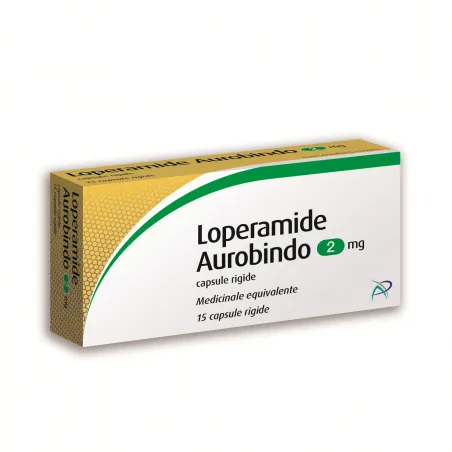
LOPERAMIDE AUROBINDO
ItalyThis medicine is used to treat sudden and short-term attacks of diarrhea in adults and children over 12 years of age, helping to make stools firmer and less frequent.
Frequently asked questions
How should Loperamide Aurobindo be taken?
The capsules should be swallowed whole with water. After the first loose stool, take 2 capsules; after each subsequent stool, take 1 capsule. Do not exceed 6 capsules in 24 hours.
When should you not take this medicine?
You must not take this medicine if you are allergic to loperamide, if you suffer from colitis or inflammatory bowel disease, if you have severe diarrhea after taking antibiotics, if you have abdominal bloating or constipation, if you have dysentery with blood and fever, or if you are a child under 12 years of age.
What are the side effects of Loperamide Aurobindo?
Common side effects include headache, dizziness, nausea, constipation, and flatulence. Fatigue, drowsiness, stomach pain, vomiting, and dry mouth may also occur. In rare cases, allergic reactions, loss of consciousness, or severe skin rashes may occur.
What should you do in case of overdose?
If an excessive dose is taken, it is necessary to contact a doctor or emergency services immediately, as serious heart problems such as rapid or irregular heartbeat may occur, as well as uncoordinated movements, drowsiness, or breathing difficulties.
Are there interactions with other medicines?
It is important to inform your doctor if you are taking medications such as ritonavir, quinidine, desmopressin, itraconazole, ketoconazole, gemfibrozil, or anticholinergic drugs.
Can it be taken during pregnancy or breastfeeding?
Use should be avoided during pregnancy, especially in the first trimester. You should not take this medicine if you are breastfeeding, as small amounts may pass into breast milk.
Instructions for use
Table of contents
Package leaflet: Information for the user
Loperamide Aurobindo 2 mg hard capsules
Equivalent medicine
Please read this leaflet carefully before taking this medicine because it contains important information for you.
- Keep this leaflet. You may need to read it again.
- If you have any questions, ask your doctor or pharmacist.
- This medicine has been prescribed for you only. Do not give it to others, even if their symptoms are the same as yours, because it could be harmful.
- If you experience any side effects, including those not listed in this leaflet, contact your doctor or pharmacist. See section 4.
Contents of this leaflet:
- What Loperamide Aurobindo is and what it is used for
- What you need to know before taking Loperamide Aurobindo
- How to take Loperamide Aurobindo
- Possible side effects
- How to store Loperamide Aurobindo
- Contents of the pack and other information
1. What Loperamide Aurobindo is and what it is used for
This medicine contains loperamide, which helps stop diarrhoea by making the stools more solid and less frequent.
This medicine is used to treat sudden, short-term (acute) episodes of diarrhoea in adults and children over 12 years of age.
This medicine provides relief from diarrhoea symptoms only, and it is important to drink enough fluids to replace the water lost due to loose stools.
2. What you need to know before taking Loperamide Aurobindo
Do not take Loperamide Aurobindo:
- if you are allergic to loperamide or to any of the other ingredients of this medicine (listed in section 6).
- if you have colitis (inflammation of the colon) or any other inflammatory bowel disease, such as ulcerative colitis.
- if you have severe diarrhoea after taking antibiotics.
- if you have a bloated stomach or abdomen, and/or constipation.
- if you have acute dysentery, whose symptoms may include blood in the stools and high fever.
- if it is for a child under 12 years of age.
If any of these situations apply to you, consult your doctor or pharmacist.
Warnings and precautions
Talk to your doctor or pharmacist before taking Loperamide Aurobindo.
- if you have AIDS and your stomach becomes bloated. Stop taking the capsules immediately and contact your doctor.
- if you have liver problems.
- if you have severe diarrhoea, as your body loses more fluids, sugars and salts than usual.
- if diarrhoea lasts for more than 48 hours, stop taking the capsules and consult your doctor.
- if an intestinal obstruction develops, stop taking the capsules and consult your doctor.
- if you have an intolerance to certain sugars, unless otherwise advised by your doctor (this medicine contains lactose). Do not take this medicine for uses other than intended (see section 1) and never take a dose higher than recommended (see section 3). In patients who have taken an excessive dose of loperamide, the active substance in Loperamide Aurobindo, serious heart problems (with symptoms including rapid or irregular heartbeat) have been reported.
Children
Not recommended for children under 12 years of age.
Other medicines and Loperamide Aurobindo
Inform your doctor or pharmacist if you are taking, have recently taken or might take any other medicines.
- ritonavir (used to treat HIV)
- quinidine (used to treat heart rhythm disorders or malaria)
- oral desmopressin (used to treat excessive urination)
- itraconazole or ketoconazole (used to treat fungal infections)
- gemfibrozil (used to treat high levels of lipids in the blood)
- anticholinergic medicines. If you are taking any of these medicines, consult a doctor before taking Loperamide Aurobindo.
It is expected that medicines with a mechanism of action similar to that of Loperamide Aurobindo may increase its effect, and medicines that accelerate gastrointestinal transit may reduce its effect.
Loperamide Aurobindo with food and drink
You may take Loperamide Aurobindo with food and drink.
Pregnancy, breast-feeding and fertility
If you are pregnant, think you may be pregnant or are planning to become pregnant, ask your doctor for advice before taking this medicine.
Pregnancy: The use of Loperamide Aurobindo should be avoided during pregnancy, especially during the first trimester.
Breast-feeding: Do not take this medicine if you are breast-feeding, as small amounts may pass into breast milk. Discuss with your doctor the most appropriate treatment.
Driving and using machines
This medicine may cause dizziness, tiredness or drowsiness. You may also lose consciousness, feel faint or less alert. If this occurs, do not drive or operate machinery.
Loperamide Aurobindo contains lactose
If your doctor has diagnosed you with an intolerance to certain sugars, contact him/her before taking this medicine.
3. How to take Loperamide Aurobindo
Take this medicine exactly as directed by your doctor or pharmacist. If you have
any doubts, consult your doctor or pharmacist.
Adults, elderly and children over 12 years of age
How to take Loperamide Aurobindo:
The capsules must be swallowed whole with water.
Dose and frequency of administration:
After the first loose stool (bowel movement), take 2 capsules with water.
After each subsequent diarrheal episode, take 1 capsule.
Separate rehydration sachets are available.
- Do not administer to children under 12 years of age.
- Do not take more than 6 capsules in 24 hours.
- If symptoms persist for more than 48 hours, stop taking the capsules and consult your doctor.
- Replace lost fluids by drinking more liquids than usual.
- DO NOT EXCEED THE RECOMMENDED DOSE.
If you take more Loperamide Aurobindo than you should
Contact your doctor or nearest emergency department, taking this leaflet with you.
If you have taken too much Loperamide Aurobindo, contact your doctor or hospital immediately for advice.
Symptoms may include: increased heart rate, irregular heartbeat, changes in heart rhythm (these symptoms may have potentially serious and life-threatening consequences), muscle stiffness, uncoordinated movements, drowsiness, constricted pupils, difficulty urinating, or weak breathing, fainting.
Compared to adults, children's reaction to high doses of Loperamide Aurobindo is stronger. If a child has taken excessive amounts or shows any of the symptoms listed above, contact a doctor immediately.
Information for the doctor in case of overdose
Signs of loperamide hydrochloride overdose may also occur after a relatively low overdose in patients with hepatic dysfunction. Treatment depends on the symptoms of overdose and clinical diagnosis.
During medical follow-up, ECG monitoring for QT interval prolongation should be initiated.
If central nervous system symptoms occur after overdose, the opioid antagonist naloxone may be administered as an antidote. Since loperamide has a longer duration of action than naloxone, repeated administration of naloxone may be necessary. The patient should therefore be closely monitored for at least 48 hours to detect any onset or recurrence of overdose symptoms.
If you forget to take Loperamide Aurobindo
Take the medicine as needed, carefully following the dosing instructions. If you forget to take a dose, take one dose after the next loose stool (bowel movement). Do not take a double dose to make up for a forgotten dose.
If you have any doubts about how to use this medicine, consult your doctor or pharmacist.
4. Possible side effects
Like all medicines, this medicine can cause side effects, although not everybody gets them.
If any of the side effects worsen, or if you notice any side effects not listed in this leaflet, inform your doctor or pharmacist.
If you experience any of the following side effects, stop taking this medicine and seek immediate medical help:
Rare: may affect up to 1 in 1,000 people
- Allergic reactions including unexplained shortness of breath, difficulty breathing, swelling of the face and throat.
- Loss of consciousness or reduced level of consciousness (feeling faint or decreased alertness).
- Skin rashes that may be severe and include blisters and peeling of the skin.
Not known (frequency cannot be estimated from the available data)
Upper abdominal pain, abdominal pain spreading to the back, tenderness when touching the abdomen, fever, rapid pulse, nausea, vomiting, which may be symptoms of inflammation of the pancreas (acute pancreatitis).
Other side effects:
If you experience any of the following side effects, stop taking this medicine and talk to your doctor:
Common: may affect up to 1 in 10 people
- Headache, dizziness.
- Nausea (feeling unwell), constipation, flatulence (gas).
Uncommon: may affect up to 1 in 100 people
- Tiredness, drowsiness.
- Stomach pain, vomiting, indigestion and heartburn, dry mouth.
- Skin rash.
Rare: may affect up to 1 in 1,000 people
- Itching or hives.
- Constriction of the pupil.
- Difficulty passing urine.
- Bloating, a burning sensation in the mouth, on the lips or on the tongue.
- Fatigue.
Reporting of side effects
If you experience any side effect, including those not listed in this leaflet, talk to your doctor or pharmacist. You can also report side effects directly via the national reporting system at www.aifa.gov.it/content/segnalazioni-reazioni-avverse. By reporting side effects, you can help provide more information on the safety of this medicine.
5. How to store Loperamide Aurobindo
Keep this medicine out of the sight and reach of children.
Do not use this medicine after the expiry date stated on the pack after EXP. The expiry date refers to the last day of that month.
Store below 30 °C.
Do not dispose of medicines via wastewater or household waste. Ask your pharmacist how to dispose of medicines no longer required. This will help protect the environment.
6. Package contents and other information
What this medicine contains:
- The active substance is loperamide hydrochloride. Each hard capsule contains 2 mg of loperamide hydrochloride.
- The other components are: Capsule contents: lactose monohydrate, maize starch, talc, magnesium stearate. Capsule shell: titanium dioxide (E171), gelatin. Printing ink: shellac, iron oxide black (E172).
Description of the appearance of this medicine and the contents of the pack:
Hard capsules.
White opaque/white opaque hard gelatin capsules with "4" size, printed with “2” on the cap and “L” on the body in black ink, containing a white to almost white powder.
Loperamide Aurobindo hard capsules are available in PVC/aluminum blister packs.
Pack sizes:
Blister packs: 6, 8, 10, 12, 15, 18, 20, 30 and 50 hard capsules.
Not all pack sizes may be marketed.
Marketing Authorization Holder
Aurobindo Pharma (Italia) S.r.l.
Via San Giuseppe, 102
21047 - Saronno (VA)
Italy
Manufacturer
APL Swift Services (Malta) Limited
HF26, Hal Far Industrial Estate, Hal Far,
Birzebbugia, BBG 3000
Malta
Generis Farmacêutica, S.A.
Rua João de Deus, 19
2700-487 Amadora
Portugal
This medicinal product is authorized in the European Economic Area countries under the following names:
Germany: Loperamid Puren 2 mg Hard Capsules
Italy: Loperamide Aurobindo
Poland: Aurostop
United Kingdom: Loperamide 2 mg Hard Capsules
Similar drugs
| Brand name | Dosage form | Active substance / Dosage | Manufacturer |
|---|---|---|---|
| DIARSTOP | capsules, hard gelatin | GIULIANI SPA | |
| LOPEMID | capsules, hard gelatin | VISUFARMA S.P.A. | |
| LOPERAMIDE GRINDEKS | capsules, hard gelatin | AS GRINDEKS | |
| LOPERAMIDE HEXAL | capsules, hard gelatin | SANDOZ S.P.A. |
The original data is available in the language of the country of manufacture.
Data source: Italian Medicines Agency (AIFA)
Data last verified: September 21, 2026