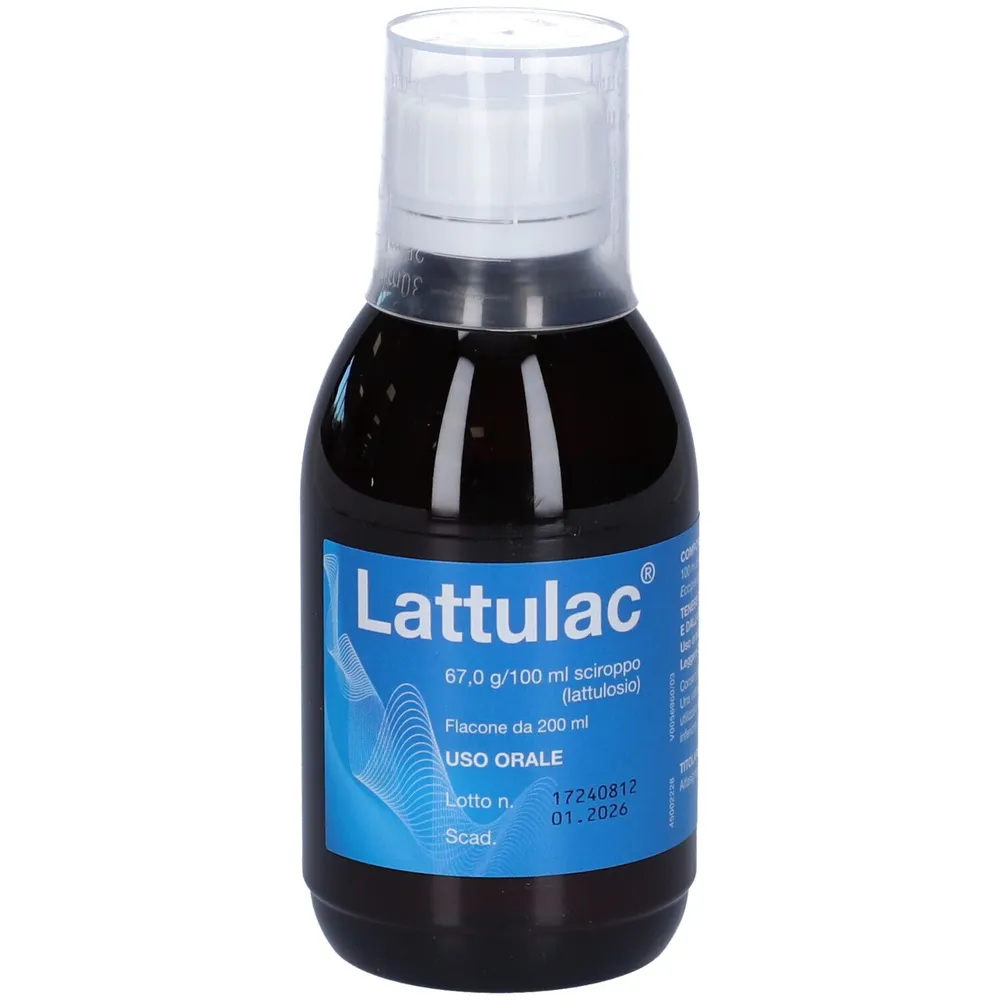
LATTULAC
ItalyIt is used for the short-term treatment of occasional constipation.
Frequently asked questions
How should Lattulac be taken?
Adults should take 10-20 ml in two doses, or one sachet per day, preferably in the evening. The dose may be doubled or halved based on individual response. It can be taken alone or with a large glass of water. For children, the dose varies between 5 and 15 ml per day, while for infants, the average is 2.5 ml per day, always according to a doctor's advice.
When should you not use this medicine?
It must not be used if you are allergic to lactulose or any of its components, if you suffer from galactosemia, if you have intestinal pain or rectal bleeding of unknown cause, if you have nausea, vomiting, a blockage or narrowing of the stomach or intestine, or in case of severe dehydration.
What are the side effects of Lattulac?
Common side effects may include abdominal pain or cramps, intestinal gas (flatulence), nausea, vomiting, diarrhea, and alterations in salt and water levels in the body. In less common cases, allergic reactions, skin rashes, itching, or hives may occur.
Are there interactions with other medicines?
It is important not to take other laxatives at the same time; it is better to wait at least two hours between taking another medicine and the laxative. Lattulac may reduce the efficacy of antibiotics and medicines for stomach acidity, and may affect intestinal anti-inflammatories (5-ASA) and heart medicines (digitalis).
What happens if an excessive dose is taken?
In case of accidental ingestion of an excessive dose, it is necessary to inform a doctor immediately or go to the nearest hospital. If abdominal pain or diarrhea occurs, treatment must be discontinued and the loss of fluids and electrolytes must be replaced.
How long can the product be used?
The medicine should be used as infrequently as possible and for a period not exceeding seven days. If symptoms persist or worsen after seven days, it is necessary to consult a doctor.
Instructions for use
Package leaflet: Information for the patient
Lattulac 67.0 g/100 ml syrup
lactulose
Please read all of this leaflet carefully before you use this medicine because it contains important information for you.
- Use this medicine exactly as described in this leaflet or as your doctor or pharmacist has instructed you.
- Keep this leaflet. You may need to read it again.
- If you would like more information or advice, please ask your pharmacist.
- If you experience any side effects, including those not listed in this leaflet, talk to your doctor or pharmacist. See section 4.
- Talk to your doctor if you do not notice any improvement or if your symptoms worsen after 7 days.
Contents of this leaflet:
- What Lattulac is and what it is used for
- What you need to know before using Lattulac
- How to use Lattulac
- Possible side effects
- How to store Lattulac
- Contents of the pack and other information
1. What Lattulac is and what it is used for
Lattulac contains lactulose, which belongs to a group of medicines called osmotic laxatives.
Lattulac is indicated for the short-term treatment of occasional constipation.
2. What you need to know before using Lactulac
Do not use Lactulac
- if you are allergic to lactulose or to any of the other ingredients of this medicine (listed in section 6)
- if you have intestinal pain or rectal bleeding of unknown cause, nausea, vomiting, a blockage or narrowing of the stomach or intestines, or severe dehydration.
- if you suffer from an inherited disorder characterized by galactose accumulation, called galactosemia. Lactulac is not recommended during pregnancy or breastfeeding unless your doctor considers its use necessary. Lactulac is not recommended for children under 12 years of age. Do not administer Lactulac to children under 12 years of age unless advised by a doctor. Consult your doctor also if any of these conditions occurred in the past.
Warnings and precautions
Talk to your doctor or pharmacist before using Lactulac.
Use Lactulac with particular caution:
- if you suffer from disorders caused by excessive intestinal gas (intestinal air): in this case, treatment should begin with the lowest doses, which may be gradually increased depending on your response.
Exercise particular caution and inform your doctor, who will monitor you:
- if you suffer from chronic or recurrent constipation
- if the need for a laxative arises from a sudden change in previous bowel habits (frequency and characteristics of bowel movements) lasting more than two weeks, or when the use of a laxative fails to produce an effect
- if you are taking medicines for heart failure (digitalis)
- if you are elderly or in poor general health
- after a short period of treatment without noticeable results
- even in cases where constipation-related symptoms have occurred in the past. Please note that:
- you should avoid using this medicine continuously
- the urge to defecate may differ from usual during treatment
- you must consult your doctor if symptoms persist for more than seven days or worsen during treatment. Abuse of laxatives (frequent or prolonged use, or excessive doses) may cause:
- persistent diarrhea with consequent loss of water, mineral salts, and other essential substances
- in more severe cases, dehydration or a serious decrease in blood potassium levels may occur, which can lead to heart, nerve, or muscle dysfunction, especially if you are also taking medicines for heart conditions (digitalis), medicines to increase urine production (diuretics), or corticosteroids (anti-inflammatory agents)
- the need to progressively increase the dosage
- chronic constipation
- loss of normal intestinal function (reduced intestinal tone).
Health education notes
A balanced diet rich in water and fiber (bran, vegetables, and fruit) can provide a lasting solution to constipation. Many people believe they are constipated if they do not have a bowel movement every day: this is a mistaken belief, as this situation is completely normal for many people.
Constipation can be considered when bowel movements are less frequent than your personal usual pattern and are associated with the passage of hard stools.
Consult your doctor if episodes of constipation occur repeatedly.
Children
Lactulac may be used in children under 12 years of age only after consulting a doctor.
Other medicines and Lactulac
Inform your doctor or pharmacist if you are taking, have recently taken, or might take any other medicines.
Avoid taking laxatives together with other medicines. After taking any medicine, wait at least two hours before taking the laxative, as laxatives may reduce the absorption of other medicines taken orally at the same time.
Lactulac may reduce the effectiveness of the following medicines:
- antibiotics
- medicines to reduce stomach acidity
Lactulac may affect the effect or toxicity of other medicines such as:
- intestinal anti-inflammatory agents (5-ASA)
- medicines used for heart conditions (digitalis). Some medicines may increase the effect of Lactulac:
- antibiotic (Neomycin)
Pregnancy and breastfeeding
If you are pregnant, think you may be pregnant, are planning a pregnancy, or are breastfeeding, consult your doctor or pharmacist before taking this medicine.
If you are pregnant or breastfeeding, use Lactulac only if necessary and under direct medical supervision. Your doctor will carefully evaluate the expected benefit for you against the possible risk to the fetus or your baby.
Driving and using machines
Lactulac does not affect the ability to drive or operate machinery.
Lactulac contains lactose and galactose
If your doctor has diagnosed you with an intolerance to certain sugars, contact them before taking this medicine.
3. How to use Lattulac
Use this medicine exactly as stated in this leaflet or as directed by your doctor or pharmacist. If you have any doubts, consult your doctor or pharmacist.
1 single-dose sachet corresponds to 15 ml of lactulose.
The recommended dose for adults is:
10–20 ml in two doses, or one sachet per day.
This dose may be doubled or halved depending on your response and symptoms.
Use in children
Children:
5 to 15 ml per day, even as a single dose, depending on age and severity of the condition, at the doctor’s discretion. For reduced doses in children (less than 15 ml per day as a single dose), Lattulac syrup is recommended.
Infants:
On average, 2.5 ml per day, at the doctor’s discretion. For administration to infants, Lattulac syrup is recommended.
Administer Lattulac orally (by mouth), alone or mixed with a large glass of water, preferably in the evening. The total daily amount may be taken as a single dose.
It is important to know that:
- the correct dose is the smallest dose sufficient to produce easy evacuation of soft stools.
- initially use the lowest recommended doses.
- if necessary, the dose may then be increased, but must never exceed the maximum recommended dose.
- do not exceed the indicated doses.
- consult your doctor if you do not notice significant improvement after a short period of treatment (no longer than seven days).
- a diet rich in fluids enhances the effect of the medicine.
- laxatives should be used as infrequently as possible and for no longer than seven days.
- use for longer periods requires a doctor’s prescription following appropriate evaluation of the individual case.
If you take more Lattulac than you should
Inform your doctor immediately or go to the nearest hospital if you have accidentally taken an excessive dose of Lattulac.
Discontinue treatment if you experience abdominal pain or diarrhoea following an overdose of Lattulac.
You must replace the resulting loss of fluids and electrolytes.
If you stop using Lattulac
If you have any doubts about using this medicine, consult your doctor or pharmacist.
4. Possible side effects
Like all medicines, this medicine can cause side effects, although not everyone gets them.
The following side effects may occur:
- abdominal pain or cramps, more frequent in cases of severe constipation
- passage of gas from the intestine (flatulence)
- nausea
- vomiting
- diarrhoea
- disturbances in levels of salts and water, due to diarrhoea.
Adverse reactions with unknown frequency (frequency cannot be estimated from the available data):
allergic reactions, skin rash, itching, urticaria.
Reporting of side effects
If you experience any side effect, including those not listed in this leaflet, talk to your doctor or pharmacist.
You can also report side effects directly via the national reporting system at https://www.aifa.gov.it/content/segnalazioni-reazioni-avverse .
By reporting side effects, you can help provide more information on the safety of this medicine.
5. How to store Lactulac
Keep this medicine out of the sight and reach of children.
200 ml bottle: Store below 25°C. After opening, the product must be used within 12 months.
15 ml single-dose sachet: Store below 25°C.
Do not use this medicine after the expiry date stated on the packaging. The expiry date refers to the last day of that month.
Do not use this medicine if the packaging is open or damaged.
Do not dispose of any medicine via wastewater or household waste. Ask your pharmacist how to dispose of medicines you no longer use. This will help protect the environment.
6. Package contents and other information
What Lattulac contains
- The active substance is lactulose. 100 ml of syrup contain 67.0 g of lactulose. A single-dose sachet of 15 ml contains 10.0 g of lactulose.
- The other component is purified water.
Description of the appearance of Lattulac and contents of the pack
Lattulac is a syrup and is available in the following pack sizes:
200 ml bottle with a dosing cup
15 ml single-dose sachet, 10 sachets
15 ml single-dose sachet, 20 sachets
15 ml single-dose sachet, 40 sachets
It is possible that not all pack sizes are marketed.
Marketing Authorisation Holder and Manufacturer
Marketing Authorisation Holder
Alfasigma S.p.A. - Via Ragazzi del '99, n. 5 - 40133 Bologna (BO)
Manufacturer
Fresenius Kabi Austria GmbH, Estermannstrasse 17, Linz, Austria
Similar drugs
| Brand name | Dosage form | Active substance / Dosage | Manufacturer |
|---|---|---|---|
| DUPHALAC | syrup | COOPER CONSUMER HEALTH B.V. | |
| LACTULAC EPS | syrup | ALFASIGMA S.P.A. | |
| LACTULOSE ABC | syrup | ABC FARMACEUTICI S.P.A. | |
| LACTULOSE ALMUS | syrup | ALMUS S.R.L. | |
| LACTULOSE AUROBINDO | syrup | AUROBINDO PHARMA (ITALIA) S.R.L. | |
| LACTULOSE COOPER | syrup | COOPER CONSUMER HEALTH B.V. | |
| LACTULOSE EG | syrup | EG S.P.A. | |
| LACTULOSE PENSA | syrup | TOWA PHARMACEUTICAL S.P.A. | |
| LACTULOSE SANDOZ | syrup | SANDOZ S.P.A. | |
| LAEVOLAC | syrup | CHIESI ITALIA S.P.A | |
| NORMASE | syrup | L. MOLTENI & C. DEI F.LLI ALITTI SOCIETA' DI ESERCIZIO S.P.A. | |
| NORMASE EPS | syrup | L. MOLTENI & C. DEI F.LLI ALITTI SOCIETA' DI ESERCIZIO S.P.A. |
The original data is available in the language of the country of manufacture.
Data source: Italian Medicines Agency (AIFA)
Data last verified: September 21, 2026