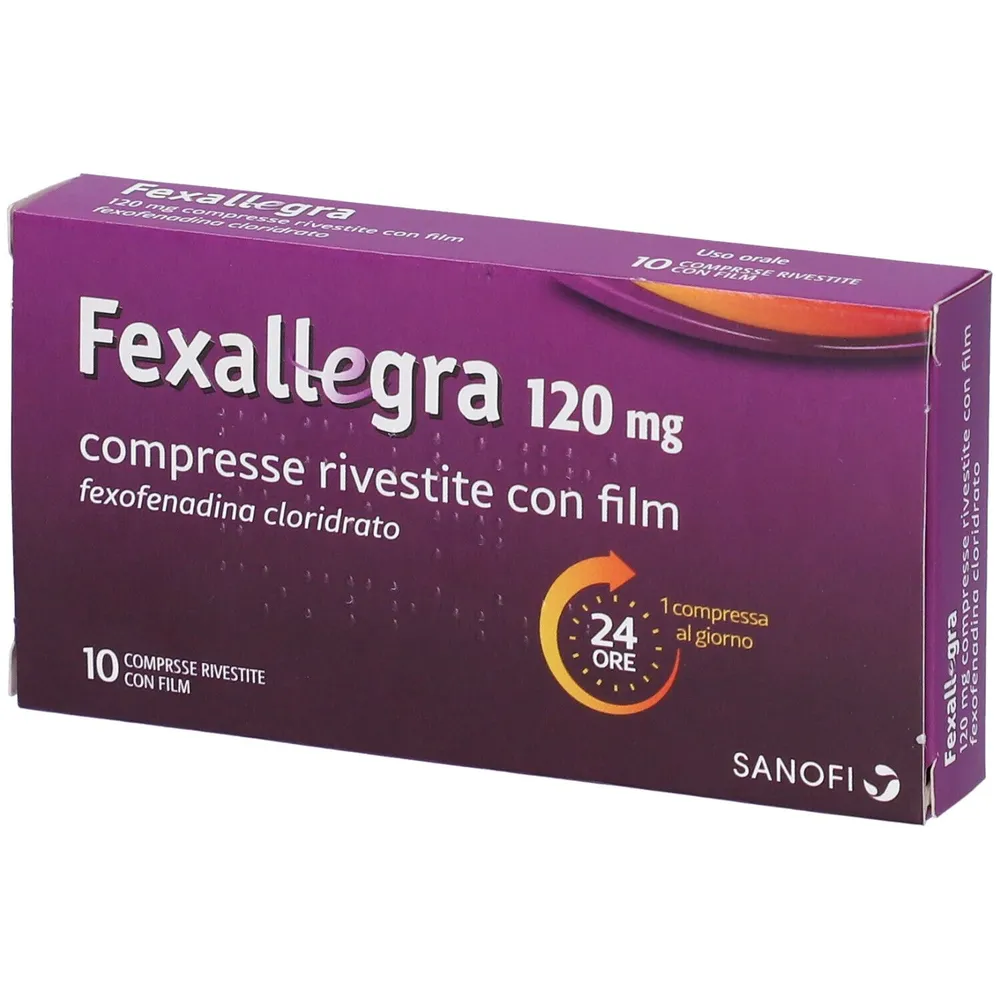
FEXALLEGRA
ItalyIt is used by adults and adolescents aged 12 years and older to treat the symptoms of seasonal allergic rhinitis, such as sneezing, nasal itching, runny or stuffy nose, and eye irritation (redness and tearing).
Frequently asked questions
How should Fexallegra be taken?
The recommended dose is 1 tablet of 120 mg once daily, to be taken with water before meals. Do not exceed the indicated dose and use the medicine only for short periods.
When should the drug not be taken?
It must not be taken if you are allergic to fexofenadine hydrochloride or any of the ingredients. Use is also prohibited in children under 12 years of age.
What are the possible side effects of Fexallegra?
Common side effects may include headache, drowsiness, nausea, and dizziness. Fatigue, insomnia, nervousness, diarrhea, rash, or rapid/irregular heartbeat have also been reported. In case of swelling of the face, lips, tongue, or throat and difficulty breathing, discontinue treatment immediately and consult a doctor.
Are there interactions with other medicines?
Antacids containing aluminum and magnesium may decrease the absorption of the drug; it is recommended to space their administration by approximately 2 hours. Conversely, absorption may increase if taken together with erythromycin (an antibiotic) or ketoconazole (for fungal infections).
What to do in case of overdose?
In case of taking an excessive dose, consult a doctor immediately or go to the emergency room. Symptoms may include dizziness, drowsiness, fatigue, and dry mouth.
Can I drive while taking this medicine?
It is unlikely to affect the ability to drive, but it is important to ensure that you do not experience drowsiness or dizziness before driving or using machinery.
Instructions for use
Package leaflet: Information for the patient
Fexallegra 120 mg film-coated tablets
Fexofenadine hydrochloride
Please read all of this leaflet carefully before taking this medicine because it contains important information for you.
Always take this medicine exactly as described in this leaflet or as your doctor or pharmacist has instructed.
- Keep this leaflet. You may need to read it again.
- If you need more information or advice, consult your pharmacist.
- If you experience any side effect, including those not listed in this leaflet, contact your doctor or pharmacist. See section 4.
- Contact your doctor if you do not notice any improvement or if your symptoms worsen.
Contents of this leaflet:
- What Fexallegra is and what it is used for
- What you need to know before taking Fexallegra
- How to take Fexallegra
- Possible side effects
- How to store Fexallegra
- Contents of the pack and other information
1. What Fexallegra is and what it is used for
Fexallegra is an oral medicine containing fexofenadine hydrochloride, an antihistamine substance that does not cause drowsiness, used to treat certain types of allergies.
Fexallegra 120 mg is used in adults and adolescents aged 12 years and older, for the treatment of inflammation or irritation of the nasal mucosa caused by seasonal allergies (seasonal allergic rhinitis). This medicine relieves symptoms caused by this allergy, such as sneezing, nasal itching, runny or blocked nose, and eye irritation (redness and tearing).
2. What you need to know before taking Fexallegra
Do not take Fexallegra
- if you are allergic to fexofenadine hydrochloride or to any of the other ingredients of this medicine (listed in section 6).
Warnings and precautions
Talk to your doctor or pharmacist before taking Fexallegra.
Be especially careful if:
- you have liver or kidney problems; in particular, if you have severe kidney problems (severe renal insufficiency), you may take this medicine only under medical supervision;
- you have or have had heart or blood circulation disorders, as this type of medicine may cause an increased or irregular heartbeat;
- you are elderly;
- you are pregnant or breastfeeding, as you should consult your doctor (see "Pregnancy and breastfeeding").
Children and adolescents
This medicine must not be taken by children under 12 years of age (see "Use in children and adolescents").
Other medicines and Fexallegra
Inform your doctor or pharmacist if you are taking, have recently taken, or might take any other medicines, including those without a prescription.
Medicines containing aluminium and magnesium used to treat excessive stomach acidity (antacids) may reduce the effect of Fexallegra by decreasing the amount of medicine absorbed.
It is recommended to leave an interval of about 2 hours between taking Fexallegra and taking these types of medicines.
An increased absorption of Fexallegra has been observed when administered together with erythromycin (an antibiotic) and ketoconazole (a medicine used to treat fungal infections).
Pregnancy, breastfeeding and fertility
If you are pregnant, think you may be pregnant, planning a pregnancy, or are breastfeeding, ask your doctor or pharmacist for advice before taking this medicine.
Do not take Fexallegra during pregnancy unless clearly necessary.
Do not take Fexallegra while breastfeeding.
There are no data available on the effect of Fexallegra on human fertility.
Driving and using machines
It is unlikely that Fexallegra will affect your ability to drive or operate machinery.
However, before driving or operating machinery, make sure that the medicine does not cause you drowsiness or dizziness.
3. How to take Fexallegra
Take this medicine exactly as directed by your doctor or pharmacist. If you have any doubts, consult your doctor or pharmacist.
Recommended dose:
Adults and children aged 12 years and older
1 tablet (120 mg) once daily.
Take the tablet with water, before meals.
The medicine starts to relieve symptoms within 1 hour and the effect lasts up to 24 hours.
Warning: Do not exceed the recommended dose. Use only for short-term treatment.
Use in children under 12 years of age
Do not administer this medicine to children under 12 years of age.
Consult your doctor if your condition recurs repeatedly or if you notice any recent changes in its characteristics.
If you take more Fexallegra than you should
In case of accidental overdose, contact your doctor immediately or go to the nearest hospital. Symptoms of overdose in adults may include: dizziness, drowsiness, fatigue, and dry mouth.
If you forget to take Fexallegra
Do not take a double dose to make up for the missed tablet. Take the next dose at the usual time, as prescribed by your doctor.
If you stop taking Fexallegra
Consult your doctor if you intend to stop taking Fexallegra before completing the prescribed course of treatment. If you stop taking Fexallegra too early, your symptoms may return.
If you have any questions about the use of this medicine, consult your doctor or pharmacist.
4. Possible side effects
Like all medicines, this medicine can cause side effects, although not everybody will experience them.
Immediately contact your doctor and stop treatment with Fexallegra if you experience:
- swelling of the face, lips, tongue or throat, and breathing difficulties, as these symptoms may be signs of a severe allergic reaction.
The following side effects were reported in clinical studies conducted in adults, with a frequency similar to that observed in patients who did not receive the active drug (placebo):
Common (may affect up to 1 in 10 people)
- headache,
- drowsiness,
- feeling unwell (nausea),
- dizziness.
Uncommon (may affect up to 1 in 100 people)
- fatigue.
The following side effects have been reported during post-marketing surveillance:
Frequency not known (frequency cannot be estimated from the available data)
- difficulty falling asleep (insomnia),
- sleep disorders,
- nightmares,
- nervousness,
- increased or irregular heartbeat,
- diarrhoea,
- skin abnormalities (rash), sometimes with small swellings and itching (urticaria),
- severe allergic reactions which may cause swelling of the face, lips, tongue or throat and breathing difficulties.
Reporting of side effects
If you experience any side effect, including those not listed in this leaflet, talk to your doctor or pharmacist.
You can also report side effects directly via the national reporting system at https://www.aifa.gov.it/content/segnalazioni-reazioni-avverse.
By reporting side effects, you can help provide more information on the safety of this medicine.
5. How to store Fexallegra
Keep this medicine out of the sight and reach of children.
Do not use this medicine after the expiry date stated on the packaging after (Exp.). The expiry date refers to the last day of that month.
Do not dispose of any medicine via wastewater or household waste. Ask your pharmacist how to dispose of medicines you no longer use. This will help protect the environment.
6. Package contents and other information
What Fexallegra contains
- The active substance is fexofenadine hydrochloride. Each tablet contains 120 mg of fexofenadine hydrochloride.
- The other components are: tablet core: microcrystalline cellulose, pregelatinized maize starch, sodium croscarmellose, magnesium stearate; film coating: hypromellose, povidone K30, titanium dioxide (E171), anhydrous colloidal silica, macrogol 400, red iron oxide (E172) and yellow iron oxide (E172).
Description of the appearance of Fexallegra and contents of the pack
Film-coated peach-coloured tablets, capsule-shaped, with the imprint “012” on one side and “e” on the other side.
Fexallegra 120 mg film-coated tablets are available in packs of 7 and 10 tablets in PVC/PE/PVDC/Al and PVC/PVDC/Al blisters.
Not all pack sizes may be marketed.
Marketing Authorization Holder
Opella Healthcare Italy S.r.l.
V.le L. Bodio, 37/B - IT-20158 Milano
Manufacturer
Sanofi Winthrop Industrie
30-36 Avenue Gustave Eiffel - 37100 Tours (France)
or:
Opella Healthcare International SAS
56, route de Choisy - 60200 Compiègne (France)
Similar drugs
| Brand name | Dosage form | Active substance / Dosage | Manufacturer |
|---|---|---|---|
| FEXOFENADINE AUROBINDO | tablets, film-coated | AUROBINDO PHARMA (ITALIA) S.R.L. | |
| FEXOFENADINE MYLAN GENERICS | tablets, film-coated | MYLAN S.P.A. | |
| FEXOFENADINE MYLAN ITALIA | tablets, film-coated | MYLAN S.P.A. | |
| FEXOFENADINE OPPELLA HEALTHCARE | tablets, film-coated | OPELLA HEALTHCARE ITALY S.R.L. | |
| FEXYNA | tablets, film-coated | AUROBINDO PHARMA (ITALIA) S.R.L. | |
| TELFAST | tablets, film-coated | OPELLA HEALTHCARE ITALY S.R.L. |
The original data is available in the language of the country of manufacture.
Data source: Italian Medicines Agency (AIFA)
Data last verified: September 21, 2026