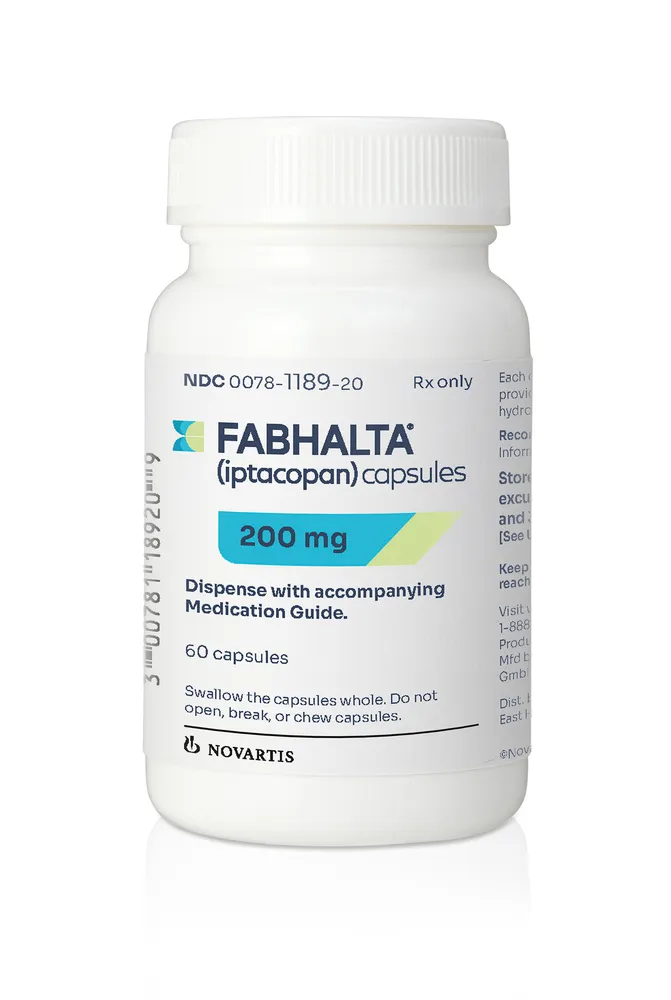
FABHALTA
ItalyIt is used in adults to treat paroxysmal nocturnal hemoglobinuria (PNH), a disease that causes red blood cell destruction and anemia, or to treat C3 glomerulopathy (C3G), a disease that can damage the kidneys.
Frequently asked questions
How should I take FABHALTA?
The recommended dose is one 200 mg capsule to be taken orally twice daily, once in the morning and once in the evening, swallowing the capsule with a glass of water. It can be taken with or without food.
When should I not take this medicine?
You must not take this medicine if you are allergic to the active substance or to any of the other ingredients, if you have an infection caused by encapsulated bacteria (such as Neisseria meningitidis or Streptococcus pneumoniae), or if you have not been vaccinated against these bacteria (unless your doctor decides on urgent treatment).
What are the side effects of FABHALTA?
The most common side effects include nose and throat infections. Other side effects may include headache, diarrhea, cough, dizziness, nausea, stomach pain, or low platelet levels. The most serious side effect is severe infection caused by encapsulated bacteria.
Are there interactions with other medicines?
Yes. Some medicines for bacterial infections (such as rifampicin) may prevent the drug from working. Other medicines, such as those for epilepsy, organ transplant rejection, migraine, chronic pain, type 2 diabetes, or cancer, may be affected by taking this medicine.
What should I do if I forget a dose?
Take the dose as soon as you remember, even if it is close to the time of your next dose, and then continue with your usual schedule. If you miss several doses in a row and suffer from PNH, contact your doctor.
Can I take the drug if I am pregnant or breastfeeding?
You must consult your doctor before taking this medicine. The doctor will assess the risks and decide whether it is necessary to stop breastfeeding or treatment, considering the benefits for you and the child.
Instructions for use
Package leaflet: Information for the patient
FABHALTA 200 mg hard capsule
iptacopan
This medicinal product is under additional monitoring. This will allow for rapid identification of
new safety information. You can help by reporting any side effects you experience while taking
this medicine. See the end of section 4 for information on how to report side effects.
Please read this leaflet carefully before taking this medicine, as it contains important
information for you.
- Keep this leaflet. You may need to read it again.
- If you have any questions, consult your doctor or pharmacist.
- This medicine has been prescribed for you only. Do not give it to others, even if their symptoms are the same as yours, as it could be harmful.
- If you experience any side effect, including those not listed in this leaflet, contact your doctor or pharmacist. See section 4.
Contents of this leaflet
- What FABHALTA is and what it is used for
- What you need to know before taking FABHALTA
- How to take FABHALTA
- Possible side effects
- How to store FABHALTA
- Contents of the pack and other information
1. What FABHALTA is and what it is used for
FABHALTA contains the active substance iptacopan, which belongs to a group of medicines
called complement inhibitors.
FABHALTA is used:
- on its own in adults to treat paroxysmal nocturnal haemoglobinuria (PNH), a disease in which the immune system (the body’s natural defence system) attacks and damages red blood cells. FABHALTA is used in adults who have anaemia (low levels of red blood cells) due to destruction of their red blood cells.
- in adults to treat patients with a disease called C3 glomerulopathy (C3G)
- in combination with a renin-angiotensin system inhibitor (RAS inhibitor), or
- on its own if a RAS inhibitor does not work adequately or cannot be used.
The active substance in FABHALTA, iptacopan, targets a protein called Factor B,
involved in part of the body’s immune system known as the “complement system”.
In patients with PNH, the complement system is overactive, causing destruction and breakdown of red blood cells, which can lead to anaemia, fatigue, difficulty with daily activities, pain, abdominal pain, dark urine, shortness of breath, difficulty swallowing, impotence, and blood clots. By binding to the Factor B protein and blocking it, iptacopan can prevent the complement system from attacking red blood cells. This medicine has been shown to increase the number of red blood cells and may therefore improve anaemia symptoms.
In patients with C3G, the complement system is overactive, leading to deposition of C3 in the glomeruli (a part of the kidneys), causing inflammation and fibrosis (scarring and thickening of tissues). As a result, patients with C3G often have high levels of protein in the urine (proteinuria) and a progressive decline in kidney function over time. By binding to the Factor B protein, iptacopan can reduce C3 deposition in the kidney. This medicine has been shown to reduce protein levels in the urine and slow the decline in kidney function.
2. What you should know before taking FABHALTA
Do not take FABHALTA
- if you are allergic to iptacopan or to any of the other ingredients of this medicine (listed in section 6).
- if you have not been vaccinated against Neisseria meningitidis and Streptococcus pneumoniae, unless your doctor decides that urgent treatment with FABHALTA is necessary.
- if you have an infection caused by a type of bacteria called encapsulated bacteria, including Neisseria meningitidis, Streptococcus pneumoniae, or Haemophilus influenzae type B, before starting treatment with FABHALTA.
Warnings and precautions
Serious infection caused by encapsulated bacteria
FABHALTA may increase the risk of infection caused by encapsulated bacteria, including Neisseria meningitidis (bacteria that cause meningococcal disease, including severe infections of the membranes surrounding the brain and bloodstream) and Streptococcus pneumoniae (bacteria that cause pneumococcal diseases, including infections of the lungs, ears, and blood).
Talk to your doctor before starting FABHALTA to ensure you receive vaccination against Neisseria meningitidis and Streptococcus pneumoniae. You may also receive vaccination against Haemophilus influenzae type B if available in your country. Even if you have previously received these vaccinations, you may still need to be revaccinated before starting FABHALTA.
These vaccinations should be administered at least 2 weeks before starting FABHALTA.
If this is not possible, you will be vaccinated as soon as possible after starting FABHALTA, and your doctor will prescribe antibiotics for you to take for up to 2 weeks after vaccination to reduce the risk of infection.
You should be aware that vaccination reduces the risk of serious infections but may not prevent all serious infections. You must be closely monitored by your doctor for signs of infection.
Immediately inform your doctor if you experience any of the following symptoms of serious infection while being treated with FABHALTA:
- fever with or without chills or shivering
- headache and fever
- fever and rash
- fever with chest pain and cough
- fever with shortness of breath/rapid breathing
- fever with rapid heart rate
- headache with feeling unwell (nausea) or vomiting
- headache with stiff neck or stiff back
- confusion
- muscle aches with flu-like symptoms
- clammy skin
- eyes sensitive to light
Children and adolescents
Do not administer FABHALTA to children or adolescents under 18 years of age. Safety and efficacy of FABHALTA in this age group have not been established.
Other medicines and FABHALTA
Inform your doctor or pharmacist if you are taking, have recently taken, or might take any other medicines, including those obtained without a prescription. In particular:
Inform your doctor or pharmacist if you are taking certain medicines, as they may prevent FABHALTA from working properly:
- certain medicines used to treat bacterial infections – such as rifampicin
Inform your doctor or pharmacist if you are taking any of the following medicines, as FABHALTA may prevent these medicines from working properly:
- certain medicines used to treat epilepsy – such as carbamazepine
- certain medicines used to prevent organ rejection after organ transplantation – such as ciclosporin, sirolimus, tacrolimus
- certain medicines used to treat migraine – such as ergotamine
- certain medicines used to treat chronic pain – such as fentanyl
- certain medicines used to control involuntary movements or sounds – such as pimozide
- certain medicines used to treat abnormal heart rhythm – such as quinidine
- certain medicines used to treat type 2 diabetes – such as repaglinide
- certain medicines used to treat hepatitis C infection – such as dasabuvir
- certain medicines used to treat cancer – such as paclitaxel
Pregnancy and breastfeeding
If you are pregnant, think you may be pregnant, planning to become pregnant, or are breastfeeding, consult your doctor or pharmacist before taking this medicine. You should also inform your doctor if you become pregnant during treatment with FABHALTA. Your doctor will discuss with you the potential risks of taking FABHALTA during pregnancy or breastfeeding.
Your doctor will decide whether you should take FABHALTA during pregnancy only after careful assessment of the benefit-risk balance.
It is unknown whether iptacopan, the active substance of FABHALTA, passes into human milk and may affect breastfed infants.
Your doctor will decide whether you should discontinue breastfeeding or discontinue treatment with FABHALTA, taking into account the benefits of breastfeeding for your child and the benefits of treatment for you.
Driving and using machines
This medicine does not affect or has negligible effect on the ability to drive and use machines.
3. How to take FABHALTA
Take this medicine exactly as directed by your doctor or pharmacist. If
you have any doubts, consult your doctor or pharmacist.
Do not exceed the prescribed dose.
The recommended dose is 200 mg (one capsule) taken orally twice daily (once in the morning and once in the evening). Swallow the FABHALTA capsule with a glass of water.
Taking FABHALTA at the same time each day will help you remember when to take the medicine.
It is important that you take FABHALTA as directed by your doctor. For patients with PNH,
this is important to reduce the risk of red blood cell destruction due to PNH.
FABHALTA with food
FABHALTA may be taken with or without food.
Switching from other PNH medicines to FABHALTA
If you are switching from any other PNH medicine, ask your doctor when to start taking FABHALTA.
How long to take FABHALTA
PNH is a lifelong condition and you are expected to require FABHALTA for a long period. Your doctor will monitor your condition regularly to ensure the treatment is having the desired effect.
If you have questions about how long you should continue treatment with FABHALTA, speak to your doctor.
If you take more FABHALTA than you should
If you have accidentally taken too many capsules or if someone else has accidentally taken your
medicine, contact your doctor immediately.
If you forget to take FABHALTA
If you miss one or more doses, take a dose of FABHALTA as soon as you remember (even if it is shortly before your next scheduled dose), then take your next dose at the usual time. If you have PNH and miss several consecutive doses, contact your doctor, who may decide to monitor you for signs of red blood cell destruction (see the section “If you stop taking FABHALTA” below).
If you stop taking FABHALTA
Stopping treatment with FABHALTA may worsen your condition. Do not stop taking FABHALTA without first talking to your doctor.
If you have PNH and your doctor decides to stop treatment with this medicine, you will be closely monitored for at least 2 weeks after stopping treatment for any signs of red blood cell destruction. Your doctor may prescribe a different medicine for PNH or restart treatment with FABHALTA.
Symptoms or problems that may occur due to red blood cell destruction include:
- low levels of haemoglobin in the blood, detectable through blood tests
- fatigue
- blood in the urine
- stomach (abdominal) pain
- shortness of breath
- difficulty swallowing
- erectile dysfunction (impotence)
- blood clots (thrombosis)
If you experience any of these symptoms after stopping treatment, contact your doctor.
If you have any questions about the use of this medicine, consult your doctor or pharmacist.
4. Possible side effects
Like all medicines, this medicine can cause side effects, although not everybody gets them.
Serious side effects
The most serious side effect is a severe infection. If you experience any of the symptoms of a severe infection listed in section “Severe infection caused by encapsulated bacteria” in paragraph 2 of this leaflet, you must inform your doctor immediately.
Side effects for EPN
Very common (may affect more than 1 in 10 people)
- infections of the nose and throat (upper respiratory tract infection)
- headache
- diarrhoea
Common (may affect up to 1 in 10 people)
- persistent cough or irritation of the airways (bronchitis)
- low levels of platelets (which help blood to clot) in the blood (thrombocytopenia), which may make you bleed or bruise more easily
- dizziness
- stomach (abdominal) pain
- nausea
- joint pain (arthralgia)
- urinary tract infection
Uncommon (may affect up to 1 in 100 people)
- lung infection, which may cause chest pain, cough and fever
- itchy skin rash (urticaria)
Side effects for C3G
Very common (may affect more than 1 in 10 people)
- infections of the nose and throat (upper respiratory tract infection)
Common (may affect up to 1 in 10 people)
- pneumococcal infection including lung infection (pneumonia) and blood infection (sepsis)
Reporting of side effects
If you get any side effects, including those not listed in this leaflet, talk to your doctor or pharmacist. You can also report side effects directly via the national reporting system referred to in Annex V. By reporting side effects, you can help provide more information on the safety of this medicine.
5. How to store FABHALTA
Keep this medicine out of the sight and reach of children.
Do not use this medicine after the expiry date which is stated on the carton after "Exp." and on the
blister after "EXP". The expiry date refers to the last day of that month.
This medicine does not require any special storage conditions.
Do not dispose of any medicine via wastewater or household waste. Ask your pharmacist how to
dispose of medicines you no longer use. This will help protect the environment.
6. Package contents and other information
What FABHALTA contains
- The active substance is iptacopan.
- The other components are:
- Capsule shell: gelatin, iron oxide red (E172), titanium dioxide (E171), iron oxide yellow (E172)
- Printing ink: iron oxide black (E172), concentrated ammonia solution (E527), potassium hydroxide (E525), propylene glycol (E1520), shellac (E904)
Description of the appearance of FABHALTA and contents of the pack
Pale yellow, opaque, hard capsules with “LNP200” printed on the body and “NVR” on the cap,
containing white or almost white powder, ranging to pale pinkish-violet. The capsule size is approximately 21–22 mm.
FABHALTA is supplied in PVC/PE/PVDC blisters with an aluminium foil backing.
FABHALTA is available in:
- packs containing 28 or 56 hard capsules, and in
- multiple packs comprising 3 cartons, each containing 56 hard capsules.
Not all pack sizes may be marketed.
Marketing Authorization Holder
Novartis Europharm Limited
Vista Building
Elm Park, Merrion Road
Dublin 4
Ireland
Manufacturer
Novartis Pharmaceutical Manufacturing LLC
Verovškova Ulica 57
1000 Ljubljana
Slovenia
Novartis Pharma GmbH
Roonstrasse 25
90429 Nuremberg
Germany
Novartis Farmacéutica S.A.
Gran Via De Les Corts Catalanes 764
08013 Barcelona
Spain
Novartis Pharma GmbH
Sophie-Germain-Strasse 10
90443 Nuremberg
Germany
For further information about this medicinal product, please contact the local representative of the Marketing Authorization Holder:
België/Belgique/Belgien Lietuva
Novartis Pharma N.V. SIA Novartis Baltics Lietuvos filialas
Tél/Tel: +32 2 246 16 11 Tel: +370 5 269 16 50
България Luxembourg/Luxemburg
Novartis Bulgaria EOOD Novartis Pharma N.V.
Тел.: +359 2 489 98 28 Tél/Tel: +32 2 246 16 11
Česká republika Magyarország
Novartis s.r.o. Novartis Hungária Kft.
Tel: +420 225 775 111 Tel.: +36 1 457 65 00
Danmark Malta
Novartis Healthcare A/S Novartis Pharma Services Inc.
Tlf.: +45 39 16 84 00 Tel: +356 2122 2872
Deutschland Nederland
Novartis Pharma GmbH Novartis Pharma B.V.
Tel: +49 911 273 0 Tel: +31 88 04 52 111
Eesti Norge
SIA Novartis Baltics Eesti filiaal Novartis Norge AS
Tel: +372 66 30 810 Tlf: +47 23 05 20 00
Ελλάδα Österreich
Novartis (Hellas) A.E.B.E. Novartis Pharma GmbH
Τηλ: +30 210 281 17 12 Tel: +43 1 86 6570
España Polska
Novartis Farmacéutica, S.A. Novartis Poland Sp. z o.o.
Tel: +34 93 306 42 00 Tel.: +48 22 375 4888
France Portugal
Novartis Pharma S.A.S. Novartis Farma - Produtos Farmacêuticos, S.A.
Tél: +33 1 55 47 66 00 Tel: +351 21 000 8600
Hrvatska România
Novartis Hrvatska d.o.o. Novartis Pharma Services Romania SRL
Tel. +385 1 6274 220 Tel: +40 21 31299 01
Ireland Slovenija
Novartis Ireland Limited Novartis Pharma Services Inc.
Tel: +353 1 260 12 55 Tel: +386 1 300 75 50
Ísland Slovenská republika
Vistor hf. Novartis Slovakia s.r.o.
Sími: +354 535 7000 Tel: +421 2 5542 5439
Italia Suomi/Finland
Novartis Farma S.p.A. Novartis Finland Oy
Tel: +39 02 96 54 1 Puh/Tel: +358 (0)10 6133 200
Κύπρος Sverige
Novartis Pharma Services Inc. Novartis Sverige AB
Τηλ: +357 22 690 690 Tel: +46 8 732 32 00
Latvija
SIA Novartis Baltics
Tel: +371 67 887 070
Other sources of information
More detailed information on this medicinal product is available on the website of the European Medicines Agency: https://www.ema.europa.eu
The original data is available in the language of the country of manufacture.
Data source: Italian Medicines Agency (AIFA)
Data last verified: September 21, 2026