BRAMITOB
ItalyBramitob is an antibiotic used for the chronic treatment of pulmonary infections caused by the bacterium Pseudomonas aeruginosa in patients with cystic fibrosis. It helps kill bacteria and improve breathing.
Frequently asked questions
Who can take Bramitob and when is it contraindicated?
The drug is indicated for patients aged 6 years and older. It must not be used by those allergic to tobramycin, other antibiotics in the aminoglycoside family, or to any of the ingredients of the medicinal product.
How should the drug be taken correctly?
Treatment involves inhaling one single-dose container in the morning and one in the evening (with a 12-hour interval between doses) for 28 consecutive days. After this period, another 28 days must pass without taking the drug before starting a new cycle. The medicinal product must be used exclusively with a nebulizer.
What are the side effects of Bramitob?
The most common side effects are cough and hoarseness. Less common side effects may also occur, such as dizziness, hearing loss, nausea, sore throat, or fungal infections (thrush). Some effects may be serious, such as reduced urine output, vomiting, confusion, or swelling of the legs and feet, which could indicate kidney problems; in these cases, it is necessary to inform a doctor immediately.
Are there interactions with other medicines?
The drug should not be used if you are taking diuretics containing furosemide or ethacrynic acid, or urea or mannitol for intravenous or oral use. It is important to inform the doctor if you are taking other medicines, as some may worsen damage to the kidneys or hearing.
What to do in case of a missed dose?
If there are more than 6 hours remaining until the next dose, take the drug immediately. If there are less than 6 hours remaining until the next dose, skip the missed dose and continue with the normal schedule.
Instructions for use
Table of contents
- Bramitob 300mg Nebuliser Solution
- 1. What Bramitob is and what it is used for
- 2. What you need to know before using Bramitob
- 3. How to use Bramitob
- Bramitob is intended for use in a nebulizer; do not use it in any other way.
- 4. Possible side effects
- 5. How to store Bramitob
- 6. Package contents and other information
PATIENT LEAFLET: INFORMATION FOR THE USER
Bramitob 300mg Nebuliser Solution
tobramycin
Please read this leaflet carefully before using this medicine because it contains
important information for you
- Keep this leaflet. You may need to read it again.
- If you have any questions, ask your doctor or pharmacist.
- This medicine has been prescribed for you only. Do not give it to other people, even if they have the same symptoms as you, because it could be harmful.
- If you experience any side effects, including those not listed in this leaflet, talk to your doctor or pharmacist. See section 4.
Contents of this leaflet:
- What Bramitob is and what it is used for
- What you need to know before using Bramitob
- How to use Bramitob
- Possible side effects
- How to store Bramitob
- Contents of the pack and other information
1. What Bramitob is and what it is used for
Bramitob contains an active substance called tobramycin, an antibiotic belonging to a family known as aminoglycosides. It fights infections caused by Pseudomonas aeruginosa.
Bramitob is used for the chronic treatment of lung infections caused by Pseudomonas bacteria in patients with cystic fibrosis. It kills the bacteria and helps improve breathing. Pseudomonas is a very common bacterium that eventually infects almost all patients with cystic fibrosis at some point in their lives. Some people acquire this infection only at an advanced age, while others become infected at a very young age. If the infection is not adequately controlled, it continues to damage the lungs, causing further problems. Since Bramitob is administered by inhalation, the antibiotic tobramycin can enter directly into the lungs and act against the bacteria causing the infection.
Bramitob is indicated only for patients aged 6 years and older.
To achieve the best results, carefully follow the instructions for the correct use of the medicine.
2. What you need to know before using Bramitob
Do not use Bramitob:
- If you are allergic (hypersensitive) to tobramycin or to any of the other ingredients of this medicine (listed in section 6) or to another type of aminoglycoside antibiotic.
- If you are taking any of the medicines listed in the section below, “Other medicines and Bramitob”.
Warnings and precautions:
Talk to your doctor or pharmacist before using Bramitob.
The tobramycin contained in Bramitob belongs to a group of medicines that occasionally cause hearing loss, dizziness, and kidney damage (see also section 4 on the reverse of this leaflet, Possible side effects). It is important that you inform your doctor if any of the following apply to you:
- If you experience a feeling of tightness in the chest after using Bramitob. Your doctor will monitor your first dose of Bramitob and check your lung function before and after administration. If you are not already doing so, your doctor may advise you to use a bronchodilator (e.g., salbutamol) before using Bramitob.
- If you have suffered from neuromuscular disorders such as parkinsonism or other conditions characterized by muscle weakness, including myasthenia gravis.
- If you have previously had kidney problems. Before starting Bramitob, your doctor may check that your kidneys are functioning properly through blood or urine tests. Your doctor may repeat these tests regularly during treatment.
- If you have previously experienced:
- ringing in the ears;
- any other hearing problems;
- dizziness. Your doctor may carry out hearing tests before starting treatment with Bramitob or at any time during treatment.
- If you notice blood in your sputum. Inhaled medicines can sometimes cause cough reflex, and your doctor may advise you to stop using Bramitob until blood in the sputum is minimal or absent.
- If you notice that Bramitob is not as effective as it should be. Bacteria can sometimes develop resistance to antibiotic treatment.
Other medicines and Bramitob
Inform your doctor or pharmacist if you are taking, have recently taken, or might take any other medicines, including those without a prescription.
- Do not use Bramitob if you are taking diuretics (used to eliminate fluid from the body by increasing urine production) containing furosemide or ethacrynic acid, without first discussing it with your doctor.
- Do not use Bramitob if you are taking intravenous or oral urea or mannitol (used to treat serious conditions in hospitalized patients).
- Some other medicines can sometimes cause kidney or hearing damage, which could worsen during treatment with Bramitob.
You may be treated with injections of tobramycin or other aminoglycosides at the same time as inhaling Bramitob. These injections, which could increase the very low levels of aminoglycoside in the body caused by inhaling Bramitob, should be avoided when taking the following medicines:
- Amphotericin B, cephalothin, ciclosporin, tacrolimus, polymyxin
- Platinum compounds (e.g., carboplatin and cisplatin)
- Anticholinesterases (e.g., neostigmine and pyridostigmine), botulinum toxin
If any of these situations apply, you must inform your doctor.
Pregnancy and breastfeeding
If you are pregnant, think you might be pregnant, are planning to become pregnant, or are breastfeeding, consult your doctor or pharmacist before using this medicine.
It is not known whether inhaling this medicine during pregnancy causes adverse effects. When administered by injection, tobramycin and other aminoglycoside antibiotics can cause harm to the fetus, such as deafness and kidney problems.
If you are breastfeeding, you should talk to your doctor before using this medicine.
Driving and using machines
Bramitob has a minor influence on the ability to drive vehicles or operate machinery. In rare cases, Bramitob may cause dizziness. Therefore, Bramitob may affect your ability to drive vehicles or use machinery.
3. How to use Bramitob
Use this medicine exactly as instructed by your doctor. If you have any doubts,
consult your doctor or pharmacist.
Instructions for use of Bramitob are provided after the section “Dosage”.
Do not dilute or mix Bramitob in the nebulizer with any other medicine.
If you are undergoing other treatments for cystic fibrosis, follow this order:
- bronchodilator (e.g. salbutamol), followed by
- chest physiotherapy, followed by
- other inhaled medicines, followed by
- Bramitob
Confirm this order with your doctor as well.
Bramitob must be used with a clean, dry, reusable nebulizer (for your personal use only) and a suitable compressor. The PARI LC PLUS and PARI LC SPRINT nebulizers are suitable for use with Bramitob. Ask your doctor or physiotherapist for advice on the correct use of Bramitob and the necessary equipment.
The single-dose container of Bramitob must be opened immediately before use. Any solution not used immediately must be discarded.
Dosage
- The dose (one 4 ml container) is the same for all patients aged 6 years and older.
- Use two single-dose containers per day for 28 days. Inhale the contents of one container in the morning and one in the evening. There must be a 12-hour interval between doses.
- After this, a 28-day period without the medicine must pass before starting a new 28-day treatment cycle.
- It is important that you continue using the product twice daily for the full 28-day treatment period and maintain the alternating treatment cycle of 28 days on / 28 days off. Continue taking Bramitob in this manner until your doctor tells you to stop.
If you use more Bramitob than you should
If you inhale too much Bramitob, your voice may become very hoarse. Inform your doctor
as soon as possible.
If you forget to use Bramitob
- If more than 6 hours remain before your next dose, use Bramitob immediately.
- If less than 6 hours remain before your next dose, skip the missed dose.
Then continue with your next dose as usual.
Instructions for use
Bramitob is intended for use in a nebulizer; do not use it in any other way.
- Wash your hands thoroughly with water and soap before opening the single-dose container, following the instructions below.
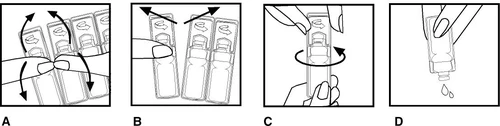
- Bend the single-dose container in both directions (Figure A).
- Carefully separate a new single-dose container from the strip, first above and then in the center (Figure B), leaving the rest in the aluminum pouch.
- Open the single-dose container by rotating the tab in the direction indicated by the arrow (Figure C).
- By applying moderate pressure to the walls of the single-dose container, squeeze out the medication and pour it into the nebulizer chamber (Figure D).
- Turn on the compressor.
- Check that a constant mist is emitted from the mouthpiece.
- Sit or stand in a comfortable position to breathe normally.
- Place the mouthpiece between your teeth and on top of the tongue. Breathe normally, but only through your mouth (a nose clip may help). Try not to block the end of the mouthpiece with your tongue.
- Continue until all of the Bramitob has been used; this will take approximately 15 minutes.
- If interrupted, or if you need to cough or rest during treatment, turn off the compressor to preserve the medication. Turn the compressor back on when you are ready to resume treatment.
If you have any further questions about the use of this product, consult your doctor or pharmacist.
Nebulizer and compressor maintenance:
Follow the manufacturer's instructions for the care and use of the nebulizer and compressor.
4. Possible side effects
Like all medicines, this medicine can cause side effects, although not everybody gets them.
If you are unsure about the side effects listed below, ask your doctor for clarification.
Some side effects can be serious
Low urine volume, vomiting, confusion, and swelling of the legs, ankles or feet, which could be signs of a sudden drop in kidney function (frequency is not known: cannot be estimated from the available data).
If you experience any of these side effects, contact your doctor immediately.
The most common side effects of Bramitob, which may affect more than 1 in 100 patients, are: cough and hoarseness.
Uncommon side effects of Bramitob, which may affect more than 1 in 1,000 patients, are: oral thrush (candida infection), dizziness, hearing loss, increased salivation, inflammation of the tongue, skin rash, throat irritation, increased levels of liver enzymes in the blood, noisy breathing, nausea, dryness of the mucous membranes, blood in sputum, sore throat (oropharyngitis), chest pain, headache, shortness of breath, weakness, increased sputum production compared to normal (the substance expelled when coughing), upper abdominal pain, and fungal infection.
Rare side effects, which may affect more than 1 in 10,000 patients, are: loss of appetite, ringing in the ears, chest tightness or breathing difficulties, loss of voice, nosebleeds, runny nose, mouth ulcers, vomiting, altered taste, asthma, dizziness, loss of strength, fever and pain, laryngitis, sore throat or chest pain, hearing loss, shortness of breath, weakness, (voice changes with irritated throat and difficulty swallowing).
Very rare side effects, which may affect fewer than 1 in 10,000 patients, are: swollen lymph nodes, drowsiness, ear problems, ear pain, hyperventilation, sinusitis, diarrhoea, allergic reactions including urticaria and itching, lack of available oxygen in the blood and body tissues (hypoxia), back pain, abdominal pain, and general feeling of malaise.
If any of the side effects worsens, or if you notice any side effects not listed in this leaflet, inform your doctor or pharmacist.
Reporting of side effects
If you experience any side effect, including those not listed in this leaflet, talk to your doctor or pharmacist. You can also report side effects directly via the national reporting system at the following website: https://www.aifa.gov.it/content/segnalazioni-reazioni-avverse.
By reporting side effects, you can help provide more information on the safety of this medicine.
5. How to store Bramitob
Keep this medicine out of the sight and reach of children.
- Single-use. Do not use Bramitob after the expiry date stated on the carton and label after "Exp." The expiry date refers to the last day of that month. You may use Bramitob even if the colour of the solution has changed.
Shelf-life after first opening of the packaging: the sachets containing Bramitob may
be stored (unopened or opened) at a temperature not exceeding 25°C for a maximum period of 3 months.
- Store Bramitob in the refrigerator (2°C - 8°C). If a refrigerator is not available or for transport, the single-dose container may be stored for up to 3 months at a temperature not exceeding 25°C.
- Keep the containers in their original packaging to protect them from light.
- After first opening of the single-dose container: use it immediately.
- After first use: immediately dispose of the used single-dose container.
- Do not dispose of any medicine via wastewater or household waste. Ask your
pharmacist how to dispose of medicines you no longer use. This will help
protect the environment.
6. Package contents and other information
What Bramitob contains
- The active substance is tobramycin. Each 4 ml single-dose container contains 300 mg of tobramycin.
- The other components are: sodium chloride, sulfuric acid, sodium hydroxide (to adjust pH), water for injections.
Description of the appearance of Bramitob and package contents
Bramitob is a clear solution, pale yellow to yellow in colour.
Bramitob nebulizer solution is supplied in 4 ml single-dose containers. Each sealed pouch contains 4 single-dose containers, and cartons contain 16, 28 or 56 containers.
Not all pack sizes may be marketed.
Marketing Authorization Holder
Chiesi Farmaceutici S.p.A., Via Palermo, 26/A – 43122 Parma – Italy
Manufacturer
Chiesi Farmaceutici S.p.A., Via San Leonardo, 96 – 43122 Parma – Italy
Genetic S.p.A., Contrada Canfora – 84084 Fisciano (SA) – Italy
Similar drugs
| Brand name | Dosage form | Active substance / Dosage | Manufacturer |
|---|---|---|---|
| TOBRAMYCIN SUN | solution for nebulizer | SUN PHARMACEUTICAL INDUSTRIES (EUROPE) B.V. | |
| TOBRINEB | solution for nebulizer | PROMEDICA S.R.L. | |
| VANTOBRA | solution for nebulizer | PARI PHARMA GMBH |
The original data is available in the language of the country of manufacture.
Data source: Italian Medicines Agency (AIFA)
Data last verified: September 21, 2026