APREMILAST EG
ItalyIt is used for the treatment of adults with active psoriatic arthritis, chronic moderate-to-severe plaque psoriasis, and Behçet's disease (for mouth ulcers). It is also indicated for children and adolescents aged 6 years and older with a minimum weight of 20 kg for moderate-to-severe plaque psoriasis.
Frequently asked questions
How should Apremilast EG be taken?
Tablets should be swallowed whole, preferably with water, with or without food. Treatment involves an initial phase of gradual dose escalation during the first week. Subsequently, the dose for adults is 30 mg twice daily (one dose in the morning and one in the evening, approximately 12 hours apart). For children and adolescents, the dose depends on body weight.
When should you not take this medicine?
You must not take this medicine if you are allergic to apremilast or any of its other ingredients, or if you are or believe you may be pregnant. It should not be used during breastfeeding.
What are the side effects of Apremilast EG?
Very common side effects include diarrhea, nausea, headache, and upper respiratory tract infections. Other common side effects are cough, vomiting, fatigue, stomach pain, loss of appetite, insomnia, and depression. Less common effects may include rash, weight loss, or suicidal ideation. In case of serious allergic reactions (such as facial swelling or difficulty breathing), consult a doctor immediately.
Are there interactions with other medicines?
Yes, it is important to inform your doctor if you are taking any other medicines, including non-prescription or herbal products. In particular, you must report the use of rifampicin (for tuberculosis), epilepsy drugs (such as phenytoin, phenobarbital, or carbamazepine), and St. John's Wort.
What should I do if I forget a dose?
If you forget a dose, take it as soon as you remember. However, if it is almost time for your next dose, skip the forgotten dose and continue with your normal schedule. Do not take a double dose to make up for the forgotten one.
Instructions for use
Table of contents
- Apremilast EG 10 mg film-coated tablets, 20 mg film-coated tablets, 30 mg film-coated tablets
- 1. What Apremilast EG is and what it is used for
- 2. What you should know before taking Apremilast EG
- 3. How to take Apremilast EG
- 4. Possible side effects
- 5. How to store Apremilast EG
- 6. Package contents and other information
Package leaflet: Information for the patient
Apremilast EG 10 mg film-coated tablets, 20 mg film-coated tablets, 30 mg film-coated tablets
Generic medicine
Please read all of this leaflet carefully before taking this medicine because it contains important information for you.
- Keep this leaflet. You may need to read it again.
- If you have any questions, ask your doctor, pharmacist or nurse.
- This medicine has been prescribed for you only. Do not give it to other people, even if their symptoms are the same as yours, as it may be harmful.
- If you experience any side effects, including those not listed in this leaflet, tell your doctor, pharmacist or nurse. See section 4.
Contents of this leaflet
- What Apremilast EG is and what it is used for
- What you need to know before taking Apremilast EG
- How to take Apremilast EG
- Possible side effects
- How to store Apremilast EG
- Contents of the pack and other information
1. What Apremilast EG is and what it is used for
What Apremilast EG is
Apremilast EG contains the active substance “apremilast”. This belongs to a group of medicines
called phosphodiesterase 4 inhibitors, which help reduce inflammation.
What Apremilast EG is used for
Apremilast EG is used to treat adult patients with the following conditions:
- Active psoriatic arthritis - when another class of medicines called “disease-modifying antirheumatic drugs” (DMARDs) cannot be used, or when treatment with one of these medicines has been tried but was not effective.
- Moderate to severe chronic plaque psoriasis - when one of the following treatments cannot be used, or when one of these treatments has been tried but was not effective:
o Phototherapy – a treatment in which certain areas of the skin are exposed to ultraviolet light,
o Systemic therapy – a treatment affecting the whole body rather than just one area, such as “ciclosporin”, “methotrexate” or “psoralen”. - Behçet’s disease (BD) - for the treatment of mouth ulcers, which are a common problem in people with this disease.
Apremilast is used to treat children and adolescents aged 6 years and older and weighing at least 20 kg with the following condition:
- Moderate to severe plaque psoriasis - when your doctor determines that it is appropriate for you to receive systemic therapy such as Apremilast EG.
What psoriatic arthritis is
Psoriatic arthritis is an inflammatory joint disease, usually accompanied by psoriasis, an inflammatory skin condition.
What plaque psoriasis is
Psoriasis is an inflammatory skin disease that can cause red, scaly, thick, itchy and painful patches on the skin, and may also affect the scalp and nails.
What Behçet’s disease is
Behçet’s disease is a rare type of inflammatory disease affecting many parts of the body. The most common problem is mouth ulcers.
How Apremilast EG works
Psoriatic arthritis, psoriasis and Behçet’s disease are usually lifelong conditions for which there is currently no cure. Apremilast EG works by reducing the activity of an enzyme in the body called “phosphodiesterase 4”, which is involved in the inflammatory process. By reducing the activity of this enzyme, Apremilast EG can help control the inflammation associated with psoriatic arthritis, psoriasis and Behçet’s disease, thereby alleviating the signs and symptoms of these conditions.
In adults with psoriatic arthritis, treatment with Apremilast EG leads to improvement in joint swelling and pain and may improve overall physical function.
In adults and in children and adolescents aged 6 years and older and weighing at least 20 kg with psoriasis, treatment with apremilast reduces psoriatic skin plaques and other signs and symptoms of the disease.
In adults with Behçet’s disease, treatment with Apremilast EG reduces the number of mouth ulcers and may stop them completely. It may also reduce associated pain.
Apremilast EG has also been shown to improve the quality of life in adult and paediatric patients with psoriasis, adult patients with psoriatic arthritis, and adult patients with Behçet’s disease. This means that the impact of the disease on daily activities, relationships and other factors would be less than before.
2. What you should know before taking Apremilast EG
DO NOT take Apremilast EG:
- if you are allergic to apremilast or to any of the other ingredients of this medicine (listed in section 6);
- if you are or think you may be pregnant.
Warnings and precautions
Talk to your doctor or pharmacist before taking Apremilast EG.
Depression and suicidal thoughts
Inform your doctor before starting Apremilast EG if you suffer from depression that is worsening, with suicidal thoughts.
You, or the person caring for you, must also immediately inform your doctor of any changes in behaviour or mood, feelings of depression, or suicidal thoughts that you may experience after taking Apremilast EG.
Severe kidney problems
If you have severe kidney problems, your dose will be different – see section 3.
If you are underweight
Consult your doctor if you lose weight unintentionally while taking Apremilast EG.
Gastrointestinal problems
If you develop severe diarrhoea, nausea or vomiting, you must discuss this with your doctor.
Children and adolescents
Apremilast EG is not recommended for use in children with moderate to severe plaque psoriasis under 6 years of age or weighing less than 20 kg, as it has not been studied in this age group or body weight group.
Apremilast EG is not recommended for use in children and adolescents under 18 years of age for other indications, as safety and efficacy have not been established in this age group.
Other medicines and Apremilast EG
Inform your doctor or pharmacist if you are taking, have recently taken, or might take any other medicines, including those without a prescription and herbal medicines. This is because Apremilast EG may affect the action of other medicines. Likewise, some other medicines may affect the action of Apremilast EG.
In particular, inform your doctor or pharmacist before taking Apremilast EG if you are taking any of the following medicines:
- rifampicin – an antibiotic used for tuberculosis;
- phenytoin, phenobarbital, and carbamazepine – medicines used in the treatment of seizures or epilepsy;
- St. John’s wort – a herbal medicine used for mild forms of anxiety and depression.
Pregnancy and breastfeeding
Do not take Apremilast EG if you are or think you may be pregnant.
If you are pregnant, suspect you may be pregnant, are planning a pregnancy, or are breastfeeding, consult your doctor or pharmacist before taking this medicine.
There is limited information on the effects of Apremilast EG during pregnancy. You must not become pregnant while taking this medicine and should use an effective method of contraception during treatment with Apremilast EG.
It is not known whether this medicine passes into breast milk. You must not use Apremilast EG during breastfeeding.
Driving and using machines
Apremilast EG does not affect the ability to drive or operate machinery.
Apremilast EG contains lactose and sodium
Apremilast EG contains lactose (a type of sugar). If your doctor has diagnosed you with an intolerance to certain sugars, contact them before taking this medicine.
This medicine contains less than 1 mmol (23 mg) of sodium per recommended dose (30 mg twice daily), i.e. essentially ‘sodium-free’.
3. How to take Apremilast EG
Take this medicine exactly as prescribed by your doctor. If you have any doubts, consult your doctor or pharmacist.
Dosage
- When you start taking Apremilast EG, you will receive a "starter pack" containing enough tablets for a total of two weeks of treatment.
- The "starter pack" is clearly labeled to ensure you take the correct tablet at the right time.
- Treatment will begin with a lower dose, which will be gradually increased during the first week of treatment (titration phase).
- The "starter pack" will also contain tablets sufficient for an additional week of treatment at the recommended dose.
- Once the recommended dose is reached, you will take only a single tablet from the prescribed packs.
- You will need to follow the dose titration phase only once, even if you restart treatment after an interruption.
Adults
- The recommended dose of Apremilast EG for adult patients is 30 mg twice daily, after completion of the dose titration phase, as shown in the following table: one 30 mg dose in the morning and one 30 mg dose in the evening, approximately 12 hours apart, with or without food. This corresponds to a total daily dose of 60 mg.
| Day | Morning dose | Evening dose | Total daily dose | |---------|------------------|------------------|------------------------| | Day 1 | 10 mg (pink) | Do not take any dose | 10 mg | | Day 2 | 10 mg (pink) | 10 mg (pink) | 20 mg | | Day 3 | 10 mg (pink) | 20 mg (brown) | 30 mg | | Day 4 | 20 mg (brown) | 20 mg (brown) | 40 mg | | Day 5 | 20 mg (brown) | 30 mg (beige) | 50 mg | | From Day 6 onwards | 30 mg (beige) | 30 mg (beige) | 60 mg |
Children and adolescents aged 6 years and older
- The dose of Apremilast EG will be based on body weight.
For patients weighing 20 kg to less than 50 kg*: The recommended dose of apremilast is 20 mg twice daily, after completion of the dose titration phase, as shown in the following table: one 20 mg dose in the morning and one 20 mg dose in the evening, approximately 12 hours apart, with or without food. This corresponds to a total daily dose of 40 mg.
| Body weight between 20 kg and less than 50 kg* | |----------------------------------------------------| | Day | Morning dose | Evening dose | Total daily dose | | Day 1 | 10 mg | Do not take any dose | 10 mg | | Day 2 | 10 mg | 10 mg | 20 mg | | Day 3 | 10 mg | 20 mg | 30 mg | | Day 4 | 20 mg | 20 mg | 40 mg | | Day 5 | 20 mg | 20 mg | 40 mg | | From Day 6 onwards | 20 mg | 20 mg | 40 mg |
* There are no available dosage strengths for Apremilast EG that allow dose titration and maintenance in pediatric patients weighing between 20 kg and less than 50 kg. Therefore, it is not possible to treat pediatric patients in this weight range with Apremilast EG; alternatively, other apremilast-containing medicinal products providing these dosages are recommended.
For patients weighing 50 kg or more: The recommended dose of Apremilast EG is 30 mg twice daily, after completion of the dose titration phase (same dose as adults), as shown in the following table: one 30 mg dose in the morning and one 30 mg dose in the evening, approximately 12 hours apart, with or without food. This corresponds to a total daily dose of 60 mg.
| Body weight ≥ 50 kg | |-------------------------| | Day | Morning dose | Evening dose | Total daily dose | | Day 1 | 10 mg (pink) | Do not take any dose | 10 mg | | Day 2 | 10 mg (pink) | 10 mg (pink) | 20 mg | | Day 3 | 10 mg (pink) | 20 mg (brown) | 30 mg | | Day 4 | 20 mg (brown) | 20 mg (brown) | 40 mg | | Day 5 | 20 mg (brown) | 30 mg (beige) | 50 mg | | From Day 6 onwards | 30 mg (beige) | 30 mg (beige) | 60 mg |
Patients with severe renal impairment
- If you are an adult with severe kidney problems, the recommended dose of Apremilast EG is 30 mg once daily (morning dose).
- In children and adolescents aged 6 years and older with severe renal impairment:
- For patients weighing 50 kg or more, the recommended dose of Apremilast EG is 30 mg once daily (morning dose).
- For children weighing between 20 kg and less than 50 kg, the recommended dose of apremilast is 20 mg once daily (morning dose).
Your doctor will explain how to increase the dose when starting treatment with Apremilast EG. Your doctor may advise you to take only the morning dose shown in the table above, appropriate for you (for adults or for children/adolescents), and to skip the evening dose.
How and when to take Apremilast EG
- Apremilast EG is for oral use.
- Swallow the tablets whole, preferably with water, to avoid damaging the film coating.
- You may take the tablets with or without food.
- Take Apremilast EG at approximately the same time each day: one tablet in the morning and one tablet in the evening.
If your condition has not improved after six months of treatment, you should consult your doctor.
If you take more Apremilast EG than you should
If you take more Apremilast EG than prescribed, consult your doctor or go to hospital immediately. Take the medicine pack and this leaflet with you.
If you forget to take Apremilast EG
- If you forget to take a dose of Apremilast EG, take it as soon as you remember. If it is almost time for your next dose, skip the missed dose and take the next dose at the usual time.
- Do not take a double dose to make up for the forgotten dose.
If you stop taking Apremilast EG
- Continue taking Apremilast EG until your doctor tells you to stop.
- Do not stop treatment with Apremilast EG without first consulting your doctor.
If you have any questions about the use of this medicine, ask your doctor or pharmacist.
4. Possible side effects
Like all medicines, this medicine can cause side effects, although not everyone gets them.
Serious side effects – depression and suicidal thoughts
Immediately inform your doctor if you experience any changes in behaviour or mood, feelings of depression, suicidal thoughts or suicidal behaviour (this is not common).
Very common side effects (may affect more than 1 in 10 people)
- diarrhoea
- nausea
- headache
- upper respiratory tract infections such as colds, runny nose, sinus infection
Common side effects (may affect up to 1 in 10 people)
- cough
- back pain
- vomiting
- feeling tired
- stomach pain
- loss of appetite
- frequent bowel movements
- difficulty sleeping (insomnia)
- indigestion or heartburn
- inflammation and swelling of the lung airways (bronchitis)
- common cold (nasopharyngitis)
- depression
- migraine
- tension headache
Uncommon side effects (may affect up to 1 in 100 people)
- skin rash
- hives
- weight loss
- allergic reaction
- bleeding in the stomach or intestines
- suicidal ideation or behaviour
Side effects with unknown frequency (frequency cannot be determined from the available data):
- severe allergic reaction (may include swelling of the face, lips, mouth, tongue or throat, which may cause difficulty breathing or swallowing).
If you are 65 years of age or older, you may be at greater risk of complications due to severe diarrhoea, nausea and vomiting. If your intestinal problems become severe, you must consult your doctor.
Reporting of side effects
If you experience any side effect, including those not listed in this leaflet, talk to your doctor, pharmacist or nurse. You may also report side effects directly via the national reporting system at https://www.aifa.gov.it/content/segnalazioni-reazioni-avverse. By reporting side effects, you can help provide more information on the safety of this medicine.
5. How to store Apremilast EG
Keep this medicine out of the sight and reach of children.
Do not use this medicine after the expiry date stated on the blister or packaging following the word “Exp.” The expiry date refers to the last day of that month.
This medicine does not require any special storage conditions.
Do not dispose of any medicine via wastewater or household waste. Ask your pharmacist how to dispose of medicines you no longer use. This will help protect the environment.
6. Package contents and other information
What Apremilast EG contains
The active substance is apremilast.
Each tablet contains 10 mg, 20 mg or 30 mg of apremilast.
The other components are:
Tablet core: powdered cellulose, monohydrate lactose, calcium carbonate, pregelatinized corn starch, crospovidone, sodium stearil fumarate.
Film coating of 10 mg tablets: hypromellose (E 464), macrogol (E 1521), titanium dioxide (E 171), red iron oxide (E 172).
Film coating of 20 mg tablets: hypromellose (E 464), macrogol (E 1521), titanium dioxide (E 171), yellow iron oxide (E 172), red iron oxide (E 172).
Film coating of 30 mg tablets: hypromellose (E 464), titanium dioxide (E 171), macrogol (E 1521), red iron oxide (E 172), yellow iron oxide (E 172), black iron oxide (E 172).
Description of the appearance of Apremilast EG and contents of the pack
Apremilast EG 10 mg film-coated tablets
Pink, oval, biconvex (8 mm in length and 4 mm in width).
Apremilast EG 20 mg film-coated tablets
Brown, oval, biconvex (10 mm in length and 5 mm in width).
Apremilast EG 30 mg film-coated tablets
Beige, oval, biconvex (13 mm in length and 6 mm in width).
Pack sizes
Apremilast EG 30 mg is available in PVC/Al blisters containing 56 or 168 film-coated tablets or in divisible unit-dose PVC/Al blisters containing 56 x 1 or 168 x 1 film-coated tablets.
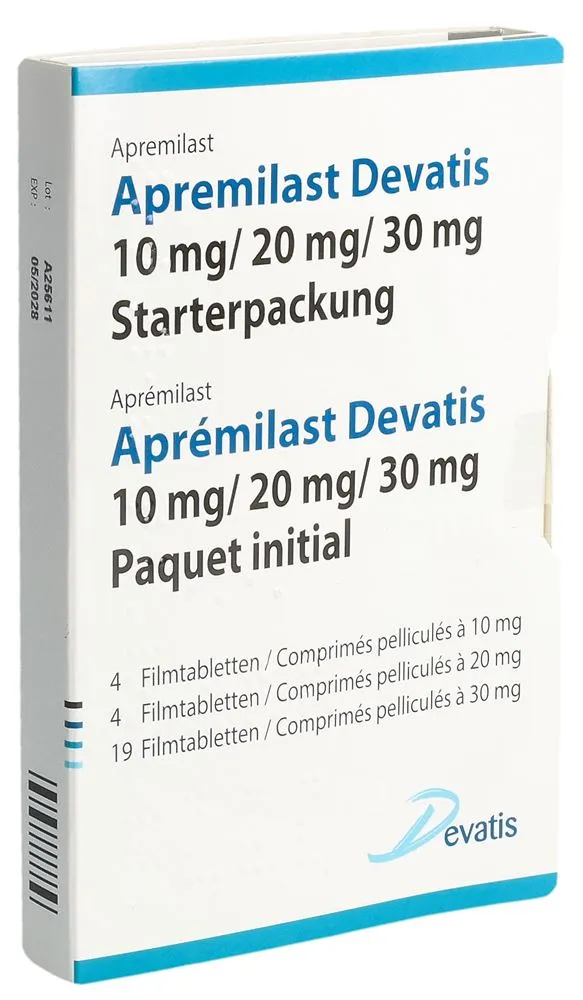
Apremilast EG 10 mg, 20 mg and 30 mg is available in PVC/Al blisters containing 27 film-coated tablets (4 x 10 mg, 4 x 20 mg, 19 x 30 mg) or in divisible unit-dose PVC/Al blisters containing 27 x 1 film-coated tablets (4 x 10 mg, 4 x 20 mg, 19 x 30 mg).
Not all pack sizes may be marketed.
Marketing Authorization Holder
EG S.p.A., via Pavia 6, 20136 Milano, Italy
Manufacturers
STADA Arzneimittel AG, Stadastrasse 2-18, 61118 Bad Vilbel - Germany
Stada Arzneimittel GmbH, Muthgasse 36/2, Vienna 1190 - Austria
Clonmel Healthcare Limited, Waterford Road, Clonmel Co. Tipperary E91 D768 - Ireland
Centrafarm Services B.V., Van De Reijtstraat 31 E Breda 4814 NE - The Netherlands
This medicinal product is authorised in the European Economic Area (EEA) Member States under the following names:
SE Apremilast STADA 30 mg filmdragerade tabletter
Apremilast STADA 10 mg/20 mg/30 mg filmdragerade tabletter
AT Apremilast STADA 30 mg Filmtabletten
Apremilast STADA Starterpackung 10 mg + 20 mg + 30 mg Filmtabletten
BE Apremilast EG 30 mg filmomhulde tabletten
Apremilast EG 10 mg + 20 mg + 30 mg filmomhulde tabletten
CY APREMILAST/STADA 30 mg επικαλυμμένα με λεπτό υμένιο δισκία
APREMILAST/STADA 10 mg/20 mg/30 mg επικαλυμμένα με λεπτό υμένιο δισκία
DE Apremilast STADA 30 mg Filmtabletten
Apremilast STADA 10 mg + 20 mg + 30 mg Filmtabletten
DK Apremilast STADA
ES Apremilast STADA 30 mg comprimidos recubiertos con pelicula EFG
Apremilast STADA 10 mg 20 mg 30 mg comprimidos recubiertos con pelicula EFG
FI Apremilast STADA 30 mg kalvopäällysteiset tabletit
Apremilast STADA 10 mg + 20 mg + 30 mg kalvopäällysteiset tabletit
FR APREMILAST STADA 30 mg, comprimé pelliculé
APREMILAST STADA 10 mg, comprimé pelliculé
APREMILAST STADA 20 mg, comprimé pelliculé
APREMILAST STADA 30 mg, comprimé pelliculé
GR APREMILAST/STADA
HU Apremilast STADA 30mg filmtabletta
Apremilast STADA 10mg filmtabletta
Apremilast STADA 20mg filmtabletta
Apremilast STADA 30mg filmtabletta
IE Apremilast Clonmel 30 mg film-coated tablets
Apremilast Clonmel 10 mg film-coated tablets
Apremilast Clonmel 20 mg film-coated tablets
Apremilast Clonmel 30 mg film-coated tablets
IS Apremilast STADA 30 mg filmuhúðaðar töflur
Apremilast STADA 10 mg/ 20 mg/ 30 mg filmuhúðaðar töflur
IT Apremilast EG
LU Apremilast EG 30 mg comprimés pelliculés
Apremilast EG 10 mg/20 mg/30 mg comprimés pelliculés
NL Apremilast STADA 30 mg, filmomhulde tabletten
Apremilast STADA 10 mg + 20 mg + 30 mg, filmomhulde tabletten
NO Apremilast STADA
Apremilast STADA
SK Apremilast STADA 30 mg filmom obalené tablet
Apremilast STADA 10 mg filmom obalené tablet
Apremilast STADA 20 mg filmom obalené tablet
Apremilast STADA 30 mg filmom obalené tablet
MT Apremilast Clonmel 30 mg film-coated tablets
Apremilast Clonmel 10 mg film-coated tablets
Apremilast Clonmel 20 mg film-coated tablets
Apremilast Clonmel 30 mg film-coated tablets
RO Apremilast Stada 30 mg comprimate filmate
Apremilast Stada 10 mg comprimate filmate
Apremilast Stada 20 mg comprimate filmate
Apremilast Stada 30 mg comprimate filmate
SI Apremilast STADA 30 mg filmsko obložene tablete
Apremilast STADA 10 mg filmsko obložene tablete
Apremilast STADA 20 mg filmsko obložene tablete
Apremilast STADA 30 mg filmsko obložene tablete
Similar drugs
| Brand name | Dosage form | Active substance / Dosage | Manufacturer |
|---|---|---|---|
| APREMILAST ACCORD | tablets, film-coated | ACCORD HEALTHCARE, S.L.U. | |
| APREMILAST DAY ZERO | tablets, film-coated | DAY ZERO EHF | |
| APREMILAST G.L. | tablets, film-coated | G.L. PHARMA GMBH | |
| APREMILAST KRKA | tablets, film-coated | KRKA D.D. NOVO MESTO | |
| APREMILAST MACLEODS | tablets, film-coated | MACLEODS PHARMA ESPANA, S.L.U. | |
| APREMILAST NOUCOR | tablets, film-coated | NOUCOR HEALTH, S.A. | |
| APREMILAST SANDOZ | tablets, film-coated | SANDOZ S.P.A. | |
| APREMILAST SANDOZ GMBH | tablets, film-coated | SANDOZ GMBH | |
| APREMILAST TEVA | tablets, film-coated | TEVA ITALIA S.R.L. | |
| APREMILAST ZENTIVA | tablets, film-coated | ZENTIVA ITALIA S.R.L. | |
| OTEZLA | tablets, film-coated | AMGEN EUROPE B.V. |
The original data is available in the language of the country of manufacture.
Data source: Italian Medicines Agency (AIFA)
Data last verified: September 21, 2026