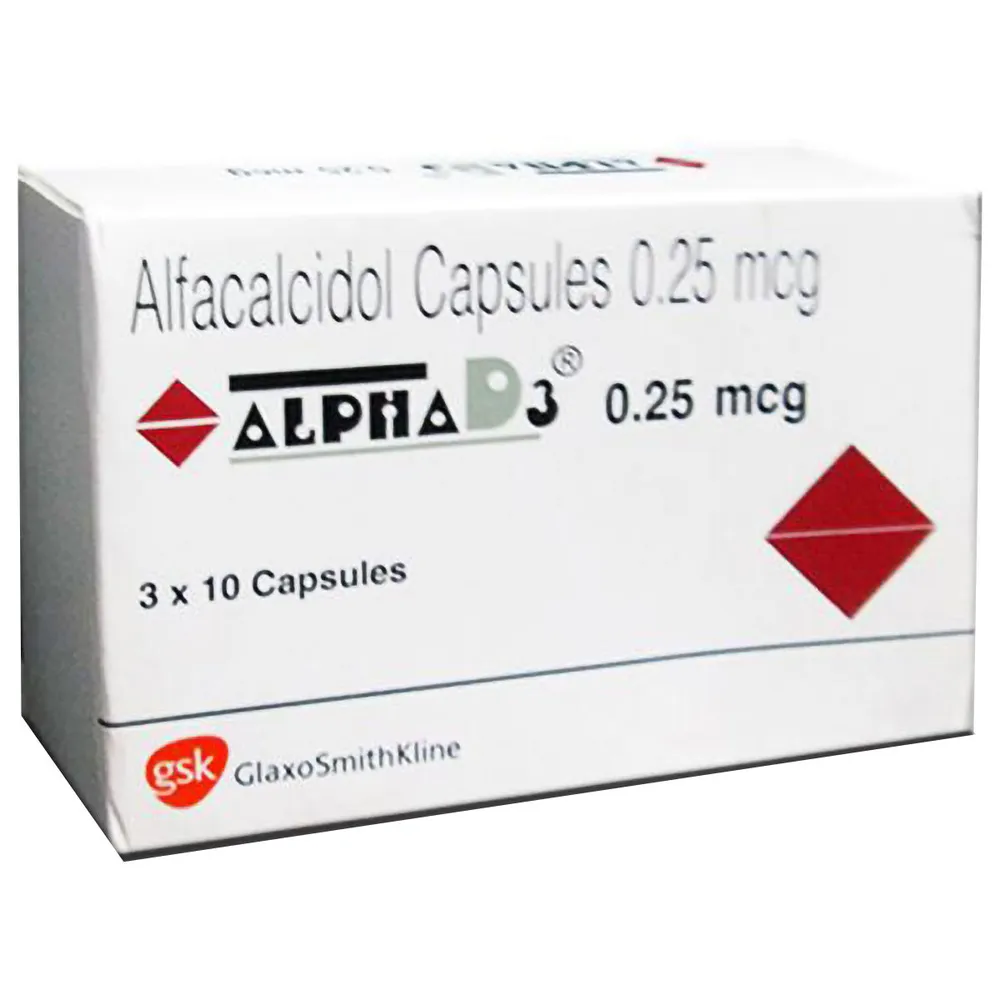
ALPHA D3
ItalyIt is prescribed to treat osteodystrophy in patients with renal insufficiency (whether on dialysis or not), hypoparathyroidism, rickets and osteomalacia (both vitamin D-resistant and those due to renal problems), and postmenopausal osteoporosis.
Frequently asked questions
How should ALPHA D3 be taken?
The suggested initial dosage for adults and boys over 20 kg is 1 microgram per day. For children under 20 kg, the dose is 0.05 micrograms per kg of body weight per day. Subsequently, the doctor may adjust the dose based on the patient's needs and response.
When should you not take this medicine?
It should not be taken if you suffer from hypercalcemia (too high levels of calcium in the blood) or vitamin D toxicity. It is also contraindicated in case of allergy or hypersensitivity to alfacalcidol, vitamin D, or any of the other components of the medicinal product.
What are the side effects of ALPHA D3?
The most common side effects are hypercalcemia (excess calcium in the blood) and hypercalciuria (excess calcium in the urine). Overdose can also cause nausea, vomiting, fatigue, constipation or diarrhea, headache, thirst, drowsiness, dizziness, and loss of appetite.
Are there interactions with other medicines?
Yes. Caution should be exercised if taking other vitamin D analogues, heart medications (such as digitalis), certain anti-epileptics, antacids (especially those containing magnesium or aluminium), laxatives, corticosteroids, or drugs such as rifampicin and isoniazid, which may alter their efficacy or absorption.
What happens in case of overdose?
An excess dose can cause dangerously high levels of calcium in the blood. In case of accidental ingestion of an excessive dose, it is necessary to inform a doctor immediately or go to the nearest emergency room.
Instructions for use
PACKAGE LEAFLET
ALPHA D3 0.25 micrograms soft capsules, 1 microgram soft capsules, 2 micrograms/ml oral drops, solution
Alfacalcidol
PHARMACOTHERAPEUTIC CATEGORY
Vitamin D and analogues.
THERAPEUTIC INDICATIONS
Renal osteodystrophy in dialysis patients or non-dialysis patients. Hypoparathyroidism. Rickets and D-resistant or D-dependent osteomalacia (pseudo-deficiency). Rickets and osteomalacia due to renal disturbances in vitamin D metabolism. Postmenopausal osteoporosis.
CONTRAINDICATIONS
- Known hypersensitivity to alfacalcidol, vitamin D (cholecalciferol, ergocalciferol), or other vitamin D metabolites (calcitriol, calciferol, calcipotriol), or to any of the excipients listed in the “Composition” section.
- Conditions of hypercalcaemia.
- Vitamin D toxicity/hypervitaminosis D confirmed.
PRECAUTIONS FOR USE
Since overdose of ALPHA D3 may cause hypercalcaemia and in some cases hypercalciuria, serum calcium levels should be measured at least twice weekly during the dose adjustment phase. Once the optimal daily dose has been established, monthly monitoring of serum calcium is sufficient, although serum calcium should be checked promptly if symptoms suggestive of toxicity occur. Similar monitoring is recommended in infants who are breastfed by mothers receiving pharmacological doses of 1-alpha-hydroxycholecalciferol.
During treatment with 1-alpha-hydroxycholecalciferol, plasma phosphate concentrations must be monitored to reduce the risk of ectopic calcifications.
A fall in alkaline phosphatase levels usually precedes the onset of hypercalcaemia and may be an early warning sign. If hypercalcaemia develops, the drug and any concomitant calcium supplementation should be temporarily discontinued until serum calcium levels return to normal, which generally occurs rapidly. Treatment may then be resumed at a lower dosage. Since ALPHA D3 influences phosphate transport in the intestine, kidney, and bone, the concurrent administration of phosphate-binding agents should be adjusted according to serum phosphate levels (normal range: 2–5 mg/100 ml).
Vitamin D supplementation in the diet may be harmful in individuals already receiving adequate intake through diet and sun exposure, as the difference between therapeutic and toxic concentrations is relatively small.
Since 1-alpha-hydroxycholecalciferol is the most potent form of vitamin D, a higher risk of toxicity might reasonably be expected; however, its effects are rapidly reversible upon discontinuation of treatment.
INTERACTIONS
Inform your doctor or pharmacist if you have recently taken any other medicines, including those without a prescription.
Vitamin D or its analogues
Pharmacological doses of vitamin D or its analogues must not be administered during treatment with 1-alpha-hydroxycholecalciferol due to the possibility of additive effects and increased risk of hypercalcaemia.
Digitalis
Hypercalcaemia in patients taking digitalis-containing preparations may worsen cardiac arrhythmia. Patients receiving digitalis concomitantly with 1-alpha-hydroxycholecalciferol must be closely monitored.
Antiepileptics
Some antiepileptic drugs may increase the requirements for 1-alpha-hydroxycholecalciferol (e.g., carbamazepine, phenobarbital, phenytoin, primidone).
Cholestyramine, colestipol, sucralfate, aluminium-based antacids
The absorption of 1-alpha-hydroxycholecalciferol may be impaired by concomitant use of bile acid-binding agents (cholestyramine, colestipol), sucralfate, or aluminium-based antacids.
Magnesium-containing antacids and laxatives
Caution should be exercised when using magnesium-containing antacids or laxatives in patients taking 1-alpha-hydroxycholecalciferol, particularly in those undergoing chronic renal dialysis. Hypermagnesaemia may occur.
Calcium or phosphate preparations or thiazide diuretics
The risk of hypercalcaemia is increased in patients taking calcium or phosphate preparations or thiazide diuretics concomitantly with 1-alpha-hydroxycholecalciferol. In these situations, plasma calcium concentrations should be monitored.
Rifampicin and isoniazid
Rifampicin and isoniazid may reduce the effectiveness of vitamin D.
Corticosteroids
Corticosteroids may counteract the effect of vitamin D.
SPECIAL WARNINGS
1-alpha-hydroxycholecalciferol must not be administered to patients with hypercalcaemia. It should be used with caution in infants, who may have increased sensitivity to its effects, and in patients with renal impairment, kidney stones, or heart disease, who are at higher risk of organ damage if hypercalcaemia occurs.
Overdose of any form of vitamin D may lead to severe manifestations. Hypercalcaemia caused by excessive doses of vitamin D or its metabolites may require emergency treatment. Chronic hypercalcaemia may lead to generalized vascular calcifications, nephrocalcinosis, and calcification of other soft tissues. Therefore, it is necessary to ensure that the product of serum calcium and phosphate levels (Ca x P) does not exceed 70. Radiographic examination of anatomical regions prone to calcification may be useful for early diagnosis.
The oral drops contain methyl p-hydroxybenzoate, which may cause allergic reactions (including delayed reactions).
The capsules and drops contain sorbitol: if you have been diagnosed with an intolerance to certain sugars, consult your doctor before taking this medicine.
The medicine contains small amounts of ethanol (alcohol), less than 100 mg per dose.
For individuals engaged in sports, the use of medicines containing ethyl alcohol may result in a positive anti-doping test, depending on the blood alcohol concentration limits set by certain sports federations.
Consult your doctor or pharmacist before taking any medicine.
Pregnancy and breastfeeding
There is insufficient evidence regarding the safety of alfacalcidol during pregnancy, although it has been widely used without apparent adverse effects.
Alfacalcidol should be used during pregnancy only if alternative treatments are unavailable, after careful assessment of the risk-benefit ratio.
Elevated levels of calcitriol may be found in breast milk of women receiving alfacalcidol treatment. This could affect calcium metabolism in breastfed infants (see section 4.4). Alfacalcidol should be used during breastfeeding only if alternative treatments are unavailable, after careful assessment of the risk-benefit ratio.
Driving and use of machinery
At therapeutic doses, this product does not impair these abilities.
DOSAGE, METHOD AND DURATION OF ADMINISTRATION
Recommended initial dosage for all indications:
Adults and adolescents over 20 kg body weight: 1 microgram per day
Children under 20 kg body weight: 0.05 micrograms/kg/day
Subsequently, the dose may be adjusted according to the patient's response, needs, and body weight.
Each drop corresponds to 0.05 micrograms of 1-alpha-hydroxycholecalciferol.
OVERDOSE
In case of accidental ingestion/overdose of ALPHA D3, contact your doctor immediately or go to the nearest hospital.
Excessive intake of vitamin D leads to the development of hypercalcaemia. Symptoms of overdose include anorexia, fatigue, nausea and vomiting, constipation or diarrhoea, polyuria, nocturia, sweating, headache, thirst, drowsiness, and dizziness.
Individual tolerance to vitamin D varies considerably; infants and children are generally more susceptible to its toxic effects. If toxicity occurs, the vitamin should be discontinued.
In acute overdose, early treatment with gastric lavage and/or administration of mineral oils may reduce absorption and promote faecal elimination.
If you have any doubts about the use of this medicine, consult your doctor or pharmacist.
UNDESIRABLE EFFECTS
Like all medicines, ALPHA D3 can cause adverse effects, although not everyone experiences them.
The frequencies of adverse reactions are classified according to the following convention: very common (≥1/10), common (≥1/100, <1/10), uncommon (≥1/1,000, <1/100), rare (≥1/10,000, <1/1,000), very rare (<1/10,000), not known (frequency cannot be estimated from available data).
Immune system disorders
Not known: Hypersensitivity
Metabolism and nutrition disorders
Common: Hypercalcaemia*, hypercalciuria
Rare: Hyperphosphataemia
*Effects associated with hypercalcaemia include hypercalciuria, ectopic calcifications, renal and cardiovascular damage, weakness, headache, drowsiness, nausea, vomiting, dry mouth, constipation, bone and muscle pain. Later symptoms may include urinary disturbances, conjunctivitis (due to calcification), photophobia, pancreatitis, rhinorrhoea, pruritus, hyperthermia, decreased libido, albuminuria, hypercholesterolaemia, increased SGOT and SGPT, ectopic calcifications, hypertension, cardiac arrhythmias, and rarely psychosis.
Since the half-life of calcitriol is short, normalization of any hypercalcaemia occurs within a few days after discontinuation of ALPHA D3 treatment, and more rapidly than during therapy with vitamin D or its metabolites.
Following the instructions in this leaflet reduces the risk of adverse effects.
If you experience any adverse effects, including those not listed in this leaflet, consult your doctor or pharmacist. You may also report adverse effects directly via the website:
http://www.agenziafarmaco.gov.it/it/responsabili
By reporting adverse effects, you can help provide more information on the safety of this medicine.
EXPIRY DATE AND STORAGE
Keep this medicine out of the sight and reach of children.
Do not use this medicine after the expiry date stated on the packaging after "Exp".
The expiry date refers to the last day of that month.
For capsules
Store in the original packaging to protect from light.
For oral drops
Do not store above 25°C and keep in the original packaging to protect from light.
Medicines must not be disposed of via wastewater or household waste. Ask your pharmacist how to dispose of medicines no longer required. This will help protect the environment.
COMPOSITION
ALPHA D3 0.25 micrograms soft capsules
Each capsule contains:
Active substance
1-alpha-hydroxycholecalciferol (alfacalcidol) 0.25 micrograms
Excipients
Anhydrous ethanol, anhydrous citric acid, propyl gallate, d,l-alpha-tocopherol, peanut oil.
Capsule shell composition: gelatin, glycerol 85%, sorbitol special solution (Anidrisorb 85/70), iron oxide red (E172), black ink.
ALPHA D3 1 microgram soft capsules
Each capsule contains:
Active substance
1-alpha-hydroxycholecalciferol (alfacalcidol) 1.0 microgram
Excipients
Anhydrous ethanol, anhydrous citric acid, propyl gallate, d,l-alpha-tocopherol, peanut oil.
Capsule shell composition: gelatin, glycerol 85%, sorbitol special solution (Anidrisorb 85/70), iron oxide yellow (E172), titanium dioxide (E171), black ink.
ALPHA D3 2 micrograms/ml oral drops, solution
Each ml (40 drops) contains:
Active substance:
1-alpha-hydroxycholecalciferol (alfacalcidol) 2.0 micrograms
(Each drop contains 0.05 micrograms of 1-alpha-hydroxycholecalciferol).
Excipients:
Polyoxyl 40 hydrogenated castor oil, anhydrous citric acid, disodium hydrogen citrate dihydrate, d,l-alpha-tocopherol, methyl p-hydroxybenzoate, ethanol, 70% non-crystallizing sorbitol solution, purified water.
PHARMACEUTICAL FORM AND CONTENT
Soft capsules: pack of 30 capsules of 0.25 micrograms or 1 microgram
Oral drops, solution: 10 ml bottle
MARKETING AUTHORISATION HOLDER
THERAMEX IRELAND LIMITED,
3RD FLOOR, KILMORE HOUSE, PARK LANE, SPENCER DOCK, DUBLIN 1, D01 YE64,
IRELAND.
MANUFACTURER
Soft capsules
Teva Pharma B.V. – Swensweg, 5 – 2031 GA Haarlem (Netherlands)
Oral drops, solution
Istituto Biochimico Nazionale Savio S.r.l. – Via del Mare, 36 – Pomezia (Rome)
Similar drugs
| Brand name | Dosage form | Active substance / Dosage | Manufacturer |
|---|---|---|---|
| ALFACALCIDOL DOC GENERICI | capsules, soft gelatin | DOC GENERICI SRL | |
| ALFACALCIDOL ZENTIVA | capsules, soft gelatin | ZENTIVA ITALIA S.R.L. | |
| DEDIOL | capsules, soft gelatin | CHEPLAPHARM ARZNEIMITTEL GMBH | |
| DERIL | capsules, soft gelatin | LANOVA FARMACEUTICI S.R.L. | |
| DISEON | capsules, soft gelatin | THERAMEX IRELAND LIMITED | |
| DISERINAL | capsules, soft gelatin | S.F. GROUP S.R.L. | |
| OSTIDIL-D3 | capsules, soft gelatin | LABORATORIO FARMACEUTICO SIT SPECIALITA IGIENICO TERAPEUTICHE S.R.L. | |
| SEFAL | capsules, soft gelatin | FARMA GROUP S.R.L. |
The original data is available in the language of the country of manufacture.
Data source: Italian Medicines Agency (AIFA)
Data last verified: September 21, 2026