ACTIVATED CHARCOAL
UkraineThe drug is used in cases of acute poisoning (food, household, industrial, as well as poisoning by drugs, heavy metal salts, or alkaloids), meteorism, dyspepsia, and foodborne infections. It is also used to prepare for radiological examinations.
Frequently asked questions
How should Activated charcoal be taken correctly?
For adults with meteorism and dyspepsia, it is recommended to take 1 to 3 tablets 3–4 times a day. In cases of poisoning, a suspension of 20–30 g of the drug per 1–2 glasses of water is used. For children aged 3 and older, 2–4 tablets 3–4 times a day are usually prescribed (in case of diarrhea, the dose is increased to 4–5 tablets). For children, the drug should always be administered as a suspension of crushed tablets, taken with a glass of water. For adults with increased acidity, 1–2 g of the drug 3–4 times a day is prescribed.
Who should not take this drug?
Contraindications include hypersensitivity to the components of the product, gastric or intestinal ulcers, as well as gastric bleeding. The drug must not be used in children under 3 years of age.
What are the possible side effects of Activated charcoal?
Possible manifestations include hypersensitivity, constipation, diarrhea, nausea, or vomiting. With prolonged use (more than 15 days), a deficiency of vitamins, hormones, fats, and proteins may occur.
Can the drug be taken together with other medicines?
Since the drug has a sorbent effect, it may reduce the efficacy of other medicines. Therefore, they should be spaced out in time: take the charcoal 1–1.5 hours before or after taking other medications or food.
Does the drug affect the color of the stool?
Yes, after taking the drug, the stool turns black.
Instructions for use
INSTRUCTION FOR MEDICAL USE OF THE MEDICINAL PRODUCT ACTIVATED CHARCOAL (CARBO ACTIVATUS)
Composition:
Active substance: activated charcoal;
1 tablet contains 0.25 g of activated charcoal;
Excipient: potato starch.
Pharmaceutical form. Tablets.
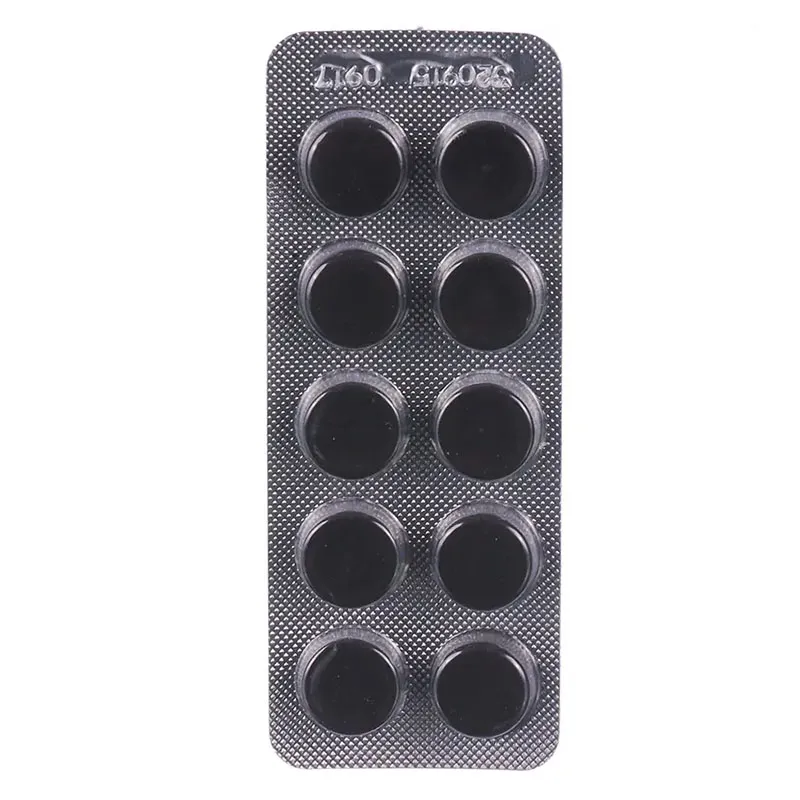
Black-colored tablets with a flat surface.
Pharmacotherapeutic group. Enterosorbents. Medicinal products containing activated charcoal. Activated medical charcoal. ATC code A07B A01.
Pharmacological properties.
Plant-derived charcoal, which, due to special processing (activation), acquires a large adsorption surface and is capable of binding gases, alkaloids, endo- and exotoxins, and other chemical compounds. The medicinal product is non-toxic and is well eliminated from the body through the intestine. It is not absorbed in the gastrointestinal tract and is completely excreted in the feces within 8–24 hours.
Clinical characteristics.
Indications.
- Acute poisoning of household, industrial, and food origin;
- acute poisoning with drugs, alkaloids, and heavy metal salts;
- dyspepsia, flatulence, foodborne toxic infections;
- preparation for radiological examinations.
Contraindications.
- Hypersensitivity to the components of the medicinal product;
- gastrointestinal ulcers;
- gastrointestinal bleeding.
Interaction with other medicinal products and other types of interactions.
Due to its adsorbing properties, activated charcoal may reduce the efficacy of medicinal products taken concomitantly. Therefore, when administering concomitant pharmacotherapy, activated charcoal should be taken 1–1.5 hours before or after other medicinal products.
Special precautions.
Due to the adsorbing properties of activated charcoal, it should be taken 1–1.5 hours before or after the administration of drugs or food, if concomitant pharmacotherapy is required.
Prolonged use (over 15 days) may impair absorption and lead to deficiencies of vitamins, hormones, fats, and proteins in the body, requiring appropriate medical or dietary correction.
Vitamin supplementation should be administered if hypovitaminosis develops during prolonged use of activated charcoal.
Stool may turn black after administration of the drug.
Women taking oral contraceptives should use additional contraceptive methods during treatment with activated charcoal.
Use during pregnancy or breastfeeding.
There are no data indicating a negative effect of activated charcoal during pregnancy or breastfeeding.
Ability to influence reaction rate while driving or operating machinery.
Does not affect.
Method of Administration and Dosage.
For meteorism and dyspepsia: adults should take 1 to 3 tablets 3–4 times daily.
In cases of poisoning — orally, adults should take a single dose of 20–30 g as an aqueous suspension (in 1–2 glasses of water). Such a suspension is also used for gastric lavage.
For increased acidity: adults should be administered 1–2 g of the medicinal product 3–4 times daily. To achieve a rapid and pronounced effect, the tablets may be crushed and taken as an aqueous suspension (in 0.5 glass of water).
Children aged 3 years and older: the usual dose is 2–4 tablets 3–4 times daily; in cases of diarrhea, the dose may be increased to 4–5 tablets 3–4 times daily.
In various poisonings, children aged 3 to 7 years should be administered orally 5 g 3 times daily; children aged 7 to 14 years should be administered orally 7 g 3 times daily.
Activated charcoal is always administered to children as a suspension of crushed tablets in a small amount of water; after administration, a glass of water should be consumed.
The treatment course for acute conditions lasts 3–5 days; for chronic conditions caused by endogenous intoxications, it lasts 10–15 days.
Children.
Do not use in children under 3 years of age.
Overdose.
Significant exceeding of the maximum single doses may lead to adverse reactions (nausea, vomiting, and constipation), which disappear after dose reduction or discontinuation of the medicinal product.
Adverse reactions.
Possible manifestations of increased sensitivity, constipation or diarrhea, which are easily resolved upon discontinuation of the drug and administration of symptomatic therapy. Nausea and vomiting may occur. With prolonged use, deficiency of vitamins, hormones, fats, and proteins may be observed, requiring medical correction.
If any adverse events occur, the patient must consult a physician.
Shelf life.
5 years.
Storage conditions.
Store at a temperature not exceeding 30 °C, separate from substances and materials that emit gases and vapors.
Keep out of reach of children.
Packaging.
10 tablets in blisters.
10 tablets in a blister; 3 blisters in a cardboard pack.
Dispensing category.
Over-the-counter.
Manufacturer.
LLC "VALARTIN PHARMA".
Address.
Ukraine, 08135, Kyiv Oblast, Kyiv-Sviatoshyn district, village of Chaika, Grushevskogo Street, building 60.
Similar drugs
| Brand name | Dosage form | Active substance / Dosage | Manufacturer |
|---|---|---|---|
| ACTIVATED CHARCOAL | tablets |
|
PJSC "Scientific and Production Center "Borshchahivskyy Chemical and Pharmaceutical Plant" |
| ACTIVATED CHARCOAL | tablets |
|
PJSC "HIMFARMZAVOD "CHERVONA ZIRKA" |
The original data is available in the language of the country of manufacture.
Data source: State Register of Medicinal Products of Ukraine
Data last verified: August 13, 2026