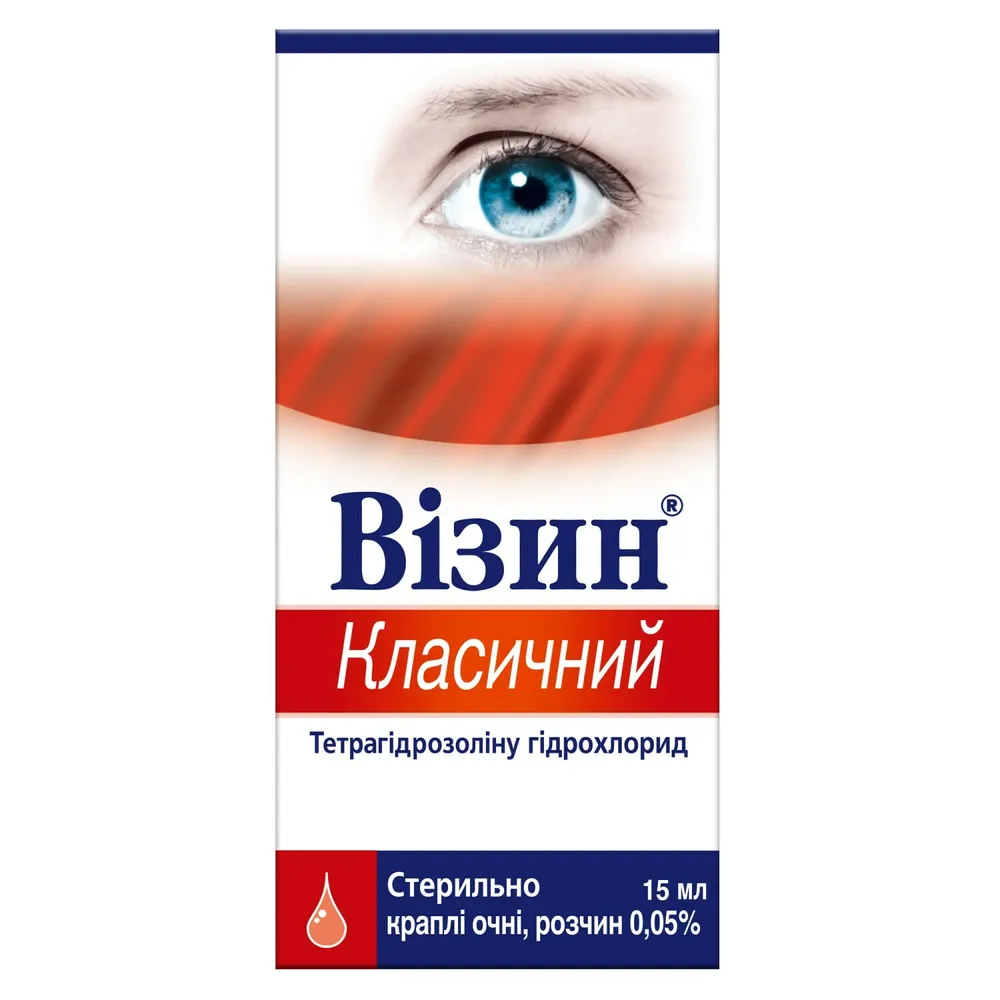
VISINE® CLASSIC
UkraineThe drug is used for the temporary relief of eye redness caused by mild irritation or allergic conjunctivitis.
Frequently asked questions
How to use Visine® classic correctly?
Adults and children aged 6 years and older should instill 1–2 drops into the affected eye up to 4 times daily. For children aged 2 to 6 years, the drug should be used only as directed by a physician.
What are the contraindications?
The drug must not be used in cases of angle-closure glaucoma, hypersensitivity to its ingredients, or in children under 2 years of age. It is also not recommended for use in cases of epidermal-epithelial corneal dystrophy.
Can the drops be used with contact lenses?
Contact lenses must be removed before applying the drops, as one of the ingredients may discolor them.
What are the possible side effects of Visine® classic?
Possible eye irritation (pain, burning, itching), vision disturbances, or pupil dilation. Very frequent use may lead to rebound eye redness.
When should you seek medical attention immediately?
If the condition does not improve within 48–72 hours, or if severe eye pain, headache, sudden loss of vision, double vision, or the appearance of spots before the eyes occurs.
Can the drug be taken with other medicines?
No significant interactions with other agents have been identified; however, it is advisable to consult a physician before using it in conjunction with other ophthalmic products.
How should the drug be stored?
Store at a temperature not exceeding 30 °C, out of reach of children. Once opened, the vial can be used for 4 weeks.
Instructions for use
INSTRUCTIONS FOR MEDICAL USE OF THE MEDICINAL PRODUCT VIZIN® CLASSIC (VISINE® CLASSIC)
Composition:
Active substance: tetrahydrozoline hydrochloride;
1 ml of solution contains 0.5 mg of tetrahydrozoline hydrochloride;
Excipients: benzalkonium chloride, sodium chloride, boric acid, sodium tetraborate, disodium edetate, purified water.
Pharmaceutical form. Eye drops, solution.
Main physicochemical properties: clear, colorless solution, free from visible foreign particles.
Pharmacotherapeutic group. Agents used in ophthalmology. Anti-edematous and anti-allergic agents. Sympathomimetics used as anti-edematous agents. ATC code S01G A02.
Pharmacological properties.
Pharmacodynamics.
Tetrahydrozoline is a sympathomimetic agent belonging to the group of imidazoline decongestants. It directly stimulates alpha-adrenergic receptors of the sympathetic nervous system with minimal or no effect on beta-adrenergic receptors. When applied locally to the conjunctival mucosa, the drug exerts a temporary vasoconstrictive effect on small blood vessels, thereby reducing vasodilation and conjunctival edema.
Local administration of tetrahydrozoline solutions to the conjunctiva results in local vasoconstriction lasting from 4 to 8 hours.
Pharmacokinetics.
The vasoconstrictive and decongestant effects of tetrahydrozoline begin within a few minutes after local application and last from 4 to 8 hours. Systemic absorption after local application cannot be ruled out, especially in patients with damaged mucosa and epithelium.
In a study involving 10 healthy volunteers, tetrahydrozoline was detected in blood serum and urine after therapeutic ocular administration. The mean elimination half-life of tetrahydrozoline from blood serum was approximately 6 hours. Systemic absorption varied among patients, with peak serum concentrations ranging from 0.068 to 0.380 ng/mL. Tetrahydrozoline was detectable in urine of all patients within 24 hours.
Clinical characteristics.
Indications.
Symptomatic temporary relief of secondary ocular hyperemia due to mild irritative effects and allergic conjunctivitis.
Contraindications.
Hypersensitivity to any component of the drug, closed-angle glaucoma.
Children under 2 years of age.
Interaction with other medicinal products and other forms of interaction.
There are no known significant interactions with other medicinal products. Consult your doctor before use with other ophthalmic medications.
Special precautions for use.
The use of the medicinal product may cause mydriasis.
The use of the medicinal product should be discontinued and medical advice sought if improvement is not observed within 72 hours, or if irritation or hyperemia persists or worsens, or if eye pain or visual disturbances occur.
Contact with contact lenses should be avoided.
The excipient benzalkonium chloride may discolor contact lenses; therefore, contact lenses must be removed before instilling the eye drops.
To avoid contamination, do not allow the tip of the container to touch any surface. Replace the cap on the bottle after use. Discard the product if the solution changes color or becomes cloudy.
Use in children aged 2 to 6 years should be carried out with caution. Patients with severe cardiovascular disorders such as ischemic heart disease, arterial hypertension, pheochromocytoma, and metabolic disorders (hyperthyroidism, diabetes mellitus), as well as patients receiving monoamine oxidase inhibitors or other agents capable of increasing blood pressure, should use Visine® Classic eye drops only if, in the physician’s opinion, the potential benefit outweighs the potential risk. Frequent use may cause eye redness.
Visine® Classic should be used only in cases of mild eye irritation. The patient should be aware:
- if the condition does not improve within 48 hours or if irritation or redness persists or increases, use of the product should be discontinued;
- if irritation or redness is associated with serious eye disorders (such as infection, foreign body, or chemical injury to the cornea), medical advice should be sought;
- if severe eye pain, headache, rapid loss of vision, sudden appearance of floating spots ("floaters") in the visual field, eye redness, photophobia (pain during exposure to light), or diplopia (double vision) occur, immediate medical advice should be sought.
Prolonged use and overdosage should be avoided, especially in children.
Contact lenses should be removed before instilling the medicinal product.
The product is unsuitable for use if the solution changes color or becomes cloudy.
Visine® Classic eye drops should not be used in patients with epithelial–epidermal corneal dystrophy.
Use during pregnancy or breastfeeding.
Adequate and well-controlled studies on the effects of tetrahydrozoline hydrochloride in pregnant or breastfeeding women have not been conducted. There are no data on the excretion of the drug into breast milk.
Although the product is not intended for systemic exposure, consultation with a physician is recommended before use in pregnant or breastfeeding women to assess potential risks. The medicinal product should not be used during pregnancy or breastfeeding except when the potential benefit to the mother outweighs the potential risk to the fetus or breastfed infant.
Ability to affect reaction speed when driving or operating machinery.
The use of eye drops may cause temporary blurred vision.
Method of Administration and Dosage
For topical ophthalmic use only.
The solution may be used for more than 72 hours only under medical supervision.
Adults and children ≥ 6 years of age
Instill 1–2 drops of the solution into the affected eye(s) up to 4 times daily.
Children aged 2 to 6 years
The solution may be used in children under 6 years of age only under medical supervision.
Children
Use in children aged 2 to 6 years should be under a physician's supervision. Experience with the use of the drug in children under 2 years of age is lacking.
Overdose
Overdose is unlikely when the drug is used as recommended.
With overdose, increasing hyperemia or reactive hyperemia may occur.
Signs and symptoms
Symptoms that may occur following ingestion or excessive use of the drug: bradycardia, drowsiness, decreased blood pressure, apathy, and reduced body temperature. Additional symptoms that may occur only with ingestion of the drug include nausea, vomiting, tachycardia, apnea, central nervous system (CNS) depression, sedation, stupor, coma, respiratory depression, salivation, mydriasis, and possible cardiovascular reactions.
Treatment
In case of drug ingestion, treatment includes administration of activated charcoal and gastric decontamination. Further treatment should be symptomatic and supportive.
Adverse Reactions
Common (≥ 1%), adverse reactions observed in clinical trials:
Eye disorders: eye irritation (pain, stinging, burning), visual disturbance.
Very rare (< 0.01%), adverse reactions associated with tetrahydrozoline hydrochloride observed in the post-marketing period:
Eye disorders: increased lacrimation, pupillary dilation (mydriasis);
Application site reactions: including burning sensation in eyes and periorbital area, eye mucous membrane irritation, eye pain, itching, erythema, swelling, eye discomfort, reactive ocular hyperemia ("rebound" hyperemia of the eye).
Systemic sympathomimetic effects may occasionally occur.
Hypersensitivity reactions may occur in patients sensitive to the components of the medicinal product.
Reporting of adverse reactions
Reporting of suspected adverse reactions after authorization of the medicinal product is important. It allows continued monitoring of the benefit-risk balance of the medicinal product. Healthcare professionals are asked to report any suspected adverse reactions via the national pharmacovigilance system.
Shelf life.
3 years.
An opened bottle should be used within 4 weeks.
Storage conditions.
Store at temperatures not exceeding 30 °C in a place inaccessible to children.
Packaging.
15 ml in a bottle equipped with a dropper and screw cap. 1 bottle in a cardboard pack.
15 ml in a bottle equipped with a dropper and screw cap with child-resistant closure. 1 bottle in a cardboard pack.
Classification of release. Over-the-counter.
Manufacturer.
Janssen Pharmaceutica NV.
Manufacturer's address and location of operations.
Turnhoutseweg 30, Beerse, 2340, Belgium.
Marketing Authorization Holder.
McNeil Products Limited.
Address of the Marketing Authorization Holder.
50-100 Holmers Farm Way, High Wycombe, HP12 4EG, England.
Representative of the Marketing Authorization Holder.
LLC "Johnson and Johnson Ukraine"
Address of the representative of the Marketing Authorization Holder.
32/2 Ostrizkykh Knyaziv St., Kyiv, 01010, Ukraine.
+38 (044) 498 0888
+38 (044) 498 7392
Similar drugs
| Brand name | Dosage form | Active substance / Dosage | Manufacturer |
|---|---|---|---|
| OFTAL | drops, ophthalmic solution |
|
LLC "Research Plant "GNCLS" (all manufacturing stages, quality control, batch release) |
| OPTIN | drops, ophthalmic solution |
|
Jadran-Galenski Laboratorij d.d. |
| VISINE COMFORT | drops, ophthalmic solution |
|
Janssen Pharmaceutica NV (manufacturing, testing, primary and secondary packaging, batch control, batch release, testing and release of raw materials and packaging components, storage and stability testing of samples) |
| VIZOPTIC | drops, ophthalmic solution |
|
Jadran Galenski Laboratorij d.d. |
The original data is available in the language of the country of manufacture.
Data source: State Register of Medicinal Products of Ukraine
Data last verified: August 13, 2026