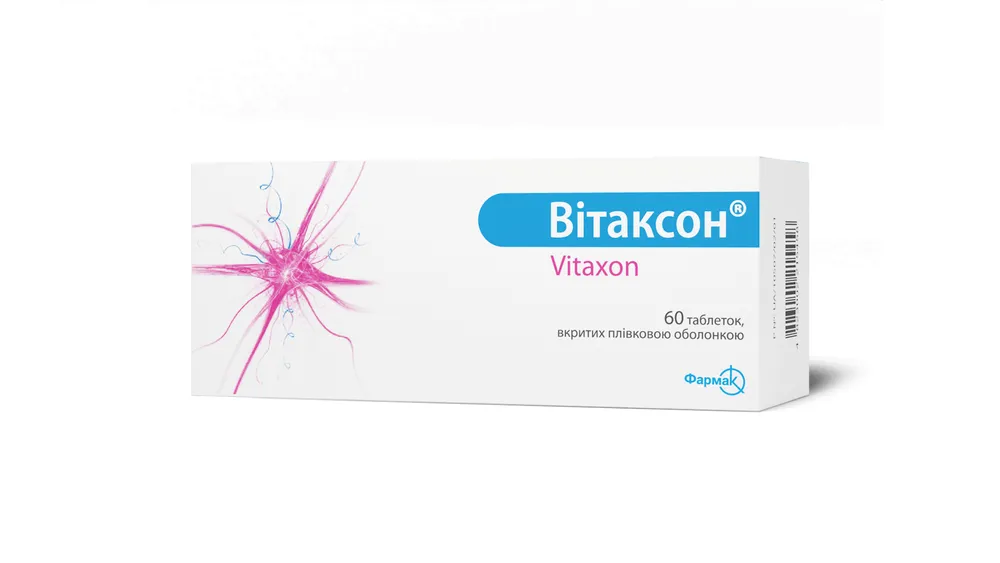
VITAXON
UkraineThe drug is prescribed for neurological diseases caused by a proven deficiency of vitamins B1 and B6.
Frequently asked questions
How should Vitaxon be taken correctly?
Tablets should be taken whole after meals, with a sufficient amount of liquid. The recommended dose is 1 tablet per day, although in certain cases, a physician may prescribe 1 tablet 3 times a day.
Who should not take this drug?
Use is contraindicated in cases of hypersensitivity to the components, allergic reactions to vitamin B1, exacerbation of gastric or duodenal ulcers, as well as during pregnancy and breastfeeding. It is not recommended for use in severe or acute forms of decompensated heart failure and angina pectoris. The drug is not prescribed to children.
What side effects may Vitaxon cause?
Possible side effects include nausea, vomiting, diarrhea, abdominal pain, increased gastric acidity, tachycardia, dizziness, headache, skin rashes, and itching. In rare cases, serious allergic reactions such as urticaria or anaphylactic shock may occur.
Does the drug affect driving?
Since the drug may cause dizziness and headache in some individuals, caution should be exercised when driving vehicles or operating machinery.
How can other medicines or products affect the drug's action?
Consumption of alcohol and black tea reduces the absorption of vitamin B1. Antacids decrease its absorption. Certain drugs (e.g., levodopa, isoniazid, furosemide) may interact with the components of the drug, reducing their efficacy or altering their action.
What are the risks associated with long-term intake of high doses?
Long-term intake of high doses of vitamin B6 (exceeding 50 mg per day for 6–12 months) may lead to nerve damage (peripheral sensory neuropathy).
Instructions for use
INSTRUCTIONS FOR MEDICAL USE OF THE MEDICINAL PRODUCT VITAXON® (VITAXON)
Composition:
Active substances: benfotiamine, pyridoxine hydrochloride;
1 tablet contains: benfotiamine – 100 mg calculated as 100% dry substance, pyridoxine hydrochloride – 100 mg calculated as 100% dry substance;
Excipients: microcrystalline cellulose, corn starch, povidone, calcium stearate, talc, colloidal anhydrous silicon dioxide;
film coating Opadry II 85 F 18422: polyvinyl alcohol, polyethylene glycol, talc, titanium dioxide (E 171).
Pharmaceutical form. Film-coated tablets.
Main physicochemical characteristics: white or almost white, round, biconvex tablets, film-coated.
Pharmacotherapeutic group. Vitamin B1 preparations, simple and in combination with vitamins B6 and B12. ATC code A11D B.
Pharmacological properties.
Pharmacodynamics.
Neurotropic vitamins of group B exert beneficial effects on the course of inflammatory and degenerative diseases of nerves and the musculoskeletal system. They should be used to correct deficiency states; in high doses, B vitamins have analgesic properties, promote improvement of blood circulation, and normalize nervous system function and hematopoiesis.
Pharmacokinetics.
Vitamin B6 and its derivatives are mostly rapidly absorbed in the upper gastrointestinal tract by passive diffusion and are excreted within 2–5 hours.
Clinical characteristics.
Indications.
In neurological disorders caused by proven deficiency of vitamins B1, B6.
Contraindications.
Hypersensitivity to the components of the drug.
Vitamin B1 is contraindicated in allergic reactions.
Vitamin B6 is contraindicated in peptic ulcer of the stomach and duodenum in the stage of exacerbation (since an increase in gastric juice acidity is possible).
Pregnancy or breastfeeding period.
Interaction with other medicinal products and other forms of interaction.
Thiamine is inactivated by 5-fluorouracil, as the latter competitively inhibits phosphorylation of thiamine to thiamine pyrophosphate. Antacids reduce thiamine absorption.
Loop diuretics (e.g., furosemide), which inhibit tubular reabsorption, may during long-term therapy lead to increased excretion of thiamine and thus reduce thiamine levels.
When taken concomitantly with levodopa, vitamin B6 may reduce the effect of levodopa.
Concomitant use of pyridoxine antagonists (e.g., isoniazid, hydralazine, D-penicillamine, or cycloserine), alcohol, and prolonged use of oral contraceptives containing estrogens may lead to vitamin B6 deficiency.
Consumption of alcohol and black tea reduces thiamine absorption.
Benfotiamine is incompatible with oxidizing and reducing compounds: mercury chloride, iodides, carbonates, acetates, tannic acid, iron-ammonium citrate, as it is inactivated in their presence. Copper accelerates the degradation of benfotiamine; in addition, thiamine loses its activity at increased pH values (above 3).
Beverages containing sulfites (e.g., wine) enhance the degradation of thiamine.
Pyridoxine may reduce the efficacy of altretamine.
Special precautions for use
The decision to use Vitaxon® in patients with severe or acute decompensated heart failure should be made individually by a physician, taking into account the patient's condition.
Since the drug contains vitamin B6, it should be prescribed with caution to patients with a history of peptic ulcer of the stomach and duodenum, or severe hepatic and renal insufficiency.
The drug is contraindicated in severe or acute forms of decompensated cardiac function and in angina pectoris.
If symptoms of peripheral sensory neuropathy (paresthesia) occur, the dosage should be reassessed and administration of Vitaxon® should be discontinued if necessary. Peripheral neuropathies have been observed with prolonged use (more than 6–12 months) of daily doses exceeding 50 mg of vitamin B6, as well as with short-term use (more than 2 months) of more than 1 g of vitamin B6 per day. Therefore, ongoing monitoring is recommended during long-term treatment.
Use during pregnancy or breastfeeding
The daily requirement for vitamin B6 during pregnancy or breastfeeding is up to 2.5 mg.
During pregnancy or breastfeeding, the recommended daily intake is 1.4–1.6 mg of vitamin B1 and 2.4–2.6 mg of vitamin B6.
There is no evidence supporting the use of higher than the recommended daily doses.
Vitamins B1 and B6 are excreted into breast milk.
High doses of vitamin B6 may interfere with lactation. Since the drug contains 100 mg of vitamin B6, it should not be used during pregnancy or breastfeeding.
Ability to influence reaction rate when driving or operating machinery
Since the drug may cause adverse effects such as dizziness, headache, and tachycardia in some patients, caution should be exercised when driving or operating machinery.
Dosage and Administration
Administer orally, swallowing with sufficient amount of liquid.
The recommended dose is 1 tablet per day. In individual cases, the dose may be increased to 1 tablet three times daily.
Tablets should be taken whole, with liquid, after meals.
The duration of treatment is determined individually by a physician. After the maximum treatment period (4 weeks), a decision regarding dose adjustment and reduction should be made.
Children
The efficacy and safety of the drug in children have not been established; therefore, it should not be prescribed to this age group of patients.
Overdose
With chronic use at high doses, possible worsening of hepatic enzyme activity, chest pain, and hypercoagulation. High doses of vitamin B1 may produce curare-like effects.
Vitamin B1
Thiamine has a wide therapeutic range. Very high doses (more than 10 g) may produce a ganglion-blocking effect similar to that of curare, and may suppress nerve impulse conduction.
Vitamin B6
Vitamin B6 is considered to have very low toxicity. However, prolonged use (more than 6–12 months) of vitamin B6 in doses exceeding 50 mg daily may cause peripheral sensory neuropathy.
Continuous use of vitamin B6 in doses exceeding 1 g daily for longer than 2 months may lead to neurotoxic effects.
Long-term use of vitamin B1 in doses exceeding 2 g daily has been associated with neuropathies with ataxia and sensory disturbances, cerebral seizures with EEG changes, and in individual cases – hypochromic anemia and seborrheic dermatitis.
In case of overdose, symptoms of adverse drug reactions are intensified.
Treatment: gastric lavage, administration of activated charcoal. Symptomatic therapy.
Adverse reactions.
Gastrointestinal tract: nausea, vomiting, diarrhea, abdominal pain, increased gastric juice acidity.
Cardiovascular system: tachycardia.
Immune system: hypersensitivity reactions, including anaphylactic shock; anaphylaxis; urticaria.
Skin: skin rashes, pruritus.
In extremely rare cases – shock condition.
Nervous system: prolonged use (more than 6–12 months) at doses exceeding 50 mg of vitamin B6 daily may lead to peripheral sensory neuropathy, nervous excitement, dizziness, headache.
Endocrine system: inhibition of prolactin secretion.
Shelf life. 3 years.
Do not use the medicinal product after the expiry date stated on the packaging.
Storage conditions.
Store in original packaging at a temperature not exceeding 25 °C.
Keep out of reach of children.
Packaging.
10 tablets in a blister. 3 or 6 blisters per carton.
Supply category. Over-the-counter.
Manufacturer.
JSC "Farmak".
Manufacturer's name and address of the place of business.
74, Kyrylivska Street, Kyiv, 04080, Ukraine.
Similar drugs
| Brand name | Dosage form | Active substance / Dosage | Manufacturer |
|---|---|---|---|
| BEDUO | tablets, film-coated |
|
Mibe GmbH Arzneimittel |
| MILGAMMA | tablets, film-coated |
|
Mauer mann-Arzneimittel KG |
| NEOVITAM | tablets, film-coated | JSC "Kyiv Vitamin Plant" | |
| NEUROBEX-TEVA | tablets, film-coated | Balkanpharma-Dupnitsa JSC | |
| NEUROBION | tablets, film-coated | P&G Health Austria GmbH & Co. KG | |
| NEUROBION® ADVANCE | tablets, film-coated | P&G Health Austria GmbH & Co. KG | |
| NEUROMAX | tablets, film-coated |
|
LLC "Corporation "Zdorovya" |
| NEUROMULTIVIT | tablets, film-coated | G.L. Pharma GmbH | |
| NEURORUBIN™-FORTЕ LACTAB | tablets, film-coated | Acino Pharma AG (Manufacturing of unpackaged product, quality control, batch release authorization, primary and secondary packaging) |
The original data is available in the language of the country of manufacture.
Data source: State Register of Medicinal Products of Ukraine
Data last verified: August 13, 2026