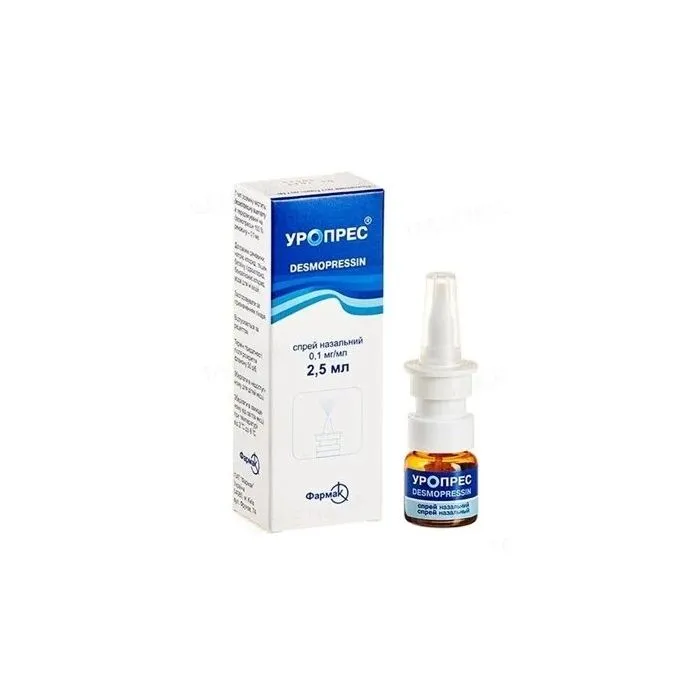
UROPRESS
UkraineThe drug is used to treat central diabetes insipidus, as well as polyuria (excessive urination) following trauma or surgery in the pituitary region. It is also used for diagnostic tests to assess the kidneys' ability to concentrate urine.
Frequently asked questions
How should Uropress be taken correctly?
The drops should be administered into the nose after clearing the nasal passages. The dosage is individualized: for adults treating diabetes, it is typically 2–4 drops 1–2 times daily. For children from 1 year of age, a dose of 2 drops 1–2 times daily is recommended. It is important to remember that fluid intake must be restricted during treatment.
Who should not use this drug?
Contraindications include hypersensitivity to the components of the product, heart failure, moderate or severe renal impairment, low blood sodium levels (hyponatremia), as well as certain conditions associated with impaired hormone secretion or psychogenic polydipsia.
What are the possible side effects of Uropress?
The most serious risk is water retention in the body and decreased sodium levels, which can cause edema, headache, nausea, seizures, or even coma. Nasal congestion, nosebleeds, increased blood pressure, dizziness, insomnia, and allergic reactions are also possible.
Can the drug be taken with other medicines?
Some drugs (for example, antidepressants, NSAIDs, certain diabetes medications, or lithium salts) may enhance or, conversely, reduce the effect of Uropress. This increases the risk of fluid retention or sodium level disturbances; therefore, when undergoing concomitant therapy, it is important to monitor blood pressure and general physical condition.
What should be done in case of overdose?
In case of overdose, it is necessary to reduce the dose or discontinue the drug. If fluid retention or decreased sodium levels occur, water intake should be restricted until levels normalize. In the event of cerebral edema or seizures, immediate hospitalization is required.
Instructions for use
INSTRUCTION FOR MEDICAL USE OF THE MEDICINAL PRODUCT UROPRES® (UROPRES)
Composition:
active substance: desmopressin;
1 ml of solution contains desmopressin acetate equivalent to 0.1 mg of desmopressin 100% substance;
excipients: benzalkonium chloride, sodium chloride, glycine, betaine hydrochloride, purified water.
Pharmaceutical form. Nasal drops.
Main physicochemical properties: clear, colorless liquid. When shaken, forms a foam layer which disappears within 30 minutes.
Pharmacotherapeutic group.
Hormones for systemic use, excluding sex hormones and insulin. Posterior pituitary hormones. Vasopressin and analogues. ATC code H01BA02.
Pharmacological properties.
Pharmacodynamics.
Desmopressin is a structural analogue of the natural hormone L-arginine-vasopressin. The drug increases the permeability of the epithelium of the distal convoluted tubules of the kidneys to water and enhances its reabsorption. It reduces the volume of excreted urine and simultaneously increases its osmolarity while decreasing plasma osmolarity. This leads to a reduction in the frequency of urination and a decrease in nocturia. The antidiuretic effect after intranasal administration of 10–20 mcg of desmopressin lasts 8–12 hours.
Pharmacokinetics.
The bioavailability of the drug after intranasal administration ranges from 3% to 5%. A noticeable concentration of the active substance in blood plasma occurs within 15–30 minutes after administration, with peak concentration reached after 1 hour and dependent on the administered dose. The volume of distribution is 0.2–0.3 L/kg. Desmopressin does not cross the blood-brain barrier. The elimination half-life after intranasal administration averages 2–3 hours. A small amount of desmopressin is metabolized in the liver.
Clinical characteristics.
Indications.
As an antidiuretic agent: treatment of central diabetes insipidus; management of post-traumatic polyuria and polydipsia in the presence of transient deficiency or absence of antidiuretic hormone following hypophysectomy, surgery in the pituitary region, or traumatic brain injury.
As a diagnostic agent: rapid test to determine renal concentrating ability; differential diagnosis of diabetes insipidus.
Contraindications.
- Hypersensitivity to desmopressin or to any of the excipients;
- Primary or psychogenic polydipsia, polydipsia in patients with alcoholism;
- Severe forms of von Willebrand's disease (type IIb); factor VIII activity below 5% and presence of inhibitors to factor VIII;
- Heart failure or other conditions requiring diuretic therapy;
- Moderate or severe renal impairment (creatinine clearance below 50 ml/min);
- Hyponatremia;
- Syndrome of inappropriate secretion of antidiuretic hormone (SIADH).
Interaction with other medicinal products and other forms of interaction.
Medicinal products capable of inducing the syndrome of inappropriate antidiuretic hormone secretion, such as tricyclic antidepressants, selective serotonin reuptake inhibitors, chlorpromazine, carbamazepine, and certain antidiabetic sulfonylurea agents (e.g., chlorpropamide), may enhance the antidiuretic effect of desmopressin and increase the risk of fluid retention or hyponatremia.
NSAIDs may cause fluid retention or hyponatremia.
Concomitant use with oxytocin requires caution due to the potential for increased antidiuretic effect and reduced uterine perfusion.
Clofibrate and indometacin may enhance the antidiuretic effect of desmopressin, whereas glibenclamide and lithium salts may reduce it.
When all the above-mentioned medicinal products are used concomitantly, monitoring of blood pressure, plasma sodium levels, and diuresis is recommended.
Interaction of desmopressin with drugs affecting hepatic metabolism is unlikely, as in vitro studies of microsomal metabolism in human liver cells have shown minimal metabolism of desmopressin. However, formal in vivo interaction studies have not been conducted.
Special precautions for use.
Treatment should be initiated with the lowest doses, and the dose should be increased gradually and cautiously. Urupres®, nasal drops, should be prescribed only to patients for whom oral administration of desmopressin in tablet form is contraindicated.
Desmopressin therapy without concomitant fluid restriction may lead to water retention and hyponatremia, which are manifested by symptoms such as weight gain, headache, nausea, vomiting, and edema. In severe cases, cerebral edema, seizures, and coma may develop. To prevent fluid overload, maintaining a proper fluid balance is essential.
In the treatment of central diabetes insipidus, severe hyponatremia may be associated with the use of the drug.
The drug should be used with caution in: young and elderly patients; patients with conditions characterized by fluid and/or electrolyte imbalance; patients at risk of increased intracranial pressure; patients at risk of thrombosis.
The drug should be used with caution in patients with cystic fibrosis.
Before initiating treatment, the absence of bladder dysfunction and obstruction of the bladder outlet should be confirmed.
Prior to treatment, it should be ensured that the patient agrees to limit fluid intake. Patients, parents (if the patient is a child), and medical staff should be warned about the need to avoid fluid overload (including during swimming) and to discontinue desmopressin during vomiting and diarrhea until fluid balance is restored.
The risk of hyponatremic seizures can be minimized by maintaining the recommended starting dose and avoiding concomitant use of drugs that increase vasopressin secretion.
Fluid retention can be detected by monitoring the patient's body weight, plasma sodium concentration, or plasma osmolality.
Weight gain may be related to drug overdose, but more commonly results from fluid overload.
Desmopressin treatment should be interrupted in the event of acute intercurrent illnesses that may disrupt fluid and electrolyte balance, such as systemic infections, gastroenteritis, or fever.
Precautionary measures to prevent hyponatremia, including careful attention to fluid restriction and more frequent monitoring of serum sodium, should be taken when concomitant therapy includes drugs known to cause the syndrome of inappropriate antidiuretic hormone secretion (SIADH), such as tricyclic antidepressants, selective serotonin reuptake inhibitors, chlorpromazine, carbamazepine, sulfonylurea derivatives, and NSAIDs.
When performing a kidney concentration test, fluid intake should be limited to 0.5 L, especially during the 1 hour before and 8 hours after drug administration.
After diagnostic testing for diabetes insipidus or kidney concentration capacity, care should be taken to avoid fluid overload. Fluid administration should not be forced, either orally or parenterally, and patients should consume only as much fluid as necessary to satisfy thirst.
Benzalkonium chloride, an excipient contained in the drug, may cause nasal mucosal swelling, especially with prolonged use. If such a reaction is suspected (e.g., chronic nasal congestion), the patient should be switched to a preservative-free nasal formulation.
Benzalkonium chloride, an excipient contained in the drug, may cause bronchospasm. Urupres®, nasal drops, should not be used in the presence of nasal mucosal abnormalities such as scarring, swelling, or other disorders, which may alter drug absorption.
Use during pregnancy or breastfeeding.
Use during pregnancy: desmopressin should be administered with caution to pregnant women. Reproductive studies conducted in rats and rabbits using doses more than 100 times higher than the human dose did not reveal any evidence of harmful effects of desmopressin on the fetus. There have been rare reports of congenital malformations in children born to mothers who received treatment for diabetes insipidus during pregnancy. However, a review of available data does not suggest an increased frequency of congenital malformations in children exposed to desmopressin throughout pregnancy.
Use during lactation: analysis of breast milk from mothers who breastfed infants while receiving high doses of desmopressin (300 mcg intranasally) indicates that the amount of desmopressin transferred to the infant is substantially lower than the dose required to affect diuresis.
Ability to influence reaction rate when driving or operating machinery.
The drug has no or negligible effect on the ability to drive or operate machinery.
Method of Administration and Dosage
The medication should be administered intranasally. The nasal passages should be cleared before use.
Each drop contains 5 mcg of the active substance.
Diabetes insipidus, post-traumatic polyuria and central polydipsia.
Dosage should be individualized; however, the optimal dose for adults is 10–20 mcg (2–4 drops) once or twice daily. For children aged 1 year and older, the dose is 10 mcg (2 drops) once or twice daily. If symptoms of fluid retention and/or hyponatremia occur, treatment must be discontinued and the dose adjusted accordingly.
Concentration test for assessing renal concentrating ability and for differential diagnosis of diabetes insipidus.
The following dosages are used to evaluate renal concentrating capacity: for adults – 40 mcg (8 drops), for children under 1 year of age – 10 mcg (2 drops), for children aged 1 year and older – 20 mcg (4 drops).
The concentration test is used for differential diagnosis between diabetes insipidus and polyuric syndromes of other etiologies, as well as for detecting reduced renal concentrating ability associated with urinary tract infections (cystitis, pyelonephritis). This test is also used for early diagnosis of tubulointerstitial damage, for example, caused by lithium, analgesics, chemotherapeutic agents, and immunosuppressants.
The concentration test should preferably be performed in the first half of the day. Fluid intake should be restricted for the first 12 hours after administration of the medication. For children under 5 years of age and patients with heart disease or arterial hypertension, fluid intake should be reduced by half.
Before starting the test, urine osmolality should be measured. After desmopressin administration, collect two urine samples (preferably at 2 and 4 hours). Urine collected during the first hour should be discarded separately. Osmolality should be measured in both urine samples. To assess renal concentrating ability, the highest achieved osmolality value should be compared with the pre-test value or with the age-appropriate reference value (for adults, 800–1000 mOsm/kg). Low values, absence of increase, or minimal increase in urine osmolality indicate impaired renal concentrating ability. If urine osmolality increases significantly and urine volume decreases markedly, this indicates polyuria due to central diabetes insipidus.
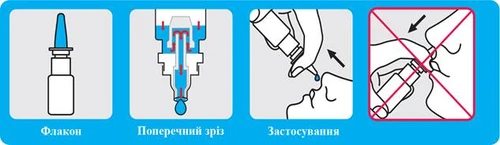
Instructions for using nasal drops in a bottle with a dropper cap:
- Remove the protective cap from the bottle.
- Turn the bottle with the nozzle downward and, before first use, perform several test sprays by pressing the pump dispenser.
- Insert the nozzle alternately into each nostril and press the pump dispenser the required number of times according to the prescribed dosage.
- After use, close the bottle with the cap.
Children.
Use in children under adult supervision to ensure accurate dosing.
The renal concentration test in children under 1 year of age must be performed exclusively in a hospital setting with subsequent monitoring.
Overdose.
Desmopressin overdose may lead to hyponatremia and seizures. Symptoms of overdose may occur with excessively high doses, excessive fluid intake during or immediately after desmopressin administration, or inadequate absorption conditions with intranasal administration. Overdose may manifest as: weight gain (water retention), headache, nausea, mild arterial hypertension, tachycardia, flushing, and in severe cases, hyperhydration and seizures.
Overdose may occur in young children due to inadequate dose adjustment.
Treatment: In case of overdose, reduce the dose, increase the interval between doses, or discontinue the medication. Cerebral edema requires immediate hospitalization in an intensive care unit. Seizures in children also require immediate intensive treatment. If hyponatremia develops, desmopressin treatment must be stopped immediately and fluid intake restricted until serum sodium levels normalize. There is no specific antidote. If diuretic therapy is indicated, saluretic diuretics such as furosemide may be used.
Adverse reactions.
Immune system disorders: hypersensitivity reactions, including fever, bronchospasm, anaphylaxis.
Metabolism and nutrition disorders: hyponatremia, dehydration.
Nervous system disorders: dizziness, headache, drowsiness, cerebral edema, hyponatremic seizures, seizures, confusion, decreased level of consciousness, coma.
Psychiatric disorders: insomnia, affective lability, nightmares, restlessness, aggression, emotional disturbances in children.
Cardiovascular system disorders: arterial hypertension, flushing; in patients with ischemic heart disease, angina attacks may occur.
Respiratory system disorders: nasal congestion, rhinitis, epistaxis, dryness of throat, upper respiratory tract infection, dyspnea.
Gastrointestinal disorders: nausea, vomiting, abdominal pain, diarrhea, gastroenteritis.
Skin and subcutaneous tissue disorders: increased sweating, allergic reactions, including skin rash, pruritus, urticaria.
Musculoskeletal and connective tissue disorders: muscle spasms.
General disorders: increased fatigue, malaise, peripheral edema, chest pain, chills.
Laboratory and instrumental findings: elevated body temperature, weight gain.
Pediatric population: hyponatremia is a reversible condition; in children it is often observed in connection with changes in daily routine affecting water intake and/or sweating.
Other special patient groups: in young children and elderly patients with serum sodium concentration at the lower limit of normal, there may be an increased risk of hyponatremia.
Shelf life.
2 years. Shelf life after opening the bottle – 50 days.
Do not use the medicinal product after the expiry date stated on the packaging.
Storage conditions.
Store in a protected from light and inaccessible to children place at a temperature from 2 °C to 8 °C.
Incompatibility. Not established.
Packaging.
2.5 ml or 5 ml in a vial, placed in a carton.
Prescription status. Prescription only.
Manufacturer. JSC "Farmak".
Manufacturer's name and address of the place of business.
74, Kyrylivska Street, Kyiv, 04080, Ukraine.
The original data is available in the language of the country of manufacture.
Data source: State Register of Medicinal Products of Ukraine
Data last verified: August 13, 2026