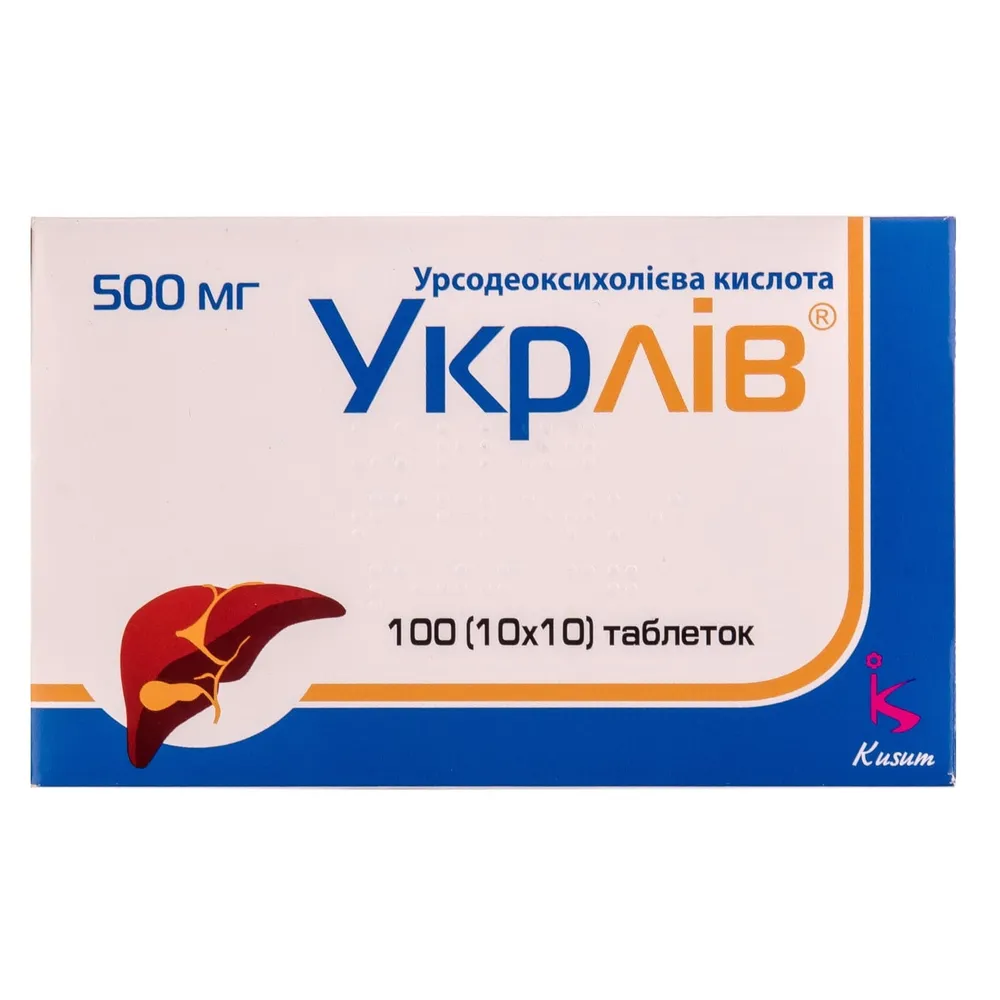
UKRLIV®
UkraineIt is used for the dissolution of cholesterol gallstones (up to 15 mm in size), for the treatment of primary biliary cirrhosis, biliary reflux gastritis, and for the treatment of children with cystic fibrosis.
Frequently asked questions
How should Ukrliv® be taken correctly?
Tablets should be swallowed whole, without chewing, and taken with water once daily in the evening before bedtime. The dosage depends on the patient's weight and the specific condition, so it must be prescribed by a physician.
What side effects may occur from taking Ukrliv®?
Diarrhea or pasty stools are the most common side effects. Very rarely, skin rashes, severe pain in the right side of the abdomen, or worsening of the condition in cases of liver cirrhosis may be observed.
Who should not take this medication?
Contraindications include acute inflammation of the gallbladder or bile ducts, biliary obstruction, frequent episodes of biliary colic, the presence of calcified stones, impaired gallbladder motility, and decompensated liver cirrhosis.
Can this medication be taken with other medicines?
It must not be taken simultaneously with cholestyramine, cholestyramine, or antacids containing aluminum or smectite (there should be an interval of at least 2 hours between doses). The medication may also affect the absorption of cyclosporine, ciprofloxacin, rosuvastatin, and nitrendipine.
Can the medication be taken during pregnancy?
It is not recommended for pregnant women, except in cases where it is absolutely necessary. Women of childbearing age should use reliable non-hormonal methods of contraception.
What should be done if diarrhea occurs?
If diarrhea occurs, it is recommended to reduce the dose, and if it becomes persistent, discontinue treatment.
Instructions for use
INSTRUCTION FOR MEDICAL USE OF THE MEDICINAL PRODUCT UKRLIVÒ (UKRLIVÒ)
Composition:
Active substance: ursodeoxycholic acid;
One tablet contains 250 mg of ursodeoxycholic acid;
Excipients: microcrystalline cellulose, sodium starch glycolate (type A), povidone K-30, magnesium stearate.
Pharmaceutical form. Tablets.
Main physicochemical properties: white, round, biconvex tablets, smooth on both sides.
Pharmacotherapeutic group.
Agents used in the treatment of liver and biliary tract disorders. Agents used in biliary pathology. ATC code A05AA02.
Agents used in liver diseases, lipotropic agents. ATC code A05B.
Pharmacological properties.
Pharmacodynamics.
A small amount of ursodeoxycholic acid (UDCA) is normally present in human bile.
After oral administration, it reduces the cholesterol saturation of bile by inhibiting cholesterol absorption in the small intestine and decreasing cholesterol secretion into bile. As a result, cholesterol dispersion and formation of liquid crystals lead to gradual dissolution of gallstones.
The effect of UDCA in liver diseases and cholestatic disorders is believed to be due to the relative replacement of lipophilic, detergent-like toxic bile acids by the hydrophilic, cytoprotective, non-toxic UDCA, as well as improvement of hepatocyte secretory function and immunoregulatory processes.
Use in children.
Cystic fibrosis.
There is evidence on long-term use of UDCA (for periods up to 10 years) in the treatment of children with hepatobiliary abnormalities associated with cystic fibrosis. In particular, UDCA therapy may reduce proliferation in bile ducts, halt the progression of histological changes, and even reverse hepatobiliary alterations if treatment is initiated at early stages of cystic fibrosis. For optimal therapeutic efficacy, UDCA treatment should be started immediately after confirmation of the diagnosis of cystic fibrosis.
Pharmacokinetics.
After oral administration, UDCA is rapidly absorbed in the small intestine and upper part of the ileum via passive transport, and in the terminal ileum via active transport. The extent of absorption usually ranges from 60% to 80%. After absorption, the bile acid undergoes almost complete conjugation in the liver with the amino acids glycine and taurine, and is then excreted in bile. The first-pass hepatic clearance is up to 60%.
Depending on the daily dose and the underlying liver disorder or condition, the more hydrophilic UDCA accumulates in bile. Concurrently, a relative reduction in other, more lipophilic bile acids is observed.
Under the influence of intestinal bacteria, partial degradation occurs to 7-ketolithocholic and lithocholic acids. Lithocholic acid is hepatotoxic and causes liver parenchyma damage in some animal species. In humans, only a small amount is absorbed, which is sulfated in the liver and thereby detoxified before being excreted in bile and ultimately in feces.
The biological half-life of UDCA is 3.5–5.8 days.
Clinical characteristics.
Indications.
For dissolution of radiolucent cholesterol gallstones no larger than 15 mm in diameter in patients with a functioning gallbladder, regardless of the presence of gallstone(s) in it.
For symptomatic treatment of primary biliary cholangitis (PBC) in the absence of decompensated liver cirrhosis.
For treatment of biliary reflux gastritis.
For treatment of hepatobiliary disorders in cystic fibrosis in children aged 6 to 18 years.
Contraindications.
Hypersensitivity to any component of the medicinal product.
Acute inflammation of the gallbladder or bile ducts.
Obstruction of the biliary tract (blockage of the common bile duct or cystic duct).
Frequent episodes of biliary (hepatic) colic.
Presence of radiopaque, calcified gallstones.
Impaired gallbladder contractility.
Decompensated liver cirrhosis.
Failed outcome of portoenterostomy or absence of adequate bile flow in children with biliary atresia.
Interaction with other medicinal products and other forms of interaction.
Ukrlyv® must not be used concomitantly with cholestyramine, colestipol, or antacids containing aluminum hydroxide and/or smectite, as these agents bind UDCA in the intestine and thereby interfere with its absorption and reduce efficacy. If administration of a medicinal product containing one of these substances is necessary, it should be taken at least 2 hours before or 2 hours after taking Ukrlyv®.
UDCA may enhance intestinal absorption of cyclosporine. Therefore, in patients receiving cyclosporine, blood levels of this substance should be monitored and the dose adjusted if necessary.
In individual cases, UDCA may reduce absorption of ciprofloxacin.
There are clinical data showing that concomitant administration of UDCA (500 mg/day) and rosuvastatin (20 mg/day) in healthy volunteers led to a slight increase in rosuvastatin plasma concentration. The clinical significance of this interaction, as well as its relevance to other statins, has not been established.
It has been demonstrated that UDCA reduces the peak plasma concentration (Cmax) and area under the curve (AUC) of the calcium antagonist nitrendipine in healthy volunteers. Close monitoring is recommended when nitrendipine and UDCA are used concomitantly. An increase in nitrendipine dosage may be required.
Additionally, reduced therapeutic effect of dapsone has been reported.
These findings, together with in vitro data, suggest that UDCA may potentially induce cytochrome P450 3A enzymes. However, in a well-designed interaction study between UDCA and budesonide—a proven substrate of cytochrome P450 3A—no such effect was observed.
Estrogenic hormones, as well as lipid-lowering agents such as clofibrate, may enhance hepatic cholesterol secretion and thus promote gallstone formation—an effect opposite to that of UDCA, which is used to dissolve gallstones.
Special precautions for use.
The medicinal product Ucrliv® should be used under medical supervision.
During the first three months of treatment, the following liver function parameters should be monitored: AST (SGOT), ALT (SGPT), and γ-GT every 4 weeks, and thereafter every 3 months. This allows assessment of treatment response in patients with PBC and timely detection of potential liver function abnormalities, especially in patients with advanced-stage PBC.
Use for dissolution of cholesterol gallstones.
To evaluate treatment progress and to detect any signs of gallstone calcification in a timely manner, depending on stone size, gallbladder imaging (oral cholecystography) with assessment of opacities in both upright and supine positions (under ultrasound monitoring) should be performed 6–10 months after initiation of treatment.
The medicinal product Ucrliv® should not be used if the gallbladder is not visualized on X-ray images or in case of gallstone calcification, impaired gallbladder contractility, or frequent biliary colic.
Female patients taking Ucrliv® for dissolution of gallstones should use an effective non-hormonal method of contraception, as hormonal contraceptives may promote gallstone formation.
Treatment of patients with advanced-stage PBC.
Rare cases of hepatic decompensation have been reported, which may partially regress after discontinuation of therapy.
In patients with PBC, worsening of symptoms may very rarely occur at the beginning of treatment, for example, pruritus may intensify. In such cases, the dose of Ucrliv® should be reduced to one tablet of Ucrliv 250 mg daily; the dose should then be gradually increased as described in the section "Posology and method of administration."
If diarrhea occurs, a dose reduction is recommended; in case of persistent diarrhea, treatment should be discontinued.
This medicinal product contains less than 1 mmol (23 mg)/dose of sodium, i.e. it is practically sodium-free.
Use during pregnancy or breastfeeding.
Pregnancy
Animal studies have not shown any effect of UDCA on fertility. Data on effects on human fertility are lacking.
There is insufficient data on the use of UDCA in pregnant women. Animal studies indicate reproductive toxicity in early pregnancy. The medicinal product Ucrliv® should not be used during pregnancy unless clearly necessary. Women of childbearing potential should only take the product if they are using reliable contraceptive methods.
Women of childbearing potential
It is recommended to use non-hormonal contraceptives or low-estrogen oral contraceptives. Female patients receiving Ucrliv® for dissolution of gallbladder stones should use effective non-hormonal contraceptive methods, as hormonal oral contraceptives may promote gallstone formation. Pregnancy should be excluded before starting treatment.
Breastfeeding.
Based on several reported cases of use in breastfeeding women, the concentration of UDCA in breast milk is extremely low; therefore, adverse effects in breastfed infants are not expected.
Effect on ability to drive and operate machinery.
No effects on the ability to drive or operate machinery have been observed.
Dosage and administration.
For patients weighing less than 47 kg or who experience difficulty swallowing tablets of the medicinal product Ukrliv®, an alternative dosage form is available – Ukrliv®, oral suspension.
For dissolution of cholesterol gallstones.
Approximately 10 mg UDCA per kilogram of body weight per day (see Table 1).
Table 1
| Body weight (kg) |
Number of tablets |
| up to 60 |
2 |
| 61-80 |
3 |
| 81-100 |
4 |
| over 100 |
5 |
The tablets should be swallowed whole, without chewing, with water, once daily in the evening before bedtime.
The tablets must be taken regularly.
The time required for dissolution of gallstones usually ranges from 6 to 24 months. If no reduction in gallstone size is observed after 12 months of treatment, therapy should not be continued.
Treatment efficacy should be evaluated every 6 months by ultrasound or X-ray imaging. Additional examinations are necessary to monitor whether calcification of stones has occurred over time. If calcification has occurred, treatment should be discontinued.
For symptomatic treatment of primary biliary cholangitis (PBC).
The daily dose depends on body weight and ranges from 3 to 7 tablets (14±2 mg UDCA per kilogram of body weight).
During the first 3 months of treatment, the medicinal product Ukrliv® should be taken throughout the day, dividing the daily dose into several administrations. After improvement in liver function parameters, the daily dose may be taken once daily in the evening.
Table 2
| Body weight (kg) |
Daily dose (mg/kg body weight) |
Ukriv®, 250 mg tablets |
|||
| first 3 months |
thereafter |
||||
| morning |
afternoon |
evening |
evening (once daily) |
||
| 47–62 |
12–16 |
1 |
1 |
1 |
3 |
| 63–78 |
13–16 |
1 |
1 |
2 |
4 |
| 79–93 |
13–16 |
1 |
2 |
2 |
5 |
| 94–109 |
14–16 |
2 |
2 |
2 |
6 |
| over 110 |
2 |
2 |
3 |
7 |
|
The tablets should be swallowed whole, without chewing, with liquid. The medication should be taken regularly.
The use of the medicinal product Ukriv® for PBC may be indefinite.
In patients with PBC, clinical symptoms such as pruritus may rarely worsen at the beginning of treatment. If this occurs, therapy should be continued by initially taking 1 tablet of Ukriv 250 mg daily, followed by gradual dose escalation (increasing the daily dose by 1 tablet weekly) until the recommended dosage regimen is achieved.
For the treatment of biliary reflux gastritis
250 mg of UDCA (1 tablet) once daily, taken with sufficient amount of water in the evening before bedtime.
Usually, for the treatment of gastritis with bile reflux, 250 mg of UDCA should be taken for 10–14 days. The duration of treatment depends on the patient's condition. The physician must decide on the treatment duration individually for each case.
Use in children.
For children with cystic fibrosis aged 6 to 18 years, the dosage is 20 mg/kg/day, divided into 2–3 doses, with subsequent dose increase up to 30 mg/kg/day if necessary.
Table 3
| Body weight (kg) |
Daily dose (mg/kg) |
Ukriv®, 250 mg tablets |
||
| Morning |
Day |
Evening |
||
| 20–29 |
17–25 |
1 |
- |
1 |
| 30–39 |
19–25 |
1 |
1 |
1 |
| 40–49 |
20–25 |
1 |
1 |
2 |
| 50–59 |
21–25 |
1 |
2 |
2 |
| 60–69 |
22–25 |
2 |
2 |
2 |
| 70–79 |
22–25 |
2 |
2 |
3 |
| 80–89 |
22–25 |
2 |
3 |
3 |
| 90–99 |
23–25 |
3 |
3 |
3 |
| 100–109 |
23–25 |
3 |
3 |
4 |
| >110 |
3 |
4 |
4 |
|
Children.
For dissolution of cholesterol gallstones and symptomatic treatment of PBC
There are no absolute age restrictions for the use of Ukriv® in children. However, for children with body weight less than 47 kg and/or children who have difficulty swallowing, administration of the drug as a suspension is recommended.
For the treatment of hepatobiliary disorders in cystic fibrosis
Administer to children aged 6 to 18 years.
Overdose.
In case of overdose, diarrhea may occur. Other symptoms of overdose are unlikely because absorption of UDCA decreases with increasing dose; therefore, most of the administered dose is excreted in feces.
If diarrhea occurs, the dose should be reduced. If diarrhea persists, treatment should be discontinued.
Specific antidotes are not required. Management of diarrhea consequences is symptomatic and includes restoration of fluid and electrolyte balance.
Additional information regarding special patient groups.
Long-term therapy with high doses of UDCA (28–30 mg/kg/day) in patients with primary sclerosing cholangitis (off-label use) has been associated with a higher incidence of serious adverse events.
Adverse Reactions
The adverse reactions listed below are categorized by system organ class and frequency: very common (≥1/10), common (≥1/100, <1/10), uncommon (≥1/1000, <1/100), rare (≥1/10000, <1/1000), very rare (<1/10000, including isolated cases), not known (frequency cannot be estimated from the available data).
Gastrointestinal disorders: common – pasty stools, diarrhoea; very rare – severe pain in the right upper quadrant of the abdominal cavity.
Hepatobiliary disorders: very rare – calcification of gallstones, decompensation of liver cirrhosis, which partially regressed after discontinuation of treatment.
Immune system disorders: very rare – hypersensitivity reactions, including skin rash (urticaria).
Reporting of suspected adverse reactions.
Reporting of suspected adverse reactions after marketing authorization is an important procedure. It allows continuous monitoring of the benefit-risk balance of the medicinal product. Healthcare professionals are required to report any suspected adverse reactions to the State Enterprise "State Expert Centre of the Ministry of Health of Ukraine" and to the marketing authorization holder via the feedback form on the website: https://kusum.ua/pharmacovigilance/.
Shelf life.
3 years.
Storage conditions.
Store at a temperature not exceeding 25 °C in the original packaging.
Keep out of reach of children.
Packaging.
10 tablets in a blister; 3 or 10 blisters in a cardboard pack.
Prescription status.
Prescription only.
Manufacturer.
LLC "KUSUM PHARM".
Manufacturer's address and place of business.
40020, Ukraine, Sumy region, Sumy city, Sykrabina St., 54.
or
Manufacturer.
KUSUM HEALTHCARE PVT LTD.
Manufacturer's address and place of business.
Plot No. M-3, Indore Special Economic Zone, Phase-II, Pithampur, Distt. Dhar, Madhya Pradesh, Pin 454774, India.
or
Manufacturer.
LLC "GLEDFARM LTD".
Manufacturer's address and place of business.
54 Davydovskoho Hryhoriia St., Sumy, Sumy region, 40020, Ukraine.
Similar drugs
| Brand name | Dosage form | Active substance / Dosage | Manufacturer |
|---|---|---|---|
| UKRLIV® | tablets |
|
KUSUM PHARM LLC (manufacturing, primary packaging, secondary packaging, quality control, batch release or secondary packaging, quality control, batch release of products in bulk) |
The original data is available in the language of the country of manufacture.
Data source: State Register of Medicinal Products of Ukraine
Data last verified: August 13, 2026