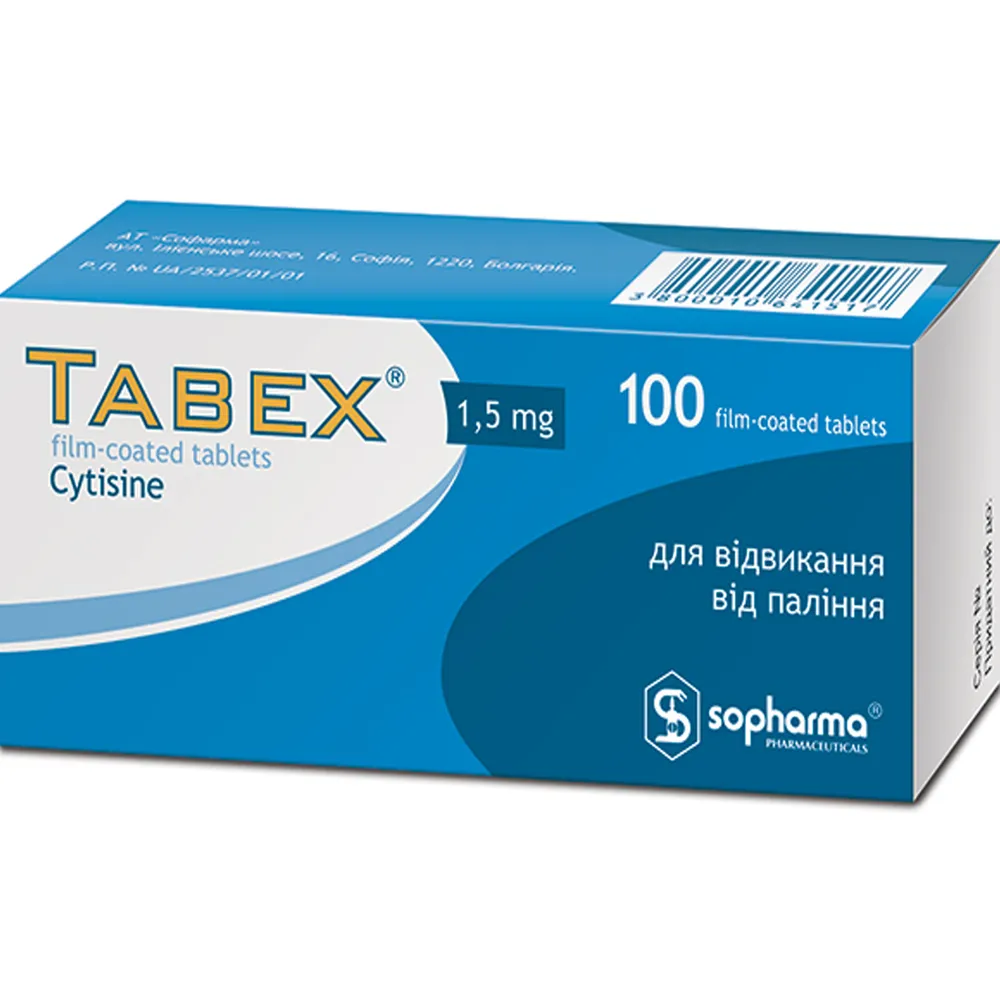
TABEX
UkraineThe drug is used for smoking cessation in cases of chronic nicotine dependence.
Frequently asked questions
How should Tabex be taken correctly?
Adults should follow a gradual dose reduction: from day 1 to day 3 — 1 tablet every 2 hours (6 per day); from day 4 to day 12 — every 2.5 hours (5 per day); from day 13 to day 16 — every 3 hours (4 per day); from day 17 to day 20 — every 5 hours (3 per day); from day 21 to day 25 — 1-2 tablets per day. Tablets should be swallowed whole with water. Smoking should be completely stopped by the fifth day of treatment.
Who should not take this drug?
Contraindications include hypersensitivity to the components, acute myocardial infarction, unstable angina, cardiac arrhythmia, recent cerebrovascular disease, atherosclerosis, severe arterial hypertension, pregnancy, and breastfeeding. It is also not recommended for children under 18 and people over 65 years of age.
What are the possible side effects of Tabex?
Dizziness, headache, and insomnia are most common at the beginning of treatment. Nausea, dry mouth, taste changes, increased sweating, palpitations, irritability, or abdominal pain are also possible. Most symptoms disappear during the course of treatment.
Can the drug be combined with other medicines?
Interaction is possible with cholinergics and anticholinesterase agents (side effects may be enhanced). Taking it with statins increases the risk of muscle pain, and taking it with antihypertensive drugs may weaken their effect. Caution should also be exercised when taking it with theophylline, ropinirole, clozapine, and olanzapine.
Does the drug affect the ability to drive a vehicle?
It generally does not affect reaction speed; however, due to possible drowsiness or dizziness in some people at the beginning of treatment, it is advisable to refrain from driving a car or operating machinery.
Instructions for use
INSTRUCTIONS FOR MEDICAL USE OF THE MEDICINAL PRODUCT TABEX® (TABEX®)
Composition:
Active substance: cytisine;
One coated tablet contains cytisine 1.5 mg;
Excipients: microcrystalline cellulose, calcium sulfate dihydrate, colloidal anhydrous silicon dioxide, magnesium stearate;
Film coating: Opadry II Brown 85G 265001 [partially hydrolyzed polyvinyl alcohol, titanium dioxide (E 171), macrogol 4000, lecithin, talc, yellow iron oxide (E 172), red iron oxide (E 172), black iron oxide (E 172)].
Pharmaceutical form. Coated tablets.
Main physico-chemical properties: round, biconvex coated tablets, 5.5 mm in diameter, with engraving on one side, beige in color.
Pharmacotherapeutic group.
Medicinal products used in nicotine dependence.
ATC code N07BA04.
Pharmacological properties.
Mechanism of action.
Cytisine is an alkaloid derived from the plant Cytisus Laburnum.
It has a chemical structure similar to that of nicotine and lobeline. It selectively and competitively binds to receptors, exhibiting partial agonist activity at nicotinic acetylcholine receptors, particularly with high affinity for the α4β2 subtype. Thus, it prevents nicotine from binding to α4β2 receptors and stimulating the central mesolimbic dopaminergic system, which is associated with the mechanisms of nicotine dependence due to nicotine's ability to activate these receptors.
Pharmacodynamics.
The drug's effect involves stimulation of autonomic ganglia, reflex stimulation of respiration, release of adrenaline from the adrenal medulla, and increased arterial blood pressure. The mechanism of action of cytisine is similar to that of nicotine, but with significantly lower toxicity and greater therapeutic effect. Cytisine competitively inhibits the interaction of nicotine with its corresponding receptors, leading to a gradual reduction and eventual elimination of nicotine dependence.
Pharmacokinetics.
Absorption: Cytisine is rapidly absorbed from the gastrointestinal tract following oral administration. Maximum plasma concentration of 15.55 ng/mL is achieved within 0.92 hours.
Distribution: No data are available regarding the volume of distribution in humans.
Biotransformation and elimination: Cytisine is not metabolized in the body. Up to 64% of the administered dose is excreted unchanged in urine within 24 hours. The elimination half-life is approximately 4 hours. The mean residence time of cytisine in the body is approximately 6 hours.
Clinical characteristics.
Indications.
For smoking cessation in chronic nicotine addiction.
Contraindications.
Hypersensitivity to the active substance or to any of the excipients, acute myocardial infarction, unstable angina pectoris, cardiac arrhythmia, recent cerebrovascular disorder, atherosclerosis, severe arterial hypertension, pregnancy and breastfeeding.
Interaction with other medicinal products and other forms of interaction.
Tobacco smoking is associated with increased CYP1A2 activity. After smoking cessation, activity of this isoenzyme may decrease, which could lead to increased plasma concentrations of drugs metabolized by CYP1A2, such as theophylline, ropinirole, clozapine, and olanzapine. In these cases, their adverse effects may be enhanced, as these drugs have a narrow therapeutic index.
Concomitant use of Tabex® with cholinomimetics and anticholinesterase agents may enhance cholinomimetic adverse effects.
Concomitant use with lipid-lowering agents (statins) increases the risk of myalgia.
Concomitant use of Tabex® with antihypertensive medicinal products may reduce their effectiveness.
Special precautions for use
Tabex® should only be used when the patient has a genuine intention to quit smoking. Taking the medication while continuing to smoke may lead to an increased risk of adverse effects of nicotine (up to nicotine intoxication).
There is insufficient clinical experience regarding the use of Tabex® in patients with ischemic heart disease, heart failure, arterial hypertension, cerebrovascular disorders, obstructive arterial diseases, hyperthyroidism, gastric peptic ulcer, diabetes mellitus, or renal or hepatic impairment. In these patient groups, the drug should be prescribed only after careful evaluation by a physician of the benefit/risk ratio.
Due to lack of adequate safety studies, use in patients with certain forms of schizophrenia, patients with chromaffin tumors of the adrenal glands, and patients with gastroesophageal reflux disease should also be considered only after careful assessment of the benefit/risk balance.
There is insufficient clinical data on the safety of Tabex® in children (under 18 years of age) and elderly patients (over 65 years of age). Therefore, the use of the drug is not recommended in these age groups.
Use during pregnancy or breastfeeding
The use of this medicinal product is contraindicated during pregnancy and breastfeeding.
Ability to influence reaction speed when driving or operating machinery
The use of Tabex® generally does not affect reaction speed when driving or operating machinery.
However, considering that in sensitive patients adverse reactions (such as drowsiness, dizziness) may rarely occur during treatment, patients should refrain from driving or operating machinery at the beginning of therapy.
Method of Administration and Dosage
Adults
The medicinal product should be used according to the following regimen:
Days 1 to 3 – 1 tablet every 2 hours (6 tablets per day).
At the same time, gradually reduce the number of cigarettes smoked.
If the result is unsatisfactory, treatment should be discontinued and may be resumed after 2–3 months.
If a positive effect is achieved, continue treatment as follows:
Days 4 to 12 – 1 tablet every 2.5 hours (5 tablets per day);
Days 13 to 16 – 1 tablet every 3 hours (4 tablets per day);
Days 17 to 20 – 1 tablet every 5 hours (3 tablets per day);
Days 21 to 25 – 1–2 tablets per day.
Tablets should be swallowed whole with sufficient liquid.
Complete smoking cessation must occur by the fifth day of treatment. After completing the treatment course, the patient must exercise willpower and refrain from smoking any cigarettes.
Duration of treatment (according to the regimen).
Patients aged 65 years and older
The use of this medicinal product is not recommended in this age group.
Children
Do not use in children.
Overdose
Symptoms of overdose: nausea, vomiting, profuse sweating, tremor, visual disturbances, general weakness, tachycardia, clonic seizures, respiratory paralysis.
Treatment: gastric lavage; if the patient is conscious – infusion of saline solutions; administration of anticonvulsants, cardiotonics, analeptics, and other symptomatic agents. Monitor respiration, arterial pressure, and heart rate.
Adverse reactions.
The drug is generally well tolerated. Adverse effects, if they occur, are usually mild to moderate in severity. Most of them appear at the beginning of treatment and tend to disappear during continued therapy. These are mostly associated with smoking cessation and manifest as dizziness, headache, and insomnia.
Endocrine system: increased sweating, weight loss.
Nervous system: headache, dizziness, insomnia, somnolence, irritability.
Cardiac disorders: tachycardia, palpitations.
Vascular disorders: slight increase in blood pressure.
Respiratory, thoracic and mediastinal disorders: dyspnoea.
Gastrointestinal disorders: taste disturbances, altered appetite, dry mouth, abdominal pain, nausea, constipation, diarrhoea, upper abdominal pain, dyspepsia, vomiting.
Musculoskeletal and connective tissue disorders: myalgia.
General disorders: chest pain.
Shelf life.
2 years.
Storage conditions.
Keep out of the reach of children.
Store in the original packaging to protect from moisture, at a temperature not exceeding 25 °C.
Packaging.
20 film-coated tablets in a blister pack made of PVC/PE/PVdC/PE/PVC film and aluminium foil. 5 blisters per cardboard box.
Supply classification.
Over-the-counter (without prescription).
Manufacturers.
Certificate holder:
JSC "Sofarma".
JSC "VITAMINS".
Manufacturers' addresses.
JSC "Sofarma"
16 Iliensko Shose Str., Sofia, 1220, Bulgaria.
JSC "VITAMINS"
31 Uspenska Street, Uman, Cherkasy region, 20300, Ukraine.
Similar drugs
| Brand name | Dosage form | Active substance / Dosage | Manufacturer |
|---|---|---|---|
| CYCOTIN® IS | tablets, film-coated |
|
Interkhim Limited Liability Partnership |
| RESIGAR | tablets, film-coated |
|
JSC "Adamed Pharma" |
The original data is available in the language of the country of manufacture.
Data source: State Register of Medicinal Products of Ukraine
Data last verified: August 13, 2026