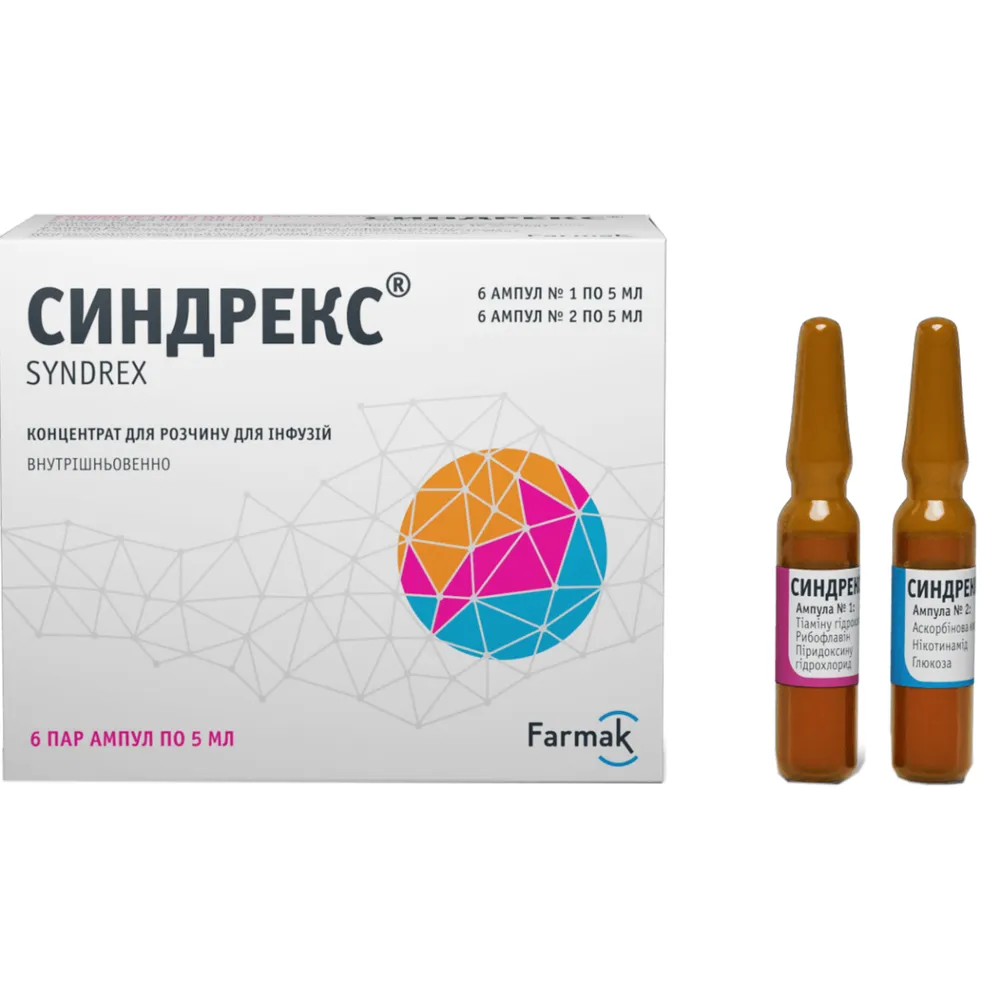
SYNDREX®
UkraineThe drug is used for the rapid treatment of severe deficiency or malabsorption of B-group and C vitamins. It is prescribed for alcoholism (to prevent Wernicke encephalopathy), following acute infections, in the postoperative period, in psychotic states, and to maintain vitamin levels in patients undergoing hemodialysis.
Frequently asked questions
How should Syndrex® be taken correctly?
The drug is intended for intravenous administration only via drip infusion. It must be diluted in 50–100 ml of saline or 5% glucose solution. The duration of the infusion itself should be 30 minutes. The dosage is determined by a physician depending on the patient's age and specific condition.
Are there any contraindications for use?
The drug must not be used in case of hypersensitivity to its active or excipient substances.
What are the possible side effects of Syndrex®?
Possible allergic reactions (rash, urticaria, anaphylaxis), tingling sensations (paresthesia), decreased blood pressure (hypotension), as well as reactions at the injection site, such as pain or swelling.
Can the drug be taken together with other medicines?
When used simultaneously with levodopa, the pyridoxine contained in the drug may affect its efficacy. Additionally, the product should not be mixed with other medicinal products, except those specified in the special dilution instructions.
Should patients on special diets be cautious?
Yes, since the drug contains sodium, caution should be exercised by patients following a sodium-restricted diet.
Can the drug be used during pregnancy?
The product should be used with caution. Sufficient studies regarding human safety have not been conducted; therefore, prescription must be carried out by a physician.
Instructions for use
INSTRUCTIONS FOR MEDICAL USE OF THE MEDICINAL PRODUCT SYNDREX® (SYNDREX)
Composition:
Ampoule No. 1
Active substances: thiamine hydrochloride, riboflavin, pyridoxine hydrochloride;
1 ml of concentrate for infusion solution contains thiamine hydrochloride 50 mg, sodium riboflavin phosphate (calculated as riboflavin) 0.8 mg, pyridoxine hydrochloride 10 mg;
Excipients: edetic acid (ethylenediaminetetraacetic acid), sodium hydroxide, water for injections.
Ampoule No. 2
Active substances: ascorbic acid, nicotinamide, glucose;
1 ml of concentrate for infusion solution contains ascorbic acid 100 mg; nicotinamide 32 mg; glucose monohydrate (calculated as glucose) 200 mg;
Excipients: edetic acid (ethylenediaminetetraacetic acid), sodium hydroxide, water for injections.
Pharmaceutical form. Concentrate for infusion solution.
Main physicochemical properties: clear yellow liquid.
Pharmacotherapeutic group. Combination of vitamin B complex with vitamin C.
ATC code A11E B.
Pharmacological properties.
Pharmacodynamics.
The medicinal product Syndrex®, concentrate for solution for infusion, contains vitamins B1, B2, B6, nicotinamide, and vitamin C.
Pharmacokinetics.
No data available.
Clinical characteristics.
Indications.
For use in adults and children for rapid treatment of severe deficiency or malabsorption of water-soluble vitamins B and C:
- in alcoholism, when severe thiamine depletion may lead to Wernicke's encephalopathy;
- after acute infectious diseases;
- in the postoperative period;
- in psychotic states.
Also indicated for maintaining vitamin B and C levels in patients undergoing chronic intermittent hemodialysis.
Contraindications.
Hypersensitivity to the active substances or excipients of the medicinal product.
Interaction with other medicinal products and other forms of interaction.
When administered concomitantly with levodopa, pyridoxine may interfere with its effects.
Special precautions for use
Although potentially serious allergic adverse reactions, such as anaphylactic shock, may rarely occur during or shortly after parenteral administration of Syndrex**®, the possibility of such reactions should not prevent the use of Syndrex®** in patients requiring treatment, especially those at risk of developing Wernicke's encephalopathy. Treatment of such patients with parenteral thiamine is essential.
Initial signs of a reaction to Syndrex**®** include sneezing or mild asthma. Further injections in such patients may lead to anaphylactic shock. Emergency treatment for anaphylactic reactions must be readily available during each intravenous administration of Syndrex**®. To minimize the risk of such events during intravenous administration, the medicinal product Syndrex®** should be administered by infusion over 30 minutes.
This medicinal product is intended solely for intravenous infusion and must not be administered by any other route.
Syndrex**®** must be administered only intravenously. Reports have been received of accidental administration by incorrect routes; however, these cases were not associated with serious adverse reactions.
Visually inspect ampoules before use and do not use if particulate matter is present in the solution.
Sodium
This medicinal product contains 2.86 mmol (65.78 mg) of sodium per pair of ampoules (ampoule No. 1 + ampoule No. 2). Caution is advised when administering to patients on a sodium-restricted diet.
Use during pregnancy or breastfeeding
When used according to clinical indications at recommended doses, no adverse effects have been reported.
There are insufficient animal studies on reproductive toxicity. The potential risk to humans has not been established.
Syndrex**®** should be used with caution during pregnancy.
Ability to affect reaction speed while driving or operating machinery
No studies on the influence on the ability to drive vehicles or operate machinery have been conducted. Given the composition of the medicinal product, no effects are expected.
Method of administration and dosage.
For intravenous use.
Adults and elderly patients:
- rapid treatment of severe deficiency or malabsorption of water-soluble vitamins B and C, particularly in alcoholism, where severe thiamine deficiency may lead to Wernicke's encephalopathy
| 10 ml solution from vial No. 1 |
+ |
10 ml solution from vial No. 2 |
| or |
||
| 15 ml solution from vial No. 1 |
+ |
15 ml solution from vial No. 2 |
2–3 pairs of 5 ml ampoules (1 pair = ampoule No. 1 + ampoule No. 2) should be diluted in 50–100 ml of infusion solution (physiological saline or 5% glucose). Infusion should be administered over 30 minutes every 8 hours or as prescribed by a physician.
- Psychosis following anesthesia or ECT (electroconvulsive therapy); intoxication in acute infections
| 5 ml solution from vial No. 1 |
+ |
5 ml solution from vial No. 2 |
Dilute 1 pair of 5 ml ampoules in 50–100 ml of infusion solution (physiological saline or 5% glucose), and administer by infusion over 30 minutes twice daily for 7 days.
- hemodialysis
| 5 ml solution from vial No. 1 |
+ |
5 ml solution from vial No. 2 |
Dilute 1 pair of 5 ml ampoules in 50–100 ml of infusion solution (physiological saline or 5% glucose), and administer by infusion over 30 minutes once every two weeks at the end of dialysis.
Children:
Synthrex**®** is rarely indicated for children; the recommended doses are given below:
| up to 6 years 6–10 years 10–14 years from 14 years |
1/4 of the adult dose 1/3 of the adult dose from 1/2 to 2/3 of the adult dose adult dose |
Method of administration
Dilute before use.
Syndrex**®**, concentrate for solution for infusion for intravenous administration, should be administered by intravenous infusion. Equal volumes of the contents of ampoules No. 1 and No. 2 should be added to 50–100 mL of physiological saline or 5% glucose solution and administered over 30 minutes.
Compatibility
The medicinal product Syndrex**®** is compatible with the following infusion solutions: 5% glucose, physiological saline (sodium chloride 0.9%), 4.3% glucose with 0.18% sodium chloride, 5% glucose with 0.3% potassium chloride, sodium lactate.
The chemical and physical stability of the medicinal product Syndrex**®** at room temperature is indicated in the table below:
| Solvent |
Time in light, hours |
| Glucose 5 % |
7 |
| Physiological solution (sodium chloride 0.9 %) |
7 |
| Glucose 4.3 % with sodium chloride 0.18 % |
4 |
| Glucose 5 % with potassium chloride 0.3 % |
4 |
| Sodium lactate |
7 |
The solutions are expected to be stable for a longer period of time if protected from light.
Children.
Syndrex**®** is indicated for administration to children (see section "Dosage and administration").
Overdose.
In the unlikely event of overdose, symptomatic and supportive therapy should be administered.
Adverse reactions.
Adverse reactions reported as possibly related to the use of the medicinal product are listed in the table below. The adverse reactions are categorized by system organ class and frequency: very common (>1/10); common (>1/100, <1/10); uncommon (>1/1000, <1/100); rare (>1/10,000, <1/1000); very rare (<1/10,000), including isolated case reports; frequency not known (cannot be estimated based on available data).
The frequency of adverse reactions identified during the post-marketing period cannot be estimated because they are derived from spontaneous reports; therefore, they are classified as frequency not known.
| Systems |
Frequency |
Adverse reaction |
| Immune system disorders |
Unknown |
Increased sensitivity (including anaphylaxis, rash, and urticaria) |
| Nervous system disorders |
Unknown |
Paraesthesia |
| Cardiovascular system disorders |
Unknown |
Hypotension |
| General disorders and administration site reactions |
Unknown |
Injection site reactions (including pain and swelling) |
Reporting of suspected adverse reactions
Reporting of adverse reactions after the medicinal product has been authorized is of great importance. It allows ongoing monitoring of the benefit-risk balance of the use of this medicinal product. Medical and pharmaceutical professionals, as well as patients or their legal representatives, are encouraged to report all suspected adverse reactions and lack of effectiveness of the medicinal product via the Automated Pharmacovigilance Information System at the following link: https://aisf.dec.gov.ua.
Shelf life. 2 years.
From a microbiological standpoint, this product should be used immediately. If not used immediately, the storage duration and conditions during use are the responsibility of the user and normally should not exceed 24 hours at a temperature of 2 to 8 °C, except when dilution is carried out under controlled and validated aseptic conditions.
Storage conditions.
Store in the original packaging at a temperature not exceeding 25 °C. Do not freeze.
The diluted solution must not be frozen.
Keep out of reach of children.
Incompatibilities.
This medicinal product must not be mixed with other medicinal products except those specified in the section "Instructions for use and dosage".
Packaging.
5 ml in a vial.
3 vials of No. 1 (thiamine hydrochloride + riboflavin + pyridoxine hydrochloride) in a blister.
3 vials of No. 2 (ascorbic acid + nicotinamide + glucose) in a blister.
2 blisters of vials No. 1 and 2 blisters of vials No. 2 per carton.
Or 6 vials of No. 1 (thiamine hydrochloride + riboflavin + pyridoxine hydrochloride) in a blister.
6 vials of No. 2 (ascorbic acid + nicotinamide + glucose) in a blister.
1 blister of vials No. 1 and 1 blister of vials No. 2 per carton.
Or 6 vials of No. 1 (thiamine hydrochloride + riboflavin + pyridoxine hydrochloride) and 6 vials of No. 2 (ascorbic acid + nicotinamide + glucose) per carton with corrugated inserts.
Prescription status. Prescription only.
Manufacturer. JSC "Farmak".
Manufacturer's address and place of business.
74, Kyrylivska Street, Kyiv, 04080, Ukraine.
The original data is available in the language of the country of manufacture.
Data source: State Register of Medicinal Products of Ukraine
Data last verified: August 13, 2026