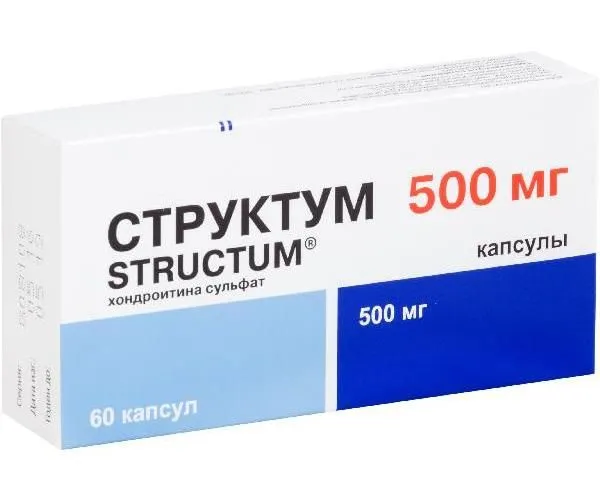
STRUCTUM
UkraineThe drug is used as an adjunct therapy for degenerative diseases of the joints and spine, such as osteoarthritis and intervertebral osteochondrosis.
Frequently asked questions
How should Structum be taken correctly?
Adults and children aged 15 years and older should take 1 capsule twice daily (a total of 1 g per day). Capsules should be swallowed whole with a large amount of water (250 ml).
What are the possible side effects of Structum?
Dizziness, diarrhea, abdominal pain, or nausea may occur frequently. Urticaria, itching, rash, or facial swelling are observed infrequently. Vomiting, angioedema, or erythema are possible but rare.
Who should not take this drug?
The drug is contraindicated in individuals with hypersensitivity to the active substance or excipients, as well as in children under 15 years of age.
Can the drug be taken during pregnancy or breastfeeding?
Pregnant women should avoid using the drug as a precautionary measure. Structum should not be used during breastfeeding, as it is unknown whether it is excreted in breast milk, and the risk to the infant cannot be excluded.
Should people on a salt-restricted diet be cautious?
Yes, since one capsule contains 45.7 mg of sodium, patients following a sodium-controlled diet should be cautious.
Instructions for use
INSTRUCTION FOR MEDICAL USE OF THE MEDICINAL PRODUCT STRUCTUM® (STRUCTUM®)
Composition:
Active substance: sodium chondroitin sulfate;
1 capsule contains sodium chondroitin sulfate 500 mg;
Excipients (capsule content): talc;
Excipients (capsule shell): gelatin, indigotine (E 132), titanium dioxide (E 171).
Pharmaceutical form. Hard capsules.
Main physicochemical properties: opaque blue capsule containing white or yellowish powder with agglomerates.
Pharmacotherapeutic group.
Non-steroidal anti-inflammatory and antirheumatic agents.
ATC code M01A X25.
Pharmacological properties.
Pharmacodynamics.
Chondroitin sulfate is an important component of bones and joint cartilage tissue, supporting cartilage matrix integrity by:
- enhancing the anabolic activity of chondrocytes (stimulating proteoglycan synthesis);
- inhibiting the detrimental effects of interleukin-1β on the cartilage matrix;
- preventing excessive degradation of the cartilage matrix (by inhibiting elastase in tissues, and by reducing the activity of metalloproteinases such as stromelysin and collagenase, while simultaneously increasing the activity of tissue inhibitors of metalloproteinases that block these enzymes).
Chondroitin sulfate also improves homeostasis of the synovial joint environment by stimulating hyaluronic acid synthesis, thereby supporting proper viscosity of synovial fluid. Due to its enzymatic and antioxidant properties, chondroitin sulfate inhibits the development of inflammatory reactions.
Pharmacokinetics.
After oral administration, chondroitin sulfate is absorbed in the gastrointestinal tract, with maximum plasma concentration reached within 4 hours.
The drug accumulates predominantly in synovial fluid. It is mainly excreted via feces.
Clinical characteristics.
Indications.
Adjunct therapy in degenerative joint and spine disorders (osteoarthritis, intervertebral osteochondrosis).
Contraindications.
Hypersensitivity to the active substance or to any of the excipients of the medicinal product.
Interaction with other medicinal products and other forms of interaction.
Interaction studies have not been conducted.
Special precautions for use.
The medicinal product contains a small amount of ethanol (alcohol), less than 100 mg per dose. Each capsule contains 7.5 mg of ethanol (alcohol), equivalent to 1.9 µl of beer or 0.8 µl of wine. This amount of alcohol does not produce any noticeable effect. (Ethanol originates from the manufacturing process of the active substance).
This medicinal product contains 45.7 mg of sodium, corresponding to 2% of the maximum daily intake of sodium of 2 g/day for adults. Caution is advised for patients on a sodium-controlled diet.
Use during pregnancy or breastfeeding.
Data on the use of chondroitin sulfate in pregnant women are lacking or limited (less than 300 pregnant women).
Animal studies have not demonstrated any direct or indirect adverse effects on reproductive toxicity.
As a precautionary measure, it is preferable to avoid using the medicinal product Structum® during pregnancy.
It is unknown whether chondroitin sulfate or its metabolites are excreted in human milk. A risk to newborns/infants cannot be excluded. Therefore, Structum® should not be used during breastfeeding.
Animal studies have shown no effect on fertility.
Ability to affect reaction speed when driving or operating machinery.
Appropriate clinical studies have not been conducted.
Method of administration and dosage.
Capsules should be swallowed whole with a large amount of water (250 ml).
For adults and children aged 15 years and older: take 1 capsule (500 mg) twice daily (total daily dose 1 g).
There is insufficient data on the use of chondroitin sulfate in patients aged 0 to 18 years. Therefore, the use of chondroitin sulfate in children is not recommended.
Children.
The drug is contraindicated in children under 15 years of age.
Overdose.
Treatment is symptomatic.
Adverse Reactions
The data below are from 7 clinical studies involving a total of 2244 patients, of whom 1154 received treatment with this medicinal product.
Adverse reactions are presented according to the MedDRA classification system and are listed by frequency as follows: very common (≥ 1/10), common (≥ 1/100 to < 1/10), uncommon (≥ 1/1000 to < 1/100), rare (≥ 1/10,000 to < 1/1000), very rare (< 1/10,000), and frequency not known (available data do not allow estimation of the frequency of these reactions).
From the nervous system
Common: dizziness.
From the gastrointestinal tract
Common: diarrhea, abdominal pain, nausea.
Rare: vomiting.
From the skin and subcutaneous tissues
Uncommon: urticaria, pruritus, rash.
Rare: angioneurotic edema, erythema.
General disorders
Uncommon: facial swelling.
Reporting of suspected adverse reactions
Reporting of suspected adverse reactions is important. It allows continued monitoring of the benefit-risk balance of the medicinal product. Healthcare professionals are asked to report any suspected adverse reactions via the national reporting system.
Shelf life
3 years.
Storage conditions
Store at a temperature not exceeding 25 °C. Keep out of reach and sight of children.
Packaging
12 capsules in a blister. 5 blisters in a cardboard pack.
or
20 capsules in a blister. 3 blisters in a cardboard pack.
Category of supply
Over-the-counter (without prescription).
Manufacturer
Pierre Fabre Médicament Production.
Pierre Fabre Medicament Production.
Manufacturer's address and location of manufacturing site
Production site Progipharm, Rue du Lycée, 45500 Gien, France /
site Progipharm, Rue du Lycee, 45500 Gien, France.
The original data is available in the language of the country of manufacture.
Data source: State Register of Medicinal Products of Ukraine
Data last verified: August 13, 2026