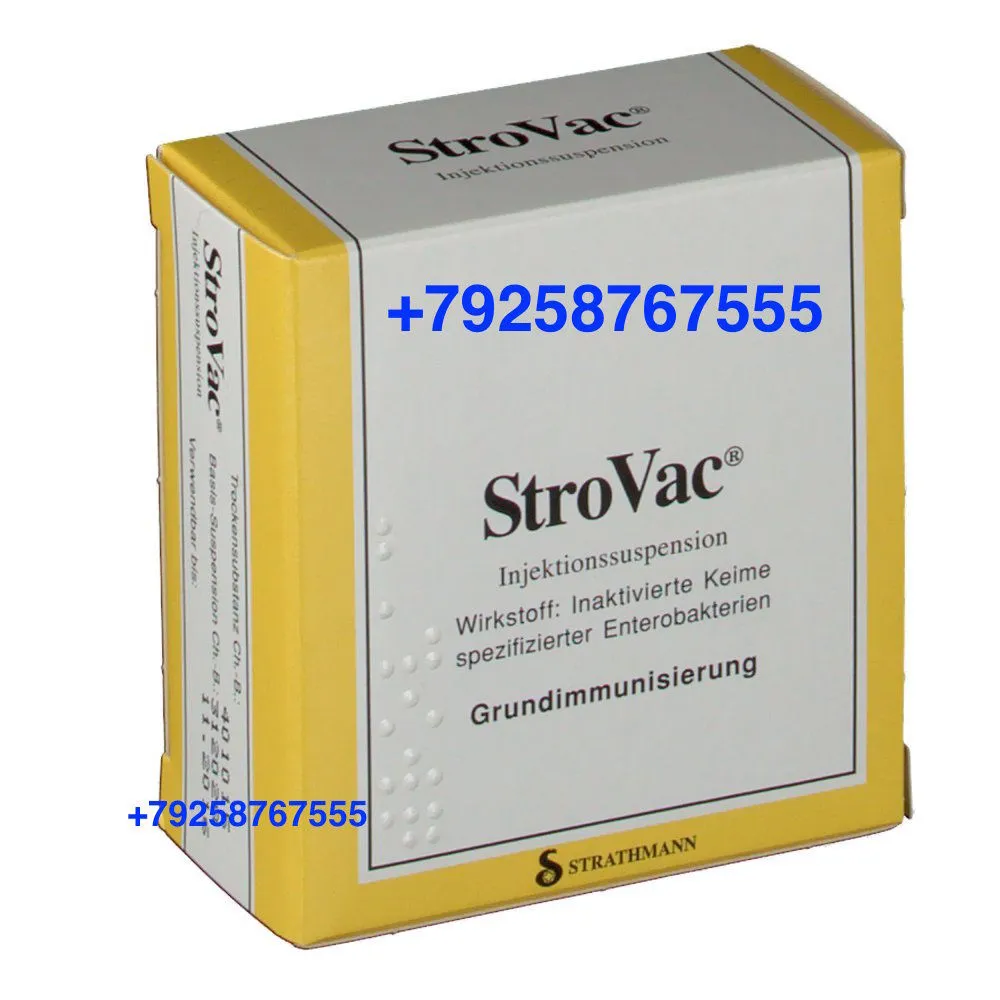
STROVAC®
UkraineThe vaccine is used for the prevention and treatment of recurrent (repeating) urinary tract infections caused by certain bacteria, particularly those that are antibiotic-resistant.
Frequently asked questions
How should Strovac® be taken correctly?
The drug is administered via intramuscular injection into the shoulder. The regimen consists of two stages: first, 3 injections are given with an interval of 1–2 weeks between them, and after one year, one more maintenance injection (revaccination) is required.
Who should not use this drug?
It is contraindicated in cases of hypersensitivity to the vaccine components, acute infections, active tuberculosis, or severe diseases of the blood, heart, kidneys, or immune system. The drug is also not prescribed to children, pregnant women, or breastfeeding women.
What side effects can Strovac® cause?
The most common side effects are reactions at the injection site (pain, redness, swelling) and general flu-like symptoms (fever, chills, fatigue). Headache, dizziness, or nausea are also possible.
Can the vaccine be mixed with other medicines?
Strovac® must not be mixed with other drugs in the same syringe, and it is also not recommended to administer it simultaneously with other injections in the same site.
Does the drug affect the ability to drive?
Some side effects may temporarily affect reaction speed, so caution should be exercised when driving a vehicle or operating machinery.
Instructions for use
INSTRUCTION |
||||||||||||||||||||||||||||||||||||||||||||||||||||||||||||||||||
STROVAC® |
||||||||||||||||||||||||||||||||||||||||||||||||||||||||||||||||||
Composition:One dose of vaccine (0.5 mL) after reconstitution contains: Active substances: at least 109 inactivated microorganisms of the following Enterobacteriaceae species: Escherichia coli (6 strains) - 7.5 x 10⁸ Morganella morganii - 3.75 x 10⁷ Proteus mirabilis - 3.75 x 10⁷ Klebsiella pneumoniae - 1.5 x 10⁸ Enterococcus faecalis - 2.5 x 10⁷ Excipients: sucrose; dextran 40, sodium chloride; disodium hydrogen phosphate dihydrate; sodium hydrogen phosphate dodecahydrate; potassium dihydrogen phosphate, thiomersal, traces of phenol, aluminium phosphate, water for injections. Pharmaceutical form. Lyophilized powder for suspension for injection supplied with solvent. Main physicochemical properties: white lyophilized powder. Solvent: milky-white suspension. |
||||||||||||||||||||||||||||||||||||||||||||||||||||||||||||||||||
| Pharmacotherapeutic group. Other bacterial vaccines. ATC Code: J07AX |
||||||||||||||||||||||||||||||||||||||||||||||||||||||||||||||||||
| Pharmacological properties / Immunological and biological properties |
||||||||||||||||||||||||||||||||||||||||||||||||||||||||||||||||||
| StroVac® is a polyvalent vaccine containing inactivated microorganisms of the following species: Escherichia coli (6 strains), Morganella morganii, Proteus mirabilis, Klebsiella pneumoniae, Enterococcus faecalis, belonging to the family Enterobacteriaceae. Urinary tract infections (UTIs) are predominantly caused by the entry of bacteria from the intestinal flora, such as Escherichia coli, Klebsiella, or faecal Enterococcus, into the urinary tract. In healthy individuals, microorganisms are washed out from the urinary tract by the flow of urine. In patients with predisposing conditions and/or highly virulent microorganisms, infection usually occurs via bacterial adhesion to the urothelium. Microbial virulence factors such as serotype and fimbriae type, as well as the status of local immunity, are thus crucial for the development and progression of urinary tract infections. Pharmacodynamics In patients prone to infection, reduced concentrations of secretory immunoglobulin A (sIgA titers) have been observed in urine and vaginal secretions. This local immune deficiency facilitates the attachment of uropathogenic bacteria and is considered a key factor in recurrent urinary tract infections. StroVac® contains a broad spectrum of inactivated bacteria and serotypes most commonly associated with urinary tract infections. Due to the high frequency of Escherichia coli in UTIs (75%), the vaccine consists of six different strains of E. coli. Animal studies have shown that administration of StroVac® induces a positive immune response against the bacterial antigens contained in the vaccine. Additionally, increased concentrations of specific and non-specific IgA and IgG immunoglobulins have been detected in urine. The treatment provides good protection against experimental infection with live bacteria whose inactivated forms are included in the vaccine. Cross-reactivity provides protection against E. coli strains not included in the vaccine. After administration of StroVac®, macrophage activity increases. The mechanisms of induced resistance to UTIs are not yet fully understood. In animal studies, StroVac® showed no toxicity. In humans, administration of StroVac® induces agglutination reactions in blood serum against the inactivated microorganisms contained in the vaccine. Compared to baseline, antibody titers increase several-fold. In urine, an increase in local production of secretory IgA is also observed, indicating improved local immune response and thus enhanced natural resistance to UTIs. Clinically, the effect of the vaccine is manifested by a significant reduction in the frequency of UTI recurrence. Up to 95% of patients showed no signs of UTI recurrence during the observation period (12 months). In other patients, the remission period between recurrences was prolonged. Pharmacokinetics. Pharmacokinetic evaluation is not required for vaccines. |
||||||||||||||||||||||||||||||||||||||||||||||||||||||||||||||||||
Clinical characteristics.Indications. StroVac® is indicated for the prevention and treatment of uncomplicated recurrent urinary tract infections of bacterial etiology caused by Escherichia coli (6 strains), Proteus mirabilis, Morganella morganii, Klebsiella pneumoniae, Enterococcus faecalis, including antibiotic-resistant strains. |
||||||||||||||||||||||||||||||||||||||||||||||||||||||||||||||||||
| Contraindications. • Hypersensitivity to bacterial antigens contained in StroVac® vaccine or to any of the excipients.
Interaction with other medicinal products and other forms of interaction. Partial or complete loss of immunization effect from StroVac® vaccine may occur during immunosuppressive or radiation therapy. Special precautions.As with any injectable vaccine, anaphylactic reactions cannot be excluded. Therefore, medical supervision and emergency treatment facilities must be available. Inflammatory reactions, including abscess formation and nerve or vascular injury, may occur following injection with non-sterile materials. StroVac® vaccine must never be administered intravascularly! Excipients – thiomersal, aluminium phosphate, and traces of phenol – may cause hypersensitivity reactions, particularly local reactions. StroVac® contains: less than 1 mmol (39 mg)/dose of potassium, i.e., practically potassium-free; less than 1 mmol (23 mg)/dose of sodium, i.e., practically sodium-free. To improve traceability of biological medicinal products, the name and batch number of the administered product should be clearly recorded in the patient's medical records. Unused vaccine or materials must be destroyed according to applicable biological waste disposal regulations. Patients should remain under medical observation for 30 minutes after vaccination. Use during pregnancy or breastfeeding. There are insufficient data on the administration of StroVac® vaccine in pregnant women, and no studies on its effects on reproductive function in animals. As with other inactivated vaccines, harmful effects on the fetus are not expected. However, StroVac® should not be used during pregnancy. There are insufficient data on the administration of StroVac® in breastfeeding women; therefore, the vaccine should not be used during breastfeeding. Ability to influence reaction speed when driving or operating machinery. Studies on the effect on reaction speed during driving or operating machinery have not been conducted. However, some adverse reactions (see section "Adverse Reactions") may temporarily affect the ability to drive or operate machinery. Method and dosage.Method of administration The vaccine is administered intramuscularly into the deltoid muscle. Dosage The dose for one injection (single dose) is 0.5 mL. The immunization schedule consists of two stages: Stage 1: Primary immunization – 3 injections of 0.5 mL each, administered at 1–2 week intervals; Stage 2: Booster vaccination – 1 injection of 0.5 mL one year after primary immunization. To achieve clinical efficacy, both the primary immunization and booster schedule (administration of a maintenance dose after one year) must be followed. Instructions for reconstitution of the lyophilized vaccine with the solvent supplied in the kit
Instructions for vaccine administration A new sterile needle should be used for injection to minimize the risk of possible local adverse reactions. The injection should be administered slowly and deeply into the deltoid muscle. Reconstitute the lyophilisate only with the supplied solvent! Do not use the product if there are cracks in the vial with lyophilisate or in the ampoule with solvent. The vaccine should be used immediately after reconstitution. Intravascular administration of the vaccine is strictly prohibited! Children. There are insufficient clinical data on the safety and efficacy of StroVac® vaccine in children. Overdose. Cases of overdose are currently unknown. |
||||||||||||||||||||||||||||||||||||||||||||||||||||||||||||||||||
Adverse reactions.Possible adverse reactions Systematic studies show that local and general reactions to vaccination most commonly manifest as flu-like symptoms, generally considered to be the body's response to vaccination. Adverse reactionsAssessment of adverse reactions is based on the following frequency parameters: Very common (≥ 1/10) Common (≥ 1/100 to < 1/10) Uncommon (≥ 1/1000 to < 1/100) Rare (≥ 1/10,000 to < 1/1,000) Very rare (< 1/10,000) Not known (cannot be estimated from available data).
If severe adverse reactions or allergic reactions occur, further injections must be discontinued. Reporting of suspected adverse reactions <Reporting of adverse reactions after drug registration is of great importance. It enables ongoing monitoring of the benefit-risk balance of this medicinal product. Healthcare and pharmaceutical professionals, as well as patients or their legal representatives, should report all cases of suspected adverse reactions and lack of efficacy via the Automated Information System for Pharmacovigilance at the link https://aisf.dec.gov.ua. Shelf life. 5 years. |
||||||||||||||||||||||||||||||||||||||||||||||||||||||||||||||||||
| Storage conditions. Keep out of reach and sight of children. Do not freeze. |
||||||||||||||||||||||||||||||||||||||||||||||||||||||||||||||||||
| Incompatibility. |
||||||||||||||||||||||||||||||||||||||||||||||||||||||||||||||||||
| In the absence of compatibility studies, this vaccine should not be mixed with other medicinal products. StroVac® must not be mixed in the same syringe with other medicinal products, and simultaneous administration with other injectable products at the same injection site is not recommended. Packaging. Lyophilized powder for injection suspension in combination with solvent. 1 vial containing lyophilized powder for single dose and 1 ampoule with 0.5 mL solvent, in a cardboard box. 3 vials containing lyophilized powder and 3 ampoules with solvent, in a cardboard box. |
||||||||||||||||||||||||||||||||||||||||||||||||||||||||||||||||||
| Prescription status. Prescription only. |
Manufacturer.
Stratmann GmbH & Co. KG
Address of the manufacturer and location of its place of business
Beim den Kampen 11, Ramelsloh Sieltal, Lower Saxony, 21220, Germany
The original data is available in the language of the country of manufacture.
Data source: State Register of Medicinal Products of Ukraine
Data last verified: August 13, 2026