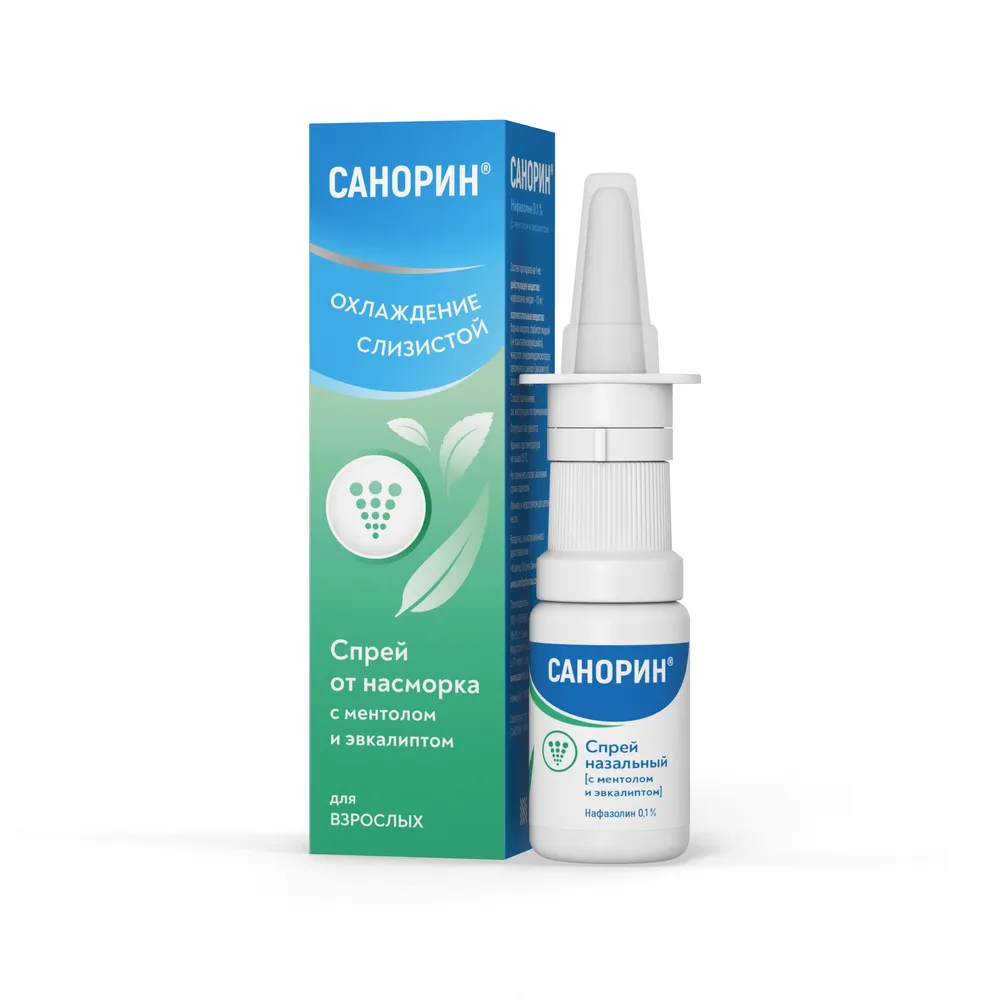
SANORIN
UkraineThe drug is used for acute rhinitis, as well as an adjunct treatment for inflammation of the middle ear and paranasal sinuses.
Frequently asked questions
How should Sanorin be taken correctly?
Children aged 3 to 6 years should receive 1–2 sprays in each nostril; children aged 6 to 15 years should receive 2 sprays. It can be used 3 times a day, but not more often than every 4 hours. It is important not to use the drug for more than 3 consecutive days.
Who should not use this drug?
It is prohibited for children under 3 years of age, as well as for people with hypersensitivity to the components of the product or dry nasal mucosa.
What are the possible side effects of Sanorin?
Possible sensations of burning, nasal dryness, or allergic reactions. When using large doses, palpitations, increased blood pressure, headache, dizziness, drowsiness, or insomnia may occur. Prolonged use may lead to dependence and damage to the nasal mucosa.
Can this product be combined with other medicines?
Caution is required when taken simultaneously with MAO inhibitors (antidepressants) and other drugs that increase blood pressure, as this may lead to a spike in arterial blood pressure.
Does the drug affect the ability to drive a car?
When used at the recommended doses, the drug has almost no effect on the ability to operate vehicles or machinery.
Instructions for use
INSTRUCTIONS FOR MEDICAL USE OF THE MEDICINAL PRODUCT SANORIN (SANORINÒ)
Composition:
Active substance: naphazoline nitrate;
1 ml of solution contains 0.5 mg of naphazoline nitrate;
Excipients: boric acid, ethylenediamine, methylparaben (E 218), purified water.
Pharmaceutical form. Nasal spray, solution.
Main physicochemical characteristics: clear, colorless, odorless solution.
Pharmacotherapeutic group. Decongestants and other agents for local use in nasal cavity disorders. Simple sympathomimetics.
ATC code R01A A08.
Pharmacological properties.
Pharmacodynamics.
Naphazoline is a sympathomimetic agent that acts on α-adrenergic receptors and exerts minimal effect on β-adrenergic receptors. Due to its vasoconstrictor action, it reduces swelling, hyperemia, and exudation, thus facilitating nasal breathing in rhinitis. Naphazoline promotes opening and dilation of the drainage pathways of the nasal sinuses and Eustachian tubes, improving secretion drainage and preventing bacterial colonization.
Therapeutic effect after intranasal administration begins within 5 minutes and lasts for 4–6 hours.
Pharmacokinetics.
When applied locally, naphazoline is completely absorbed.
Clinical characteristics.
Indications.
Acute rhinitis. As an adjunctive agent in inflammation of the paranasal sinuses and the middle ear.
Contraindications.
Hypersensitivity to the active substance or to any component of the medicinal product.
Dry inflammation of the nasal mucosa.
Not to be used in children under 3 years of age.
Interaction with other medicinal products and other forms of interaction.
Concomitant use of Sanorin with monoamine oxidase inhibitors (MAO), tricyclic antidepressants, mianserin, or within several days after discontinuation of these drugs may cause an increase in blood pressure (even several days after administration).
Special precautions.
Use the drug with caution in severe cardiovascular disorders (arterial hypertension, ischemic heart disease), diabetes mellitus, hyperthyroidism, pheochromocytoma, and during concomitant use of monoamine oxidase inhibitors (MAO inhibitors) or other drugs that may exert a hypertensive effect.
Caution is required during general anesthesia using anesthetics that increase myocardial sensitivity to sympathomimetics (e.g., halothane), in bronchial asthma, as well as during pregnancy and breastfeeding.
When high doses of the drug are used, adverse effects on the cardiovascular and nervous systems may occur, such as palpitations, arterial hypertension, arrhythmia, headache, dizziness, drowsiness, or insomnia.
Prolonged use and overdosage should be avoided, as they may lead to edema and subsequent atrophy of the nasal mucosa.
This medicinal product contains methylparaben, which may cause allergic reactions (possibly delayed).
Use during pregnancy or breastfeeding.
There are no data regarding the ability of naphazoline to cross the placental barrier or to be excreted in breast milk. Therefore, the decision to prescribe the drug to women during pregnancy or breastfeeding should be made only after careful consideration of all potential risks and benefits, and the drug should be prescribed only if absolutely necessary.
Ability to affect reaction speed when driving vehicles or operating machinery.
Use of the medicinal product Sanorin at recommended doses has no effect or negligible effect on the ability to drive vehicles or operate machinery.
Method of Administration and Dosage.
Children aged 3 to 6 years: administer 1–2 sprays into each nostril; children aged 6 to 15 years: 2 sprays into each nostril.
Sanorin should be used 3 times daily, but no more frequently than every 4 hours.
Sanorin must not be used for longer than 3 days.
If nasal breathing improves, treatment may be discontinued earlier.
Sanorin may be re-administered only after several days.
Children.
To be used in children aged 3 years and older.
Overdose.
Overdose or accidental ingestion of the medication may cause systemic adverse effects: nervousness, increased sweating, headache, tremor, tachycardia, palpitations, arterial hypertension. Cyanosis, nausea, elevated body temperature, spasms, cardiac arrest, pulmonary edema, psychiatric disturbances, pallor of the skin, and myocardial infarction may also occur.
Depressive effects on the central nervous system may manifest as decreased body temperature, bradycardia, increased sweating, drowsiness, hypotensive shock-like state, apnea, and coma. The risk of overdose is higher in children, who are more vulnerable to adverse effects than adults.
Post-marketing data indicate that excessive systemic exposure, for example due to intentional or accidental overdose of naphazoline (including unintentional oral ingestion), may lead to severe cardiovascular and/or cerebrovascular adverse reactions.
Treatment is symptomatic.
Side effects
In patients with increased sensitivity, the medicinal product may rarely cause burning and dryness of the nasal mucosa. In isolated cases, a sensation of severe nasal congestion may occur.
Systemic adverse reactions (most often occurring in cases of overdose) are observed only rarely:
Immune system: allergic reactions, including angioedema (Quincke's edema), burning sensation.
Nervous system: nervousness, headache, tremor.
Cardiac system: tachycardia, palpitations.
Vascular system: arterial hypertension.
Skin and subcutaneous tissues: increased sweating.
Prolonged or frequent use of the medicinal product may lead to drug dependence—known as rhinitis medicamentosa—characterized by intense swelling of the nasal mucosa occurring after a relatively short time following administration. Long-term use of the product may result in damage to the mucosal epithelium, suppression of epithelial ciliary activity, and may cause irreversible mucosal damage and development of atrophic rhinitis (dry rhinitis).
Reporting of suspected adverse reactions
Reporting suspected adverse reactions after the medicinal product has been authorized is important. It allows continued monitoring of the benefit-risk balance of the medicinal product. Healthcare professionals and patients, as well as their legal representatives, are encouraged to report all suspected adverse reactions and lack of efficacy via the automated pharmacovigilance information system at the following link: https://aisf.dec.gov.ua.
Shelf life: 3 years.
Storage conditions
Store in the original packaging to protect from light, at a temperature not exceeding 25 °C, in a place inaccessible to children. Do not freeze.
Packaging
10 ml of solution in a bottle with a mechanical spray pump; 1 bottle with a nasal applicator in a carton.
Supply classification: Over-the-counter (without prescription).
Manufacturer:
Teva Czech Industries s.r.o.
Sandoz Pharmaceuticals d.d.
Manufacturer's address and location of operations:
Ostravska 29/305, Opava-Komarov, 747 70, Czech Republic.
Nitrianska 100, 920 27 Glogovec, Slovak Republic.
Similar drugs
| Brand name | Dosage form | Active substance / Dosage | Manufacturer |
|---|---|---|---|
| SANORIN | spray, nasal solution |
|
Teva Czech Industries s.r.o. (full production cycle) |
The original data is available in the language of the country of manufacture.
Data source: State Register of Medicinal Products of Ukraine
Data last verified: August 13, 2026