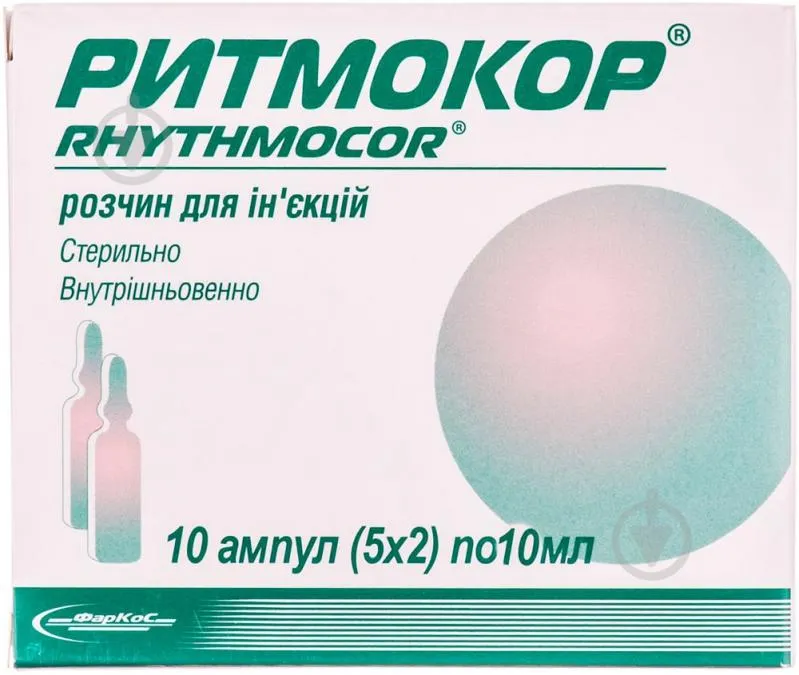
RHYTHMICOR
UkraineThe drug is used for the complex treatment of cardiac rhythm disorders (including myocardial infarction, atrial fibrillation, and other arrhythmias), ischemic heart disease, myocarditis, as well as potassium and magnesium deficiency in the body.
Frequently asked questions
How should Rhythmicor be taken correctly?
The drug is administered intravenously (as a bolus or infusion) after preliminary dilution in saline or a 5% glucose solution. For adults, it is usually prescribed 1–2 times a day, with a treatment course of 10–14 days. The dosage for children depends on age and must be prescribed by a physician.
Who should not use this drug?
Contraindications include hypersensitivity to the components, cardiogenic shock, low systolic blood pressure (below 90 mmHg), serious cardiac conduction disturbances (second or third-degree blocks), comatose states, decompensated diabetes mellitus, severe renal failure, Addison's disease, as well as excess potassium or magnesium in the blood.
What side effects can Rhythmicor cause?
Side effects occur rarely. Possible effects include nausea, vomiting, diarrhea, abdominal pain, hot flashes, dizziness, drowsiness, as well as allergic reactions (rash, itching, urticaria).
Can the drug be combined with other medicines?
When used simultaneously with antiarrhythmic and antihypertensive agents, their effect may be enhanced. When used with cardiac glycosides, the risk of their toxicity is reduced. If you are taking potassium-sparing diuretics or ACE inhibitors, it is necessary to monitor blood potassium and magnesium levels.
What should be noted during treatment?
During administration, it is necessary to regularly monitor serum potassium and magnesium levels, as well as ECG data. Patients with diabetes mellitus should remember that the drug may lead to false high glucose readings when using certain analytical methods.
Instructions for use
INSTRUCTIONS FOR MEDICAL USE OF THE MEDICINAL PRODUCT RYTHMOCORÒ (RHYTHMOCORÒ)
Composition:
Active substances: magnesium salt of 2,3,4,5,6-pentahydroxycaproic acid, potassium salt of 2,3,4,5,6-pentahydroxycaproic acid.
1 ml of solution contains magnesium salt of 2,3,4,5,6-pentahydroxycaproic acid, calculated as 100 % substance, 0.0833 g; potassium salt of 2,3,4,5,6-pentahydroxycaproic acid, calculated as 100 % substance, 0.0167 g;
Excipient: sodium benzoate (E 211).
Pharmaceutical form. Solution for injection.
Main physico-chemical properties: almost clear yellowish liquid.
Pharmacotherapeutic group. Combined cardiovascular preparations. ATC code C01EX.
Pharmacological properties.
Pharmacodynamics. The medicinal product exerts metabolic, antioxidant, membrane-stabilizing, and antiarrhythmic effects. The metabolic activity is due to activation of redox enzymes and elevation of adenosine triphosphate (ATP) and creatine phosphate levels. This effect of the drug promotes optimization of cellular ion pump function. One of the mechanisms of drug action on cells under conditions of ischemia and hypoxia is suppression of the intensity of free-radical oxidation processes of proteins and lipid peroxidation. Administration of the drug in conditions associated with activation of free-radical reactions is accompanied by reduced permeability of cellular membranes. Due to this action, as well as the content of magnesium and potassium ions, the drug exerts antiarrhythmic effects and enhances the clinical efficacy of antiarrhythmic agents.
Pharmacokinetics. After intravenous administration, 95% of the drug is metabolized to water and carbon dioxide within 48 hours.
Clinical characteristics.
Indications.
The drug is indicated as part of combination therapy for cardiac arrhythmias, including those associated with cardiac glycoside intoxication, paroxysmal atrial fibrillation/flutter with normal ventricular response, acute myocardial infarction, ventricular extrasystolic arrhythmias, reciprocal nodal tachycardia, and "torsade de pointes" tachycardia, especially in the presence of electrolyte imbalances (hypokalemia, hypomagnesemia).
The drug is used in the treatment of ischemic heart disease (to reduce hypoxic and ischemic metabolic disturbances of the myocardium associated with insufficient coronary blood flow). The drug is also indicated in the treatment of myocarditis and hypokalemia induced by the use of diuretics.
Contraindications.
Hypersensitivity to the components of the drug. Cardiogenic shock, systolic blood pressure below 90 mm Hg in adults, second- or third-degree atrioventricular block, comatose states of unknown etiology, decompensated forms of diabetes mellitus, acute and chronic renal insufficiency of grade II–IV, Addison's disease. Rhythmocor® is contraindicated in hyperkalemia and hypermagnesemia.
Interaction with other medicinal products and other forms of interaction.
When Rhythmocor® is used concomitantly with antiarrhythmic and antihypertensive agents, mutual enhancement of drug activity may occur. When used simultaneously with cardiac glycosides, the risk of their toxic effects on the heart is reduced. When used concomitantly with potassium-sparing diuretics and angiotensin-converting enzyme inhibitors, serum levels of potassium and magnesium should be monitored.
Special precautions.
When prescribing Rhythmocor® to patients with diabetes mellitus, it should be noted that false-positive results for elevated glucose levels may occur when using the orthotoluidine method, due to the presence of gluconic (pentahydroxycaproic) acid in the drug.
During treatment with this medication, serum potassium and magnesium levels should be monitored. Particular attention should be paid to patients at high risk of developing hyperkalemia, in whom electrolyte balance and ECG parameters should be regularly monitored.
Hypermagnesemia and hyperkalemia may manifest as paresthesia, decreased tendon reflexes, tremor, and respiratory depression. Calcium preparations are used to counteract hypermagnesemia.
The drug should be used with caution in patients with myasthenia gravis and in conditions that may lead to hyperkalemia, such as acute dehydration, extensive tissue damage, including severe burns.
One ampoule (5 ml) of the drug contains 0.008 bread units.
This medicinal product contains less than 1 mmol (23 mg)/dose of sodium, i.e. it is practically sodium-free.
Use during pregnancy or breastfeeding.
Experience with use is lacking.
Ability to affect reaction speed when driving or operating machinery.
If dizziness, drowsiness, or a sensation of warmth throughout the body occurs during treatment with this drug, patients should refrain from driving or operating machinery.
Administration and Dosage.
For adults, Rhythmocor® should be administered 1–2 times daily intravenously as a bolus injection of 5–10 mL, previously diluted in 10 mL of isotonic sodium chloride solution or 5% glucose solution. The drug may also be administered intravenously by infusion: 5–20 mL of the drug should be diluted in 50–400 mL of isotonic sodium chloride solution or 5% glucose solution. The usual treatment course lasts 10–14 days.
For the treatment of torsades de pointes tachycardia, administer 10–20 mL of the drug intravenously as a bolus injection, previously diluted in 10 mL of isotonic sodium chloride solution or 5% glucose solution, followed by intravenous infusion: 5–20 mL of the drug diluted in 50–400 mL of isotonic sodium chloride solution or 5% glucose solution.
For children aged 1–3 years, the drug is administered at a dose of 1–2 mL of solution per year of life, previously diluted in 5–10 mL of isotonic sodium chloride solution or 5% glucose solution, 1–2 times daily; for children aged 3–6 years – 5 mL of solution, previously diluted in 10 mL of isotonic sodium chloride solution or 5% glucose solution, 1–2 times daily; for children aged 6–12 years – 5–10 mL, previously diluted in 10 mL of isotonic sodium chloride solution or 5% glucose solution, 1–2 times daily; for children aged 12 years and older, the drug is administered at the same dose as for adults.
Children. This medicinal product is indicated for use in children aged 1 year and older.
Overdose.
Following intravenous administration of large doses, manifestations of hypersensitivity to the drug may occur, as well as signs of hyperkalemia and hypermagnesemia, which may present as paresthesia, decreased tendon reflexes, tremor, and respiratory depression. To reduce the effects of hypermagnesemia, calcium preparations are used.
Hypermagnesemia and hyperkalemia may manifest as decreased tendon reflexes, tremor, respiratory depression, and arrhythmia.
Symptoms of hyperkalemia: general weakness, paresthesia, bradycardia, muscle paralysis.
Symptoms of hypermagnesemia: facial skin flushing, weakness, drowsiness, nausea, vomiting, diarrhea, arterial hypotension, bradycardia, slurred speech, diplopia.
Adverse reactions.
The medicinal product is well tolerated, and adverse effects develop very rarely. In individual cases, in patients with increased individual sensitivity to the drug, the following may occur during its use:
From the gastrointestinal tract: nausea, diarrhea, vomiting, abdominal pain, feeling of discomfort or burning in the epigastric region.
From the vascular system: sensation of warmth throughout the body, dizziness, and drowsiness.
From the immune system: allergic reactions are rarely observed, including rash, itching, urticaria, sensation of warmth, skin hyperemia. After discontinuation of the drug, all adverse effects rapidly resolve. In case of allergic manifestations, desensitizing therapy is prescribed.
Shelf life. 2 years.
Storage conditions. Store in the original packaging at a temperature not exceeding 25 °C.
Keep out of reach of children.
Packaging. 5 ml in ampoules № 10 (5×2) in carton packs.
Prescription status. Prescription only.
Manufacturer: LLC "Pharmaceutical Company "FARCOС".
Manufacturer's address and location of business activities:
360, Svyato-Pokrovska St., Gorodnyanskyi district, Hostomel, Irpin, Kyiv region, Ukraine, 08290.
Marketing authorization holder: LLC "Pharmaceutical Company "FARCOС".
Address of the marketing authorization holder: 50-A, Zodchykh St., Kyiv, Ukraine, 03162.
Similar drugs
| Brand name | Dosage form | Active substance / Dosage | Manufacturer |
|---|---|---|---|
| CARDIOARGININE-ZDOROVYA | solution for injection |
|
LLC "Corporation "Zdorovya" |
The original data is available in the language of the country of manufacture.
Data source: State Register of Medicinal Products of Ukraine
Data last verified: August 13, 2026