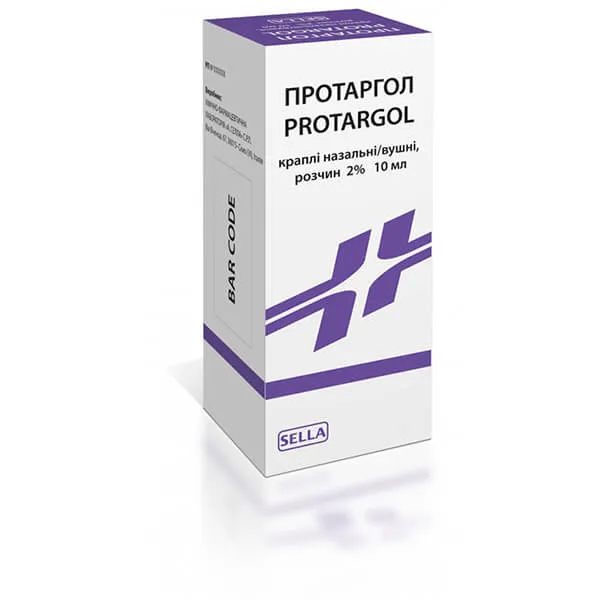
PROTARGOL
UkraineThe drug is used as an antiseptic for the ear canal and as a remedy for the nasal mucosa to help reduce swelling.
Frequently asked questions
How should Protargol be taken correctly?
Instill 1–2 drops into each nostril or into the ear canal 2–3 times a day. Typically, the course of treatment lasts from 5 to 10 days.
Can the drug be used by children?
The 0.5% concentration solution is recommended for children from birth to 3 years of age; however, for infants under 3 months, it should only be used as prescribed by a physician. The 1% and 2% concentration solutions are intended for adults only.
Who should not use this product?
The drug is contraindicated in individuals with hypersensitivity to any of its components. It is also not recommended for use during pregnancy and breastfeeding due to a lack of sufficient data.
What are the possible side effects of Protargol?
Possible allergic reactions (urticaria, Quincke's edema), irritation, burning, or itching of the mucous membrane. Prolonged and excessive use may cause argyria—a change in skin color to gray or dark blue.
With which other medicines should the drug not be combined?
The product should not be used simultaneously with preparations containing papain (an enzyme from papaya), as this may reduce the effectiveness of the latter. Local application is also not recommended together with alkaloid salts, organic bases (e.g., adrenaline), or zinc sulfate.
What should be done if an allergic reaction occurs?
Before the first use, it is advisable to apply a small amount of the solution to the skin in the elbow crease area. If irritation, burning, or itching occurs, immediately rinse the area with plenty of water and discontinue use.
Instructions for use
INSTRUCTION FOR MEDICAL USE OF THE MEDICINAL PRODUCT PROTAARGOL (PROTARGOL)
Composition:
Active substance: silver proteinate;
100 g of solution contains 0.5 g, 1 g, or 2 g of silver proteinate;
Excipients: disodium hydrogen phosphate, potassium dihydrogen phosphate, imidourea, purified water.
Pharmaceutical form. Nasal/otic drops, solution 0.5%, 1%, or 2%.
Main physicochemical properties: brown solution with slight opalescence.
Pharmacotherapeutic group. Agents used in nasal diseases. Decongestants and other agents for local application in nasal diseases. Other agents for treatment of nasal diseases. ATC code R01A X10.
Pharmacological Properties
Pharmacodynamics. Antibacterial agent. Silver proteinate preparations, silver ions, or silver salts inhibit the growth of gram-positive and gram-negative bacteria (bacteriostatic effect). In addition, silver ions cause precipitation of bacterial proteins (bactericidal effect).
Pharmacokinetics.
Silver proteinate, when applied topically, is poorly absorbed.
Clinical characteristics.
Indications. A decongestant and antiseptic agent for nasal mucosa, and an antiseptic for the ear canal.
Contraindications. Hypersensitivity to any component of the medicinal product.
Special precautions. Avoid contact of the medicinal product with the eyes.
Before use, apply a small amount of the solution to the skin in the area of the elbow flexure to detect individual intolerance. If symptoms of individual intolerance occur (irritation, burning, itching of the skin), wash the application site thoroughly with large amounts of water, discontinue use, and consult a physician if necessary.
Adhere strictly to the recommended dosage and method of administration. Silver-containing preparations, when used over prolonged periods or in excessive doses, may cause argyria (pigmentation associated with deposition of silver in tissues).
Interaction with other medicinal products and other forms of interaction. Protargol may interact with preparations containing papain. Papain is a proteolytic enzyme of the hydrolase class, obtained from immature fruits of papaya (Carica papaya). Concurrent use of silver proteinate and papain may reduce the enzymatic activity of the latter.
Concomitant topical use with agents containing alkaloid salts and organic bases (e.g., adrenaline) is not recommended. The medicinal product is pharmaceutically incompatible with zinc sulfate.
Special precautions for use.
Avoid concomitant use with papain-based preparations (see section "Interaction with other medicinal products and other forms of interaction"). The recommended dosage and administration route of the medicinal product should be strictly followed. Prolonged excessive use of silver proteinate may cause toxic effects.
Use during pregnancy or breastfeeding. The medicinal product should not be used during pregnancy or breastfeeding due to insufficient data on its use during these periods.
Ability to influence reaction speed when driving or operating machinery. No influence.
Administration and Dosage.
Instill 1–2 drops into each nostril or into the ear canal 2–3 times daily. The treatment course lasts 5–10 days. The duration of treatment should be determined individually by a physician.
Children. The 0.5% formulation is recommended for children from birth up to 3 years of age. For infants from birth to 3 months of age, the medication should be used only as prescribed by a physician. The 1% and 2% formulations are not intended for use in children.
Overdose. There have been no reported cases of overdose with this medication.
Symptoms. In the event of overdose associated with accumulation of high concentrations of silver ions in blood plasma, skin discoloration and slurred speech may occur. Prolonged uncontrolled daily intake of silver protein may lead to irreversible neurotoxicity with myoclonic epileptic status, resulting in coma and ultimately death. Accumulation of silver in the skin, mucous membranes, spleen, membranes, and eyes due to ingestion or absorption—even in small amounts—may cause argyria, characterized by grayish to dark blue skin pigmentation resulting from silver's interaction with various proteins and subsequent pigment formation. UV radiation enhances pigmentation. The first signs of argyria during treatment with silver-containing drugs typically appear 2–4 years after the start of continuous daily use: deposition of silver may occur in connective tissue, capillary walls of various organs, including kidneys and bone marrow. Symptoms of argyria may include right upper quadrant pain, hepatomegaly, and reduced twilight vision. Additionally, systemic symptoms such as hepatotoxicity, cardiomyopathy, and amnesia may occur as consequences of neurotoxic processes.
Side effects.
Data on the frequency of adverse effects are not specified.
Immune system disorders: hypersensitivity reactions, including allergic reactions such as urticaria, atopic dermatitis, anaphylactic shock, and Quincke's edema.
Skin and subcutaneous tissue disorders: dermatitis, rash, burning sensation, skin irritation, skin discoloration, hypersensitivity reactions, allergy.
General disorders and administration site reactions: mild irritation of the nasal mucosa, burning, itching.
Prolonged use may cause argyria (see section "Overdose").
Reporting suspected adverse reactions. Reporting suspected adverse reactions after authorization of the medicinal product is important. It allows ongoing monitoring of the benefit-risk balance of the medicinal product. Medical and pharmaceutical professionals, as well as patients or their legal representatives, should report all suspected adverse reactions and lack of efficacy via the Automated Information System for Pharmacovigilance at the following link: https://aisf.dec.gov.ua
Shelf life. 2 years.
Storage conditions. Store in the original packaging at a temperature not exceeding 25 °C. Keep out of reach of children. The shelf life after opening the packaging is 15 days.
Packaging. 10 ml in a glass vial with a dropper cap; 1 vial per cardboard package.
Supply category. Over-the-counter.
Manufacturer. A. Sella S.R.L. Chemical-Pharmaceutical Laboratory.
Manufacturer's address and place of business. Via Vicenza, 67, 36015-Schio (VI), Italy.
Similar drugs
| Brand name | Dosage form | Active substance / Dosage | Manufacturer |
|---|---|---|---|
| ARGOL | drops, nasal/aural, solution |
|
DKP "Pharmaceutical Factory" LLC |
| PROTARGOL | drops, nasal/aural, solution |
|
Chemical-Pharmaceutical Laboratory "A. Sella" s.r.l. |
| PROTARGOL | drops, nasal/aural, solution |
|
Chemical-Pharmaceutical Laboratory "A. Sella" S.r.l. |
The original data is available in the language of the country of manufacture.
Data source: State Register of Medicinal Products of Ukraine
Data last verified: August 13, 2026