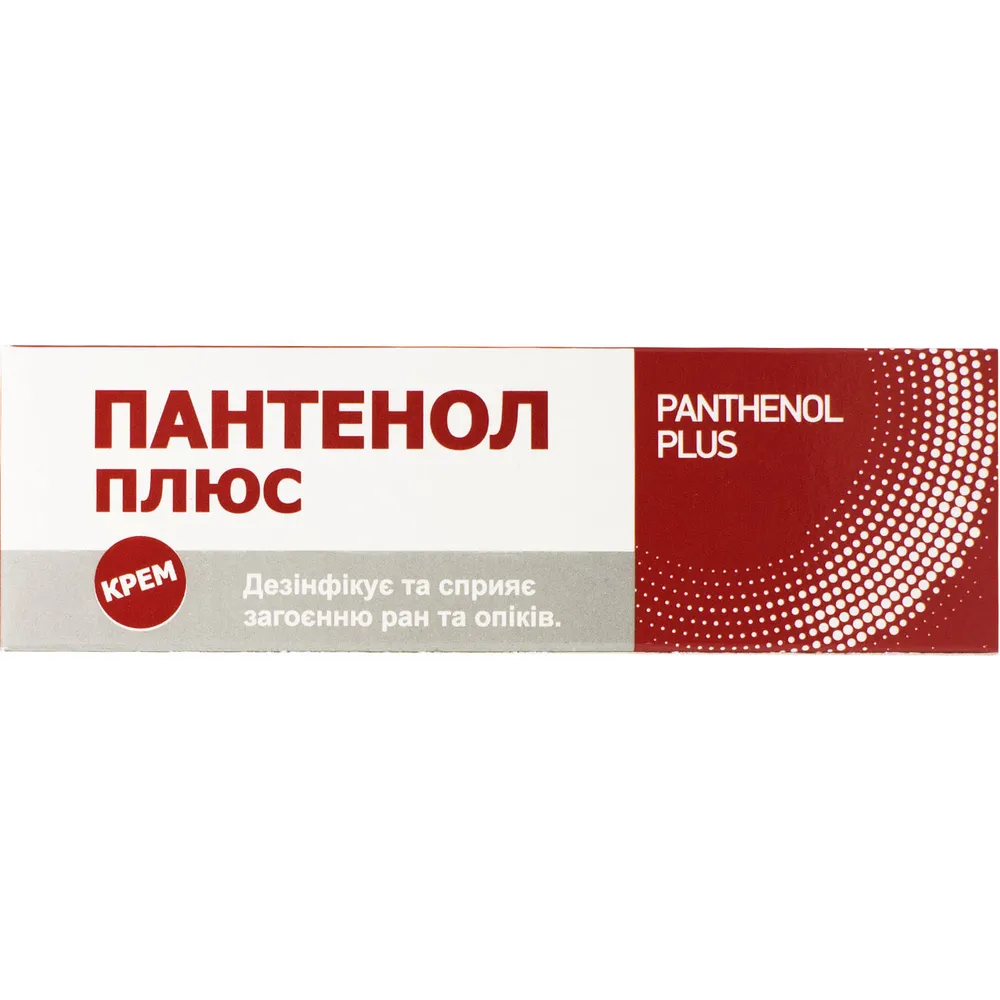
PANTHENOL PLUS
UkraineThe cream is used for the treatment of superficial skin damage with a risk of infection (scratches, cuts, burns, cracks), chronic lesions (pressure sores, ulcers), skin infections (eczema, neurodermatitis), as well as for the treatment of nipple cracks in breastfeeding women and for surgical wounds.
Frequently asked questions
How should Panthenol plus be used correctly?
For adults and children from 1 year of age, apply the cream once or several times a day to pre-cleaned skin. The daily dose should not exceed 5 g. If necessary, a dressing may be applied. Avoid application to large areas of skin.
Are there any contraindications for the drug?
It must not be used in case of hypersensitivity to the components of the product, and it is prohibited to apply to a damaged eardrum. It is not recommended for use in allergic skin diseases without infectious complications and for treating irritations with a low risk of infection (e.g., sunburns).
What are the possible side effects of Panthenol plus?
Possible allergic reactions: itching, swelling, rash, dermatitis, burning sensation. In rare cases, serious reactions of the respiratory tract, cardiovascular system, or gastrointestinal tract may occur. If contact with eyes occurs, serious corneal damage is possible.
Can this cream be combined with other products?
It is not recommended to use Panthenol plus simultaneously with other antiseptics to prevent them from neutralizing each other. Additionally, the chlorhexidine in the composition is incompatible with saponifying substances.
What should be done if the cream gets into the eyes?
The eyes must be immediately and thoroughly rinsed with water, and an ophthalmologist must be consulted.
Can the drug be used by pregnant and breastfeeding women?
It is not recommended for pregnant women to apply the product to large areas of skin. Breastfeeding women may use the cream, but should also avoid large areas; if the product is used to treat nipple cracks, it must be washed off before feeding.
Instructions for use
INSTRUCTIONS FOR MEDICAL USE OF THE MEDICINAL PRODUCT PANTHENOL PLUS (PANTHENOL PLUS)
Composition:
Active substances: chlorhexidine dihydrochloride, dexpanthenol;
1 g of cream contains 5 mg of chlorhexidine dihydrochloride and 50 mg of dexpanthenol;
Excipients: DL-pantolactone, cetyl alcohol, stearyl alcohol, soft white paraffin, mineral oil, lanolin, polyethylene glycol stearate, purified water.
Pharmaceutical form. Cream.
Main physicochemical characteristics: homogeneous cream ranging from almost white to pale yellow in color.
Pharmacotherapeutic group. Dermatological agents. Antiseptics and disinfectants. Chlorhexidine combinations. ATC code D08AC52.
Pharmacological properties.
Pharmacodynamics. Chlorhexidine dihydrochloride is an antiseptic agent exerting bactericidal activity against gram-positive bacteria, particularly against sensitive strains of Staphylococcus aureus — microorganisms most commonly associated with skin infections. Chlorhexidine dihydrochloride is less active against gram-negative pathogenic microorganisms. Some species of Pseudomonas and Proteus are resistant to chlorhexidine. It has weak activity against fungi and is not active against viruses.
Dexpanthenol, the active component of the medicinal product Pantenol Plus, is rapidly converted into pantothenic acid within skin cells and acts as a vitamin. However, dexpanthenol has an advantage, as it is absorbed more rapidly than pantothenic acid upon topical application.
Pantothenic acid is a component of the essential coenzyme A (CoA). In this form, acetyl-coenzyme A (CoA) plays a central role in the metabolism of every cell. Thus, pantothenic acid is necessary for epithelial formation and healing of damaged skin and mucous membranes.
Pharmacokinetics. Absorption of chlorhexidine through intact skin has not been detected. In infants bathed in a 4% chlorhexidine gluconate cleansing solution, low blood concentrations of chlorhexidine (1 µg/mL) have been observed.
Little is known about the distribution of chlorhexidine in organs and tissues due to minimal absorption through the skin. After oral administration of 300 mg in healthy adults, a Cmax in plasma of 0.2 µg/mL can be detected within 30 minutes.
Chlorhexidine is practically not absorbed after topical dermal application. After oral administration, chlorhexidine is almost completely excreted in feces.
Dexpanthenol is rapidly absorbed through the skin. In skin cells, it is quickly converted into pantothenic acid and replenishes endogenous stores of this vitamin.
In blood, pantothenic acid binds to plasma proteins (mainly β-globulin and albumin). In healthy adults, concentrations are approximately 500–1000 µg/L and 100 µg/L in whole blood and blood serum, respectively.
Pantothenic acid is not metabolized in the body and is excreted unchanged. 60–70% of an oral dose is excreted in urine, the remainder in feces. In adults, 2–7 mg per day is excreted in urine; in children, 2–3 mg per day.
Clinical characteristics.
Indications.
- Superficial skin lesions of any origin where there is a risk of infection: scratches, cuts, abrasions, skin fissures, burns, abscesses, dermatitis.
- Chronic skin lesions such as leg ulcers and pressure sores.
- Skin infections, for example, secondarily infected eczema and neurodermatitis.
- Treatment of nipple fissures in breastfeeding women.
- Minor surgery: injuries and surgical wounds.
Contraindications.
Hypersensitivity to dexpanthenol and/or chlorhexidine or to any of the other components of the medicinal product.
Prohibited for application on a perforated eardrum.
Interaction with other medicinal products and other forms of interaction.
Chlorhexidine is incompatible with surfactants and other anionic compounds. Pantothenol Plus is not recommended for simultaneous use with other antiseptics to avoid mutual interference (antagonism or inactivation).
Special precautions for use
Contact with eyes, ears, and mucous membranes should be avoided.
Serious cases of persistent corneal damage, potentially requiring corneal transplantation, have been reported following accidental exposure of the eyes to medicinal products containing chlorhexidine, despite protective measures, due to migration of the medicinal product beyond the intended surgical site. Extreme caution must be exercised during application to ensure that Panthenol Plus does not migrate beyond the intended site of application into the eyes. Particular caution is required in anesthetized patients who are unable to immediately report exposure of the eyes to the medicinal product. In case of accidental contact with eyes, they should be immediately and thoroughly rinsed with water. An ophthalmologist should be consulted.
Panthenol Plus is not recommended for the treatment of skin irritations with low risk of infection (e.g., sunburn). It should not be used in allergic skin conditions without infectious complications.
Rarely, when using antiseptic agents containing chlorhexidine, mild to moderate symptoms of allergic reactions may occur, affecting the skin (e.g., itching, urticaria), face (e.g., angioneurotic edema), respiratory tract (e.g., asthma, wheezing, or other breathing difficulties), gastrointestinal tract, or cardiovascular system. If symptoms of a severe allergic reaction occur, use of Panthenol Plus should be discontinued immediately, and medical advice should be sought to prevent further progression.
Large, heavily contaminated, or deep wounds, as well as wounds resulting from bites or punctures, require medical intervention (risk of tetanus). If wound size remains extensive or the wound does not heal within 10–14 days, the continued use of the product should be re-evaluated. This is also necessary if pronounced perifocal hyperemia, swelling, severe pain, increased purulent exudation, or fever occur (risk of sepsis). The product should not be used for the treatment of infected wounds with abundant purulent exudation.
If infection persists or the condition worsens, medical advice should be sought.
The medicinal product contains cetyl alcohol and stearyl alcohol, which may cause local skin reactions (e.g., contact dermatitis).
Use during pregnancy or breastfeeding
Animal reproductive studies have shown no risk to the fetus. However, during pregnancy, Panthenol Plus should not be applied to large areas of skin, as there are no controlled studies in pregnant women.
The product may be used by women during breastfeeding, but application to large skin areas should be avoided. If the product is used to treat cracked nipples, it should be washed off before breastfeeding.
Ability to influence reaction rate while driving or operating machinery
No effect.
Dosage and Administration.
For adults and children aged 1 year and older, apply the medicinal product once or several times daily, as needed, to previously cleansed affected areas of the skin.
The daily dose during repeated application must not exceed 5 g of cream.
If necessary, dressings may be used.
The frequency of cream application and duration of treatment are determined individually according to the physician's recommendation, depending on the clinical signs of skin damage. Application to large skin areas should be avoided.
Children.
The medicinal product can be used in children aged 1 year and older.
Overdose.
Cases of overdose with topical application of the drug are unknown.
Dexpanthenol, even at high doses, is well tolerated and considered non-toxic. Cases of hypervitaminosis are unknown.
Elevated levels of aminotransferase after self-poisoning with chlorhexidine have been reported.
Skin irritation may frequently occur after repeated topical application to the same skin areas. The drug is intended for the treatment of superficial skin injuries. Application to large skin areas should be avoided.
Adverse reactions.
Immune system, skin and subcutaneous tissue disorders. Allergic reactions, including skin allergic reactions such as contact dermatitis, allergic dermatitis, pruritus, erythema, burning sensation, eczema, rash, urticaria, swelling, skin irritation, blisters. Hypersensitivity, anaphylactic reactions and anaphylactic shock (potentially life-threatening) with corresponding laboratory and clinical manifestations, including asthma syndrome, reactions ranging from mild to moderate severity, potentially affecting the skin, respiratory system, gastrointestinal tract, cardiovascular system, including cardiorespiratory failure.
Eye disorders. Corneal erosion, epithelial defect/corneal injury, severe irreversible visual impairment. In the post-marketing period, cases of severe corneal erosion and serious irreversible visual impairment due to accidental ocular exposure have been reported, resulting in corneal transplantation being required for some patients (see section "Special precautions for use").
Reporting of adverse reactions after marketing authorization of the medicinal product is of great importance. It enables continuous monitoring of the benefit-risk balance of the medicinal product. Healthcare and pharmaceutical professionals, as well as patients or their legal representatives, should report all suspected adverse reactions and lack of efficacy of the medicinal product through the Automated Information System for Pharmacovigilance at the following link: https://aisf.dec.gov.ua
Shelf life. 3 years.
Storage conditions.
Store at a temperature not exceeding 25 ºC.
Keep out of reach of children.
Packaging.
30 g in a tube, in a cardboard box.
Availability category. Over-the-counter.
Manufacturer/Applicant.
TOV "Ternopharm".
Address of manufacturer and location of activity / Address of applicant.
46010, Ternopil, Fabrychna Street, 4, Ukraine.
Tel./Fax: (0352) 521-444, www.ternopharm.com.ua
Similar drugs
| Brand name | Dosage form | Active substance / Dosage | Manufacturer |
|---|---|---|---|
| BEPANTHEN® PLUS | cream |
|
State Enterprise Grenzach Productions GmbH |
| PANTANOL-ZDOROVYA PLUS | cream | LLC "Corporation "Zdorovya" | |
| RYATIVNYK® | cream |
|
PJSC "Kyivmedpreparat" |
The original data is available in the language of the country of manufacture.
Data source: State Register of Medicinal Products of Ukraine
Data last verified: August 13, 2026