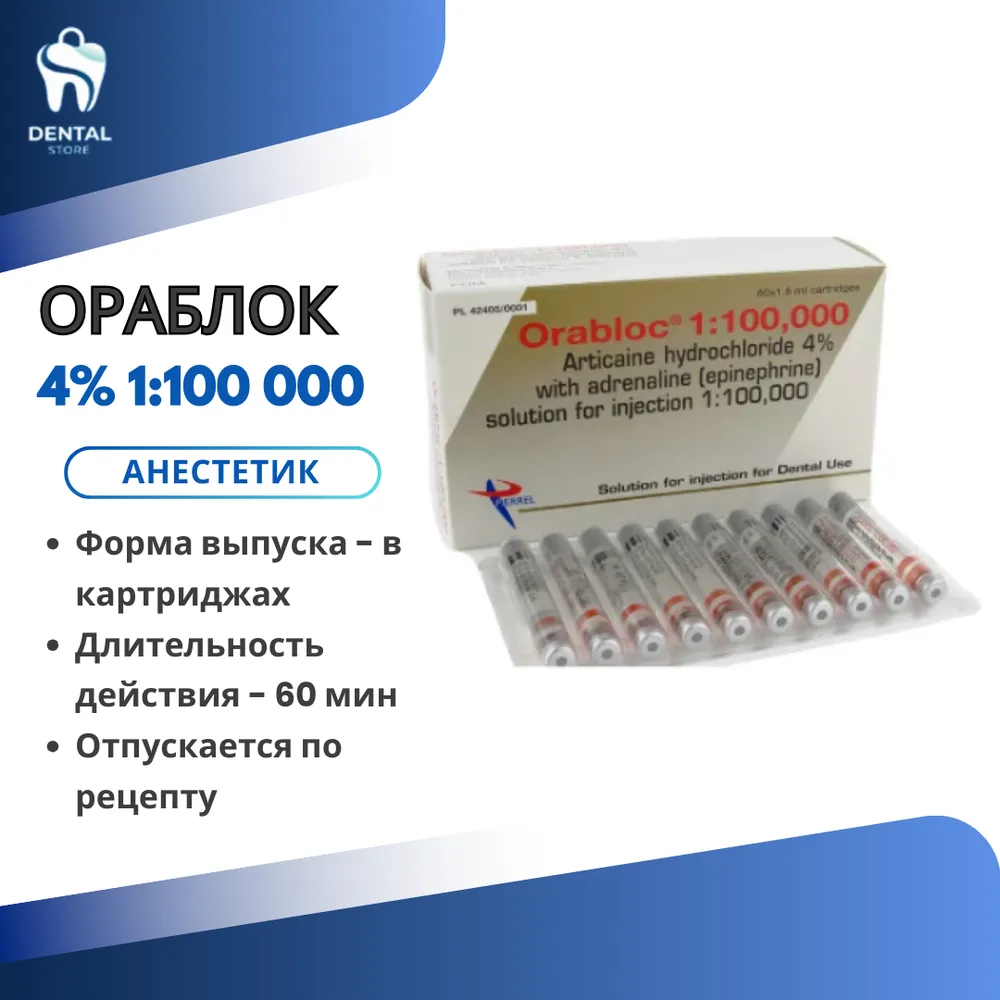
ORABLOC 1:100,000
UkraineThe drug is used in dentistry to perform local anesthesia during surgical interventions on teeth, gums, bones, and the oral mucosa.
Frequently asked questions
How should Orabloc 1:100,000 be used correctly?
The drug is administered via injection under the oral mucosa by a dentist. The dosage is selected individually depending on body weight (maximum dose for adults is 7 mg of articaine per 1 kg of weight) and the complexity of the procedure. The drug must not be administered intravenously.
Who should not use this drug?
Use is prohibited in cases of hypersensitivity to articaine, epinephrine, or sulfites. It is also contraindicated in patients with cardiac disorders (arrhythmia, severe heart failure, recent myocardial infarction), glaucoma, hyperthyroidism, pheochromocytoma, severe hypertension, or bronchial asthma (due to the risk of sulfite allergy).
What are the possible side effects of Orabloc 1:100,000?
Possible allergic reactions (swelling, itching, difficulty breathing), headache, dizziness, nausea, vomiting, as well as cardiac rhythm disturbances or increases/decreases in arterial blood pressure. In case of overdose, seizures, loss of consciousness, or respiratory impairment may occur.
Does the drug interact with other medicines?
A particular danger is the combination with non-selective beta-blockers (e.g., propranolol), tricyclic antidepressants, and MAO inhibitors, as this may cause serious cardiovascular problems. Caution should also be exercised when taking antithrombotic agents due to the risk of bleeding.
Can the drug be used in children and pregnant women?
In children, the drug is prescribed at the minimum necessary dose, taking their weight into account. In pregnant women, use is possible only after a thorough analysis of the risks and benefits to the mother, and it is recommended to consider an option with a lower epinephrine content.
Instructions for use
INSTRUCTIONS for medical use of the medicinal product Orabloc 1:100,000 (Orabloc 1:100,000)
Composition:
Active substances: 1 ml of injection solution contains 40 mg of articaine hydrochloride and 0.01 mg of adrenaline (epinephrine) in the form of adrenaline tartrate;
Excipients: sodium chloride, sodium metabisulfite (E 223), water for injections.
Pharmaceutical form. Injection solution.
Main physicochemical characteristics: cartridges containing a clear, colorless solution without visible particles.
Pharmacotherapeutic group.
Local anesthetics. Articaine, combinations.
ATC code N01B B58.
Pharmacological Properties
Pharmacodynamics.
OraBlock 1:100,000 is an amide-type local anesthetic used in dentistry for infiltration and conduction anesthesia. The drug has a rapid onset of action (latent period of 1 to 3 minutes) and provides strong analgesic effect. The duration of effective anesthesia is approximately 75 minutes.
The mechanism of action of articaine is believed to involve reduced impulse conduction along nerve fibers through blockade of voltage-dependent sodium channels in cellular membranes.
Clinical studies involving up to 210 patients demonstrated that administration of 4% articaine + 0.005 mg/mL adrenaline (epinephrine) at doses up to 5 mg/kg, and 4% articaine + 0.010 mg/mL adrenaline (epinephrine) at doses up to 7 mg/kg, in children aged 3.5 to 16 years provided reliable local anesthesia when administered via infiltration (for the mandible) and conduction (for the maxilla) techniques. The duration of anesthesia was similar across all age groups and depended on the amount of anesthetic administered.
Pharmacokinetics.
The plasma protein binding of articaine is 95%. After injection into the oral mucosa, the elimination half-life is 25.3 ± 3.3 minutes. Approximately 10% of articaine is metabolized in the liver, primarily by esterases present in blood plasma and tissues. Articaine is excreted predominantly by the kidneys in the form of articainic acid.
In children, total systemic exposure following infiltration anesthesia from the vestibular side was similar to that in adults, although minimum plasma concentrations were reached more rapidly.
Preclinical Safety Data.
Results of standard preclinical studies on safety pharmacology, chronic toxicity, reproductive toxicity, and genotoxicity indicate no special hazard to humans when therapeutic doses are used. At doses exceeding therapeutic levels, articaine exerts cardiodepressant effects and may produce vasodilatory effects. Adrenaline (epinephrine) counteracts the effects of sympathomimetics.
In embryotoxicity studies, no increased frequency of fetal mortality or developmental malformations was observed with daily intravenous administration of articaine at doses up to 20 mg/kg (rats) and 12.5 mg/kg (rabbits). Adrenaline (epinephrine) demonstrated toxic effects on reproductive function in animals at doses ranging from 0.1 to 5 mg/kg (several times higher than the maximum allowable dose of epinephrine (adrenaline) when using OraBlock 1:100,000), manifested as congenital developmental abnormalities and impaired uteroplacental blood flow.
In studies on embryofetotoxicity of articaine and adrenaline (epinephrine), no increased incidence of developmental abnormalities was observed with daily administration of articaine at doses up to 80 mg/kg (rats) and 40 mg/kg (rabbits).
In fertility and early embryofetal development studies in rats, no adverse effects on fertility in males or females were observed at doses causing toxic effects in parent animals.
Clinical characteristics.
Indications.
Surgical procedures on mucous membranes and bones requiring more intense ischemia; surgical procedures on dental pulp (amputation and extirpation); removal of periodontal or broken teeth (osteotomy); prolonged surgical procedures; transcutaneous osteosynthesis; removal of cysts; surgical procedures on gingival mucosa; apicectomy.
Contraindications.
Orabloc 1:100,000 must not be used in cases of hypersensitivity to the active substances—epinephrine and articaine—as well as to sulfites (metabisulfite (E 223)) or to any of the excipients of the medicinal product.
Due to the presence of articaine in Orabloc 1:100,000, the product must not be used in cases of:
- hypersensitivity to other amide-type local anesthetics;
- severe disturbances in cardiac impulse generation and conduction disorders (II–III degree AV block, marked bradycardia);
- acute decompensated heart failure (acute congestive heart failure);
- severe arterial hypotension.
Due to the presence of epinephrine in the formulation, Orabloc 1:100,000 must not be used:
- in patients with closed-angle glaucoma;
- in patients with hyperthyroidism;
- in patients with paroxysmal tachycardia or atrial fibrillation with tachycardia;
- in patients who have recently (within 3 to 6 months) suffered myocardial infarction;
- in patients who have recently (within 3 months) undergone coronary artery bypass surgery;
- in patients taking non-selective beta-blockers such as propranolol (due to the risk of hypertensive crisis or severe bradycardia);
- in patients with pheochromocytoma;
- in patients with severe arterial hypertension;
- when used concomitantly with tricyclic antidepressants or monoamine oxidase inhibitors (MAOIs), as their active substances may potentiate cardiovascular effects of adrenaline (epinephrine). This phenomenon may persist for up to 14 days after discontinuation of MAOI therapy.
Intravenous administration of the medicinal product is contraindicated.
Due to the presence of epinephrine, Orabloc 1:100,000 should not be used for anesthesia of extremities (e.g., fingers), as there is a risk of ischemia.
Orabloc 1:100,000 should not be used in patients with bronchial asthma and hypersensitivity to sulfites. In such patients, administration of Orabloc 1:100,000 may provoke acute allergic reactions with symptoms of anaphylaxis, such as bronchospasm.
Interaction with other medicinal products and other forms of interaction.
Combinations of different anesthetics exhibit additive effects and have a more pronounced impact on the cardiovascular system and CNS.
The hypertensive effects of sympathomimetic vasoconstrictors such as adrenaline may be enhanced by tricyclic antidepressants or MAO inhibitors. Therefore, such combinations are contraindicated (see section "Contraindications").
Orabloc 1:100,000 must not be administered to patients taking non-selective beta-blockers such as propranolol (see section "Contraindications").
Adrenaline (epinephrine) may inhibit insulin release from the pancreas, thereby reducing the effectiveness of oral antidiabetic agents.
Some inhalational anesthetics, such as halothane, may increase myocardial sensitivity to catecholamines, potentially causing ventricular arrhythmia after administration of the product.
It should be noted that in patients receiving antithrombotic agents (e.g., heparin, acetylsalicylic acid), accidental vessel puncture during local anesthesia may lead to severe bleeding. Such patients generally have an increased tendency to bleeding.
Special precautions for use
OraBlock 1:100,000 may be administered to patients with cholinesterase deficiency only when there are absolute indications for its use, since in such cases there is a high probability of prolonged duration of action of the drug and sometimes undesirable intensification of its effect.
OraBlock should be used with caution in:
- coagulation disorders;
- severe renal or hepatic impairment;
- concomitant use of halogen-containing inhalation anesthetics (see section "Interaction with other medicinal products and other forms of interaction");
- history of epilepsy (see section "Adverse reactions").
OraBlock 1:100,000 should be used with particular caution in patients with:
- cardiovascular diseases (e.g., heart failure, ischemic heart disease, angina pectoris, history of myocardial infarction, cardiac arrhythmias, arterial hypertension);
- atherosclerosis;
- cerebrovascular disorders, history of stroke;
- chronic bronchitis, pulmonary emphysema;
- diabetes mellitus;
- pronounced anxiety.
Furthermore, OraBlock 1:200,000 contains less epinephrine than OraBlock 1:100,000; therefore, in the above-mentioned cases, the use of OraBlock 1:200,000 is preferable.
Injections should not be administered into inflamed (infected) areas due to enhanced absorption of OraBlock 1:100,000, which leads to reduced efficacy.
Before administering this medicinal product, the patient must be interviewed, a medical history taken, information collected about concomitant medications being used, and verbal contact with the patient must be maintained throughout the administration process. An intradermal test injection with 5 to 10% of the intended dose should be performed if there is a risk of allergic reaction.
To avoid adverse reactions, the following should be observed:
- use the lowest possible dose;
- perform a two-stage aspiration test before injection (to avoid intravascular administration).
It is recommended that the patient eat only after full sensation has returned.
The medicinal product contains less than 1 mmol (23 mg) of sodium per dose, i.e., it is practically sodium-free.
Sodium metabisulfite (E 223) may rarely cause hypersensitivity reactions and bronchospasm.
Use in children
Caregivers of young children should be warned about the potential for soft tissue injury due to biting, resulting from prolonged numbness of soft tissues after anesthesia.
Use during pregnancy or breastfeeding
Pregnancy
There is no experience with the use of articaine in pregnant women, except during labor. Animal studies have not revealed any evidence of direct or indirect adverse effects of articaine on pregnancy, embryofetal development, labor, or postnatal development. Animal studies have demonstrated that epinephrine (adrenaline), at doses exceeding the maximum recommended, has a toxic effect on reproductive function (see section "Non-clinical safety data"). Epinephrine (adrenaline) and articaine cross the placental barrier, although articaine crosses to a significantly lesser extent compared to other local anesthetics. The concentration of articaine in newborn serum is approximately 30% of its concentration in maternal blood. Accidental intravascular administration of epinephrine (adrenaline) to the mother may reduce uterine blood flow. Use of OraBlock 1:100,000 during pregnancy is possible only after careful benefit-risk assessment.
OraBlock 1:200,000, which contains a lower amount of adrenaline (epinephrine), should be preferred over OraBlock 1:100,000.
Breastfeeding
Due to rapid decline in plasma concentrations and fast elimination of articaine from the body, it does not appear in breast milk in clinically significant amounts. Adrenaline (epinephrine) passes into breast milk but is also rapidly metabolized. There is no need to interrupt breastfeeding after short-term use of the drug.
Fertility
Animal studies with articaine 40 mg/mL + epinephrine 0.01 mg/mL did not reveal any negative effect on fertility (see section "Pharmacological properties"). When used at therapeutic doses, a negative effect on human fertility is not expected.
Ability to influence reaction speed when driving vehicles or operating machinery
Only the physician can decide in each individual case whether the patient is able to drive or operate machinery after administration of the drug. Fear associated with anticipation of dental procedures and the stress accompanying them may impair the ability to function effectively; however, appropriate studies have shown that local anesthesia with articaine does not cause any noticeable impairment of the ability to drive a vehicle.
Administration and Dosage
In the case of uncomplicated forceps removal of an upper jaw tooth in the absence of inflammation, it is sufficient to administer 1.8 mg of the drug into the vestibular fold on the vestibular side for each tooth. Occasionally, an additional vestibular injection of 1–1.8 mL of the drug may be required to achieve complete anesthesia. In most cases, there is no need to perform a painful palatal injection.
If an incision on the palate or suturing thereof is required, administration of 0.1 mL of the drug on the palatal side is sufficient to create a depot of the anesthetic. During multiple extractions of adjacent teeth, the number of vestibular depot injections can usually be reduced.
In uncomplicated forceps removal of mandibular premolars in the absence of inflammation, mandibular anesthesia may be omitted, as infiltration anesthesia achieved by injecting 1.8 mL of the drug per tooth is usually sufficient. If complete analgesia is not achieved, an additional vestibular injection of 1–1.8 mL should first be performed. Only if this also fails to provide complete anesthesia is standard inferior alveolar nerve block indicated.
For surgical procedures, the dose of OraBlock 1:100,000 should be adjusted according to the severity and duration of the surgery.
During a single treatment procedure, adults may receive up to 7 mg of articaine per 1 kg of body weight. Doses of up to 500 mg (equivalent to 12.5 mL of injectable solution) have been well tolerated by patients when an aspiration test is performed prior to injection.
Geriatric patients and patients with severe hepatic and renal dysfunction
Increased plasma concentrations of articaine may occur in geriatric patients and in patients with severe hepatic and renal dysfunction. Such patients require special caution, and the minimum dose necessary to achieve adequate depth of anesthesia should be used.
Route of administration and duration of use
OraBlock 1:100,000 is intended for submucosal administration into the oral cavity.
To avoid intravascular injection, an aspiration test must always be performed before injection. The aspiration test should be conducted in two planes, i.e., by rotating the needle 90° or even 180°.
Most systemic reactions resulting from accidental intravascular injection can be avoided in most cases by proper injection technique: after aspiration, slowly inject 0.1–0.2 mL, then slowly administer the remainder no sooner than 20–30 seconds later. Injection pressure should match tissue sensitivity.
A special injection device with appropriate disposable needles should be used for drug administration.
This medicinal product must not be used if it is cloudy or has changed color.
Children
OraBlock 1:100,000 should be administered to children in the minimal amount necessary to achieve adequate analgesia; the administered amount should be individually adjusted according to the child's age and body weight.
The maximum dose, which is 7 mg of articaine per 1 kg of body weight, must not be exceeded.
The use of the drug in children under 1 year of age has not been studied.
Overdose
Symptoms of overdose
Signs of CNS excitation: restlessness, anxiety, confusion, rapid breathing, tachycardia, elevated blood pressure accompanied by facial flushing, nausea, vomiting, tremor, involuntary muscle contractions, tonic-clonic seizures.
Signs of CNS depression: dizziness, hearing loss, inability to speak, stupor, loss of consciousness, muscular atony, vasomotor paralysis (weakness, pallor of the skin), dyspnea, fatal outcome due to respiratory center paralysis.
Signs of cardiovascular depression: bradycardia, arrhythmia, ventricular fibrillation, decreased blood pressure, cyanosis, cardiac arrest.
Emergency measures and antidotes
Upon the first signs of adverse reaction or toxic effects (e.g., dizziness, motor agitation, or stupor), the injection should be stopped immediately and the patient placed in a horizontal position. Airway patency should be ensured, and pulse and blood pressure should be monitored.
Even if intoxication symptoms do not appear severe, it is recommended to insert an intravenous catheter to ensure immediate intravenous access if needed.
For respiratory disturbances, depending on the severity of the condition, oxygen should be administered; artificial ventilation may be necessary. If required, endotracheal intubation combined with controlled mechanical ventilation should be performed.
Involuntary muscle contractions or generalized seizures should be controlled by intravenous administration of short-acting anticonvulsants (e.g., succinylcholine chloride, diazepam). Artificial ventilation (oxygen) is also recommended.
Hypotension, tachycardia, or bradycardia may be corrected simply by placing the patient in a horizontal position or in a position with legs slightly elevated above the head.
In cases of severe circulatory disturbances or shock, regardless of cause, the following emergency measures should be taken immediately after stopping the injection:
- Ensure the patient is in a horizontal position with slightly elevated lower limbs and maintain airway patency (oxygen insufflation);
- Initiate intravenous infusion of a balanced electrolyte solution;
- Administer intravenous glucocorticoids (250–1000 mg of prednisolone or equivalent dose of its derivative, e.g., methylprednisolone);
- Restore circulating blood volume (additionally, if necessary, use plasma substitutes or human albumin).
In case of impending circulatory collapse and increasing bradycardia, immediate intravenous injection of adrenaline (epinephrine) is required. For this purpose, 1 mL of adrenaline (epinephrine) 1:1000 solution should be diluted to 10 mL (alternatively, adrenaline (epinephrine) 1:10,000 solution may be used), and 0.25–1 mL of this solution (containing 0.025–0.1 mg of adrenaline (epinephrine)) should be slowly injected under continuous monitoring of pulse rate and blood pressure (caution: arrhythmia may occur). Do not administer more than 1 mL of this solution (0.1 mg of adrenaline (epinephrine)) during a single intravenous injection. If this amount of adrenaline is insufficient, it is recommended to add it to the infusion solution (infusion rate adjusted according to pulse rate and blood pressure).
Severe forms of tachycardia and tachyarrhythmia can be managed with antiarrhythmic agents, excluding non-selective beta-blockers such as propranolol (see section "Contraindications"). In such cases, oxygen administration and hemodynamic monitoring are essential.
In hypertensive patients with elevated blood pressure, if necessary, peripheral vasodilators should be administered.
Adverse Reactions
The following categories are used to classify the frequency of adverse reactions:
Very common (≥ 1/10).
Common (≥ 1/100, < 1/10).
Uncommon (≥ 1/1,000, < 1/100).
Rare (≥ 1/10,000, < 1/1,000).
Very rare (< 1/10,000).
Frequency not known (frequency cannot be estimated from the available data).
Immune system disorders
Frequency not known: hypersensitivity reactions (allergic and pseudoallergic) may occur. These may manifest as swelling and/or inflammation at the injection site, or independently of the injection site, as skin redness, itching, conjunctivitis, rhinitis, facial swelling (angioneurotic edema) with swelling of the upper and/or lower lip and/or cheeks, laryngeal edema causing a sensation of a lump in the throat and difficulty swallowing; urticaria and breathing difficulties, which may progress to anaphylactic shock.
Nervous system disorders
Common: paresthesia, hypoesthesia, headache (due to adrenaline content).
Uncommon: dizziness.
Frequency not known:
- When excessively high doses are used or in case of accidental intravascular administration, dose-dependent central nervous system (CNS) reactions may occur: restlessness, nervousness, stupor (which may progress to loss of consciousness), coma, respiratory depression (which may progress to respiratory arrest), muscle tremors, involuntary muscle contractions (which may progress to generalized seizures).
- Theoretical possibility of nerve injury (e.g., facial nerve paralysis) exists during any dental procedure due to improper injection technique or anatomical peculiarities of the injection site. In such cases, facial nerve injury and facial nerve palsy may occur. This may lead to reduced taste sensitivity.
Eye disorders
Frequency not known: during or shortly after local anesthetic injection in the head area, temporary visual disturbances may also occur (blurred vision, diplopia, mydriasis, blindness).
Cardiovascular system disorders
Uncommon: tachycardia.
Frequency not known: cardiac arrhythmias, increased blood pressure, arterial hypotension, bradycardia, heart failure, and shock (which may be life-threatening).
Gastrointestinal disorders
Common: nausea, vomiting.
General disorders and administration site conditions
Frequency not known: in case of accidental intravascular injection, ischemic areas may develop at the injection site, sometimes progressing to tissue necrosis (see section "Dosage and administration").
Cases of chills have been reported, mainly associated with anxiety related to dental procedures, increased sweating, tinnitus, and mydriasis.
Special warnings
In isolated cases, particularly in patients with bronchial asthma, the product may cause hypersensitivity reactions due to the presence of sodium metabisulfite (E 223) in its composition. These reactions may clinically present as vomiting, diarrhea, stridor, acute asthma attack, disturbances of consciousness, or shock.
Pediatric population
According to published study results, the safety profile in children aged 4 to 18 years was similar to that in adults. However, accidental soft tissue injuries due to prolonged soft tissue anesthesia were observed more frequently (up to 16% of children), especially in children aged 3 to 7 years. In a retrospective study involving 211 children aged 1 to 4 years, dental treatment was performed using 4% articaine + 0.005 mg/mL or 0.01 mg/mL adrenaline (epinephrine) at doses up to 4.2 mL. During this period, no adverse effects were reported.
Shelf life.
2 years.
Storage conditions.
Keep out of reach of children. Store at a temperature not exceeding 25 °C in the original packaging to protect from light.
Incompatibilities.
The product should not be mixed with other medicinal products.
Packaging.
Glass cartridges of type I hydrolytic resistance, 1.8 mL, sealed with an aluminum cap, bromobutyl rubber stopper, and bromobutyl rubber plunger.
Cartridges are labeled according to national requirements.
Cartridges are packed in transparent plastic blisters for easy inspection, each containing 10 cartridges; 5 blisters per lithographed carton, together with the patient leaflet.
Prescription status. Prescription only.
Manufacturer.
Pierrel S.p.A., Italy.
Manufacturer/Marketing Authorisation Holder and address of the place of business.
S.S. Appia – 81043 Capua (CE), Italy.
Marketing Authorisation Holder.
Pierrel S.p.A.
Manufacturer/Marketing Authorisation Holder and address of the place of business.
S.S. Appia 7BIS 46-48 – 81043 Capua (CE) – Italy.
Similar drugs
| Brand name | Dosage form | Active substance / Dosage | Manufacturer |
|---|---|---|---|
| ARTIDENT | solution for injection |
|
Huons Co., Ltd. |
| ARTIFRIN-ZDOROVYA | solution for injection |
|
LLC "Corporation "Zdorovya" (all manufacturing stages, quality control, batch release) |
| ARTIFRIN-ZDOROVYA FORTE | solution for injection |
|
LLC "Corporation "Zdorovya" (all manufacturing stages, quality control, batch release) |
| ARTINIBS WITH EPINEPHRINE 1:100.000 | solution for injection |
|
Laboratorios Inibsa, S.A. |
| ORABLOC 1:200,000 | solution for injection |
|
Pierrel S.p.A. |
| SEPTANEST WITH ADRENALINE 1/100 000 | solution for injection |
|
Septodont |
| SEPTANEST WITH ADRENALINE 1/200 000 | solution for injection |
|
Septodont |
| UBISTESIN | solution for injection |
|
Solventum Germany GmbH |
| UBISTESIN FORTE | solution for injection |
|
Solventum Germany GmbH |
| ULTRACAINE® D-S | solution for injection |
|
Sanofi-Aventis Deutschland GmbH |
| ULTRACAINE® D-S FORTE | solution for injection |
|
Sanofi-Aventis Deutschland GmbH |
The original data is available in the language of the country of manufacture.
Data source: State Register of Medicinal Products of Ukraine
Data last verified: August 13, 2026