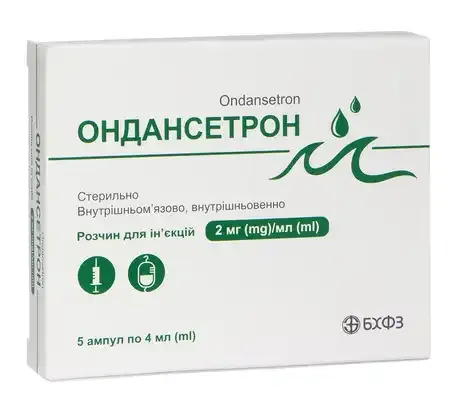
ONDANSETRON
UkraineThe drug is used to prevent or treat nausea and vomiting caused by chemotherapy, radiation therapy, or following surgical procedures.
Frequently asked questions
How should Ondansetron be taken correctly?
The drug is administered intramuscularly or intravenously. The dosage depends on age, body weight, and the purpose of use (prevention or treatment). For example, for adults undergoing chemotherapy, a dose of 8 mg is usually recommended immediately before the procedure. For the prevention of prolonged vomiting after the first few days, oral or rectal routes may be used.
Who should not use this drug?
Ondansetron should not be used in case of hypersensitivity to its components; it is also contraindicated for use in combination with apomorphine hydrochloride, as this may lead to severe loss of consciousness and a sharp drop in blood pressure.
What are the possible side effects of Ondansetron?
Possible reactions include headache, dizziness, constipation, sensations of warmth, hiccups, as well as cardiac disturbances (arrhythmia, chest pain, changes in heart rhythm). Visual disturbances, seizures, or skin rashes may also occur.
Can the drug be taken with other medicines?
Caution is required when combining with drugs that affect heart rhythm (prolong the QT interval) or electrolyte balance. Interaction is also possible with serotonergic drugs (serotonin syndrome may occur) and tramadol (the effect of tramadol may be reduced).
Can the drug be used during pregnancy?
Ondansetron is not recommended for use during the first trimester of pregnancy, as there is a suspicion of a risk of developing craniofacial defects in the child.
Does the drug affect the ability to drive a vehicle?
The drug does not cause drowsiness and does not affect reaction speed; however, when deciding whether to drive a vehicle, possible side effects should be taken into account.
Instructions for use
INSTRUCTIONS FOR MEDICAL USE OF THE MEDICINAL PRODUCT ONDANSETRON (ONDANSETRON)
Composition:
Active substance: ondansetron;
1 ml of solution contains 0.002 g of ondansetron (as ondansetron hydrochloride dihydrate);
Excipients: citric acid monohydrate, sodium citrate, sodium chloride, water for injections.
Pharmaceutical form. Injection solution.
Main physicochemical properties: clear, colorless liquid, practically free from mechanical impurities.
Pharmacotherapeutic group. Antiemetic agents and drugs eliminating nausea. Serotonin receptor antagonists (5HT3). Ondansetron. ATC code A04AA01.
Pharmacological properties.
Pharmacodynamics.
Ondansetron is a potent, highly selective 5-HT3 (serotonin) receptor antagonist. The drug prevents or eliminates nausea and vomiting caused by cytotoxic chemotherapy and/or radiation therapy, as well as postoperative nausea and vomiting. The mechanism of action of ondansetron has not been fully elucidated. It is likely that the drug blocks the initiation of the vomiting reflex by exerting antagonistic effects on 5-HT3 receptors located in neurons of both the peripheral and central nervous systems. The drug does not reduce psychomotor activity and does not produce sedative effects.
Pharmacokinetics.
After intramuscular administration, maximum plasma concentration is reached within 10 minutes. The volume of distribution after parenteral administration in adults is 140 L. The majority of the administered dose undergoes hepatic metabolism. Less than 5% of the drug is excreted unchanged in urine. The elimination half-life is approximately 3 hours (in elderly patients – 5 hours). Plasma protein binding is 70–76%.
In patients with moderate renal impairment (creatinine clearance 15–60 mL/min), both systemic clearance and volume of distribution of ondansetron are reduced, resulting in a slight and clinically insignificant prolongation of the elimination half-life. The pharmacokinetics of ondansetron is practically unchanged in patients with severe renal impairment undergoing chronic hemodialysis (studies were conducted between hemodialysis sessions). In patients with severe chronic hepatic impairment, systemic clearance of ondansetron is markedly reduced, with an increase in elimination half-life (15–32 hours).
Clinical characteristics.
Indications.
Nausea and vomiting induced by cytotoxic chemotherapy and radiation therapy.
Prevention and treatment of postoperative nausea and vomiting.
Contraindications.
Concomitant use of ondansetron with apomorphine hydrochloride is contraindicated, as cases of severe arterial hypotension and loss of consciousness have been observed during combined administration.
Hypersensitivity to any component of the drug.
Interaction with other medicinal products and other forms of interaction.
Ondansetron does not accelerate or inhibit the metabolism of other drugs when used concomitantly. Specific studies have shown that ondansetron does not interact with alcohol, temazepam, furosemide, alfentanil, tramadol, morphine, lidocaine, thiopental, or propofol.
Ondansetron is metabolized by various liver cytochrome P450 enzymes: CYP3A4, CYP2D6, and CYP1A2. Due to the diversity of ondansetron-metabolizing enzymes, inhibition or reduced activity of one of them (e.g., genetic deficiency of CYP2D6) is normally compensated by other enzymes and will have no effect or only a negligible effect on overall creatinine clearance.
Ondansetron should be used with caution when administered together with medicinal products that prolong the QT interval and/or cause electrolyte imbalances (see section "Special precautions for use").
Apomorphine.
Concomitant use of ondansetron with apomorphine hydrochloride is contraindicated, as cases of severe hypotension and loss of consciousness have been observed during combined administration.
Phenytoin, carbamazepine, and rifampicin.
In patients receiving potential inducers of CYP3A4 (e.g., phenytoin, carbamazepine, and rifampicin), the clearance of ondansetron is increased and its blood concentration is decreased.
Serotonergic agents (e.g., SSRIs and SNRIs).
Serotonin syndrome (including changes in mental status, autonomic instability, and neuromuscular disturbances) has been reported following concomitant use of ondansetron and other serotonergic agents, including selective serotonin reuptake inhibitors (SSRIs) and serotonin-norepinephrine reuptake inhibitors (SNRIs) (see section "Special precautions for use").
Tramadol.
According to a limited number of clinical studies, ondansetron may reduce the analgesic effect of tramadol.
Concomitant use of ondansetron with other medicinal products that prolong the QT interval may result in additional QT prolongation. Combined use of ondansetron with cardiotoxic medicinal products (e.g., anthracyclines) may increase the risk of arrhythmias (see section "Special precautions for use").
Special precautions for use.
In patients with known hypersensitivity to other selective 5HT3 receptor antagonists, hypersensitivity reactions have been observed.
Respiratory reactions should be treated symptomatically. Healthcare professionals should pay special attention to these reactions, as they may indicate hypersensitivity to the drug.
Ondansetron prolongs the QT interval in a dose-dependent manner (see section "Pharmacological properties"). There have also been reports of ventricular tachycardia (Torsade de Pointes) associated with ondansetron use. Ondansetron should be avoided in patients with congenital long QT syndrome. Ondansetron should be used with caution in patients who have or may develop QT interval prolongation, including patients with electrolyte imbalances, congestive heart failure, bradyarrhythmias, or those receiving other medications that may cause QT prolongation or electrolyte disturbances. Hypokalemia and hypomagnesemia should be corrected prior to initiating treatment.
Cases of myocardial ischemia have been reported in patients receiving ondansetron. In some patients, particularly following intravenous administration, symptoms appeared immediately after ondansetron injection. Patients should be informed about the signs and symptoms of myocardial ischemia.
Serotonin syndrome has been reported following concomitant use of ondansetron and other serotonergic drugs (see section "Interaction with other medicinal products and other forms of interaction"). If concomitant treatment with ondansetron and other serotonergic agents is clinically justified, appropriate patient monitoring is recommended.
Since ondansetron reduces gastrointestinal motility, careful monitoring is required in patients with signs of subacute intestinal obstruction during ondansetron therapy.
In patients undergoing adenotonsillar surgery, the use of ondansetron for prevention of nausea and vomiting may mask the onset of postoperative bleeding. Therefore, such patients require careful monitoring after ondansetron administration.
One injection of the medicinal product contains less than 1 mmol sodium (23 mg) per dose, i.e., is essentially "sodium-free".
Children.
In children receiving ondansetron together with hepatotoxic chemotherapeutic agents, careful monitoring for possible liver function abnormalities is required.
Dosing regimens.
When dosing according to body weight and administering three doses at 4-hour intervals, the total daily dose will be higher than with a single dose of 5 mg/m² and one oral dose. The comparative efficacy of these two dosing regimens has not been evaluated in clinical trials. However, comparison of results from different studies suggests similar efficacy for both regimens.
Use during pregnancy or breastfeeding.
Women of childbearing potential.
Women of childbearing potential receiving ondansetron should consider using contraception.
Pregnancy.
Epidemiological studies suggest that ondansetron may cause orofacial malformations when used during the first trimester of pregnancy. In one cohort study involving 1.8 million pregnancies, ondansetron use during the first trimester was associated with an increased risk of oral clefts (3 additional cases per 10,000 women exposed to ondansetron; adjusted relative risk 1.24 (95% CI 1.03–1.48)). Available epidemiological data on cardiac malformations show conflicting results.
Animal studies do not indicate direct or indirect harmful effects with respect to reproductive toxicity. Ondansetron is not recommended for use during the first trimester of pregnancy.
Breastfeeding.
Experimental studies have shown that ondansetron passes into the milk of animals. If treatment with the drug is necessary, breastfeeding should be discontinued.
There is no information available on the effect of ondansetron on human fertility.
Ability to affect reaction speed when driving or operating machinery.
Psychomotor tests have shown that ondansetron does not impair the ability to drive or operate machinery and has no sedative effect. However, the drug's adverse effect profile should be taken into account when assessing a patient’s ability to drive or operate machinery.
Administration and Dosage.
Nausea and vomiting induced by chemotherapy and radiotherapy.
The emetogenic potential of cancer therapy varies depending on the dose and combination regimens of chemotherapy and radiotherapy. The choice of dosing regimen depends on the severity of emetogenic impact.
Adults.
Emetogenic chemotherapy and radiotherapy.
The recommended intravenous or intramuscular dose of Ondansetron is 8 mg administered as a slow injection over at least 30 seconds, immediately before treatment.
For prevention of delayed or prolonged vomiting after the first 24 hours, oral or rectal administration of the drug is recommended.
Highly emetogenic chemotherapy (e.g., high-dose cisplatin).
Ondansetron may be administered as a single 8 mg dose intravenously or intramuscularly immediately before chemotherapy. Doses exceeding 8 mg (up to 16 mg) may be administered only as an intravenous infusion in 50–100 mL of 0.9% sodium chloride solution or another suitable solvent (see below); the infusion should last no less than 15 minutes. Single doses exceeding 16 mg must not be used (see section "Special precautions for use").
For highly emetogenic chemotherapy, 8 mg of Ondansetron or lower doses do not require dilution and may be administered by slow intravenous or intramuscular injection (over at least 30 seconds) immediately before chemotherapy, followed by two additional intravenous or intramuscular doses of 8 mg administered 2 and 4 hours later, or by continuous infusion of 1 mg/hour for 24 hours.
The efficacy of Ondansetron in highly emetogenic chemotherapy may be enhanced by additional single intravenous administration of 20 mg of sodium dexamethasone phosphate before chemotherapy.
For prevention of delayed or prolonged vomiting after the first 24 hours, oral or rectal administration of the drug is recommended.
Children and adolescents (aged 6 months to 17 years).
In pediatric practice, Ondansetron should be administered by intravenous infusion in 25–50 mL of 0.9% sodium chloride solution or another suitable solvent (see below "Instructions for use") over no less than 15 minutes.
The drug dose can be calculated based on body surface area or body weight of the child.
Dose calculation according to the child's body surface area.
Ondansetron should be administered immediately before chemotherapy as a single intravenous injection at a dose of 5 mg/m²; the intravenous dose must not exceed 8 mg. Oral administration of the drug may be initiated 12 hours later and may continue for another 5 days. Adult dose must not be exceeded.
Dose calculation according to the child's body weight.
Ondansetron should be administered immediately before chemotherapy as a single intravenous injection at a dose of 0.15 mg/kg. The intravenous dose must not exceed 8 mg. On the first day, two additional intravenous doses may be administered with a 4-hour interval. Oral administration of the drug may be initiated 12 hours later and may continue for another 5 days. Adult dose must not be exceeded.
Elderly patients.
For patients aged 65 years and older, all doses for intravenous injections should be diluted and administered over 15 minutes; with repeated administration, the interval between injections should be at least 4 hours.
For patients aged 65 to 74 years, the initial dose of ondansetron is 8 mg or 16 mg, administered by intravenous infusion over 15 minutes, which may be followed by two additional doses of 8 mg each, administered by infusion over 15 minutes with an interval between infusions of at least 4 hours.
For patients aged 75 years and older, the initial intravenous injection of ondansetron must not exceed 8 mg, administered by infusion over no less than 15 minutes. After the initial 8 mg dose, treatment may be continued with two additional doses of 8 mg each, administered by infusion over 15 minutes with an interval between infusions of at least 4 hours.
Patients with renal impairment.
There is no need to modify the dosing regimen or route of administration in patients with impaired renal function.
Patients with hepatic impairment.
In patients with moderate to severe hepatic impairment, the clearance of Ondansetron is significantly reduced and the serum half-life is prolonged. For such patients, the maximum daily dose of the drug must not exceed 8 mg.
Patients with impaired metabolism of sparteine/debrisoquine.
The elimination half-life of ondansetron in patients with impaired sparteine and debrisoquine metabolism is unchanged. In such patients, repeated administration results in the same drug concentration as in patients with normal metabolism. Therefore, dose adjustment or change in frequency of administration is not required.
Postoperative nausea and vomiting.
Adults.
For prevention of postoperative nausea and vomiting, the recommended dose of Ondansetron is 4 mg administered as a single intramuscular or slow intravenous injection during induction of anesthesia.
For treatment of postoperative nausea and vomiting, the recommended single dose of Ondansetron is 4 mg administered as an intramuscular or slow intravenous injection.
Children and adolescents (aged 1 month to 17 years).
For prevention and treatment of postoperative nausea and vomiting in children undergoing general anesthesia, Ondansetron may be administered at a dose of 0.1 mg/kg body weight (maximum up to 4 mg) by slow intravenous injection (over at least 30 seconds) before, during, or after induction of anesthesia or after surgery.
Elderly patients.
Experience with the use of Ondansetron for prevention and treatment of postoperative nausea and vomiting in elderly patients is limited; however, Ondansetron is well tolerated in patients aged 65 years and older who receive chemotherapy.
Patients with renal impairment.
There is no need to modify the dosing regimen or route of administration in patients with impaired renal function.
Patients with hepatic impairment.
In patients with moderate to severe hepatic impairment, the clearance of Ondansetron is significantly reduced and the serum half-life is prolonged. For such patients, the maximum daily dose of the drug must not exceed 8 mg.
Patients with impaired metabolism of sparteine/debrisoquine.
The elimination half-life of ondansetron in subjects with impaired sparteine and debrisoquine metabolism is unchanged. In such patients, repeated administration results in the same drug concentration as in patients with normal metabolism. Therefore, dose adjustment or change in frequency of administration is not required.
Instructions for use.
Ondansetron vials do not contain preservatives and must be used immediately after opening; any unused solution must be discarded.
Ondansetron vials must not be autoclaved.
Compatibility with other intravenous solutions.
Intravenous infusion solutions should be prepared immediately before infusion. However, it has been established that ondansetron solution remains stable for 7 days at room temperature (up to 25 °C) under daylight or in the refrigerator when diluted in the following media: 0.9% sodium chloride solution, 5% glucose solution, 10% mannitol solution, Ringer's solution, 0.3% potassium chloride and 0.9% sodium chloride solution, 0.3% potassium chloride and 5% glucose solution.
It has been demonstrated that ondansetron remains stable when using polyethylene and glass bottles. Ondansetron diluted in 0.9% sodium chloride or 5% glucose has been shown to remain stable in polypropylene syringes. Stability in polypropylene syringes has also been demonstrated when ondansetron is diluted with other recommended solvents.
If prolonged storage of the drug is required, dilution should be performed under appropriate aseptic conditions.
Compatibility with other drugs.
Ondansetron may be administered by intravenous infusion at a rate of 1 mg/hour. Through a Y-injector, together with ondansetron at a concentration of 16 to 160 mcg/mL (i.e., 8 mg/500 mL or 8 mg/50 mL, respectively), the following may be administered:
− cisplatin at a concentration up to 0.48 mg/mL, over 1–8 hours;
− 5-fluorouracil at a concentration up to 0.8 mg/mL (e.g., 2.4 g in 3 L or 400 mg in 500 mL) at a rate not exceeding 20 mL/hour. Higher concentrations of 5-fluorouracil may cause precipitation of ondansetron. The 5-fluorouracil infusion solution may contain up to 0.045% magnesium chloride in addition to other compatible excipients;
− carboplatin at a concentration from 0.18 mg/mL to 9.9 mg/mL (e.g., from 90 mg in 500 mL to 990 mg in 100 mL) over 10–60 minutes;
− etoposide at a concentration from 0.14 mg/mL to 0.25 mg/mL (e.g., from 72 mg in 500 mL to 250 mg in 1 L) over 30–60 minutes;
− ceftazidime at a dose from 250 mg to 2 g, diluted in water for injection (e.g., 2.5 mL per 250 mg or 10 mL per 2 g of ceftazidime), administered as an intravenous bolus injection over 5 minutes;
− cyclophosphamide at a dose from 100 mg to 1 g, diluted in water for injection (5 mL per 100 mg cyclophosphamide), administered as an intravenous bolus injection over 5 minutes;
− doxorubicin at a dose from 10 mg to 100 mg, diluted in water for injection (5 mL per 10 mg doxorubicin), administered as an intravenous bolus injection over 5 minutes;
− dexamethasone at a dose of 20 mg, administered as a slow intravenous injection over 2–5 minutes (when co-administered with 8 mg or 16 mg of ondansetron diluted in 50–100 mL of infusion solution) over approximately 15 minutes. Since these drugs are compatible, they may be administered through the same infusion line, with dexamethasone phosphate (as sodium salt) concentrations ranging from 32 mcg to 2.5 mg per 1 mL and ondansetron concentrations from 8 mcg to 1 mg per 1 mL.
Children. To be used in children aged 6 months (during chemotherapy) and aged 1 month (for prevention and treatment of postoperative nausea and vomiting).
Overdose.
Data on Ondansetron overdose are limited. In most cases, symptoms are similar to those described in patients receiving recommended doses (see section "Adverse reactions").
Ondansetron prolongs the QT interval in a dose-dependent manner. In case of overdose, ECG monitoring is recommended.
Manifestations of overdose have included visual disturbances, severe constipation, hypotension, vasovagal reactions with transient second-degree AV block. In all cases, these effects resolved completely.
There is no specific antidote; therefore, symptomatic and supportive therapy is required in cases of overdose.
The use of ipecacuanha for treatment of ondansetron overdose is not recommended, as its effect may be ineffective due to the antiemetic action of Ondansetron.
Children: Serotonin syndrome has been reported in infants and children aged 12 months to 2 years after accidental overdose of the oral formulation (doses exceeding the recommended level of 4 mg/kg).
Adverse reactions.
Immune system: immediate-type hypersensitivity reactions, sometimes severe, up to anaphylaxis.
Nervous system: headache; seizures, movement disorders (including extrapyramidal reactions such as oculogyric crisis, dystonic reactions, and dyskinesia without persistent clinical consequences); dizziness, mainly during rapid intravenous administration of the drug.
Eye disorders: transient visual disturbances (blurred vision), mainly during intravenous administration; transient blindness, mainly during intravenous administration. In most cases, blindness resolves within 20 minutes.
Cardiac disorders: arrhythmias, chest pain (with or without ST segment depression), bradycardia; QT interval prolongation (including ventricular fibrillation/torsades de pointes), myocardial ischemia (see section "Special precautions for use").
Vascular disorders: sensation of warmth or flushing; hypotension.
Respiratory, thoracic and mediastinal disorders: hiccups.
Gastrointestinal disorders: constipation.
Hepatobiliary disorders: asymptomatic elevation of liver function tests. These cases occur mainly in patients receiving chemotherapy containing cisplatin.
Cases of hepatic failure have been reported in cancer patients receiving concomitant therapy, including potentially hepatotoxic chemotherapy and antibiotics.
Skin and subcutaneous tissue disorders: toxic skin eruptions, including toxic epidermal necrolysis.
General disorders: local reactions at the site of intravenous administration.
Post-marketing surveillance has reported the following adverse reactions.
Cardiovascular system: chest pain and discomfort, extrasystoles, tachycardia, including ventricular and supraventricular tachycardia, atrial fibrillation, palpitations, syncope, ECG changes.
Hypersensitivity reactions: anaphylactic reactions, angioedema, bronchospasm, anaphylactic shock, pruritus, skin rashes, urticaria.
Nervous system: gait disturbances, chorea, myoclonus, restlessness, burning sensation, tongue protrusion, diplopia, paresthesia.
General disorders and administration site conditions: increased body temperature, pain, redness, burning at the injection site.
Other: hypokalemia.
Shelf life. 2 years.
Storage conditions. Store out of reach of children, in the original packaging, at temperatures not exceeding 30 °C.
Incompatibility. Ondansetron must not be used in the same syringe or infusion solution with other medicinal products. Injectable ondansetron may be mixed only with recommended infusion solutions (see section "Administration and dosage").
Packaging. 2 ml or 4 ml in an ampoule; packs of 5 or 100 ampoules, or 5 ampoules in a blister, 1 blister per pack.
Prescription category. Prescription only.
Manufacturer. Joint Stock Company "Lekhim-Kharkiv".
Manufacturer's address and location of business activity.
36 Severina Pototskoho Street, Kharkiv, Kharkiv Oblast, 61115, Ukraine.
Similar drugs
| Brand name | Dosage form | Active substance / Dosage | Manufacturer |
|---|---|---|---|
| AURODANS | solution for injection |
|
Yujia Pharma Specialities Limited Unit-III |
| EMESETRON-ZDOROVYA | solution for injection |
|
LLC "Corporation "Zdorovya" |
| EMETON | solution for injection |
|
Farmasel LLC |
| ONDAAR | solution for injection |
|
Mankind Pharma Limited |
| ONDANSET | solution for injection |
|
Help S.A. |
| ONDANSETRON | solution for injection |
|
Subsidiary Enterprise "Farmatreyd" |
| ONDANSETRON | solution for injection |
|
PJSC "Scientific and Production Center "Borshchahivskyy Chemical and Pharmaceutical Plant" |
| ONDANSETRON-BAXTER | solution for injection |
|
Baxter Pharmaceuticals India Private Limited |
| ONDANSETRON-VISTA | solution for injection |
|
PT. Novell Pharmaceutical Laboratories |
| ONDAVEL | solution for injection |
|
PT. Novell Pharmaceuticals Laboratories |
| OSETRON® | solution for injection |
|
Dr. Reddy's Laboratories Limited |
| VOMENDA | solution for injection |
|
Aspiron Pharma Limited |
The original data is available in the language of the country of manufacture.
Data source: State Register of Medicinal Products of Ukraine
Data last verified: August 13, 2026