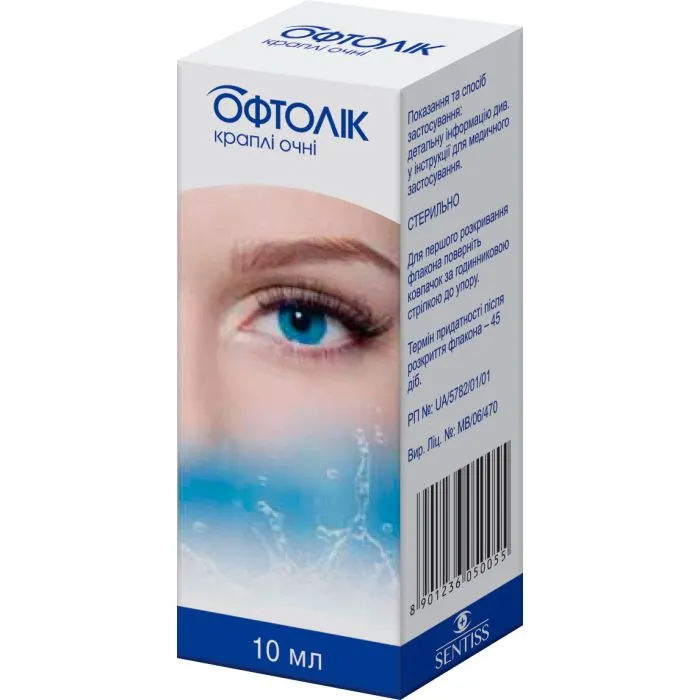
OFTOLIK
UkraineThe drug is used for 'dry eye' syndrome (when irritation, redness, and discomfort are felt due to a lack of tear fluid) and for dry keratoconjunctivitis.
Frequently asked questions
How should Oftolik be taken correctly?
Adults should instill 1–2 drops into one eye 3–4 times a day. If you are using other eye drops, allow a 15–20 minute interval between them, and Oftolik should always be administered last.
What are the possible side effects of Oftolik?
Possible sensations include burning, stinging, eye pain, or temporary blurred vision. Allergic reactions (itching, rash, skin redness) or headaches may also occur.
Can contact lenses be used during treatment?
Soft contact lenses must not be worn during the course of treatment. Hard lenses must be removed before instillation and should not be reinserted for at least 20 minutes.
Who should not use this drug?
The drug should not be used by individuals with hypersensitivity to its components.
Does the drug affect the ability to drive a vehicle?
Immediately after instillation, vision may become less clear for a short time; therefore, one should wait for full visual recovery before driving a car or operating machinery.
Can the drug be used by pregnant or breastfeeding women?
This is only possible if a physician determines that the benefit to the mother outweighs the potential risk to the child.
Instructions for use
INSTRUCTIONS for medical use of the medicinal product OFTOLIQUE (OPHTOLIQUE)
Composition:
Active substances: 1 ml of solution contains polyvinyl alcohol 14 mg, povidone 6 mg;
Excipients: benzalkonium chloride, disodium edetate, sodium chloride, sodium hydroxide, hydrochloric acid, water for injections.
Pharmaceutical form. Eye drops.
Main physicochemical properties: clear, colorless or slightly yellowish solution.
Pharmacotherapeutic group.
Ophthalmological agents. ATC code S01X A20.
Pharmacological Properties:
Oftolik is a preparation that provides protective action on the cornea of the eye under conditions of reduced tear secretion, ensuring the necessary moisturizing effect and maintaining prolonged contact with the corneal surface. The main component, polyvinyl alcohol, has properties similar to mucin (a substance produced by the conjunctiva of the eye). In combination with povidone, it enhances the lubricating effect, thereby reducing irritation and dryness of the eye surface. Thickening of the tear film provides a soothing effect on the eye in case of changes in mucin properties, for example, during colds, bacterial, fungal, and inflammatory eye diseases. The protective function of the thickened tear layer is especially evident in injuries and erosions of the conjunctiva and cornea.
When applied locally, it does not exert systemic effects.
Clinical characteristics.
Indications.
Dry keratoconjunctivitis, dry eye syndrome (redness, irritation, and sensation of discomfort in the eye(s) caused by decreased production or absence of tear gland secretion).
Contraindications.
Hypersensitivity to the components of the drug.
Interaction with other medicinal products and other forms of interaction.
The drug should not be used with other medicinal products without consulting a physician. Prolongs the absorption of other ophthalmic drugs (adrenomimetics, antibiotics, beta-adrenergic blockers, corticosteroids). Polyvinyl alcohol is incompatible with highly concentrated solutions of inorganic salts, especially sulfates and phosphates. Precipitation may occur when polyvinyl alcohol solution (at concentrations of 5% or higher) interacts with phosphates. In the presence of borate, gelation of polyvinyl alcohol solution may occur. Povidone forms molecular complexes with sulfathiazole solutions, sodium salicylate, salicylic acid, phenobarbital, tannin, and other substances. It may reduce the effectiveness of certain preservatives, for example, thimerosal.
Instructions for use.
Wash your hands before application. Do not touch the dropper tip to any surfaces, including hands or eyes, to prevent contamination which may lead to eye infections. If eye pain (eyes), blurred vision, worsening of vision, prolonged redness or irritation occur within 72 hours after using the medication and do not resolve, discontinue use and consult a physician. Do not use the medication if it has changed color, become cloudy, or contains foreign particles. The medication must be used and stored exactly as indicated in the instructions for medical use.
During treatment, soft contact lenses should not be worn. Rigid contact lenses must be removed before instilling eye drops. Contact lenses may be reinserted no sooner than 20 minutes after administration.
If more than one type of eye drops is prescribed, they should be administered at intervals of at least 15–20 minutes, with Oftolik always administered last.
Use during pregnancy or breastfeeding.
Since the medication has no systemic effect on the body, it may be used only if, in the physician’s opinion, the expected therapeutic benefit to the mother outweighs the potential risk to the fetus or infant.
Fertility.
A battery of tests with polyvinyl alcohol and povidone did not reveal any toxic effects on reproductive function. However, since serious studies investigating the effects of eye drops containing 1.4% polyvinyl alcohol and 0.6% povidone on fertility are lacking, the decision to prescribe them should be made by a physician, weighing the potential risk versus benefit.
Ability to affect reaction speed when driving or operating machinery.
Since transient reduction in visual acuity may occur immediately after instillation, wait until vision is fully restored before driving or operating machinery.
Dosage and administration.
For adults, 1-2 drops should be administered into one eye 3-4 times daily. The duration of treatment and repeated courses are determined individually by a physician.
Administration method. Tilt the head backward, gently pull down the lower eyelid of the affected eye with a finger, instill 1-2 drops of the medication, and then close the eyes. Press the inner corner of the eye with a finger for 1-2 minutes to prevent the medication from entering the tear duct and reduce the possibility of systemic absorption. Do not blink. Remove any excess medication around the eye using a clean tissue, avoiding contact with the eye.
To prevent contamination of the dropper tip, do not touch the eyelids or surrounding areas with the dropper.
Children. Safety and efficacy in children have not been established.
Overdose.
Overdose is unlikely. However, if overdose is suspected or accidental ingestion occurs, symptomatic treatment should be administered following consultation with a physician.
Adverse Reactions.
The drug is applied locally, therefore systemic effects are absent.
Ophthalmic disorders related to the site of application. Burning sensation in eyes, stinging sensation, blurred vision, eye pain (ocular pain).
Immune system disorders. Allergic reactions including rash, skin itching, redness, including skin around the eyes (eye).
Nervous system disorders. Headache.
Since the drug contains benzalkonium chloride as a preservative, reactions related to it may occur, namely: redness, increased corneal epithelium permeability, reduced density of goblet cells, enhanced irritation, inflammation. With prolonged use, a cytostatic effect on the cornea may occur, manifested by inhibition of cytokinesis, direct reduction in epithelial cells, their motility and ability to divide within 2 hours after application, and damage to cells of the anterior segment of the eye.
Shelf life.
3 years.
Shelf life after opening the bottle – 45 days.
The drug must not be used after the expiry date stated on the packaging.
Storage conditions.
Store at a temperature not exceeding 25 °C.
Keep the bottle in the carton.
Do not freeze.
Keep out of reach of children.
Packaging.
10 ml in a dropper bottle, 1 in a carton.
Supply category. Over-the-counter.
Manufacturer.
SENTISS PHARMA PVT. LTD., India / SENTISS PHARMA PVT. LTD., India
Manufacturer's address.
Village Khera Nihla, Tehsil Nalagarh, Distt. Solan, Himachal Pradesh, 174 101 /
Village Khera Nihla, Tehsil Nalagarh, Distt. Solan, Himachal Pradesh, 174 101.
Marketing Authorization Holder.
SENTISS PHARMA PVT. LTD., India / SENTISS PHARMA PVT. LTD., India
Address.
212/D-1, Ashirwad Commercial Complex, Green Park, New Delhi, 110016, India /
212/D-1, Ashirwad Commercial Complex, Green Park, New Delhi, 110016, India.
Similar drugs
| Brand name | Dosage form | Active substance / Dosage | Manufacturer |
|---|---|---|---|
| HILO-COMOD® | drops, ophthalmic |
|
URSAPHARM Arzneimittel GmbH |
| HILO-KEA® | drops, ophthalmic |
|
URSAPHARM Arzneimittel GmbH |
The original data is available in the language of the country of manufacture.
Data source: State Register of Medicinal Products of Ukraine
Data last verified: August 13, 2026