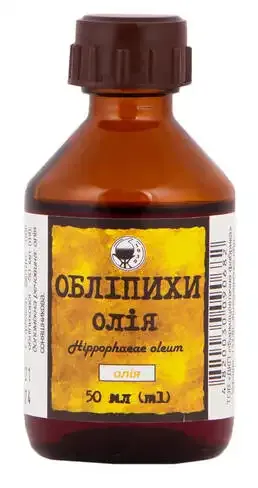
SEA BUCKTHORN OIL
UkraineThe preparation is used to treat burns, bedsores, skin and mucosal lesions, gynecological diseases, rectal problems (hemorrhoids, fissures), gastric and duodenal ulcers, as well as diseases of the ENT organs and eyes.
Frequently asked questions
How should the preparation be taken orally?
For esophageal pathologies or gastric and duodenal ulcer disease, take 1 teaspoon 2–3 times a day. The course of treatment usually lasts 3–4 weeks.
When should Sea buckthorn oil not be used?
The preparation should not be used in case of individual hypersensitivity to it. For oral administration, inflammatory processes in the liver, gallbladder, and pancreas, as well as gallstone disease, are contraindicated.
What are the possible side effects?
Allergic reactions (itching, swelling, rash), a bitter taste in the mouth, or diarrhea may occur with oral administration. Topical application may cause a burning sensation, and inhalation may cause bronchospasm or excessive salivation.
Can the product be used by pregnant women and children?
For pregnant and breastfeeding women, the preparation is prescribed by a physician when the benefit to the mother outweighs the risk to the child. Use in children is only possible after a physician has assessed the benefit-risk ratio.
What should be done in case of overdose?
An overdose may cause nausea, vomiting, headache, convulsions, or diarrhea. In such cases, it is necessary to rinse the stomach, take activated charcoal or other adsorbents, and seek medical attention.
Instructions for use
INSTRUCTIONS FOR MEDICAL USE OF THE MEDICINAL PRODUCT SEA BUCKTHORN OIL (HIPPOPHAEAOLEUM)
Composition:
Active substance: Hippophaeae oleum;
1 bottle contains sea buckthorn oil – 50 ml;
Excipient: sunflower oil.
Pharmaceutical form. Oil.
Main physico-chemical properties: oily liquid, orange-red in color, with a characteristic odor. Slight sediment formation is allowed, which dissolves upon heating to 40 °C.
Pharmacotherapeutic group.
Agents affecting the gastrointestinal system and metabolism. Agents for the treatment of acid-related disorders. ATC code A02X.
Pharmacological properties.
Pharmacodynamics.
A plant-derived preparation, sea buckthorn oil. Reduces the harmful effects of toxins, peroxides, and other aggressive factors, and protects cellular membranes and intracellular structures due to the presence of natural biologically active substances in its composition. The preparation stimulates healing processes in lesions of skin and mucous membranes, exerts antibacterial (inhibits bacterial growth), soothing, and choleretic effects. Sea buckthorn oil favorably influences cellular nutrition processes and the function of digestive organs.
Pharmacokinetics.
The rate of absorption of the preparation depends on the route of administration. Metabolites of sea buckthorn oil are excreted in feces and urine following oral administration.
Clinical characteristics.
Indications.
For local, external use in the treatment of burns, pressure sores, radiation injuries of skin and mucous membranes, gynecological diseases (colpitis, endocervicitis, cervical erosion), proctological conditions (erosive-ulcerative, atrophic and other pathologies of the rectum, anal fissures, hemorrhoids).
For internal use as part of complex therapy for esophageal pathology, peptic ulcer disease of the stomach and duodenum.
In the form of inhalations, for the treatment of chronic inflammatory diseases of the upper respiratory tract (nasopharynx, vocal cords, trachea, bronchi).
Locally, the drug is used to treat chronic conditions and during the recovery period after acute pathologies of the tonsils (tonsillitis, angina), maxillary sinuses (sinusitis), corneal membranes of the eyes (keratitis), conjunctival membranes of the eyes (conjunctivitis), inflammation of eyelid margins (blepharitis), and corneal ulcers.
Contraindications.
Individual sensitivity to the drug. Internal use of the drug is contraindicated in inflammatory conditions of the gallbladder, liver, pancreas, and in cholelithiasis.
Interaction with other medicinal products and other forms of interaction.
Pathological effects on the human body due to interaction of sea buckthorn oil with other medicinal products have not been described.
Special precautions for use.
The drug should be used with caution in patients prone to allergic reactions.
Shake well before use.
Use during pregnancy or breastfeeding.
During pregnancy and breastfeeding, the drug should be used only as prescribed by a physician and only when the expected benefit to the mother outweighs the potential risk to the fetus or infant.
Ability to affect reaction speed while driving or operating machinery.
No effect.
Method of Administration and Dosage
The product is administered topically, orally, or by inhalation.
In skin pathological conditions, apply the product topically every other day as oily dressings after cleaning the affected skin areas from necrotic tissues, continuing until tissue regeneration sites appear.
In gynecological conditions—such as colpitis and endocervicitis—vaginal walls, vaginal portion, and cervical canal are lubricated with cotton swabs moistened with the oil (after preliminary treatment). In cervical erosion, cotton tampons saturated with oil are used (the tampon is firmly pressed against the eroded area; tampon replacement is performed daily). The treatment course for colpitis consists of 10–15 procedures; for endocervicitis and cervical erosion, 8–12 procedures. If necessary, the treatment course may be repeated after 4–6 weeks.
In proctological conditions—such as anal fissures and hemorrhoids—the anus and hemorrhoidal nodes are lubricated with cotton swabs soaked in the product. In pathological conditions of the rectum, the oil is administered into its lumen via micro-enema (after prior cleansing enema). The treatment course consists of 10–12 procedures. If necessary, the course may be repeated after 4–6 weeks.
In esophageal pathology and peptic ulcer disease of the stomach and duodenum, the product is taken orally, 1 teaspoon 2–3 times daily. The treatment course for these conditions lasts 3–4 weeks. If necessary, the course may be repeated after 4–6 weeks.
In ENT organ pathology—such as chronic tonsillitis, post-angina condition, chronic pharyngitis—tonsils and pharynx are lubricated with cotton swabs moistened with oil. In chronic sinusitis, gauze wicks soaked in oil are inserted into the external nasal passages (after prior removal of their contents). The treatment course for ENT conditions consists of 8–10 procedures. If necessary, the course may be repeated after 4–6 weeks.
In upper respiratory tract diseases, the product is administered by inhalation under medical facility conditions.
In eye diseases, sea buckthorn oil is used only as prescribed and under physician supervision.
Children
The medicinal product in children should be used only after a physician evaluates the benefit-risk ratio.
Overdose
In case of overdose, nausea, vomiting, headache, confusion, seizures, diarrhea, skin rash, epithelial desquamation may occur. Oliguria may develop. In individual cases, shock states may occur.
In such cases, gastric lavage is required, along with administration of activated charcoal or other adsorbents, and appropriate symptomatic therapy.
Side effects
Individual hypersensitivity to the drug is possible; gastrointestinal disturbances may include bitter taste in the mouth (with oral administration) and diarrhea; immune system reactions may include allergic reactions, itching, hyperemia, skin swelling, skin rashes, and burning sensation (with topical application); with inhalation administration, breathing difficulties due to bronchospasm and excessive salivation are possible.
Shelf life. 3 years.
Storage conditions.
Store at a temperature not exceeding 25 °C in a place inaccessible to children.
Packaging.
50 ml in bottles.
Availability.
Over-the-counter.
Manufacturer.
LLC "DKP "Pharmaceutical Factory"
Manufacturer's location and address of business activity.
4 Korolyova St., Stanyshevska village, Zhytomyr district, Zhytomyr region, 12430, Ukraine
The original data is available in the language of the country of manufacture.
Data source: State Register of Medicinal Products of Ukraine
Data last verified: August 13, 2026