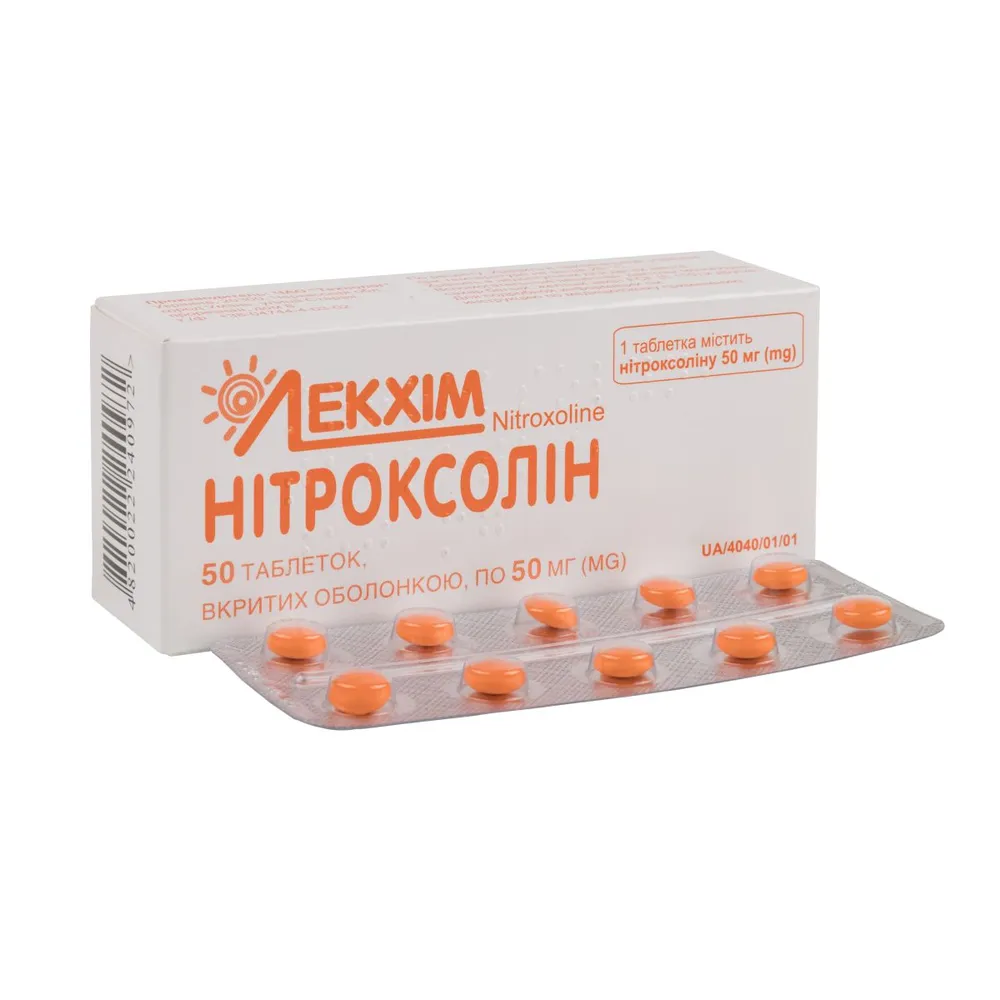
NITROXOLINE
UkraineThe drug is used to treat acute, chronic, and recurrent urinary tract infections caused by bacteria or fungi. It is also used for the prevention of recurrent urinary tract infections.
Frequently asked questions
How should Nitroxoline be taken correctly?
Adults take from 400 to 800 mg per day, divided into 4 doses (usually 2 or 4 tablets 4 times a day before meals). Children aged 3 years and older take from 200 to 400 mg per day (1–2 tablets 4 times a day before meals). The duration of the course is determined by a physician.
What are the possible side effects of Nitroxoline?
Nausea, vomiting, abdominal bloating, headache, weakness, or rapid heartbeat are possible. Allergic reactions (rash, itching) may occur. It is important to know that the drug causes urine to turn an intense yellow color.
Who should not take this drug?
Contraindications include hypersensitivity to the components of the drug or to quinolines, as well as severe renal or hepatic impairment. The drug is not recommended for pregnant or breastfeeding women.
Can it be combined with other medicines?
It should not be combined with drugs containing hydroxyquinolines or nitrofurans. Taking antacids containing magnesium may slow absorption. The drug also reduces the efficacy of nalidixic acid.
Are there any special precautions during administration?
For patients with renal or hepatic impairment, the dose should be reduced by half. Due to the presence of lactose, the drug should not be taken by people with galactose intolerance. Caution should also be exercised by individuals with cataracts.
Instructions for use
INSTRUCTIONS FOR MEDICAL USE OF THE MEDICINAL PRODUCT NITROXOLINE (NITROXOLINE)
Composition:
Active ingredient: 1 tablet contains 50 mg of nitroxoline;
Excipients: lactose monohydrate, potato starch, talc, magnesium stearate, colloidal anhydrous silicon dioxide, white sugar, povidone 25, titanium dioxide (E 171), gelatin, heavy magnesium carbonate, polyethylene glycol 6000 (macrogol 6000), yellow FCF (E 110).
Pharmaceutical form. Coated tablets.
Main physicochemical properties: round, coated tablets, yellow-orange to orange in color, with convex upper and lower surfaces.
On fracture, when examined under a magnifying glass, a core surrounded by two continuous layers is visible.
Pharmacotherapeutic group. Antibacterials for systemic use. Other antibacterials. Nitroxoline.
ATC code J01XX07.
Pharmacological Properties
Pharmacodynamics
Nitroxoline is a synthetic urinary antiseptic acting via a chelating mechanism. It blocks enzyme function by binding metal ions in microbial enzymes, thereby preventing the binding of these enzymes to their specific substrates. This results in bacteriostatic, bactericidal, and fungicidal effects. At sub-inhibitory concentrations in urine, nitroxoline—both in its original form and as a glucuronide conjugate—inhibits the adhesion of uropathogenic bacteria Escherichia coli to the urogenital tract epithelium.
Nitroxoline is effective against a broad spectrum of Gram-positive and Gram-negative bacteria as well as fungi. Its antimicrobial and antifungal activity covers most microorganisms responsible for urinary tract infections.
Microorganisms sensitive to nitroxoline include Escherichia coli, Ureaplasma urealyticum, Mycoplasma hominis, Candida spp., Torulopsis spp.
Microorganisms partially sensitive to nitroxoline include Proteus spp., Staphylococcus spp.
Microorganisms resistant to nitroxoline include Pseudomonas spp., Providencia spp., Klebsiella spp., Enterobacter spp., Serratia spp., and anaerobic bacteria.
Sensitivity of streptococci, Corynebacterium diphtheriae, Enterococcus spp., Salmonella spp., Shigella spp., Neisseria gonorrhoeae, and Haemophilus influenzae to nitroxoline has also been demonstrated.
Pharmacokinetics
Nitroxoline is rapidly and almost completely (90%) absorbed from the gastrointestinal tract following oral administration. After a single 200 mg oral dose, the mean peak plasma concentration is reached within 1.5–2 hours and amounts to 4–4.7 mg/L. The elimination half-life from blood serum is approximately 2 hours. Following oral administration, high concentrations of both conjugated and unconjugated nitroxoline are achieved in urine. Nitroxoline is metabolized in the liver, where it conjugates with glucuronic acid and sulfuric acid. It is excreted primarily in the urine (55–60%) as glucuronide conjugate and to a lesser extent in bile. Only 5% is excreted in urine in the unconjugated, active form.
Clinical characteristics.
Indications.
Acute, chronic, and recurrent urinary tract infections caused by gram-positive and gram-negative microorganisms and fungi sensitive to nitroxoline.
Prophylaxis of recurrent urinary tract infections.
Contraindications.
Hypersensitivity to nitroxoline or to any component of the medicinal product, as well as to quinolines; severe hepatic and renal insufficiency (creatinine clearance less than 0.33 ml/s).
Interaction with other medicinal products and other forms of interaction.
Nitroxoline should not be used concomitantly with preparations containing hydroxyquinolines or their derivatives.
When used simultaneously with antacid agents containing magnesium, absorption of nitroxoline is slowed.
Nitroxoline reduces the effectiveness of nalidixic acid.
When used in combination with tetracycline-group preparations, summation of the effects of each drug is observed.
When used together with nystatin and levorin, potentiation of action is observed.
Nitroxoline should not be combined with nitrofurans to avoid summation of the negative neurotropic effect.
Special precautions for use
Use with caution in patients with impaired renal function due to the potential for nitroxoline accumulation. The drug should also be used with caution in patients with cataracts. Cases of peripheral neuropathy and optic neuritis have been reported during repeated and prolonged treatment with high doses of halogenated hydroxyquinolines. Nitroxoline is a nitro derivative of quinoline, and such adverse effects have not been observed with this substance; however, caution is recommended when treating with nitroxoline. Patients should be under close medical supervision. Treatment should not exceed 4 weeks without additional medical evaluation.
The drug contains lactose; therefore, it should not be administered to patients with rare hereditary forms of galactose intolerance, lactase deficiency, or glucose-galactose malabsorption syndrome.
The drug contains the dye "Yellow West FCF" (E 110), which may cause allergic reactions.
Use during pregnancy or breastfeeding.
The safety and efficacy of the drug during pregnancy or breastfeeding have not been established; therefore, nitroxoline should not be used during these periods.
Ability to affect reaction speed while driving or operating machinery.
There are no data regarding a negative effect of the drug on reaction speed while driving or operating machinery.
Dosage and Administration.
Adults: The recommended daily dose is 400–800 mg, divided into 4 doses. The average daily dose is 400 mg (2 tablets 4 times daily before meals). In severe diseases, the daily dose may be increased to 800 mg (4 tablets 4 times daily). The maximum daily dose for adults is 800 mg.
Children aged 3 years and older: The recommended daily dose is 200–400 mg (1–2 tablets 4 times daily before meals).
The duration of treatment is determined by the physician depending on the nature and course of the disease. In chronic infections, the drug should be administered in repeated courses of 2 weeks duration, with 2-week intervals (the treatment course may last several months).
Renal impairment.
In patients with moderate renal impairment (creatinine clearance > 0.33 ml/sec), the usual dose should be halved.
Hepatic impairment.
In patients with hepatic impairment, the usual dose should be halved.
Elderly patients.
Dose adjustment is not required.
Children.
The use of the drug in tablet form (with coating) is not recommended for children under 3 years of age.
Overdose.
Information regarding nitroxoline overdose is lacking. Treatment is symptomatic.
Adverse reactions.
Gastrointestinal disorders: in isolated cases, dyspeptic symptoms (nausea, vomiting, bloating, loss of appetite) may occur; these can be prevented by taking the medicinal product during meals.
Hepatic and biliary disorders: decreased transaminase activity, liver function abnormalities.
Immune system disorders: allergic reactions such as skin rashes, itching, which rapidly resolve after discontinuation of the drug; very rarely – allergic reactions leading to thrombocytopenia.
Nervous system disorders: rarely – headache, ataxia, paresthesia, polyneuropathy.
Renal disorders: decreased plasma uric acid levels.
Since nitroxoline is excreted by the kidneys, urine may turn an intense yellow color.
Other: general weakness, tachycardia.
The product contains the dye "Yellow West FCF" (E 110), which may provoke allergic reactions, including asthma. This is particularly relevant for patients with hypersensitivity to acetylsalicylic acid.
Shelf life. 4 years.
Storage conditions.
Store in the original packaging at a temperature not exceeding 25°C. Keep out of reach of children.
Packaging.
10 tablets in a blister; 1 or 5 blisters per cardboard box.
10 tablets in a blister; 80 blisters per cardboard box.
Prescription status. Prescription only.
Manufacturer.
PJSC "Tekhnolohiya"
Manufacturer's address and location of business activity.
8, Stara Prorina Street, Uman, Cherkasy region, 20300, Ukraine.
Similar drugs
| Brand name | Dosage form | Active substance / Dosage | Manufacturer |
|---|---|---|---|
| NITROXOLINE | tablets, film-coated |
|
PJSC "Scientific and Production Center "Borshchahivskyy Chemical and Pharmaceutical Plant" |
The original data is available in the language of the country of manufacture.
Data source: State Register of Medicinal Products of Ukraine
Data last verified: August 13, 2026