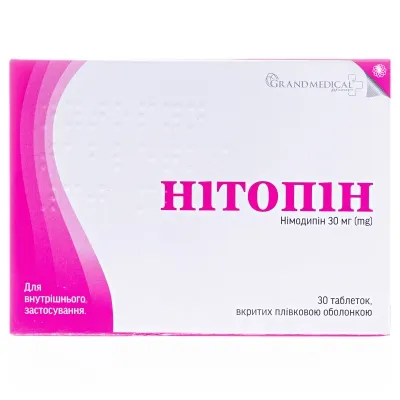
NITOPIN
UkraineThe drug is used for the prevention and treatment of ischemic neurological disorders following a subarachnoid hemorrhage caused by an aneurysm rupture.
Frequently asked questions
How should Nitopin be taken correctly?
Tablets should be swallowed whole with a small amount of water, regardless of food intake. The recommended dose for subarachnoid hemorrhage is 2 tablets every 4 hours (total daily dose is 360 mg). Treatment usually lasts 21 days and should be initiated within 4 days after the hemorrhage.
Who should not take this medication?
Nitopin is contraindicated in individuals with hypersensitivity to its components, as well as during and for one month after a myocardial infarction or an episode of unstable angina. It must not be combined with rifampicin or certain anticonvulsants (phenobarbital, phenytoin, carbamazepine).
What are the possible side effects of Nitopin?
The most common side effects include headache, nausea, decreased blood pressure (hypotension), and vasodilation. Tachycardia, allergic reactions, rash, or thrombocytopenia are also possible.
Can grapefruit juice be consumed during treatment?
No, consuming grapefruit juice is not recommended, as it may increase the concentration of the drug in the blood, leading to an enhanced reduction in blood pressure.
How does the drug interact with other medicines?
Nitopin may enhance the effect of blood pressure-lowering agents (e.g., diuretics or beta-blockers). Interaction with certain antibiotics, antivirals, and antifungals is also possible, which requires blood pressure monitoring.
Can I drive while taking this medication?
Caution should be exercised, as the drug may cause dizziness, which could affect the ability to drive vehicles or operate machinery.
Instructions for use
INSTRUCTION FOR MEDICAL USE OF THE MEDICINAL PRODUCT NITOPIN (NITOPIN®)
Composition:
Active substance: nimodipine;
One film-coated tablet contains 30 mg of nimodipine;
Excipients: microcrystalline cellulose, maize starch, povidone, crospovidone, magnesium stearate;
Coating: hypromellose, polyethylene glycol 4000, titanium dioxide (E 171).
Pharmaceutical form. Film-coated tablets.
Main physicochemical characteristics: white or yellowish biconvex tablets.
Pharmacotherapeutic group.
Selective calcium channel blockers with predominant vascular effect. Dihydropyridine derivatives. Nimodipine.
ATC code C08CA06.
Pharmacological properties.
Pharmacodynamics.
Nimodipine is a dihydropyridine calcium channel blocker with predominant action on cerebral blood vessels. Nimodipine increases cerebral perfusion, particularly in areas with impaired perfusion, by dilating arteries. This effect is proportionally greater in smaller vessels than in larger ones.
In in vitro conditions, vasoconstriction induced by various vasoactive substances (e.g., serotonin, prostaglandin, and histamine) or blood components and blood breakdown products could be prevented or reduced (by up to 75%) by nimodipine.
Pharmacokinetics.
After oral administration, the drug is rapidly absorbed. Maximum plasma concentration is observed within 30–60 minutes after oral administration. Despite high gastrointestinal absorption of nimodipine, its absolute bioavailability is only 5–15%, due to extensive presystemic metabolism (approximately 85–95%).
The calculated volume of distribution (Vss, two-compartment model) following intravenous administration is 0.9–2.3 L/kg body weight. Total (systemic) clearance is 0.8–1.6 L/h/kg. Nimodipine is 97–99% bound to plasma proteins.
Metabolic elimination of nimodipine is primarily mediated by the cytochrome P450 3A4 system. Nimodipine is excreted as metabolites formed mainly via dehydrogenation of the dihydropyridine ring and oxidative O-demethylation. Oxidative cleavage of the ester, hydroxylation of the 2- and 6-methyl groups, and glucuronidation as a conjugation reaction are subsequent important steps in metabolism. Three main metabolites identified in plasma have shown no or only negligible residual therapeutic activity.
No enzyme-inducing or enzyme-inhibiting activity toward liver enzymes has been observed. Elimination of metabolites in humans occurs approximately 50% via the kidneys and 30% via bile.
After oral administration, maximum plasma concentration and area under the concentration-time curve increase proportionally with dose up to the highest studied dose (90 mg). Elimination kinetics are linear. The elimination half-life of nimodipine ranges from 1.1 to 1.7 hours. The terminal half-life of 5–10 hours is not relevant for determining the recommended dosing interval.
Clinical characteristics.
Indications.
Prevention and treatment of ischemic neurological disorders following subarachnoid hemorrhage due to aneurysm rupture.
Contraindications.
Hypersensitivity to nimodipine or to any of the excipients of the medicinal product.
During and within one month after myocardial infarction or episode of unstable angina.
Concomitant use with rifampicin or antiepileptic agents (phenobarbital, phenytoin, carbamazepine) due to significant reduction in efficacy of the medicinal product Nitoopin (see section "Interaction with other medicinal products and other types of interactions").
Interaction with other medicinal products and other types of interactions.
Medicinal products affecting nimodipine
Nimodipine is metabolized via the cytochrome P450 3A4 system, located both in the intestinal mucosa and in the liver. Therefore, medicinal products known as inhibitors or inducers of this enzyme system may affect presystemic metabolism or clearance of nimodipine when used concomitantly.
When using nimodipine concomitantly with the following medicinal products, the extent and duration of interaction should be taken into account.
Concomitant administration of oral nimodipine and rifampicin or antiepileptic agents that are inducers of the cytochrome P450 3A4 system (such as phenobarbital, phenytoin or carbamazepine) is contraindicated. The efficacy of the medicinal product Nitoopin may be reduced when these medicinal products are used concomitantly.
Concomitant administration in elderly patients of nimodipine 30 mg three times daily and the antidepressant nortriptyline 10 mg three times daily resulted in a slight decrease in plasma levels of nimodipine, while plasma levels of nortriptyline remained unchanged. The daily dose used in patients with subarachnoid hemorrhage is four times higher than the dose used in this study; therefore, the clinical significance of this interaction in the treatment of subarachnoid hemorrhage due to aneurysm rupture has not been established.
When used concomitantly with the following medicinal products that are inhibitors of the cytochrome P450 3A4 system, blood pressure should be monitored and dose adjustment of nimodipine should be considered if necessary:
- macrolide antibiotics (e.g., erythromycin);
- antiviral agents for treatment of HIV: protease inhibitors (e.g., ritonavir);
- azole antifungal agents (e.g., ketoconazole);
- nefazodone.
Although formal studies to investigate the potential interaction between nimodipine and these medicinal products have not been conducted, an increased probability of elevated plasma concentrations of nimodipine cannot be excluded (see section "Special precautions for use").
Azithromycin, although structurally belonging to the class of macrolide antibiotics, is not an inhibitor of CYP3A4.
Concomitant administration in elderly patients of nimodipine 30 mg twice daily and the antidepressant fluoxetine 20 mg daily resulted in an almost 50 % increase in plasma levels of nimodipine and a significant decrease in fluoxetine levels without affecting its active metabolite norfluoxetine (see section "Special precautions for use").
Concomitant administration of nimodipine with the anticonvulsant agent (valproic acid) or an H2-receptor antagonist (cimetidine) may lead to increased plasma concentration of nimodipine (see section "Special precautions for use").
Based on experience with the calcium antagonist nifedipine, concomitant use with quinupristin/dalfopristin may lead to increased plasma concentrations of nimodipine (see section "Special precautions for use").
Effect of nimodipine on other medicinal products
Animal studies have shown that concomitant administration of nimodipine and zidovudine leads to an increase in AUC of zidovudine and a decrease in its volume of distribution and clearance. The clinical significance of this interaction is unknown, but due to the dose-dependent nature of zidovudine's adverse effect profile, this interaction should be considered in patients receiving both nimodipine and zidovudine.
Other types of interactions
Antihypertensive medicinal products.
Nimodipine may enhance the hypotensive effect of the following antihypertensive medicinal products when used concomitantly:
- diuretics;
- beta-blockers;
- ACE inhibitors (angiotensin-converting enzyme);
- A1-antagonists;
- other calcium antagonists;
- alpha-adrenoblockers;
- phosphodiesterase-5 inhibitors;
- alpha-methyldopa.
However, if such combinations cannot be avoided, careful monitoring of the patient is required.
Concomitant intake of grapefruit juice with nimodipine is not recommended, as it may lead to increased plasma concentrations of nimodipine due to inhibition of oxidative metabolism of dihydropyridines. As a result, the hypotensive effect may be enhanced. This effect may persist for at least 4 days after the last intake of grapefruit juice.
Proven absence of interaction
In a study investigating the effect of administering 90 mg of nimodipine (in divided doses) to elderly patients receiving haloperidol, no signs of potential interactions were observed. The significance of these results for use in subarachnoid hemorrhage has not been established, since nimodipine is administered at higher doses in this condition.
No potential interactions were observed with concomitant oral administration of nimodipine and diazepam, digoxin, glyburide, indomethacin, ranitidine, or warfarin.
Special precautions for use.
Nytopen tablets should not be used simultaneously with nimodipine solution.
Nytopen should not be administered to patients with traumatic subarachnoid hemorrhage, as a favorable benefit-risk profile has not been established for this indication, and specific patient groups likely to benefit cannot be identified.
Nytopen should be used with caution in patients with cerebral edema or severe intracranial hypertension. Although treatment with Nytopen has not been shown to be associated with increased intracranial pressure, careful monitoring of the patient is recommended in such cases or in cases of increased water content in brain tissue (generalized cerebral edema).
Caution should be exercised when treating patients with arterial hypotension (systolic pressure less than 100 mm Hg).
In patients with liver cirrhosis receiving Nytopen, the drug clearance may be reduced; therefore, careful monitoring of arterial blood pressure is recommended in such patients.
Nimodipine is metabolized by the cytochrome P450 3A4 enzyme system. Medicinal products known as inhibitors or inducers of this enzyme system may affect presystemic metabolism or alter nimodipine clearance (see sections "Interaction with other medicinal products and other forms of interaction" and "Method of administration and dosage" – "Patients with hepatic impairment").
Medicinal products known as inhibitors of the cytochrome P450 3A4 enzyme that may increase plasma concentrations of nimodipine include:
- macrolide antibiotics (e.g., erythromycin);
- antiviral agents for HIV treatment: protease inhibitors (e.g., ritonavir);
- antifungal azole agents (e.g., ketoconazole);
- antidepressants nefazodone and fluoxetine;
- quinupristin/dalfopristin;
- cimetidine;
- valproic acid.
When used concomitantly with any of these medicinal products, arterial blood pressure should be monitored and the dose of nimodipine reduced if necessary.
Use during pregnancy or breastfeeding.
Pregnancy.
Adequate controlled studies on the use of the medicinal product in pregnant women have not been conducted. Reproductive toxicology studies in animals with oral administration of nimodipine demonstrated absence of teratogenic effects; however, reproductive toxicity has been demonstrated in animal studies. If nimodipine is required during pregnancy, the benefit and potential risks should be carefully weighed according to the severity of the clinical condition.
Breastfeeding period.
It has been found that the concentration of nimodipine and its metabolites in breast milk is of the same order of magnitude as the concentration in maternal plasma. Breastfeeding should be discontinued during treatment with nimodipine.
Reproductive function.
In isolated cases under in vitro fertilization conditions, calcium antagonists have been associated with reversible biochemical changes in the sperm head region, which may lead to impaired sperm function. The clinical significance of these changes during short-term treatment is unknown.
Ability to influence reaction speed when driving or operating machinery.
The patient's ability to drive or operate machinery may be impaired due to the possible occurrence of dizziness.
Dosage and Administration.
Subarachnoid hemorrhage due to aneurysm rupture
The recommended dose is 2 tablets administered at 4-hour intervals (total daily dose – 360 mg), taken with water. Treatment should be initiated within 4 days after subarachnoid hemorrhage and continued for 21 days.
If surgical intervention is performed, treatment with the medicinal product NITOPIN should be continued (at the dosage specified above) until completion of the 21-day treatment period.
If adverse reactions develop, the dose should be reduced or treatment discontinued, as necessary.
Subarachnoid hemorrhage due to trauma
The use of nimodipine is not recommended, as a favorable benefit/risk profile has not been established.
Patients with hepatic impairment
In patients with severe hepatic dysfunction, particularly cirrhosis, the bioavailability of nimodipine may increase due to reduced presystemic metabolism and metabolic clearance. The effect of the medicinal product and adverse reactions, such as a decrease in blood pressure, may be more pronounced in these patients.
In such cases, the dose should be reduced (depending on blood pressure), and treatment may need to be discontinued if necessary.
When used concomitantly with inhibitors or inducers of CYP3A4, dose adjustment may be required (see section "Interaction with other medicinal products and other types of interactions").
Elderly patients
No specific dosage requirements exist for administration to elderly patients.
Administration method
Tablets should be swallowed whole with a small amount of liquid, independent of food intake. The interval between consecutive doses should be at least 4 hours.
Grapefruit juice should be avoided (see section "Interaction with other medicinal products and other types of interactions").
Children
The safety and efficacy of nimodipine in patients under 18 years of age have not been established.
The medicinal product is not intended for use in children.
Overdose.
Symptoms. Acute overdose may result in marked arterial hypotension, tachycardia or bradycardia, and, following oral administration, gastrointestinal disturbances and nausea.
Treatment. In case of acute overdose, administration of NITOPIN should be immediately discontinued. Emergency supportive care requires symptomatic therapy. Following oral intake of nimodipine, gastric lavage followed by administration of activated charcoal is recommended as emergency treatment. In cases of significant reduction in blood pressure, intravenous administration of noradrenaline or dopamine is indicated. As no specific antidote is known, management of other adverse reactions should be based on the most prominent symptoms.
Adverse Reactions
Listed below are adverse reactions identified during clinical trials of nimodipine for the indication "subarachnoid hemorrhage due to rupture of an aneurysm", categorized by frequency as follows: very common (≥ 1/10), common (≥ 1/100, < 1/10), uncommon (≥ 1/1,000, < 1/100), rare (≥ 1/10,000, < 1/1,000), very rare (< 1/10,000), frequency not known (cannot be estimated from available data).
Within each frequency category, adverse reactions are listed in order of decreasing severity.
Blood and lymphatic system disorders:
Uncommon – thrombocytopenia.
Immune system disorders:
Uncommon – allergic reaction, rash.
Nervous system disorders:
Uncommon – headache.
Cardiac disorders:
Uncommon – tachycardia;
Rare – bradycardia.
Vascular disorders:
Uncommon – arterial hypotension, vasodilation.
Gastrointestinal disorders:
Uncommon – nausea;
Rare – intestinal obstruction.
Hepatobiliary disorders:
Rare – transient increase in liver enzyme activity.
Respiratory, thoracic and mediastinal disorders:
Not known – hypoxia.
Shelf life. 3 years.
Storage conditions.
Store in the original packaging at a temperature not exceeding 25 °C, protected from light.
Keep out of reach of children.
Packaging.
10 film-coated tablets in a blister; 3 blisters per cardboard box.
Prescription category. Prescription only.
Manufacturer.
Anfarm Ellas S.A.
Manufacturer's address and location of its business operations.
61st km National Road Athens-Lamia, Schimatari Viotias, 32009, Greece.
Similar drugs
| Brand name | Dosage form | Active substance / Dosage | Manufacturer |
|---|---|---|---|
| NEMOTAN | tablets, film-coated |
|
Medochemie Limited |
| NIMODIPINE | tablets, film-coated |
|
PJSC "Scientific and Production Center "Borshchahivskyy Chemical and Pharmaceutical Plant" |
The original data is available in the language of the country of manufacture.
Data source: State Register of Medicinal Products of Ukraine
Data last verified: August 13, 2026