NEURORUBIN™
UkraineThe drug is used to treat neuritis and neuralgia, specifically intercostal neuralgia, lumbar syndrome (lumbago), plexitis (cervical and brachial plexus), and radicular neuritis. It is also used as an adjunct therapy for trigeminal neuralgia and sciatica.
Frequently asked questions
How should Neurorubin™ be taken correctly?
The drug is intended for intramuscular injection only. In acute cases, 1 ampoule per day is administered until symptoms subside. After the condition improves, the dosage is 1 ampoule 1–3 times per week. It is important not to exceed the recommended daily dose.
Who should not use this drug?
Contraindications include hypersensitivity to the components, allergic diseases (due to vitamin B1), exacerbation of gastric and duodenal ulcers (due to vitamin B6), as well as erythremia, erythrocytosis, thromboembolism, and psoriasis (due to vitamin B12). It is also not recommended in cases of severe heart failure, angina pectoris, and neoplasms (except for cases of megaloblastic anemia and B12 deficiency).
What are the possible side effects of Neurorubin™?
Possible allergic reactions (edema, rash, itching, anaphylactic shock), gastrointestinal disorders (nausea, vomiting, diarrhea, abdominal pain), palpitations, dizziness, headache, feelings of restlessness, as well as the appearance of acne or worsening of skin condition. Prolonged use of high doses of vitamin B6 may lead to nerve damage (neuropathy).
Can the drug be taken during pregnancy or breastfeeding?
Use during pregnancy is not recommended, as the risks to the human are unknown. During breastfeeding, the drug is also not recommended, as vitamins pass into breast milk, and high doses of vitamin B6 may suppress lactation.
How does the drug interact with other medicines?
Neurorubin™ may reduce the effect of Parkinson's disease medications (levodopa) and the efficacy of altretamine. It may increase the toxicity of isoniazid and the requirement for vitamin B6 when taking oral contraceptives. Antacids slow the absorption of vitamin B1, and certain diuretics may reduce its levels in the body.
Can I drive a car during treatment?
The drug generally does not affect the ability to drive, but if you experience dizziness during treatment, you should refrain from driving and operating complex machinery.
Instructions for use
INSTRUCTIONS FOR MEDICAL USE OF THE MEDICINAL PRODUCT NEURORUBINE™
Composition:
Active substances: thiamine hydrochloride (vitamin B1), pyridoxine hydrochloride (vitamin B6), cyanocobalamin (vitamin B12);
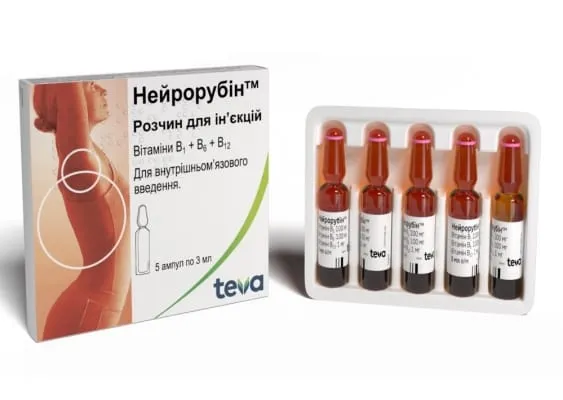
Each ampoule of solution (3 mL) contains: thiamine hydrochloride (vitamin B1) 100 mg, pyridoxine hydrochloride (vitamin B6) 100 mg, cyanocobalamin (vitamin B12) 1 mg;
Excipients: potassium cyanide, benzyl alcohol, water for injections, sodium hydroxide (if necessary).
Pharmaceutical form. Injection solution.
Main physicochemical properties: clear, red-colored solution.
Pharmacotherapeutic group. Vitamin B1 in combination with vitamin B6 and/or vitamin B12.
ATC code A11D B.
Pharmacological properties.
Pharmacodynamics.
Neurorubin™ combines high doses of three vitamins: B1, B6, and B12, which play an important role in the functioning of the nervous system. Each of these vitamins is essential for ensuring optimal metabolism in nerve cells. In addition, when administered in high doses, these vitamins exhibit analgesic effects.
Like all other vitamins, they are indispensable nutrients that cannot be synthesized directly in the body.
Therapeutic administration of vitamins B1, B6, and B12 replenishes insufficient dietary intake of these vitamins, thereby ensuring adequate levels of coenzymes in the body. B vitamins are components of enzyme systems that regulate the metabolism of proteins, fats, and carbohydrates. However, each of the B vitamins performs a specific biological role. Their presence in balanced amounts is necessary for normal metabolism.
Therapeutic use of these vitamins in various nervous system disorders is aimed at compensating, on one hand, for existing deficiencies (possibly due to increased bodily requirements caused directly by the disease), and on the other hand, at stimulating natural recovery mechanisms. Vitamins B1, B6, and B12 have very low toxicity and pose no potential risk to humans. Currently, there are no data indicating carcinogenic, mutagenic, or teratogenic properties of these vitamins.
Pharmacokinetics.
Water-soluble vitamins are completely absorbed by the body after intramuscular administration. The extent of absorption depends on blood flow relative to the injection site.
Cyanocobalamin (vitamin B12). After absorption, vitamin B12 binds in serum to specific B12-binding proteins: beta-globulin (transcobalamin) and B12-binding alpha1-globulin.
Vitamin B12 accumulates primarily in the liver. The half-life in blood serum is approximately 5 days, and in the liver—approximately 1 year.
Thiamine hydrochloride (vitamin B1). A portion of absorbed thiamine participates in enterohepatic circulation. The main excretion products of thiamine are thiamine carboxylic acid and pyramin (2,5-dimethyl-4-aminopyrimidine). In addition, a small amount of unchanged thiamine is excreted.
Pyridoxine hydrochloride (vitamin B6). In the body, pyridoxine is oxidized to pyridoxal or aminated to pyridoxamine. Its function as a coenzyme requires phosphorylation of the CH2OH group at the 5th position, forming pyridoxal-5-phosphate (PLP). In blood, about 80% of PLP is protein-bound. Pyridoxine is primarily stored in muscles in the form of PLP. The main excretion product is 4-pyridoxic acid.
Clinical characteristics.
Indications.
Treatment of neuritis and neuralgia, such as:
- intercostal neuralgia;
- lumbar syndrome (lumbago);
- plexitis (cervical and brachial plexus);
- radicular neuritis due to degenerative spine diseases.
As adjunctive treatment:
- trigeminal neuralgia;
- sciatica.
Contraindications.
Hypersensitivity to any component of the drug.
Vitamin B1 is contraindicated in allergic conditions.
Vitamin B6 is contraindicated in peptic ulcer of the stomach and duodenum during the acute phase (since it may increase gastric juice acidity).
Vitamin B12 is contraindicated in erythremia, erythrocytosis, thromboembolism, and psoriasis.
Interaction with other medicinal products and other types of interactions.
High doses of vitamin B6, such as those contained in Neurorubin™, may reduce the therapeutic effect of levodopa in Parkinson's disease, except when a decarboxylase inhibitor is administered concomitantly.
The toxicity of isoniazid may be increased.
Vitamin B6 may reduce the effectiveness of altretamine.
Concomitant use with pyridoxine antagonists (e.g., isoniazid, hydralazine, penicillamine, or cycloserine) and oral contraceptives may increase the requirement for vitamin B6.
The action of thiamine is inactivated by 5-fluorouracil, as the latter competitively inhibits phosphorylation of thiamine to thiamine pyrophosphate.
Antacids delay the absorption of vitamin B1.
Loop diuretics, such as furosemide, which inhibit tubular reabsorption, may increase thiamine excretion during long-term therapy, thereby reducing its levels.
Special precautions for use.
The drug must not be administered intravenously.
Since Neurorubin™ contains vitamin B6, caution should be exercised when administering the drug to patients with a history of peptic ulcer of the stomach and duodenum, or with pronounced renal or hepatic impairment.
The drug should not be used in patients with neoplastic diseases, except in cases associated with megaloblastic anemia and vitamin B12 deficiency.
The drug should not be used in severe or acute forms of cardiac decompensation and angina pectoris.
Continuous monitoring for signs of peripheral sensory neuropathy is recommended during prolonged use.
Short-term parenteral administration of vitamin B12 may temporarily complicate the diagnosis of funicular myelosis or pernicious anemia.
If symptoms of peripheral sensory neuropathy (paresthesia) occur, the dosage should be reassessed and, if necessary, administration of the drug should be discontinued.
Cases of neuropathies have been observed during prolonged use (more than 6–12 months) of vitamin B6 at daily doses exceeding 50 mg, as well as during short-term use (more than 2 months) of vitamin B6 at doses exceeding 1 g per day.
Intramuscular injections of vitamin B12 may cause anaphylactoid reactions in patients with hypersensitivity.
This medicinal product contains less than 1 mmol (23 mg)/dose of sodium, i.e., it is practically sodium-free. This medicinal product also contains less than 1 mmol (39 mg)/dose of potassium, i.e., it is practically potassium-free.
Use during pregnancy or breastfeeding.
Pregnancy
Clinical studies on treatment with Neurorubin™ in animals or pregnant women are lacking. The potential risk for humans is unknown; therefore, the drug is not recommended for use during pregnancy.
Breastfeeding
Vitamins B1, B6, and B12 are excreted in breast milk. High concentrations of vitamin B6 may suppress breast milk production. Data from animal studies on the extent of excretion into breast milk are lacking. The drug is not recommended for use during breastfeeding. The decision to discontinue breastfeeding or to discontinue therapy with the drug should be made by weighing the benefits of breastfeeding for the child against the benefits of therapy for the mother.
Ability to affect reaction speed when driving or operating machinery.
The drug does not affect the ability to drive or operate complex machinery.
If dizziness occurs during treatment with the drug, driving and operating machinery should be avoided.
Method of administration and dosage.
The medication is intended for intramuscular injection.
Dosage
In severe (acute) cases: 1 ampoule daily until the intensity of acute symptoms decreases.
After symptom relief: 1 ampoule 1–3 times per week.
To maintain or continue the initial course of injectable therapy and for prevention of relapse, it is recommended to use Neurorubin™-Fortе Lactab, film-coated tablets.
Do not exceed the recommended daily dose.
The duration of treatment, which depends on the nature and course of the disease, is determined by the physician.
Administration technique.
To open the ampoule:
- hold the ampoule with the dot marking facing upwards;
- shake the ampoule until the liquid flows into the lower part;
- snap off the top of the ampoule at the scored mark.
Children.
There is no experience with the use of this medication in children; therefore, the medication should not be administered to children.
Overdose.
In case of overdose, adverse reactions are intensified.
Vitamin B1
Thiamine has a wide therapeutic range. Very high doses (more than 10 g) exert a ganglion-blocking effect and suppress nerve impulse conduction in a curare-like manner.
Vitamin B6
Vitamin B6 toxicity is considered to be very low.
However, prolonged use (> 6–12 months) of vitamin B6 at daily doses exceeding 50 mg may cause peripheral sensory neuropathy.
Continuous use of vitamin B6 at daily doses exceeding 1 g for more than two months may lead to neurotoxic adverse reactions.
When administering more than 2 g daily, neuropathies with ataxia and sensory disturbances have been reported, as well as cerebral seizures with EEG changes, and in isolated cases – hypochromic anemia and seborrheic dermatitis.
Vitamin B12
After parenteral administration (in rare cases – after oral administration) of doses higher than recommended, allergic reactions, eczematous skin disorders, and benign forms of acne have been observed. With prolonged use at high doses, possible adverse effects include altered liver enzyme activity, chest pain, and hypercoagulability.
Adverse reactions.
Immune system disorders: chromaturia, hypersensitivity reactions, including angioneurotic edema, anaphylactoid reactions, anaphylactic shock, mainly in patients with increased sensitivity.
Endocrine system disorders: inhibition of prolactin secretion.
Nervous system disorders: feeling of anxiety; long-term use (over 6–12 months) of pyridoxine hydrochloride (vitamin B6) at doses exceeding 50 mg daily may lead to peripheral sensory neuropathy, nervous excitement, malaise, headache, dizziness.
Cardiovascular system disorders: tachycardia, circulatory collapse, mainly in patients with increased sensitivity.
Respiratory system disorders: cyanosis, pulmonary edema, mainly in patients with increased sensitivity.
Gastrointestinal disorders: gastrointestinal disturbances, including vomiting, diarrhea, abdominal pain, increased gastric juice acidity, nausea, gastrointestinal bleeding, mainly in patients with increased sensitivity.
Hepatobiliary system disorders: high doses of the drug may lead to increased serum levels of aspartate aminotransferase (AST).
Skin and subcutaneous tissue disorders: rash, skin hyperemia, eczema, pruritus, urticaria, mainly in patients with increased sensitivity.
High doses of the drug may cause acne. Pyridoxine hydrochloride may provoke worsening of pre-existing acne vulgaris or development of acneiform eruptions.
General disorders and administration site reactions: reactions at the injection site, increased sweating, weakness, sensation of a "lump in the throat".
Shelf life. 3 years.
Storage conditions. Store at 2 to 8 °C (in a refrigerator). Keep out of reach of children.
Incompatibilities.
Due to lack of compatibility studies, Neurorubin™ must not be mixed with other medicinal products.
Packaging. 3 ml in an ampoule; 5 ampoules per box.
Prescription status. Prescription only.
Manufacturer. Merckle GmbH.
Manufacturer's address and place of business.
Ludwig-Merckle-Straße 3, 89143 Blaubeuren, Germany.
Similar drugs
| Brand name | Dosage form | Active substance / Dosage | Manufacturer |
|---|---|---|---|
| CELULAR | solution for injection | PJSC "Lekhim – Kharkiv" | |
| DIAGAMA | solution for injection | PJSC "Lekhim - Kharkiv" | |
| MILGAMMA® | solution for injection | Solupharm Pharmazeutische Erzeugnisse GmbH | |
| NERVIPLEX-N | solution for injection | PJSC "Lekhim-Kharkiv" | |
| NEURALON | solution for injection | World Medicine Ilac San. Ve Tij. A.S. | |
| NEURAXIN® B | solution for injection | JSC "Kalceks" (manufacturer responsible for batch release) | |
| NEUROBION | solution for injection | Senexis HSC (full production cycle) | |
| NEUROCORD | solution for injection | PJSC "Lekhim-Kharkiv" | |
| NEUROLEK | solution for injection | PJSC "Lekhim - Kharkiv" | |
| NEUROMAX | solution for injection | LLC "Corporation "Zdorovya" | |
| TAMBO | solution for injection | K.T. Rompharm Company S.R.L. | |
| VITACETIN | solution for injection | PJSC "Lekhim-Kharkiv" |
The original data is available in the language of the country of manufacture.
Data source: State Register of Medicinal Products of Ukraine
Data last verified: August 13, 2026