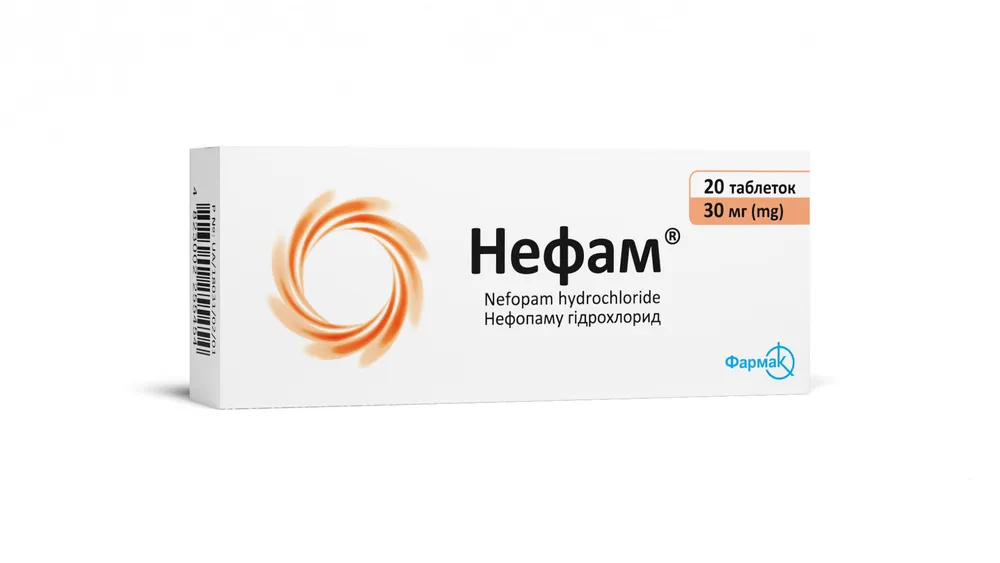
NEFAM
UkraineThe drug is intended for adults for the symptomatic treatment of moderate to severe pain, specifically dental pain, muscle pain, joint pain, post-operative pain, as well as in patients with oncological diseases.
Frequently asked questions
How should Nefam be taken correctly?
Adults are recommended to start with 2 tablets (60 mg), then take 1 tablet 3 times a day. If necessary, the dose can be increased to 2 tablets 3 times a day. For elderly people and patients with renal impairment, it is recommended to reduce the initial dose to 1 tablet 3 times a day.
What side effects can Nefam cause?
The most common side effects are drowsiness, nausea, vomiting, and excessive sweating. Dizziness, dry mouth, rapid heartbeat, urinary retention, and allergic reactions are also possible. In elderly people, hallucinations or confusion may occur.
Who should not take this drug?
The drug is contraindicated in people with hypersensitivity to its components, patients with a history of seizures, those taking MAO inhibitors, as well as in cases of hepatic or renal impairment.
Can the drug be taken during pregnancy or breastfeeding?
The use of the drug during pregnancy is not recommended for safety reasons. During breastfeeding, the medication should also not be taken, as it is excreted in breast milk.
Does the drug affect the ability to drive a vehicle?
Yes, due to the risk of drowsiness, caution should be exercised when driving a car or operating machinery.
With which other medicines should the drug not be combined?
Caution is required when taking it simultaneously with drugs that have anticholinergic or sympathomimetic effects, as well as with opiates, neuroleptics, hypnotics, antidepressants, and certain blood pressure medications. Caution should also be exercised when combining it with paracetamol due to the risk of liver damage.
Instructions for use
INSTRUCTION for medical use of the medicinal product NEFAM® (NEFAM)
Composition:
Active substance: nefopam hydrochloride;
One film-coated tablet contains 30 mg of nefopam hydrochloride;
Excipients: calcium hydrogen phosphate dihydrate, microcrystalline silicified cellulose, pregelatinized starch, hydrogenated vegetable oil, magnesium stearate, colloidal anhydrous silicon dioxide;
Excipients for the film coating: Opadry 03F180011 White (hypromellose, titanium dioxide (E 171), macrogol).
Pharmaceutical form. Film-coated tablets
Main physicochemical characteristics: white to yellowish-white, round, biconvex film-coated tablets.
Pharmacotherapeutic group. Analgesics and antipyretics. ATC code: N02BG06.
Pharmacological Properties
Pharmacodynamics
Chemically, nefopam hydrochloride is derived from diphenhydramine: nefopam was synthesized by cyclization of orphenadrine. Therefore, like its two precursors, nefopam hydrochloride possesses anticholinergic properties.
Mechanism of Action
There is limited information available regarding the mechanism of action. The studied pharmacological properties do not allow a precise description of its effects.
Pharmacodynamic Effects
Nefam® is an analgesic agent. Nefopam hydrochloride stimulates descending serotonergic pathways that regulate/modulate pain. It inhibits the reuptake of synaptic norepinephrine, dopamine, 5-hydroxytryptophan, and gamma-aminobutyric acid (GABA); it also stimulates the release of dopamine and GABA in the brain.
Nefopam hydrochloride is fundamentally different from other centrally-acting analgesics such as morphine, codeine, pentazocine, and propoxyphene. It does not bind to opioid receptors and is not antagonized by naloxone. Unlike opioid agents, nefopam hydrochloride does not cause respiratory depression. There have been some reports of dependence. Nefopam hydrochloride lacks antipyretic and anti-inflammatory properties and does not inhibit prostaglandin synthesis in vitro.
Pharmacokinetics
Absorption
Following an oral dose of 90 mg, the time to reach maximum plasma concentration ranging from 73 to 154 ng/mL is between 1 and 3 hours. After an oral dose of 60 mg, maximum plasma concentration of 29–67 ng/mL is reached approximately 2 hours post-administration. Plasma protein binding is 73%.
Biological Transformation
Nefopam undergoes extensive biotransformation: only a negligible amount of unchanged nefopam is found in urine. Seven metabolites have been identified, including desmethyl-nefopam, glucuronide, and nefopam N-oxide. However, the enzyme responsible for this biotransformation remains unknown.
Elimination
Metabolites and a small unchanged fraction are rapidly eliminated by the kidneys. Thus, the majority of the administered dose is recovered in urine. After intravenous administration of 20 mg of radiolabeled nefopam to four volunteers, less than 5% of the administered dose was detected unchanged in urine. Within 5 days, 87% of the administered radioactive material was recovered in urine and 8% in feces. The elimination half-life of nefopam in healthy volunteers is 4 hours (range: 3–8 hours).
Clinical characteristics.
Indications.
The medicinal product Neffam® is indicated in adults for symptomatic treatment of moderate to severe pain, including postoperative pain, dental pain, myalgia, arthralgia, and pain in oncology patients.
Contraindications.
Hypersensitivity to nefopam or to any of the excipients of the medicinal product.
Neffam® must not be administered to patients with a history of seizures and to patients receiving monoamine oxidase inhibitors (MAOIs).
Neffam® must not be administered to patients with hepatic or renal insufficiency. Due to its anticholinergic properties, Neffam® should be used with caution in patients with glaucoma, prostatic hypertrophy, or urinary retention, and, if necessary, treatment should be discontinued.
Interaction with other medicinal products and other forms of interaction.
Adverse effects of nefopam may be enhanced when used concomitantly with other drugs exhibiting anticholinergic or sympathomimetic activity. It should be noted that a significant number of medicinal products may enhance central nervous system depression due to additive effects and reduce alertness: opioids (analgesics, antitussives, opioid substitution therapy), neuroleptics, barbiturates, benzodiazepines, non-benzodiazepine anxiolytics (meprobamate), hypnotics, antidepressants with sedative effect (amitriptyline, doxepin, mianserin, mirtazapine, trimipramine), sedative H1-histamine receptor blockers, centrally acting antihypertensives, baclofen.
In patients receiving Neffam®**, false-positive results may occur during testing for benzodiazepines and opioids.
The intensity and frequency of adverse effects increase when nefopam hydrochloride is administered concomitantly with codeine, pentazocine, or dextropropoxyphene.
Nefopam hydrochloride is extensively metabolized, but the enzyme responsible for the biotransformation of nefopam is unknown. Potential interactions with CYP inhibitors/inducers cannot be predicted. Caution is required when administering nefopam hydrochloride concomitantly with any CYP inhibitor/inducer.
In studies in dogs, high hepatotoxicity was observed with concomitant administration of paracetamol and nefopam hydrochloride at high doses. Oral administration of 236 mg/kg/day paracetamol and 24 mg/kg/day nefopam hydrochloride enhanced the hepatotoxicity of paracetamol; these doses are approximately 6 to 8 times higher than the average doses administered to humans. Doses equivalent to 3 to 4 times lower than the human dose did not cause potentiation of hepatotoxicity.
Use in specific populations.
Paediatric population: the medicinal product Neffam® is not recommended for children.
Use with caution in patients with symptoms of anxiety, glaucoma, prostate hypertrophy, or urinary retention due to the moderate central adrenergic activity and anticholinergic effect of Neffam®.
Extreme caution is advised when prescribing this medicinal product to patients with a history of cardiovascular disorders (symptomatic tachycardia, myocardial infarction, heart failure), as there is a risk of developing tachycardia. In all such cases, consultation with a cardiologist is necessary prior to initiating treatment in order to evaluate the risk-benefit ratio in patients with cardiovascular disorders.
Hepatic and/or renal impairment may interfere with the metabolism and elimination of nefopam.
In elderly patients, dose reduction may be required due to slowed metabolism. The initial dose should be limited to 1 tablet three times daily, as elderly patients are more sensitive to adverse effects on the central nervous system (in this patient group, cases of hallucinations and confusion have been reported).
Use during pregnancy or breastfeeding.
Pregnancy.
There are no clinical data on the use of the medicinal product in pregnant women. Animal studies do not indicate any direct or indirect harmful effects on reproductive function. For safety reasons, Neffam**®** should not be used during pregnancy.
Breastfeeding period.
Nefopam hydrochloride is excreted in breast milk. The maximum amount transferred to the infant is 0.05 mg/kg/day. The medicinal product Neffam**®** is contraindicated during breastfeeding.
Ability to influence reaction speed when driving vehicles or operating machinery.
The possibility of somnolence should be considered during treatment with Neffam**®**, which may affect the ability to drive vehicles or operate machinery.
Method of Administration and Dosage.
Adults:
The initial dose is 2 tablets (60 mg), followed by 1 tablet taken 3 times a day. If required due to the intensity of pain, the dose may be increased to 2 tablets 3 times a day.
A reduced dose is recommended for elderly patients due to their slower metabolism. The initial dose should be limited to 1 tablet 3 times a day, as elderly patients are more susceptible to adverse reactions related to the central nervous system.
Renal Insufficiency
In patients with end-stage renal disease, the maximum plasma concentration may increase during treatment with the medicinal product Neffam®. Therefore, it is recommended to reduce the daily dose not only in elderly patients but also in patients with end-stage renal insufficiency.
Children. The medicinal product must not be used in children.
Overdose.
Symptoms of anticholinergic origin: tachycardia, coma, seizures, hallucinations.
Adults
Initial signs of toxicity, i.e., tachycardia, may appear after ingestion of 30 tablets of the medicinal product Neffam® (15 mg/kg). In such a case, hospitalization is required.
Treatment
General supportive therapy. If the medicinal product was ingested at least 1 hour earlier, it should be removed by gastric lavage or by inducing emesis. Administration of activated charcoal orally may be beneficial in preventing absorption. Seizures and hallucinations should be treated, for example, by administering diazepam intravenously or rectally. Beta-blockers may help manage cardiovascular complications.
Adverse reactions
The reported adverse reactions are classified by system organ class and frequency: very common (≥ 1/10), common (≥ 1/100, < 1/10), uncommon (≥ 1/1,000, < 1/100), rare (≥ 1/10,000, < 1/1,000), very rare (< 1/10,000), frequency not known (frequency cannot be estimated from the available data).
Central nervous system disorders: very common – somnolence; common – vertigo*, dizziness, paraesthesia, tremor; rare – seizures*, confusion, postoperative confusion (disorientation), insomnia, headache; frequency not known – coma.
Cardiac disorders: common – tachycardia*, increased heart rate*, hypotension.
Gastrointestinal disorders: very common – nausea, vomiting; common – dry mouth*, abdominal pain, diarrhoea.
Renal and urinary disorders: common – urinary retention; rare – reduced kidney function, harmless pink discoloration of urine.
Immune system, skin and subcutaneous tissue disorders: very common – hyperhidrosis*; common – allergic reactions; rare – hypersensitivity reactions in the postoperative period (including Quincke's oedema, anaphylactic shock), pruritus, erythema, urticaria, malaise.
Psychiatric disorders: rare – nervousness*, irritability*, hallucinations, abuse, drug dependence; frequency not known – confusion.
Eye disorders: rare – visual disturbances.
*Other anticholinergic-like reactions may occur, even if they have never been reported.
Reporting of suspected adverse reactions
Reporting of suspected adverse reactions after registration of the medicinal product is important. It allows ongoing monitoring of the benefit-risk balance of the medicinal product. Medical and pharmaceutical professionals, as well as patients or their legal representatives, should report any suspected adverse reactions and lack of efficacy of the medicinal product via the Automated Pharmacovigilance Information System at the following link: https://aisf.dec.gov.ua.
Shelf life. 2 years.
Do not use the medicinal product after the expiry date stated on the packaging.
Storage conditions. Store at a temperature not exceeding 25°C.
Keep out of the reach and sight of children.
Packaging. 10 tablets in a blister. 2 or 6 blisters in a carton.
Prescription status. Prescription only.
Manufacturer. JSC "Farmak".
Address of the manufacturer and location of operations.
74, Kyrylivska Street, Kyiv, 04080, Ukraine.
Similar drugs
| Brand name | Dosage form | Active substance / Dosage | Manufacturer |
|---|---|---|---|
| NEFOBOL | tablets, film-coated |
|
Gipax Pharmaceuticals Private Limited |
The original data is available in the language of the country of manufacture.
Data source: State Register of Medicinal Products of Ukraine
Data last verified: August 13, 2026