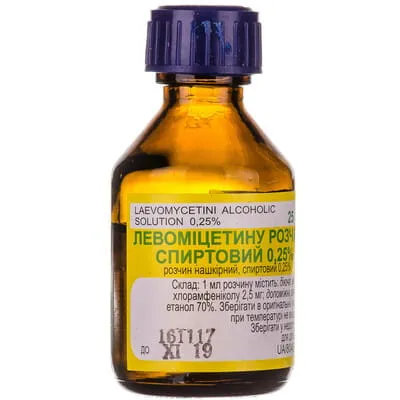
LEVOMYCETIN SPIRIT SOLUTION 0,25 %
UkraineIt is used topically for burns, cuts, and skin cracks, as well as for otitis and inflammatory diseases accompanied by a purulent process.
Frequently asked questions
How should the drug be used correctly?
Affected areas of the skin should be lubricated with the solution (can be under a dressing). In case of purulent otitis, 2–3 drops are instilled into the external auditory canal 1–2 times a day. If there is heavy discharge that washes away the agent, the procedure can be repeated up to 3–4 times a day.
When should Levomycetin spirit solution 0,25 % not be used?
The drug is contraindicated in cases of hypersensitivity to its components, glucose-6-phosphate dehydrogenase deficiency, acute intermittent porphyria, as well as psoriasis, eczema, and fungal skin infections. It must not be used by pregnant women, breastfeeding women, and children under 1 year of age.
What are the possible side effects?
Allergic reactions are possible: skin rashes, itching, dermatitis, burning, redness, edema, or urticaria. If such symptoms appear, use of the drug should be discontinued.
Can this product be combined with other medicines?
It is undesirable to use the drug simultaneously with agents that suppress blood formation (for example, sulfanilamides, cytostatics, or pyrazoline derivatives).
What should be done if too much of the drug has been used?
Overdose may cause irritation of the skin and mucous membranes, as well as local allergic reactions such as rash, itching, redness, and tissue swelling.
Instructions for use
INSTRUCTIONS FOR MEDICAL USE OF THE MEDICINAL PRODUCT CHLORAMPHENICOL ALCOHOLIC SOLUTION 0.25%
Composition:
Active ingredient: chloramphenicol;
1 ml of solution contains chloramphenicol 2.5 mg;
Excipient: ethanol 70%.
Pharmaceutical form. Topical alcoholic solution 0.25%.
Main physicochemical properties: clear, colorless liquid with a characteristic alcoholic odor.
Pharmacotherapeutic group.
Antibiotics for local use. ATC code D06AX02.
Pharmacological properties.
Pharmacodynamics.
When applied locally, the drug exerts an antimicrobial effect against most Gram-positive and Gram-negative bacteria. It acts on pathogens resistant to penicillin-group antibiotics, streptomycin, and sulfonamides. Resistance to chloramphenicol itself develops slowly. The drug exerts a bacteriostatic effect; being lipid-soluble, chloramphenicol penetrates the bacterial cell membrane and reversibly binds to the 50S subunit of bacterial ribosomes, where it inhibits the transfer of amino acids to growing peptide chains, thereby disrupting the formation of peptide bonds and subsequent protein synthesis.
Pharmacokinetics.
When applied topically, the drug poorly penetrates intact skin and mucous membranes, so its systemic absorption is weak. The bacteriostatic effect upon surface application depends on the size of the affected area, the amount of pus, and mechanical barriers. On average, the antimicrobial effect persists for 6–12 hours, after which the drug should be reapplied.
Clinical characteristics.
Indications. For topical use in burns, cuts, skin fissures, otitis, and inflammatory conditions complicated by purulent pathology.
Contraindications. Hypersensitivity to the components of the drug, glucose-6-phosphate dehydrogenase deficiency, acute intermittent porphyria, skin diseases (psoriasis, eczema, fungal infections).
Special precautions.
Topical use of antibacterial agents may lead to skin sensitization, resulting in hypersensitivity reactions upon subsequent topical or systemic administration of the drug.
The antibacterial effect of the drug is preserved in the presence of purulent or necrotic material.
Peripheral blood parameters should be monitored during prolonged treatment (longer than 1 month). The drug must not enter the eyes or mucous membranes.
The instructions for use of the medicinal product must not be violated.
Interaction with other medicinal products and other forms of interaction.
Concomitant use with drugs that suppress hematopoiesis (sulfonamides, cytostatics, pyrazolone derivatives) is undesirable.
Special precautions for use.
In severe skin or ear infections, topical application of chloramphenicol should be used after consultation with a physician as part of combination therapy together with systemic antibacterial agents.
Use during pregnancy or breastfeeding.
The drug is contraindicated during pregnancy and breastfeeding.
Ability to affect reaction rate while driving or operating machinery.
There is no evidence that the drug may negatively affect reaction speed while driving or operating machinery.
Method of Administration and Dosage
For external use only. Apply to affected areas of the skin (can be used under an occlusive dressing). Duration of treatment depends on the nature and severity of the pathological process and the therapeutic effect achieved. In purulent otitis, instill the preparation into the external auditory canal (2–3 drops). Repeat the procedure 1–2 times daily; in cases of abundant discharge that washes away the applied solution, repeat up to 3–4 times daily.
Children. Do not use in children under 1 year of age.
Overdose.
In case of overdose, skin and mucous membrane irritation may occur, as well as local allergic reactions such as rash, itching, redness, and tissue swelling, along with exacerbation of other adverse reactions.
Side effects.
Immune system: allergic reactions, including skin rashes, itching, dermatitis, burning sensation, hyperemia, angioneurotic edema, urticaria. If such reactions occur, the drug should be discontinued.
Shelf life. 2 years.
Storage conditions. Store in the original packaging at a temperature not exceeding 25 °C.
Keep out of reach of children.
Packaging. 25 ml in a bottle.
Availability. Over-the-counter (without prescription).
Manufacturer. JSC "FITOFARM".
Manufacturer's address and location of business activity.
2 Sybirtseva Street, Bakhmut, Donetsk region, 84500, Ukraine.
Marketing authorization holder. JSC "FITOFARM".
Address of the marketing authorization holder.
7, Verkhovnoyi Rady Avenue, Kyiv, 02100, Ukraine, 3rd floor, room 18.
The original data is available in the language of the country of manufacture.
Data source: State Register of Medicinal Products of Ukraine
Data last verified: August 13, 2026