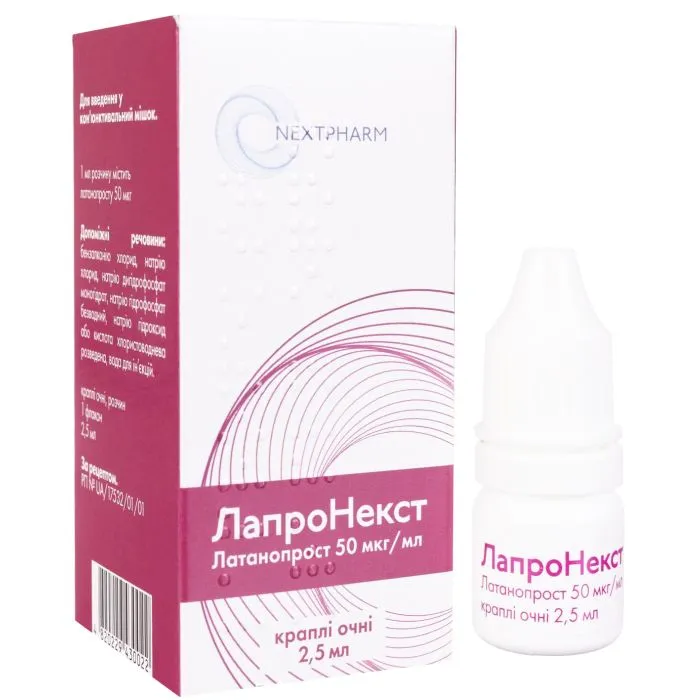
LAPRONEXT
UkraineThe drug is used to reduce elevated intraocular pressure in patients with open-angle glaucoma, as well as in children with pediatric glaucoma and elevated intraocular pressure.
Frequently asked questions
How should Lapronext be taken correctly?
Adults and children are recommended to instill 1 drop into the affected eye once daily, preferably in the evening. The drug should not be used more than once a day, as this may reduce its efficacy. Contact lenses must be removed before application, and they may only be reinserted 15 minutes after instillation.
What are the possible side effects of Lapronext?
The most common side effects observed are changes in the color of the iris (increased pigmentation), eye irritation (burning, itching, a gritty sensation), eye redness, and changes in eyelash growth (they may become longer, thicker, or grow in the wrong direction). Headache, dizziness, and temporary blurred vision are also possible.
Who should not use this drug?
The drug is contraindicated in cases of known hypersensitivity to any of its components. It is also not recommended for use during pregnancy and breastfeeding.
Can this drug be combined with other agents?
It is not recommended to use two or more prostaglandin analogues simultaneously, as this may lead to a paradoxical increase in intraocular pressure. If you are using other eye drops, an interval of at least 5 minutes should be maintained between their applications.
How does the drug affect vision and driving?
Instillation may cause temporary blurred vision. Until this effect subsides, it is not recommended to drive vehicles or operate machinery.
Instructions for use
INSTRUCTIONS for medical use of the medicinal product LaproNext (LaproNext)
Composition:
Active substance: latanoprost;
1 ml of solution contains latanoprost 50 mcg;
Excipients: benzalkonium chloride, sodium chloride, sodium dihydrogen phosphate monohydrate, sodium hydrogen phosphate anhydrous, sodium hydroxide or hydrochloric acid diluted, water for injections.
Pharmaceutical form. Eye drops, solution.
Main physicochemical properties: clear, colorless aqueous solution.
Pharmacotherapeutic group. Ophthalmological agents. Anti-glaucoma preparations and miotics. Prostaglandin analogues. Latanoprost. ATC code S01E E01.
Pharmacological properties.
Pharmacodynamics.
The active substance, latanoprost, a prostaglandin F2α analogue, is a selective prostaglandin FP receptor agonist that reduces intraocular pressure by increasing uveoscleral outflow of aqueous humour. Reduction in intraocular pressure in humans begins approximately 3–4 hours after administration of the drug, with maximum effect observed at 8–12 hours. The hypotensive effect lasts for at least 24 hours.
Preclinical studies have shown that latanoprost is effective as monotherapy. In addition, clinical studies on combination therapy have demonstrated that latanoprost is effective in combination with beta-adrenergic blockers (timolol).
Short-term (1 or 2 weeks) studies indicate that the effect of latanoprost is additive when used in combination with adrenergic agonists (dipivefrin), oral carbonic anhydrase inhibitors (acetazolamide), and at least partially additive when used with cholinergic agonists (pilocarpine).
Clinical studies have shown that latanoprost does not significantly affect aqueous humour production. No effect of latanoprost on the blood-aqueous barrier has been observed.
Latanoprost did not cause leakage of fluorescein into the posterior segment of pseudophakic human eyes during short-term treatment.
No significant pharmacological effects of latanoprost on the cardiovascular and respiratory systems have been observed at clinically relevant doses.
Children
The efficacy of the drug LaproNext in pediatric patients (≤ 18 years of age) was demonstrated in a 12-week double-masked clinical trial comparing latanoprost with timolol in 107 patients diagnosed with ocular hypertension and childhood glaucoma. In this study, neonates were required to have a gestational age of at least 36 weeks. Patients received either 0.005% latanoprost once daily or 0.5% timolol (or 0.25% for patients under 3 years of age, at investigator’s discretion) twice daily. The primary efficacy endpoint was mean reduction in intraocular pressure (IOP) from baseline at week 12 of the study. Mean reductions in IOP were similar between the latanoprost and timolol treatment groups. Across all age subgroups evaluated (from birth to 3 years, 3 to 12 years, and 12 to 18 years), mean IOP reductions at week 12 were similar between patients receiving latanoprost and those receiving timolol. However, efficacy data for latanoprost in the age group from birth to 3 years were derived from only 13 patients, and no significant efficacy was demonstrated in the 4 patients representing the birth to 1 year age group in the clinical trial. Data on use in preterm neonates (born before 36 weeks of gestation) are lacking.
IOP reduction outcomes in the subgroup of patients with primary congenital glaucoma/infantile glaucoma (PCG) were similar between patients treated with latanoprost and those treated with timolol. Results in the non-PCG subgroup (i.e., patients with, for example, juvenile open-angle glaucoma, aphakic glaucoma) were comparable to those in PCG patients.
The effect on IOP was evident after the first week of treatment (see table) and was maintained throughout the 12-week study period, similar to observations in adults.
| Reduction in IOP (mm Hg) at Week 12 of the study according to active treatment group and initial diagnosis |
||||
| Parameter |
Latanoprost |
Timolol |
||
| Mean baseline value (MBV) |
27.3 (0.75) |
27.8 (0.84) |
||
| Change at Week 12 compared to mean baseline value†(MBV) |
-7.18 (0.81) |
-5.72 (0.81) |
||
| p-value compared to timolol |
0.2056 |
|||
|
|
POAG |
Non-POAG N=25 |
POAG N=26 |
Non-POAG N=28 |
| Mean baseline value (MBV) |
26.5 (0.72) |
28.2 (1.37) |
26.3 (0.95) |
29.1 (1.33) |
| Change at Week 12 compared to mean baseline value†(MBV) |
-5.90 (0.98) |
-8.66 (1.25) |
-5.34 (1.02) |
-6.02 (1.18) |
| p-value compared to timolol |
0.6957 |
0.1317 |
||
SP – standard error.
†Adjusted calculated value based on the analysis of covariance (ANCOVA) model.
Pharmacokinetics.
Latanoprost (molecular weight 432.58) is an isopropyl ester prodrug that is biologically inactive per se but becomes biologically active after hydrolysis to latanoprost acid.
Prodrugs penetrate well through the cornea, and all of the drug that reaches the intraocular fluid is hydrolyzed during passage through the cornea.
Studies in humans have shown that maximum concentration in the intraocular fluid is reached approximately 2 hours after topical administration. There is almost no metabolism of latanoprost acid within the eye. The main metabolism of the drug occurs in the liver. In humans, the plasma half-life is 17 minutes.
Children
An open-label pharmacokinetic study of latanoprost acid plasma concentrations was conducted in adult patients and pediatric patients (from newborns up to children under 18 years of age) with intraocular hypertension and glaucoma. Patients in all age groups received treatment with 0.005% latanoprost, one drop in each eye, for at least 2 weeks. Systemic exposure to latanoprost acid was approximately twice as high in patients aged 3 to <12 years and six times higher in children under 3 years of age compared to adult patients; however, a wide safety margin for systemic adverse effects was maintained. The median time required to reach peak plasma concentration of the drug was 5 minutes after dosing across all age groups. The median plasma half-life of the drug was short (less than 20 minutes) and similar in pediatric and adult patients, indicating no accumulation of latanoprost acid in the systemic circulation at steady state.
Clinical characteristics.
Indications.
Reduction of elevated intraocular pressure in patients with open-angle glaucoma and elevated intraocular pressure.
Reduction of elevated intraocular pressure in pediatric patients with elevated intraocular pressure and congenital glaucoma.
Contraindications.
Known hypersensitivity to any component of the medicinal product LaproNext.
Interaction with other medicinal products and other forms of interaction.
Comprehensive data on interactions with other medicinal products are lacking.
Cases of paradoxical increase in IOP have been reported following concomitant ocular administration of two prostaglandin analogues. Therefore, concomitant use of two or more prostaglandins, prostaglandin analogues, or their derivatives is not recommended.
Drug interaction studies have been conducted only in adult patients.
Special precautions for use.
LaproNext may cause a gradual change in eye color due to increased brown pigment in the iris. Patients should be informed about the possibility of permanent eye color change prior to initiating treatment. Treating only one eye may lead to permanent heterochromia.
Changes in eye color are predominantly observed in patients with mixed iris pigmentation, such as blue-brown, gray-brown, yellow-brown, or green-brown. In latanoprost studies, color changes typically occurred within the first 8 months of treatment, less frequently during the second or third year, and were not observed after the fourth year of treatment. Progression of iris pigmentation decreases over time and stabilizes after 5 years. The effect of increased pigmentation after 5 years of treatment has not been evaluated. In an open-label 5-year safety study of latanoprost, increased iris pigmentation was recorded in 33% of patients (see section "Adverse reactions"). Iris color changes are mostly minor and often clinically unnoticeable. The incidence in patients with mixed iris color ranged from 7% to 85%, with the highest frequency observed in patients with yellow-brown iris color. Eye color changes have not been observed in patients with uniformly blue iris color and are rare in patients with uniformly gray, green, or brown iris color.
The color change occurs due to increased melanin content in the iris stromal melanocytes, not due to an increase in melanocyte number. Typically, brown pigmentation spreads concentrically from around the pupil toward the periphery of the treated eye, although the entire iris or parts of it may become more brown. After discontinuation of treatment, further progression of brown iris pigmentation has not been observed. Currently, clinical studies have not shown this phenomenon to be associated with any symptoms or pathological changes.
No changes in iris nevi or freckles have been observed under therapy. Pigment accumulation in the trabecular meshwork or any other part of the anterior chamber of the eye has not been observed in clinical studies. Results from 5 years of clinical use indicate that increased iris pigmentation does not lead to clinical complications, and treatment with LaproNext may continue even if iris pigmentation changes occur. However, patients should undergo regular ophthalmic examinations, and if clinically indicated, treatment with LaproNext should be discontinued.
Experience with LaproNext is limited in chronic angle-closure glaucoma, open-angle glaucoma in pseudophakic patients, and pigmentary glaucoma. Currently, there are no data on the use of LaproNext in inflammatory or neovascular glaucoma, or in inflammatory eye diseases. The drug has no or minimal effect on the pupil, but data on its use during acute attacks of angle-closure glaucoma are lacking. Therefore, LaproNext should be used with caution in such conditions until more data become available.
Data on the use of LaproNext during the perioperative period of cataract surgery are limited. The drug should be used with caution in such patients.
LaproNext should be used with caution in patients with a history of herpetic keratitis, but should be avoided in cases of active herpetic keratitis caused by herpes simplex virus and in patients with a history of recurrent herpetic keratitis, particularly if associated with prostaglandin analogs.
Cases of macular edema have been reported (see section "Adverse reactions"), primarily in aphakic patients, pseudophakic patients with posterior capsule rupture or anterior chamber lenses, and in patients with known risk factors for cystoid macular edema (such as diabetic retinopathy and retinal vein occlusion). LaproNext should be used with caution in aphakic patients, pseudophakic patients with posterior capsule rupture or anterior chamber lenses, and in patients with known risk factors for cystoid macular edema.
LaproNext may be used with caution in patients with known risk factors for development of iritis/uveitis.
Experience with the use of the drug in patients with bronchial asthma is limited, although some cases of asthma exacerbation and/or dyspnea have been reported during the post-marketing period. Until sufficient clinical experience is accumulated, the drug should be prescribed with caution to patients with bronchial asthma (see also section "Adverse reactions").
Changes in skin color in the periorbital area have been observed, with most cases reported in Japanese patients. Available data suggest that periorbital skin pigmentation changes are not permanent and may resolve during continued treatment with LaproNext.
Latanoprost may gradually change the eyelashes and vellus hair around the treated eye and adjacent areas, including increased length, thickness, pigmentation, and number of eyelashes or vellus hairs, as well as misdirected eyelash growth. Changes in eyelashes are reversible and resolve after discontinuation of the drug.
Preservative
LaproNext contains benzalkonium chloride, commonly used as a preservative in ophthalmic preparations. According to limited available data, there are no differences in the adverse effect profile between children and adults. However, overall, children's eyes are more sensitive to irritants than adults'. Irritation may lead to non-compliance with the treatment regimen in children. Reports indicate that benzalkonium chloride may cause ocular irritation, dry eye symptoms, and may affect the tear film and corneal surface. The drug should be used with caution in patients with dry eye and in those with potential corneal damage. Careful monitoring is required during prolonged use.
Contact lenses
Contact lenses may absorb benzalkonium chloride; therefore, they should be removed before applying LaproNext and may be reinserted 15 minutes after instillation (see section "Dosage and administration").
Use during pregnancy or breastfeeding.
Pregnancy
The safety of this medicinal product for use during pregnancy has not been established. Its pharmacological action poses a potential risk to pregnancy, the fetus, or the newborn. Therefore, LaproNext should not be used during pregnancy.
Breastfeeding period
Latanoprost and its metabolites may pass into human breast milk; therefore, women who are breastfeeding should either discontinue treatment with LaproNext or stop breastfeeding.
Fertility
Animal studies have shown no effect of latanoprost on male or female fertility.
Effect on ability to drive or operate machinery.
LaproNext has a minor influence on the ability to drive or operate machinery. As with other ophthalmic drops, instillation may cause transient blurred vision. Patients should refrain from driving or operating machinery until this effect resolves.
Method of Administration and Dosage
Recommended dosage for adults, including elderly patients
Recommended therapy: 1 drop in the affected eye (eyes) once daily. The optimal effect is achieved when LaproNext is administered in the evening.
The medication should not be used more frequently than once daily, as more frequent administration has been shown to reduce the effectiveness of intraocular pressure reduction.
If a dose is missed, treatment should be continued by taking the next dose at the usual time.
As with any eye drops, to minimize potential systemic absorption, it is recommended to press on the lacrimal sac at the medial canthus of the eye (punctal occlusion) for 1 minute immediately after instillation of each drop.
Contact lenses should be removed before instilling eye drops and may be reinserted 15 minutes after administration.
When using multiple ophthalmic topical agents, the medications should be administered with an interval of at least 5 minutes between them.
Children
LaproNext eye drops may be used in pediatric patients at the same dosage as in adults.
Data on the efficacy and safety of LaproNext in patients under 1 year of age are very limited (4 patients) (see section "Pharmacological Properties"). There are no available data on the use of the medication in preterm infants (born before 36 weeks of gestation). In children aged from birth to 3 years, primarily suffering from primary congenital glaucoma, surgical intervention (e.g., trabeculotomy/goniotomy) remains the first-line treatment.
The long-term safety of LaproNext in pediatric patients has not been established.
Overdose
Apart from eye irritation and conjunctival hyperemia, no other ocular adverse effects have been observed following overdose of LaproNext.
The following information may be helpful in case of accidental ingestion of LaproNext. Each bottle contains 125 mcg of latanoprost. More than 90% is metabolized during the first pass through the liver. Intravenous infusion of the drug at a dose of 3 mcg/kg in healthy volunteers did not cause any symptoms; however, at doses of 5.5–10 mcg/kg, it caused nausea, abdominal pain, dizziness, increased fatigue, hot flashes, and increased sweating.
However, when latanoprost doses up to 7 times higher than the clinical dose of LaproNext were administered topically into the eyes, no bronchoconstriction was observed in patients with mild bronchial asthma.
In case of overdose with LaproNext, symptomatic treatment should be administered.
Adverse Reactions
Most adverse events are related to the eye. In an open-label 5-year study of latanoprost, iris pigmentation changes were observed in 33% of patients (see section "Special Warnings and Precautions for Use"). Other ocular adverse events are usually temporary and occur after drug instillation.
Adverse reactions are categorized according to frequency as follows: very common (≥ 1/10), common (≥ 1/100, < 1/10), uncommon (≥ 1/1000, < 1/100), rare (≥ 1/10000, < 1/1000), very rare (< 1/10000), frequency not known (cannot be estimated from available data).
Infections and parasitic diseases
Rare: Herpetic keratitis*§.
Nervous system disorders
Uncommon: Headache*; dizziness*.
Eye disorders
Very common: Increased iris pigmentation; mild to moderate conjunctival hyperemia; eye irritation (burning sensation, foreign body sensation, itching, gritty feeling in the eye); changes in eyelashes and vellus hair of the eyelids (increased length, thickness, pigmentation, and number of eyelashes).
Common: Punctate keratitis, mostly asymptomatic; blepharitis; eye pain; photophobia; conjunctivitis*.
Uncommon: Eyelid edema; dry eye; keratitis*; blurred vision; macular edema, including cystoid macular edema*; uveitis*.
Rare: Iritis*; corneal edema*; corneal erosion; periorbital edema; trichiasis*; distichiasis; iris cyst*§; local skin reaction on the eyelids; darkening of the eyelid palpebral skin; ocular conjunctival pseudopemphigoid*§.
Very rare: Periorbital changes and eyelid changes leading to deepening of the eyelid fold.
Cardiac disorders
Uncommon: Angina pectoris; tachycardia*.
Very rare: Unstable angina.
Respiratory, thoracic and mediastinal disorders
Uncommon: Bronchial asthma*; dyspnea*.
Rare: Exacerbation of bronchial asthma.
Gastrointestinal disorders
Uncommon: Nausea; vomiting.
Skin and subcutaneous tissue disorders
Uncommon: Skin rash.
Rare: Itching.
Musculoskeletal and connective tissue disorders
Uncommon: Myalgia*; arthralgia*.
General disorders and administration site conditions
Uncommon: Chest pain*.
* Adverse reaction identified during the post-marketing period.
§ Frequency of the adverse reaction was estimated using the "Rule of Three".
Cases of corneal calcification associated with ophthalmic solutions containing phosphate have been reported very rarely in patients with significantly damaged corneas.
Children
In two short-term clinical studies (≤12 weeks) involving 93 pediatric patients (25 and 68), the safety profile of the drug was similar to that in adults, and no new adverse reactions were identified. Short-term safety profiles were also similar across different pediatric subgroups (see section "Pharmacological Properties"). In pediatric patients, the following adverse reactions occurred more frequently than in adults: nasopharyngitis and increased body temperature.
Reporting of suspected adverse reactions
Reporting suspected adverse reactions after drug approval is important. It allows continued monitoring of the benefit-risk balance of the medicinal product. Healthcare professionals, pharmacists, patients, and their legal representatives are encouraged to report all suspected adverse reactions and lack of efficacy through the Automated Pharmacovigilance Information System at: https://aisf.dec.gov.ua.
Shelf life. 36 months.
After first opening, use within 4 weeks.
Storage conditions.
To protect from light, store in the original packaging at 2–8 °C. Do not freeze. Keep out of reach of children.
After first opening, store the bottle in the original packaging, protected from light, at a temperature not exceeding 25 °C.
Packaging.
2.5 ml in a white plastic dropper bottle closed with a screw cap and protective seal.
One dropper bottle per cardboard box.
Prescription status. Prescription only.
Manufacturer. RAFARM SA / RAFARM SA.
Manufacturer's address and location of operations.
Thesi Pousi-Xatzi Agiou Louka, Paiania (Attiki), P.O. Box 37, TK 19002, Greece / Thesi Pousi-Xatzi Agiou Louka, Paiania Attiki, TK 19002, TO 37, Greece.
Similar drugs
| Brand name | Dosage form | Active substance / Dosage | Manufacturer |
|---|---|---|---|
| GLUMAX | drops, ophthalmic solution |
|
JSC "Kevelt" |
| LATASOPT | drops, ophthalmic solution |
|
K.O. Rompharm Company S.R.L. |
| LATASOPT | drops, ophthalmic solution |
|
World Medicine Ilac San. Ve Tij. A.S. |
| MONOPROST® | drops, ophthalmic solution |
|
ExcelVision |
| UNILAT | drops, ophthalmic solution |
|
Unimed Pharma LLC |
| XALATAN | drops, ophthalmic solution |
|
Pfizer Manufacturing Belgium |
| XALOPTIC | drops, ophthalmic solution |
|
Taejoon Pharm. Co. Ltd (manufacturing APIs, primary packaging, quality control) |
| XALOPTIC ECO | drops, ophthalmic solution |
|
Lomapharm GmbH (manufacturing, packaging, quality control and batch release of medicinal product) |
The original data is available in the language of the country of manufacture.
Data source: State Register of Medicinal Products of Ukraine
Data last verified: August 13, 2026