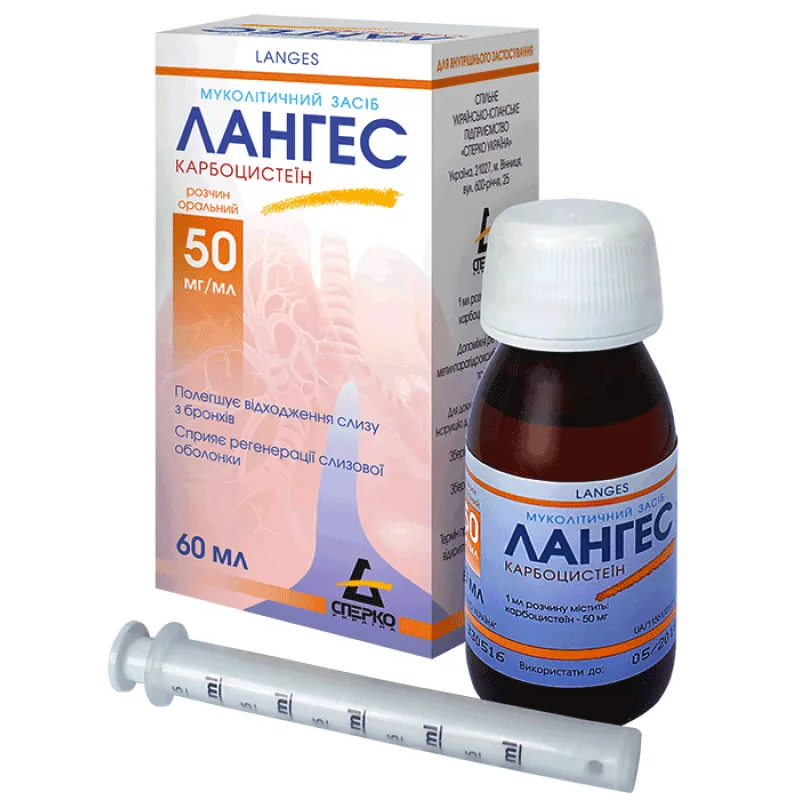
LANGES
UkraineThe drug is used to treat symptoms of bronchial secretion disorders and to facilitate phlegm removal, particularly in acute bronchitis or the exacerbation of chronic respiratory diseases.
Frequently asked questions
How to take Langes?
The drug is taken orally. For children aged 2 to 5 years — 2 ml twice daily; for children aged 5 to 15 years — 2 ml three times daily; for adults and adolescents aged 15 years and older — 15 ml three times daily. For accurate dosing, use a dosing syringe (for small bottles) or a measuring cup (for large bottles).
Who should not take this drug?
Contraindications include hypersensitivity to the components of the product, exacerbation of gastric or duodenal ulcers, the first trimester of pregnancy, and children under 2 years of age.
What are the possible side effects of Langes?
Possible side effects include digestive disorders (nausea, vomiting, stomach pain, diarrhea), dizziness, weakness, as well as allergic reactions such as itching, rash, or swelling.
Can this product be combined with other medicines?
During treatment, antitussive agents or drugs that suppress bronchial secretion should not be taken. Taking this drug may increase the effectiveness of antibacterial therapy and glucocorticoids.
What is the duration of the treatment course?
The total duration of treatment should not exceed 8–10 days; however, for children, the duration of use should be as short as possible — no more than 5 days.
Instructions for use
INSTRUCTIONS FOR MEDICAL USE OF THE MEDICINAL PRODUCT LANGES (LANGES)
Composition:
Active substance: carbocisteine;
1 ml of the preparation contains 50 mg of carbocisteine;
Excipients: sodium saccharin, methylparahydroxybenzoate (E 218), raspberry flavoring, sodium hydroxide, sodium carmellose, purified water.
Pharmaceutical form. Oral solution.
Main physico-chemical properties: clear light-yellow solution with a characteristic raspberry odor.
Pharmacotherapeutic group. Mucolytic agents. Carbocisteine. ATC code R05CB03.
Pharmacological properties.
Pharmacodynamics.
Carbocysteine affects the gel phase of respiratory tract mucus: by cleaving disulfide bridges of glycoproteins, it reduces the viscosity of excessively thick bronchial secretions, thereby facilitating expectoration.
The mucoregulatory effect of carbocysteine is associated with activation of sialyltransferase—an enzyme of goblet cells in the bronchial mucosa. Carbocysteine normalizes the quantitative ratio of acidic and neutral sialomucins in bronchial secretions, restoring their viscosity and elasticity. It activates ciliary epithelium function and improves mucociliary clearance. It promotes regeneration of the respiratory tract mucosa, normalizes its structure, reduces goblet cell hyperplasia, and consequently decreases mucus production. It restores secretion of immunologically active IgA (specific defense) and increases the number of sulfhydryl groups in mucus components (nonspecific defense). It exerts anti-inflammatory effects due to kinin-inhibiting activity of sialomucins, resulting in reduced edema and bronchoobstruction.
Pharmacokinetics.
After oral administration, the drug is rapidly absorbed in the gastrointestinal tract. Maximum plasma concentration is reached within 2 hours. Bioavailability of carbocysteine is low (approximately 10% of the administered dose) due to extensive metabolism in the gastrointestinal tract and first-pass hepatic metabolism. The elimination half-life is approximately 2 hours. Carbocysteine and its metabolites are primarily excreted in urine.
Clinical characteristics.
Indications.
Treatment of symptoms related to impaired bronchial secretion and mucus expectoration, particularly in acute bronchopulmonary diseases such as acute bronchitis, and in exacerbations of chronic respiratory diseases.
Contraindications.
- Hypersensitivity to carbocisteine or to any of the excipients (especially to methylparahydroxybenzoate or other parahydroxybenzoate salts);
- active peptic ulcer of the stomach or duodenum;
- first trimester of pregnancy due to insufficient data on teratogenic and embryotoxic effects;
- children under 2 years of age.
Interaction with other medicinal products and other forms of interaction.
During treatment with this medicinal product, antitussive agents and drugs that suppress bronchial secretion should not be used. Enhances the effectiveness of glucocorticoid therapy (mutually) and antibacterial therapy.
Special precautions for use.
Productive cough is a fundamental protective mechanism of the bronchopulmonary system and generally should not be suppressed. It is irrational to combine medicinal products that modify bronchial secretion with antitussive agents and/or substances that reduce secretion (e.g., atropine-like drugs).
The use of mucolytic agents may impair bronchial patency in children under 2 years of age due to limited ability to clear bronchial secretions, related to age-related anatomical and physiological characteristics. Mucolytic agents should not be administered to children under 2 years of age.
Treatment should be re-evaluated if there is no therapeutic effect or if symptoms worsen.
If productive cough with purulent sputum, high fever, or chronic bronchial or pulmonary disease is present, the clinical situation should be re-assessed.
The recommended doses of the drug should not be exceeded.
The drug should be used with caution in patients with a history of peptic ulcer of the stomach or duodenum.
This medicinal product contains sodium: namely, 2 ml of solution contains 0.67 mmol (or 15.5 mg) of sodium, and 15 ml of solution contains 5.07 mmol (or 116.6 mg) of sodium. This should be taken into account for patients on a sodium-controlled diet.
The medicinal product contains methylparahydroxybenzoate, which may cause allergic reactions (possibly delayed).
Use during pregnancy or breastfeeding.
Use of the drug during the first trimester of pregnancy is contraindicated. During the second or third trimester of pregnancy or during breastfeeding, the drug should be used only under medical supervision if the benefit to the mother outweighs the potential risk to the fetus/infant.
Ability to affect reaction rate while driving or operating machinery.
No effect.
Method of administration and dosage.
The drug is intended for oral use. The dosage depending on the patient's age is given in the table.
| Age |
Form of release |
Dosage |
| 2-5 years |
60 ml container |
2 ml twice daily |
| 5-15 years |
60 ml container |
2 ml three times daily |
| Children from 15 years and adults |
200 ml container |
15 ml three times daily |
The maximum single dose for children under 15 years of age should not exceed 100 mg (2 ml).
The duration of treatment should not exceed 8–10 days.
The duration of carbocysteine use in children should be as short as possible, not exceeding 5 days.
For adults and adolescents aged 15 years and older, the solution in 200 ml containers should be prescribed; for children aged 2 to 15 years, the solution in 60 ml containers should be used. For accurate dosing, use a measuring cup when administering the solution in 200 ml containers, and a dosing syringe when using 60 ml containers.
Children.
The drug should be used in children aged 2 years and older. Treatment of children should be carried out under medical supervision.
Overdose.
In case of overdose, symptoms such as stomach pain, nausea, and diarrhea may occur.
Treatment is symptomatic. In case of overdose, medical advice should be sought.
Adverse reactions.
Respiratory system, thoracic organs and mediastinum: risk of developing impaired bronchial patency in children under 2 years of age (see sections "Contraindications" and "Special precautions").
Gastrointestinal tract: digestive disturbances, nausea, vomiting, stomach pain, diarrhea.
Central nervous system: dizziness, weakness, malaise.
Allergic reactions: in isolated cases – itching, urticaria, exanthema, angioneurotic edema, erythematous skin rashes (may be delayed in time).
There have been several reported cases of fixed eruption caused by the use of this medicinal product.
If adverse reactions occur, it is recommended to reduce the dose or discontinue the drug and consult a physician immediately.
Shelf life.
2 years.
Do not use the drug after the expiry date stated on the packaging.
Shelf life of the solution after opening the container – 12 months.
Storage conditions.
Store at a temperature not exceeding 25 °C. Keep out of reach of children.
Packaging.
60 ml or 200 ml of solution in brown-colored polyethylene terephthalate containers, sealed with polyethylene or aluminum caps.
Container of 60 ml with dosing syringe or container of 200 ml with measuring cup, packed in a cardboard box.
Prescription status.
Over-the-counter.
Manufacturer.
Ukrainian-Spanish joint venture "Sperko Ukraine".
Manufacturer's address and place of business.
25, 600-richchia St., Vinnytsia, Ukraine, 21027
Similar drugs
| Brand name | Dosage form | Active substance / Dosage | Manufacturer |
|---|---|---|---|
| FLUDITEC | solution, oral |
|
Innotera Shuzi (manufacturer responsible for batch release) |
The original data is available in the language of the country of manufacture.
Data source: State Register of Medicinal Products of Ukraine
Data last verified: August 13, 2026