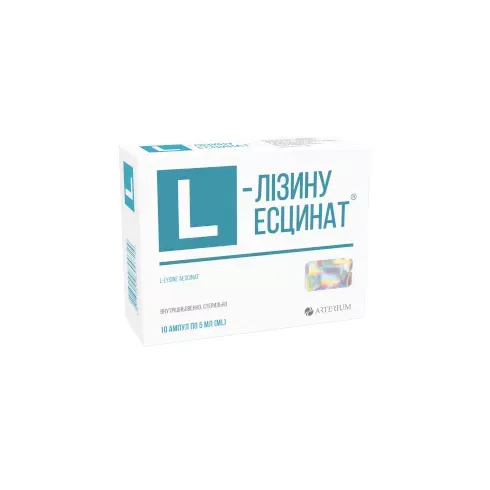
L-LYSINE ESЦИНATE®
UkraineThe drug is used to treat cerebral edema (traumatic, non-traumatic, and postoperative), spinal cord edema, as well as soft tissue edema accompanied by pain. It is also used for venous circulation disorders and vegetative-vascular dystonia.
Frequently asked questions
How should L-lysine escinate® be taken correctly?
The drug is administered intravenously or via intravenous drip (slow infusion) after dilution in 0.9% sodium chloride solution. It is strictly forbidden to administer the drug into the arteries. Adults are usually prescribed 5–10 ml per day; in critical conditions, the dose may be increased to 20 ml per day.
What are the contraindications for use?
The drug must not be taken in case of hypersensitivity to its components, active bleeding with unstable hemodynamics, or severe impairment of liver or kidney functions. Use during pregnancy and breastfeeding is prohibited.
What are the possible side effects of L-lysine escinate®?
Possible allergic reactions (rash, itching, Quincke's edema), nervous system reactions (headache, dizziness), digestive problems (nausea, abdominal pain), changes in blood pressure, palpitations, as well as local reactions at the injection site (burning, pain, swelling).
Can this drug be combined with other medicines?
The prescription of anti-inflammatory, analgesic, and antimicrobial agents is possible. However, aminoglycosides should not be taken simultaneously, as this increases the risk of kidney damage. During long-term use of anticoagulants, the dosage of the latter must be adjusted under medical supervision. Additionally, taking cephalosporins may increase the concentration of the active substance in the blood.
Does the composition contain alcohol?
Yes, the drug contains 0.9 to 1.1 g of ethanol per ampoule. This may be harmful to individuals with alcoholism.
What should be done in case of overdose?
Symptoms of overdose include sensations of heat, rapid heartbeat, nausea, heartburn, and stomach pain. In such cases, symptomatic therapy is required.
Instructions for use
INSTRUCTIONS FOR MEDICAL USE OF THE MEDICINAL PRODUCT L-LYSINE AESCINATE® (L-LYSINE AESCINATE)
Composition:
Active substance: aescinic acid salt of 2,6-diaminohexanoic acid;
1 ml of solution contains 1.0 mg of aescinic acid salt of 2,6-diaminohexanoic acid, calculated as 100 % substance;
Excipients: ethanol 96%, propylene glycol, water for injections.
Pharmaceutical form. Injection solution.
Main physicochemical properties: clear, colorless liquid.
Pharmacotherapeutic group. Vasoprotectives. Capillary-stabilizing agents. Other capillary-stabilizing agents. ATC code C05CX.
Pharmacological properties.
Pharmacodynamics.
The drug exerts anti-inflammatory, anti-edematous, and analgesic effects. Aescin reduces the activity of lysosomal hydrolases, thereby preventing the breakdown of mucopolysaccharides in capillary walls and in the surrounding connective tissue, which in turn normalizes increased vascular-tissue permeability and produces anti-exudative (anti-edematous), anti-inflammatory, and analgesic effects. The drug increases vascular tone and demonstrates moderate immunomodulatory and hypoglycemic effects.
Pharmacokinetics.
Not studied.
Clinical characteristics.
Indications.
As part of complex therapy for cerebral edema of traumatic, non-traumatic, and postoperative origin, including cases with intracranial hemorrhages, increased intracranial pressure, and signs of edema-swelling.
Spinal cord edema of traumatic, non-traumatic, and postoperative origin.
Cerebrospinal fluid-venous disturbances in chronic cerebral circulation disorders (CCCD) and vegetative-vascular dystonia.
Edema of soft tissues involving the musculoskeletal system, accompanied by local disturbances in blood supply and pain syndrome; edema-pain syndromes of the spine and limbs; severe venous circulation disorders in the lower limbs in acute thrombophlebitis accompanied by edema-inflammatory syndrome.
Contraindications.
Hypersensitivity to escin salt of 2,6-diaminohexanoic acid and/or other components of the drug;
ongoing active bleeding associated with hemodynamic instability;
severe renal function impairment;
severe hepatic function impairment.
Interaction with other medicinal products and other types of interactions.
During treatment with L-lysine esculin, other medicinal products may be prescribed as indicated (anti-inflammatory agents, analgesics, antimicrobials).
The drug should not be used simultaneously with aminoglycosides, as this may increase their nephrotoxicity. In cases of prolonged anticoagulant therapy prior to administration of L-lysine esculin, or when concomitant use of L-lysine esculin and anticoagulants is necessary, the dose of the latter should be adjusted (reduced) and the prothrombin index should be monitored.
Protein binding of escin may be impaired when cephalosporin antibiotics are used concomitantly, potentially increasing the concentration of free escin in the blood and thereby increasing the risk of adverse effects.
Special precautions for use.
In individual patients with hepatocholangitis, short-term increases in transaminase activity and bilirubin (direct fraction) may occur during treatment with the drug. This does not pose a threat to patients and does not require discontinuation of the drug.
This medicinal product contains from 0.9 to 1.1 g of ethanol (alcohol) per ampoule. It may be harmful for patients suffering from alcoholism. Caution should be exercised when administering to children, patients with liver disorders, and patients with epilepsy.
Use during pregnancy or breastfeeding.
The use of this drug during pregnancy or breastfeeding is contraindicated. Breastfeeding should be discontinued for the duration of treatment.
Ability to influence reaction rate when driving or operating machinery.
Currently, there are no reported cases; however, when using this drug, the possibility of expected adverse reactions affecting the nervous system should be taken into account.
Administration and Dosage
The drug is administered intravenously or by intravenous infusion.
Intra-arterial administration of the drug is strictly contraindicated!
The drug should be administered by slow intravenous infusions after diluting the recommended single dose to a volume of 15–50 ml with 0.9% sodium chloride solution.
The optimal recommended duration of treatment course is 5–10 days of daily administration of the drug.
The maximum daily dose of L-lysine escinate® for adults is 25 ml (5 ampoules).
Recommended daily doses:
For adults
The recommended daily dose of L-lysine escinate® is 5–10 ml (1–2 ampoules).
In life-threatening conditions, the daily dose may be increased to 20 ml, divided into two administrations; the treatment course lasts up to 8 days.
In cases of liquor-venous disorders in chronic venous insufficiency (CVI) and vegetative-vascular dystonia – 10 ml per day, the treatment course lasts 10 days.
For children, the single dose is:
1–5 years – 0.22 mg of L-lysine escinate per 1 kg of body weight;
5–10 years – 0.18 mg/kg; from 10 years and older – 0.15 mg/kg of body weight. The drug should be administered twice daily. The duration of treatment course is from 2 to 8 days depending on the patient's condition and therapeutic response.
Children. The drug is contraindicated in children under 1 year of age.
Overdose.
Symptoms: sensation of heat, tachycardia, menorrhagia, nausea, heartburn, epigastric pain.
Treatment: symptomatic therapy.
Adverse reactions.
In individual patients with increased sensitivity to escin, the following may occur:
Allergic reactions: skin rash (papular, petechial, erythematous), pruritus, skin hyperemia, hyperthermia, urticaria; in isolated cases – Quincke's edema, anaphylactic shock;
Central and peripheral nervous system: headache, dizziness, tremor, paresthesia; in isolated cases – unsteady gait, loss of balance, transient loss of consciousness;
Hepatic and biliary system: increased levels of transaminases and bilirubin;
Gastrointestinal tract: nausea; in isolated cases – vomiting, diarrhea, abdominal pain;
Cardiovascular system: arterial hypotension, arterial hypertension, tachycardia, chest pain;
Respiratory system: in isolated cases – sensation of shortness of breath, dyspnea, bronchoconstriction, dry cough;
Local reactions: burning sensation along the vein during administration, phlebitis, pain and swelling at the injection site;
Other: general weakness, chills, sensation of warmth, back pain, sweating.
Shelf life. 2 years.
Storage conditions. Store in a place inaccessible to children. Store in the original packaging at a temperature not exceeding 25 °C.
Packaging. 5 ml in an ampoule, 5 ampoules in blisters; 2 blisters per pack.
Prescription status. Prescription only.
Manufacturer. JSC "Halychpharm".
Manufacturer's address and place of business.
6/8 Opryshkovska St., Lviv, 79024, Ukraine.
Similar drugs
| Brand name | Dosage form | Active substance / Dosage | Manufacturer |
|---|---|---|---|
| EMOXYPINE® | solution for injection |
|
PJSC "Lekhim - Kharkiv" |
| LYSINATE | solution for injection |
|
Farmak JSC |
| OFTALEK | solution for injection |
|
PJSC "Lekhim - Kharkiv" |
The original data is available in the language of the country of manufacture.
Data source: State Register of Medicinal Products of Ukraine
Data last verified: August 13, 2026