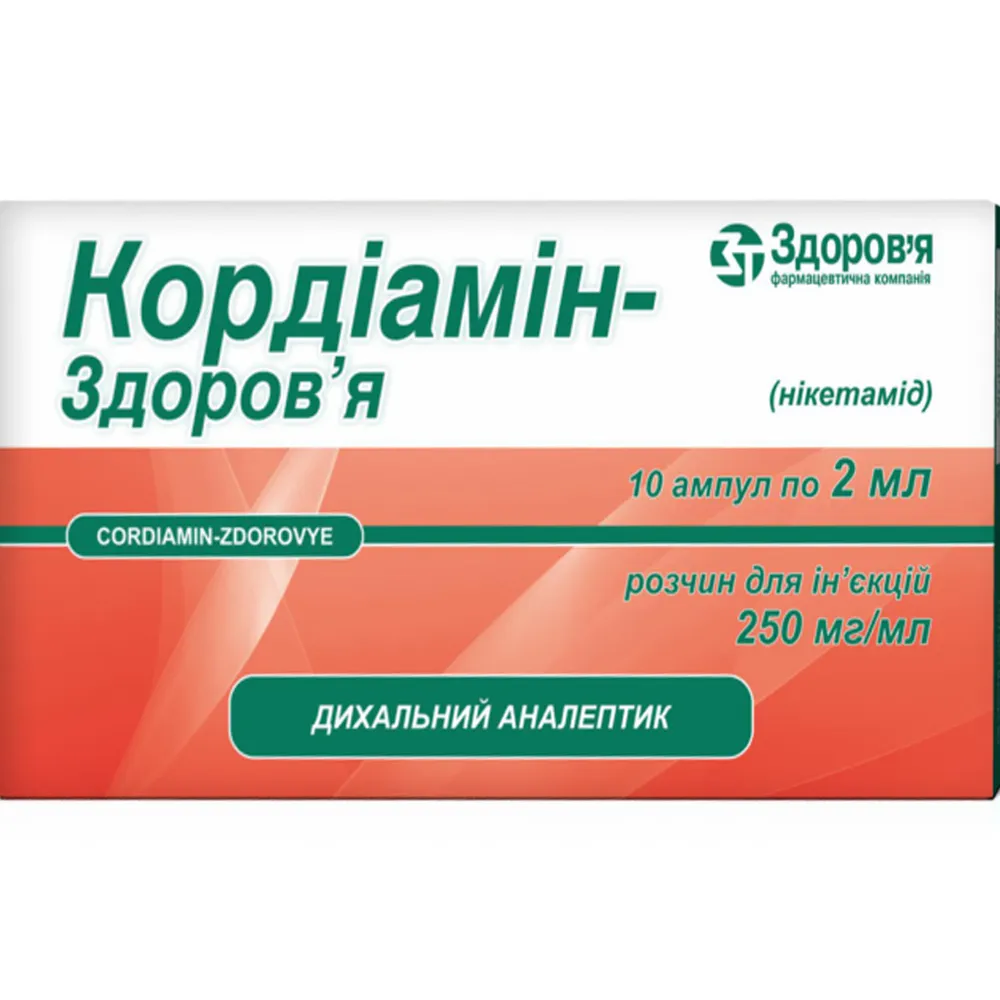
CORDIAMIN-ZDOROVYA
UkraineThe drug is used in cases of collapse, asphyxia (including in newborns), shock states during or after surgery, acute and chronic circulatory disorders, decreased vascular tone, and respiratory depression during infectious diseases, as well as in poisoning by hypnotics and analgesics.
Frequently asked questions
How should Cordiamin-zdorovya be taken correctly?
The drug is administered subcutaneously, intramuscularly, or intravenously exclusively under medical supervision in a hospital setting. Dosage and frequency of administration are determined by a physician individually, depending on the age and condition of the patient. For intravenous administration, a single dose must be diluted in 10 ml of 0.9% sodium chloride solution and administered over 1-3 minutes.
What side effects can Cordiamin-zdorovya cause?
Possible reactions include: restlessness, irritability, anxiety; nausea and vomiting; increased blood pressure, arrhythmia, and rapid heartbeat; muscle twitching, tremor, or muscle rigidity; facial flushing, skin itching; increased body temperature and sweating. Allergic reactions (urticaria, edema) and pain or irritation at the injection site are also possible.
Who should not use this drug?
Contraindicated in cases of hypersensitivity to nicetamide, predisposition to seizures, epilepsy, porphyria, and elevated body temperature (hyperthermia) in children. The drug is prohibited during pregnancy, and use should be discontinued during breastfeeding.
Can the drug be combined with other medicines?
The drug may interact with many substances. Its effect is reduced by PAS (phenobarbital), saluside, and certain antipsychotics (e.g., aminazine), while aminazine may enhance its anticonvulsant effect. The effect of the drug is enhanced by MAO inhibitors, psychostimulants, and antidepressants, but it reduces the effect of narcotic analgesics, hypnotics, and anticonvulsants. The drug must not be mixed with other medicinal products.
Can you drive a vehicle during treatment?
During the treatment period, you should avoid driving vehicles and performing any other activities that require high concentration and rapid reaction.
Instructions for use
Table of contents
INSTRUCTIONS FOR MEDICAL USE OF THE MEDICINAL PRODUCT CORDIAMIN-ZDOROVA
Composition:
Active substance: 1 ml of solution contains 250 mg of nikethamide;
Excipient: water for injections.
Pharmaceutical form. Injection solution.
Main physicochemical characteristics: clear, colorless or slightly colored solution with a characteristic odor.
Pharmacotherapeutic group. Respiratory analeptics. Nikethamide. ATC code R07AB02.
Pharmacological properties.
Pharmacodynamics.
A mixed-type analeptic. The mechanism of action consists of two components: central and peripheral. The central component is due to the direct effect on the vasomotor center of the medulla oblongata, leading to its excitation and indirect increase in systemic arterial pressure (especially in the presence of initial suppression of this center). The peripheral component is associated with stimulation of carotid sinus chemoreceptors, resulting in increased respiratory rate and depth.
Cordiamine stimulates the central nervous system, causing both direct and reflex excitation of respiratory and vasomotor centers, leading to increased total peripheral resistance and elevation of arterial pressure (the effect manifests when arterial pressure is reduced).
It does not exhibit a direct stimulatory effect on the heart or vasoconstrictive action.
Duration of action – 15–60 minutes.
Pharmacokinetics.
The drug is well absorbed, regardless of the route of administration. It undergoes rapid metabolism in the liver with formation of inactive metabolites. It is rapidly eliminated by the kidneys.
Clinical characteristics.
Indications.
- Collapse and asphyxia (including neonatal asphyxia);
- shock states during surgical interventions and in the postoperative period;
- acute and chronic circulatory disorders;
- decreased vascular tone and respiratory depression in infectious diseases and during convalescence;
- poisoning with hypnotics and analgesics (as part of complex therapy).
Contraindications. Hypersensitivity to nikethamide, predisposition to seizures, epilepsy, history of epileptic seizures, porphyria, hyperthermia in children.
Interaction with other medicinal products and other types of interactions. The analeptic effect of nikethamide is reduced under the influence of PAS, saluzide, and phenothiazine derivatives (aminazine). Aminazine and reserpine may enhance the convulsant effect of nikethamide. The pressor effect of nikethamide is increased under the influence of MAO inhibitors. Nikethamide promotes the development of intolerance to phthivazid. It enhances the effects of psychostimulants and antidepressants. It reduces the effects of narcotic analgesics, hypnotics, antipsychotics, anticonvulsants, and anxiolytics. Cordiamine is ineffective during deep anesthesia.
Special considerations for use. The drug should be used only under medical supervision in hospital settings. When administered intravenously, the effect is short-lived.
Since subcutaneous and intramuscular injections of the drug are painful, to reduce pain at the injection site, novocaine should be injected beforehand (1 ml of 0.5% solution for adults, age-appropriate doses for children).
Use during pregnancy or breastfeeding. The drug is contraindicated during pregnancy. If use is necessary, breastfeeding should be discontinued.
Ability to affect reaction speed when driving or operating machinery. During treatment, patients should avoid driving and performing potentially hazardous activities requiring concentration and increased psychomotor reaction speed.
Method of administration and dosage. The drug is administered subcutaneously, intramuscularly, or intravenously. Single and daily doses, as well as frequency of administration, are determined individually by a physician depending on indications and patient age. For intravenous administration, dilute the single dose in 10 ml of 0.9% sodium chloride solution; administer over 1–3 minutes.
For adults and children aged 14 years and older: 1–2 ml, 1–3 times daily. Higher subcutaneous doses for adults: single dose – 2 ml, daily dose – 6 ml. Higher single subcutaneous and intravenous doses in poisoning cases for adults – 5 ml.
For children, subcutaneous single doses depending on age: under 1 year – 0.1 ml; 1–4 years – 0.15–0.25 ml; 5–6 years – 0.3 ml; 7–9 years – 0.5 ml; 10–14 years – 0.75 ml; administered 1–3 times daily.
Children. The drug is permitted for use in pediatric practice at age-dependent doses. Use is contraindicated in hyperthermia.
Overdose.
Symptoms: intensification of adverse effects; in large doses, the drug may cause generalized tonic-clonic seizures, disturbances in consciousness and respiration, apnea during seizures; a fatal outcome is not excluded.
Treatment: administration of anticonvulsants, forced diuresis; if necessary, artificial ventilation of the lungs.
Side effects.
Nervous system: restlessness, increased irritability, anxiety.
Gastrointestinal tract: nausea, vomiting.
Cardiovascular system: arrhythmia, arterial hypertension, tachycardia.
Musculoskeletal system: muscle twitching (starting from the orbicularis oris muscles), tremor, muscle rigidity.
Dermatological disorders: facial puffiness or redness, itching and/or skin peeling.
General disorders: hyperthermia, increased sweating.
Allergic reactions: hypersensitivity reactions, including urticaria, angioneurotic edema, generalized papular rashes.
Reactions at injection site: infiltration, pain, hyperemia, itching, burning sensation of the skin at the injection site.
Shelf life: 5 years.
Storage conditions: Store in the original packaging at a temperature not exceeding 25 °C.
Keep out of reach of children.
Incompatibility: The drug is inactivated by acids and alkalis. Use only the recommended solvent. Do not mix with other medicinal products.
Packaging: 2 ml in vials, 5x2, № 10 in blisters in a box; № 10 in a box.
Prescription status: Prescription only.
Manufacturer: LIMITED LIABILITY COMPANY "CORPORATION "ZDOROVTYA".
Manufacturer's address:
22, Shevchenko Street, Kharkiv, Kharkiv region, 61013, Ukraine.
Similar drugs
| Brand name | Dosage form | Active substance / Dosage | Manufacturer |
|---|---|---|---|
| CORDIAMINE®-DARNITSA | solution for injection |
|
PJSC «Pharmaceutical Company «Darnitsa» |
The original data is available in the language of the country of manufacture.
Data source: State Register of Medicinal Products of Ukraine
Data last verified: August 13, 2026