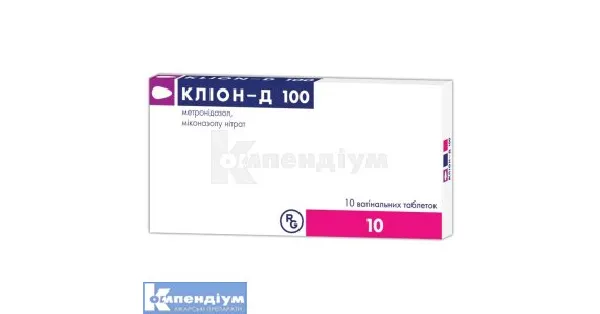
CLION-D 100
UkraineThe drug is used for the local treatment of urogenital trichomoniasis and/or fungal infections (vaginal mycoses) in women.
Frequently asked questions
How should Clion-d 100 be used correctly?
The tablet should be slightly moistened with water and inserted deep into the vagina once a day (preferably in the evening before bedtime). In the case of trichomoniasis, this method is used in conjunction with oral metronidazole tablets for 10 days.
Who should not use this drug?
Use is contraindicated in individuals with hypersensitivity to the active substances or excipients, as well as during the first trimester of pregnancy.
What are the possible side effects of Clion-d 100?
Irritation or burning at the site of administration is possible. When used simultaneously with oral metronidazole, headache, nausea, abdominal pain, diarrhea, dizziness, a metallic taste in the mouth, or darkening of urine color may occur.
Can alcohol be consumed during treatment?
The consumption of alcoholic beverages is prohibited during the use of vaginal tablets and for at least one day after completing the course.
Is sexual intercourse permitted during therapy?
It is recommended to refrain from sexual intercourse during treatment with vaginal tablets.
How does the drug interact with other medicines?
When used simultaneously with oral metronidazole, interactions may occur with anticoagulants (enhancement of their effect), lithium (increase in its levels), cyclosporine, as well as with certain enzyme inducers and inhibitors. It is also not recommended to combine with disulfiram.
Instructions for use
INSTRUCTIONS FOR MEDICAL USE OF THE MEDICINAL PRODUCT KLION-D 100 (KLION-D 100)
Composition:
Active substances: metronidazole, miconazole nitrate;
One tablet contains 100 mg of metronidazole and 100 mg of miconazole nitrate;
Excipients: sodium lauryl sulfate, colloidal anhydrous silicon dioxide, magnesium stearate, povidone, sodium hydrocarbonate, tartaric acid, sodium starch glycolate (type A), crospovidone, hypromellose, lactose monohydrate.
Pharmaceutical form. Vaginal tablets.
Main physicochemical properties: white, almost white, oval-shaped, biconvex vaginal tablets with a pointed end, approximately 24 mm × 14 mm in size, engraved with "100" on one side.
Pharmacotherapeutic group. Gynecological antimicrobial and antiseptic agents. Imidazole derivatives. ATC code G01AF20.
Pharmacological Properties
Pharmacodynamics
Clinical efficacy and safety. Metronidazole is an antitrichomonal agent for topical and oral administration. Miconazole nitrate is an effective antifungal agent active against dermatophytes and Candida species; in addition, it exerts pronounced bacteriostatic activity against certain Gram-positive bacteria during topical therapy.
The purpose of topical application of this combined medicinal product is local treatment of trichomoniasis and prevention of vaginal mycoses, which frequently develop following metronidazole administration.
The medicinal product may be used in primary vaginal mycoses.
Pharmacokinetics
Absorption. When administered topically, metronidazole and miconazole nitrate are absorbed through the mucous membrane in negligible amounts. According to study data, the absorbed amounts of metronidazole and miconazole nitrate are difficult to determine, with plasma concentrations reaching 0.2 µg/mL and 0.3 µg/mL, respectively.
Metronidazole is generally well absorbed after oral administration and reaches peak serum concentration within 1–3 hours. After a single 250 mg oral dose, peak plasma concentration of 5 µg/mL is achieved, as determined by gas chromatography. Oral bioavailability is nearly 100%.
Distribution. Studies conducted in patients and healthy volunteers have shown that metronidazole rapidly penetrates into cerebrospinal fluid and achieves therapeutic concentrations in brain abscesses and lung abscesses. It has a large volume of distribution, and less than 20% of circulating metronidazole is protein-bound in plasma. It penetrates into bile and reaches concentrations similar to those in plasma.
Elimination. The mean elimination half-life of metronidazole in healthy volunteers is approximately 8 hours. Metronidazole and its metabolites are primarily excreted via the kidneys (60–80% of the dose), while 6–15% of the administered dose is eliminated through the intestine.
Clinical characteristics.
Indications. Local treatment in women of urogenital trichomoniasis and/or fungal infections.
Contraindications.
Hypersensitivity to the active substances or to any of the excipients of the medicinal product.
First trimester of pregnancy.
Interaction with other medicinal products and other forms of interaction.
There are no data available on interactions when metronidazole and miconazole nitrate are administered vaginally with other medicinal products.
When using vaginal tablet Clion-D 100 concomitantly with oral metronidazole, the following types of drug interactions may occur:
- enhancement of the effect of oral anticoagulant agents, resulting in prolonged prothrombin time; therefore, the dose of anticoagulant should be reviewed;
- enzyme inducers (e.g., phenytoin, phenobarbital) may accelerate the elimination of metronidazole, leading to reduced plasma levels of metronidazole and simultaneous increase in phenytoin clearance;
- enzyme inhibitors (e.g., cimetidine) may increase the elimination half-life and reduce the plasma clearance of metronidazole;
- consumption of alcoholic beverages during metronidazole therapy may cause adverse reactions similar to a disulfiram-like reaction (spasmodic abdominal pain, nausea, vomiting, headache, and facial flushing);
- concomitant use of metronidazole with disulfiram is not recommended (may cause additive effects, psychotic disorders, confusion);
- metronidazole intake may increase plasma lithium levels; therefore, the dose of lithium should be reduced or lithium treatment discontinued prior to initiating metronidazole therapy;
- simultaneous administration of cyclosporine with metronidazole may lead to increased cyclosporine plasma levels; if combination therapy is necessary, monitoring of cyclosporine plasma levels is recommended;
- metronidazole reduces the clearance of 5-fluorouracil and increases its toxicity;
- metronidazole may affect the results of biochemical serum tests, such as aspartate aminotransferase, alanine aminotransferase, lactate dehydrogenase, glucose-hexokinase, and triglyceride levels.
Special precautions for use
Alcoholic beverages are contraindicated during treatment with Clion-D 100 vaginal tablets and for at least 1 day after completion of treatment.
It is recommended to abstain from sexual intercourse during treatment with Clion-D 100 vaginal tablets.
If treatment is ineffective, alternative systemic antitrichomonal or antifungal therapy should be considered.
If sensitivity or irritation of the vaginal mucosa occurs, treatment should be discontinued.
Cases of severe hepatotoxicity/acute liver failure, including fatal outcomes occurring rapidly after initiation of treatment, have been reported in patients with Cockayne syndrome receiving systemic metronidazole-containing medicinal products. Therefore, metronidazole should not be used in such patients, except when the benefit is considered to outweigh the risk and no alternative treatment is available. Before starting treatment, and throughout and after completion of therapy, liver function tests should be monitored until values return to normal or reach baseline levels. If significantly elevated liver function test results occur during therapy, treatment with the drug should be discontinued. Patients with Cockayne syndrome should be advised to immediately inform their physician about any symptoms suggestive of possible hepatic injury and to discontinue metronidazole (see section "Adverse reactions").
Excipients
This medicinal product contains sodium lauryl sulfate, which may cause local skin reactions (such as stinging or burning sensations) or enhance skin reactions caused by other products applied to the same area.
Use during pregnancy or breastfeeding
Pregnancy. Use of Clion-D 100 vaginal tablets is contraindicated during the first trimester of pregnancy.
Orally administered metronidazole crosses the placental barrier and rapidly enters fetal circulation.
In reproductive toxicity studies conducted in rats, doses five times higher than those used in humans were applied. These studies did not reveal any evidence of impaired fertility or adverse effects on the fetus due to metronidazole. Intraperitoneal administration of metronidazole to pregnant mice at doses approximately equivalent to those used in humans caused fetotoxic effects. However, no fetotoxic effects were observed following oral administration to pregnant mice. Nevertheless, adequate and well-controlled studies in pregnant women are currently lacking.
Based on a meta-analysis of studies conducted during the first trimester of pregnancy, no increased risk of fetotoxicity has been observed. Clion-D 100 vaginal tablets may be prescribed during the second and third trimesters of pregnancy only after careful assessment of the expected benefits versus potential risks of treatment.
Breastfeeding. Orally administered metronidazole is excreted in breast milk at concentrations equal to those in plasma. It may impart a bitter taste to breast milk. To avoid potential adverse effects of the drug on the infant, either metronidazole should be discontinued or breastfeeding should be suspended during metronidazole treatment and for an additional 12–24 hours after completion of the course, taking into account the importance of therapy for the mother.
Ability to affect the speed of reactions when driving vehicles or operating machinery
Clion-D 100 vaginal tablets do not affect the ability to drive vehicles or operate machinery.
Method of Administration and Dosage
The medicinal product is intended for intravaginal use only. The vaginal tablet should be slightly moistened before administration and inserted deeply into the vagina.
Trichomoniasis. Concurrently with oral metronidazole, one vaginal tablet of Klyon-D 100 should be administered once daily (in the evening before bedtime) for 10 days. During these 10 days, take orally one tablet of metronidazole twice daily (2 × 250 mg) every day (one in the morning and one in the evening), during or immediately after meals, without chewing.
To ensure long-term recovery, simultaneous treatment of the sexual partner with oral metronidazole tablets is recommended.
If treatment is ineffective, the 10-day treatment course may be repeated.
Fungal infection. One vaginal tablet of Klyon-D 100 should be administered once daily (in the evening before bedtime) for 10 days.
Children.
Safety and efficacy in children and adolescents have not been established. No data are available.
Overdose.
The medicinal product is intended exclusively for intravaginal administration. In case of accidental ingestion of a large dose, gastric lavage may be performed.
In the event of overdose symptoms (nausea, vomiting, ataxia), symptomatic therapy should be administered (gastric lavage, activated charcoal, and hemodialysis), as there is no specific antidote. Metronidazole and its metabolites are effectively eliminated by hemodialysis.
Side effects
Local irritation at the application site has been reported during therapy with Clion-D 100 vaginal tablets. Local hypersensitivity reactions may rarely occur.
Adverse reactions are listed below by system organ class and frequency: very common (≥ 1/10); common (≥ 1/100 to < 1/10); uncommon (≥ 1/1,000 to < 1/100); rare (≥ 1/10,000 to < 1/1,000); very rare (< 1/10,000).
When used concomitantly with oral metronidazole, the following adverse reactions may occur:
Infections and infestations
Rare: fungal superinfection (e.g., candidiasis).
Blood and lymphatic system disorders
Very rare: neutropenia (leukopenia), thrombocytopenia.
Immune system disorders
Very rare: anaphylactic reactions.
Metabolism and nutrition disorders
Uncommon: decreased appetite.
Psychiatric disorders
Rare: confusion.
Central nervous system disorders
Very common: headache.
Uncommon: peripheral neuropathy (hypoaesthesia), seizures, somnolence, dizziness, coordination disturbances, taste disturbances (metallic taste in mouth).
Gastrointestinal disorders
Very common: nausea.
Common: lower abdominal pain, lower abdominal cramps, diarrhoea.
Very rare: vomiting, coated tongue.
Hepatobiliary disorders
Very rare: cholestasis, jaundice.
Skin and subcutaneous tissue disorders
Uncommon: angioneurotic oedema, pruritus, rash, urticaria.
Very rare: erythema multiforme.
General disorders and administration site conditions
Uncommon: irritation at the application site, pyrexia.
Investigations
Uncommon: change in urine colour (darkening of urine due to metronidazole metabolite; this is not clinically significant).
Very rare: increased liver enzyme activity.
Peripheral neuropathy (numbness of extremities), headache, seizures, somnolence, dizziness, coordination disturbances, and confusion have been observed in individual cases during prolonged treatment or therapy with high doses of the drug. All of the above symptoms resolved without treatment after dose reduction or discontinuation of therapy.
Cases of severe, irreversible hepatotoxicity/acute liver failure, including fatal cases with rapid progression after initiation of systemic metronidazole therapy, have been reported in patients with Cockayne syndrome (see section "Special warnings and precautions for use").
Adverse reactions associated with miconazole nitrate
In most cases, adverse reactions are rare and mild. Local irritation and burning sensation have been reported at the site of application.
Reporting of suspected adverse reactions
It is important to report suspected adverse reactions after marketing authorization of the medicinal product. This allows ongoing monitoring of the benefit-risk balance of the medicinal product. Healthcare professionals are required to report any suspected adverse reactions.
Shelf life. 5 years.
Storage conditions. Store at temperatures not exceeding 30 °C in the original packaging to protect from light and moisture.
Keep the medication out of the reach of children!
Packaging. 10 vaginal tablets in a strip. 1 strip in a cardboard package.
Prescription category. Prescription only.
Manufacturer. Gedeon Richter Plc., Hungary.
Manufacturer's address and place of business.
H-1103 Budapest, Demrédi út 19-21, Hungary.
The original data is available in the language of the country of manufacture.
Data source: State Register of Medicinal Products of Ukraine
Data last verified: August 13, 2026