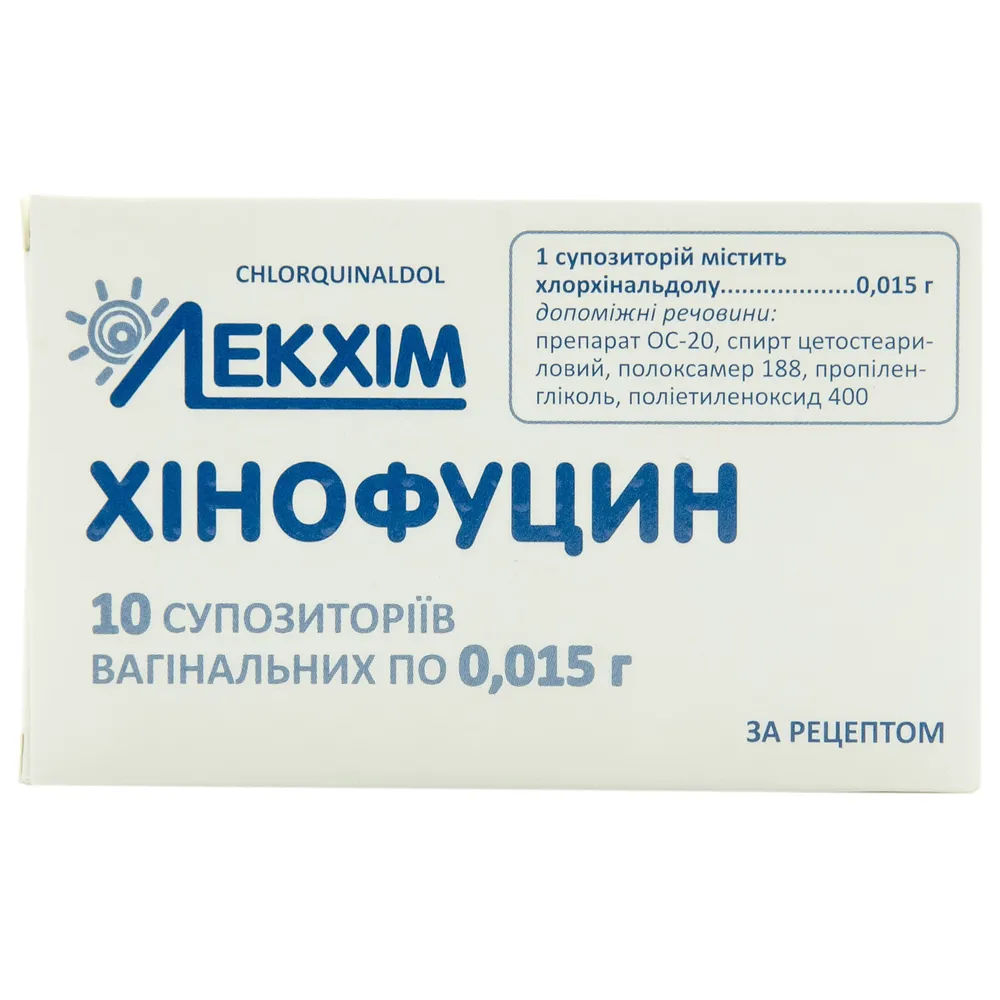
KHINOFUTSIN
UkraineThe drug is used for the treatment of colpitis and vulvovaginitis caused by fungi or bacteria.
Frequently asked questions
How should Khinofutsin be taken correctly?
Adult women should insert 1 suppository vaginally once daily for 20 days, or 1 suppository twice daily for 10 days. The suppository should be moistened with water before use. It is preferable to start treatment at the beginning of the menstrual cycle.
What are the possible side effects of Khinofutsin?
Possible allergic reactions (rash, genital itching, contact dermatitis), as well as burning or irritation at the site of administration.
Who should not use this drug?
The product should not be used in case of hypersensitivity to chlorhydal or to other components of the drug.
Can the drug be used during pregnancy or breastfeeding?
This can only be done in cases where the expected benefit to the mother outweighs the potential risk to the child.
Can this drug be prescribed to children?
Due to the lack of clinical data, prescribing the drug to children is not recommended.
Can this drug be combined with other medicines?
In cases of vulvovaginal candidiasis, treatment should be carried out along with the administration of nystatin tablets. In cases of non-specific colpitis, a combination with systemic antibiotics may be required. It is also important to treat the sexual partner simultaneously.
Instructions for use
INSTRUCTION for medical use of the medicinal product chinofucin (chinofucin)
Composition:
Active substance: chlorquinaldol;
1 suppository contains chlorquinaldol 0.015 g;
Excipients: OS-20 preparation (a mixture of polyoxyethylene glycol ethers of higher fatty alcohols), cetostearyl alcohol, poloxamer 188, propylene glycol, polyethylene glycol 400.
Pharmaceutical form. Vaginal suppositories.
Main physicochemical properties: white or white with a yellowish tint, bullet-shaped suppositories.
Pharmacotherapeutic group. Antimicrobial and antiseptic agents used in gynecology. ATC code G01A C03.
Pharmacological properties.
Pharmacodynamics.
The suppositories exert antifungal activity against Ascomycetes of the genus Aspergillus and the genus Penicillium, as well as against yeast and yeast-like fungi (Candida albicans and others) and dermatophytes. Suppositories Chinofoquin exert antibacterial activity against gram-positive and gram-negative bacteria (Streptococcus pyogenes, Staphylococcus aureus, Pseudomonas aeruginosa, Proteus vulgaris, Corynebacterium diphtheriae, Salmonella spp., Escherichia coli), as well as against some protozoa (Entamoeba histolytica, Trichomonas vaginalis, Giardia intestinalis).
The medicinal product has moderate hyperosmolar activity, due to which it absorbs vaginal secretions.
Pharmacokinetics.
Chlorquinaldol is not absorbed following vaginal administration and does not produce any systemic effects.
Clinical characteristics.
Indications.
Treatment of fungal and non-specific bacterial colpitis and vulvovaginitis.
Contraindications.
Hypersensitivity to chlorquinaldol or to other components of the drug.
Interaction with other medicinal products and other forms of interactions.
No data on interactions available.
Special precautions for use.
Since the medicinal product has a broad spectrum of antimicrobial activity, it should be used in cases of mixed bacterial and fungal infection, especially during the initial phase of treatment (before identification of the causative agents of the disease). Douching should be avoided during the use of suppositories.
In vulvovaginal candidiasis, treatment should be administered in combination with oral nystatin tablets to eliminate foci of candidiasis infection in the gastrointestinal tract.
For nonspecific colpitis, combination therapy is recommended: vaginally – use Quinofucin suppositories, and orally – appropriate systemic antibiotics to suppress infection in the urogenital tract. At the same time, the sexual partner should also be treated.
Quinofucin contains propylene glycol, which may cause irritation.
Use during pregnancy or breastfeeding.
Due to the possibility of systemic reactions, the medicinal product should be used during pregnancy or breastfeeding only if the expected benefit to the mother outweighs the potential risk to the fetus.
Ability to affect reaction rate when driving or operating machinery.
No data available.
Method of Administration and Dosage
Before using the suppository, it is necessary to:
- tear off one suppository in the primary packaging along the perforated line of the blister pack;
- pull the edges of the film in opposite directions, tearing it apart, and remove the suppository from the primary packaging.
The medication should be administered vaginally to adult women, 1 suppository per day for 20 days, or 1 suppository twice daily for 10 days. Before administration, the suppository should be moistened with water. Therapy should be initiated at the beginning of the menstrual cycle.
Children.
Due to the lack of clinical data, the medication is not recommended for use in children.
Overdose.
Cases of overdose have not been reported.
An increase in adverse reactions is possible. In such cases, symptomatic treatment should be administered if necessary.
Side effects.
Possible allergic reactions, including rash, itching in the genital area, contact dermatitis. Possible reactions at the site of administration, such as burning and irritation.
Cetyl stearyl alcohol may cause local skin reactions, contact dermatitis.
Propylene glycol may cause irritation.
Shelf life.
3 years.
Storage conditions.
Store in a place inaccessible to children, in the original packaging, at a temperature not exceeding 25 °C.
Packaging.
5 suppositories per blister; 1 or 2 blisters per carton.
Prescription status.
Prescription only.
Manufacturer.
Private Joint-Stock Company "Lekhim-Kharkiv".
Manufacturer's address and place of business.
Ukraine, 61115, Kharkiv region, city of Kharkiv, Severin Pototskogo Street, 36.
The original data is available in the language of the country of manufacture.
Data source: State Register of Medicinal Products of Ukraine
Data last verified: August 13, 2026