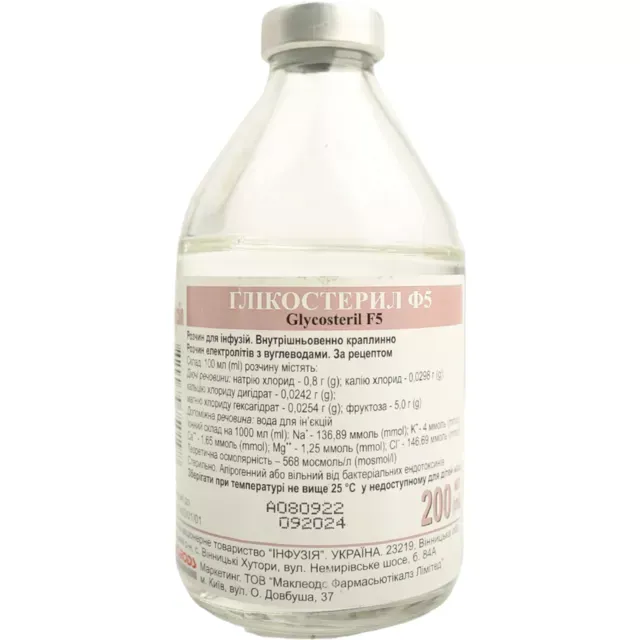
GLYCOSTERYL F5
UkraineThe drug is used to replace blood and plasma losses in cases of burns, and for dehydration due to vomiting, diarrhea, or intestinal obstruction. It also helps compensate for the body's carbohydrate requirements, particularly in diabetes mellitus.
Frequently asked questions
How should Glycosteryl f5 be taken correctly?
The drug is administered intravenously as a drip. The dosage and infusion rate are prescribed by a physician depending on the patient's weight, age, and condition. The maximum daily dose should not exceed 2000 ml.
Who should not use this drug?
Contraindications include edema, excess fluid or salts (sodium, potassium) in the body, heart failure, acute renal failure, cerebral hemorrhage, methanol intoxication, as well as hypersensitivity to the components of the solution.
What are the possible side effects of Glycosteryl f5?
Possible allergic reactions, increased temperature, fluctuations in arterial blood pressure, edema, and palpitations (tachycardia). During massive administration, electrolyte imbalance and water metabolism disturbances may occur.
Can the drug be mixed with other agents?
No, Glycosteryl f5 must not be mixed with solutions containing phosphates or carbonates.
How does the drug interact with other medicines?
An increase in sodium retention is possible when taking anti-inflammatory drugs or hormones. When combined with potassium-sparing diuretics or ACE inhibitors, the risk of potassium excess increases. The drug may also enhance the effect of cardiac glycosides due to its calcium content.
Can the drug be used in children?
In pediatric practice, use is not recommended due to a lack of clinical trials.
Instructions for use
INSTRUCTIONS for medical use of the medicinal product GLYCOSTERIL F5 (Glycosteril F5)
Composition:
Active substances: sodium chloride, potassium chloride, calcium chloride dihydrate, magnesium chloride hexahydrate, fructose;
100 ml of solution contain: sodium chloride – 0.8 g; potassium chloride – 0.0298 g; calcium chloride dihydrate – 0.0242 g; magnesium chloride hexahydrate – 0.0254 g; fructose – 5 g;
Ionic composition per 1000 ml of solution: Na+ – 136.89 mmol; K+ – 4 mmol; Ca++ – 1.65 mmol;
Mg++ – 1.25 mmol; Cl- – 146.69 mmol;
Excipient: water for injections.
Pharmaceutical form. Infusion solution.
Main physicochemical properties: clear, colorless or slightly yellowish liquid; theoretical osmolarity — 568 mosmol/L; pH 3.0–6.0.
Pharmacotherapeutic group. Plasma substitutes and perfusion solutions. Solutions used for correction of electrolyte balance disorders. Electrolytes with carbohydrates. ATC code B05B B02.
Pharmacological properties.
A plasma-substituting isotonic saline solution containing a balanced composition of essential body ions and fructose. The medicinal product compensates for losses of fluid, electrolytes, and partially energy, restoring water and electrolyte balance. Fructose stimulates the formation of glucose and glycogen in the liver and improves glucose uptake into cells. Fructose metabolism occurs independently of insulin; therefore, blood glucose levels do not increase during its administration, which is important in the treatment of patients with diabetes mellitus. Fructose exhibits pronounced anti-ketogenic activity, has a slight diuretic effect, and has a specific effect on protein metabolism manifested by sparing amino acids due to their reduced utilization in gluconeogenesis.
Clinical characteristics.
Indications. For primary plasma replacement in blood loss and burns; iso- and hypotonic dehydration due to persistent vomiting, profuse diarrhea, intestinal obstruction, peritonitis; for partial compensation of carbohydrate requirements, including as part of complex therapy in patients with diabetes mellitus and in other disorders of glucose utilization, provided normal blood acid-base balance or its shift towards alkalinity.
Contraindications. Edema, hypervolemia/hyperhydration, hypernatremia, hyperkalemia, decompensated cardiovascular insufficiency, acute renal failure, oliguria, anuria, intracerebral hemorrhage, hypersensitivity to fructose and/or to other components of the medicinal product, methanol intoxication, hyperlactatemia, hypertonic dehydration, metabolic acidosis.
Interaction with other medicinal products and other forms of interactions. The preparation must not be mixed with phosphate- and carbonate-containing solutions.
Possible increased sodium retention in the body may occur when used concomitantly with the following medicinal products: nonsteroidal anti-inflammatory drugs, androgens, anabolic hormones, estrogens, corticotropin, mineralocorticoids, vasodilators, or ganglion blockers.
When used concomitantly with potassium-sparing diuretics, angiotensin-converting enzyme (ACE) inhibitors, and potassium-containing preparations, the risk of developing hyperkalemia is increased.
Concomitant use of the medicinal product "Glycosteryl F5" and cardiac glycosides enhances the toxic effect of the latter due to the presence of Ca++ ions in the solution.
Special precautions for use.
During prolonged parenteral therapy, laboratory parameters should be monitored and clinical assessment of the patient's condition should be performed every 6 hours (depending on the infusion rate) to monitor electrolyte concentrations and fluid-electrolyte balance.
Administration of intravenous solutions may lead to fluid and/or solution overload, hyperhydration, congestion, and pulmonary edema. The risk of dilution is inversely proportional to the electrolyte concentration. The risk of solution overload causing congestion with peripheral edema and pulmonary edema is directly proportional to the electrolyte concentration.
If any signs of hypersensitivity reactions occur, administration of the solution must be stopped immediately and appropriate treatment initiated.
Due to the presence of sodium ions, the solution should be administered with caution to patients with arterial hypertension, cardiac and/or renal diseases, elderly patients, as well as patients with clinical conditions associated with sodium retention and edema, and those with hypoxia or hepatic insufficiency.
Sodium-containing solutions should be used cautiously in patients receiving corticosteroids or corticotropin.
The potassium content requires caution when administering the solution to patients with cardiac diseases and clinical conditions associated with potassium retention.
In patients with impaired renal excretory function, administration of the solution may lead to sodium or potassium retention.
Calcium administration should be performed with consideration of electrocardiography (ECG) findings, especially in patients receiving digitalis. Serum calcium levels do not always reflect tissue calcium levels.
The presence of calcium ions in the solution requires caution when co-administered with blood products due to the potential risk of coagulation.
Parenteral calcium administration requires particular attention in patients receiving cardiac glycosides.
Since each 100 mL of the drug contains 5 g of fructose, it should be used with caution in patients with diabetes mellitus.
Prolonged use (more than 5 days) of "Glycosteryl F5" is not recommended, as it may lead to fructose-induced hyperglycemia and hypertriglyceridemia due to lipid metabolism disturbances and reduced number of glucose transporters on the outer surfaces of cell membranes.
Use during pregnancy or breastfeeding. The medicinal product should be used during pregnancy or breastfeeding only if clearly needed and when the expected benefit to the mother outweighs the potential risk to the fetus/child.
Ability to affect reaction speed when driving or operating machinery. Data are unavailable due to the exclusive use of the medicinal product under hospital conditions.
Method of administration and dosage.
Administer intravenously to adults. The dosing regimen should be determined by a physician depending on the patient's age, body weight, clinical condition, and laboratory parameters.
Administer intravenously by drip infusion at a rate of 3 mL/kg/hour, i.e., 210 mL/hour for a body weight of 70 kg. The maximum dose is 30 mL/kg/day (1.5 g of fructose/kg/day), but not more than 2000 mL/day. The maximum infusion rate is 5 mL/kg/hour, i.e., 350 mL/hour for a body weight of 70 kg.
To rapidly achieve the target catalytic concentration of fructose, a bolus infusion of 100–120 mL of "Glycosteryl F5" is required.
Maintenance of the target fructose concentration is achieved by infusion of "Glycosteryl F5" at a rate of 120 to 150 mL/hour over 12–24 hours.
For preoperative preparation in emergency cases, "Glycosteryl F5" should be administered in a dose of 800–1200 mL in combination with colloidal and crystalloid solutions.
Children. Not to be used in pediatrics due to lack of clinical trials.
Overdose. Administration of an excessive amount of the solution may lead to disturbances in fluid, electrolyte (hypervolemia, hypernatremia, hypercalcemia, hyperchloremia), and acid-base balance.
Exceeding the recommended infusion rate may result in tachycardia, increased arterial pressure, dyspnea, headache, chest pain, and abdominal pain. These symptoms usually resolve spontaneously shortly after stopping or significantly reducing the infusion rate.
Side effects.
Immune system side effects: allergic reactions, including skin and systemic manifestations, hyperthermia.
Cardiovascular system side effects: fluctuations in blood pressure, edema, tachycardia.
Water-electrolyte imbalance disorders: during massive infusion therapy, disturbances in electrolyte metabolism (potassium, calcium, sodium, chloride) may occur, as well as lactate acidosis and hyperhydration.
Shelf life. 3 years.
Storage conditions. Store at a temperature not exceeding 25 °C, in a place inaccessible to children.
Incompatibility. The drug must not be mixed with phosphate- or carbonate-containing solutions.
Packaging. 200 ml, 250 ml, 400 ml, 500 ml in bottles or 250 ml, 500 ml in polymer bags, placed in a transparent plastic bag.
Prescription status. Prescription only.
Manufacturer. Private Joint-Stock Company "Infuziya".
Manufacturer's address and location of business activity.
Ukraine, 23219, Vinnytsia region, Vinnytsia district, village Vinnytski Khutory, Nemirovskе Highway, 84A.
Date of last review.
Similar drugs
| Brand name | Dosage form | Active substance / Dosage | Manufacturer |
|---|---|---|---|
| GLUCOSOL | solution for infusion |
|
Subsidiary Enterprise "Farmatreyd" |
| GLYCOSTERYL F10 | solution for infusion |
|
PJSC "Infuziya" |
| HIK | solution for infusion |
|
Yuria-Pharm LLC |
The original data is available in the language of the country of manufacture.
Data source: State Register of Medicinal Products of Ukraine
Data last verified: August 13, 2026