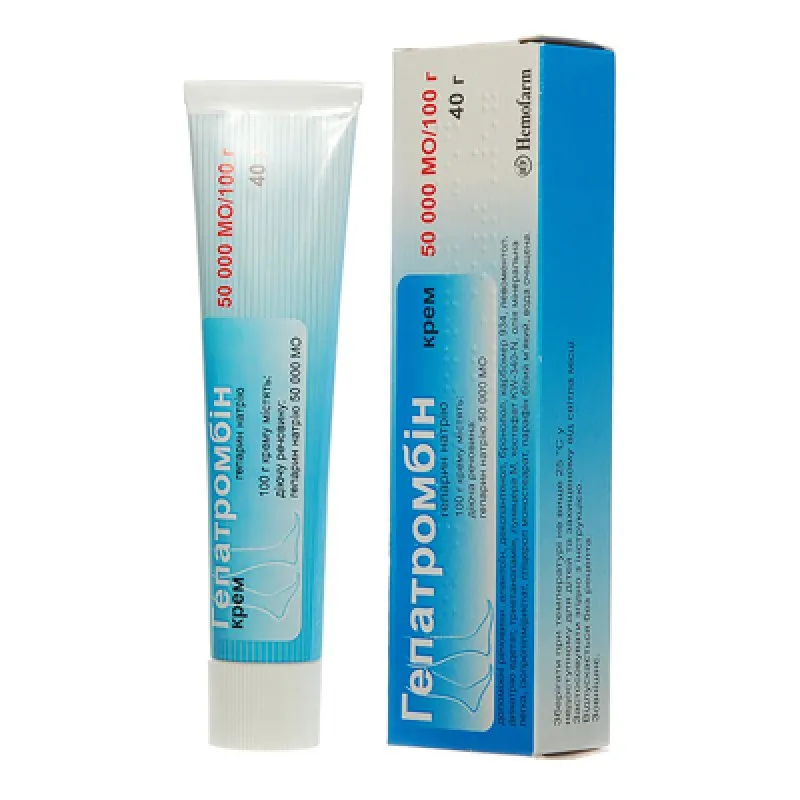
HEPATROMBIN
UkraineThe drug is used for the treatment of superficial vein diseases (e.g., varicose veins, thrombophlebitis), as well as for injuries, bruises, swelling, and subcutaneous hematomas.
Frequently asked questions
How should Hepatrombin be applied correctly?
The cream should be applied to the affected area and its surrounding skin in a layer of approximately 1 mm and gently rubbed in 1–3 times daily. If treating phlebitis, the cream should not be rubbed in, but simply applied to the affected area and covered with an elastic bandage.
What are the possible side effects of Hepatrombin?
The drug is most commonly well-tolerated, but mild skin redness is possible. Allergic reactions may also occur: itching, swelling, burning, rash, or edema. If accidentally ingested, nausea or vomiting may occur.
Who should not use this cream?
The product is contraindicated in cases of hypersensitivity to its components, presence of bleeding ulcers, open or infected wounds, hemophilia, thrombocytopenia, and a tendency to bleeding. It is also not recommended for pregnant women, breastfeeding women, and children.
Can the cream be applied to damaged skin?
No, the cream should only be applied to intact skin. It must not be applied to wounds, ulcers, moist areas, mucous membranes, or the areas around the eyes.
Can this product be combined with other medicines?
It must not be used together with preparations containing tetracycline, hydrocortisone, salicylic acid, or other anticoagulants. Caution should also be exercised if you are already taking blood-thinning tablets, as this may increase the risk of bleeding.
Does the drug affect the ability to drive a vehicle?
No, the use of the cream does not affect reaction speed when driving vehicles or operating machinery.
Instructions for use
INSTRUCTIONS FOR MEDICAL USE OF THE MEDICINAL PRODUCT HEPATROMBIN (HepatHrombin)
Composition:
Active substance: sodium heparin;
100 g of cream contains sodium heparin 30000 IU or 50000 IU;
Excipients: allantoin, dexpanthenol, disodium edetate, bronopol, Hostaphat KW-340-N, Lanucera M, carbomer 934, levomenthol, light mineral oil, glycerol monostearate, isopropyl myristate, white soft paraffin, triethanolamine, purified water.
Pharmaceutical form. Cream.
Main physicochemical properties: white homogeneous cream with a characteristic menthol odor.
Pharmacotherapeutic group. Agents used in varicose veins. Heparin or heparinoids for topical use. ATC code C05B A03.
Pharmacological properties.
Pharmacodynamics.
Hepatrombin, cream, is a high-dose topical preparation of the directly acting anticoagulant heparin. It exerts local antithrombotic, anti-edematous, and anti-inflammatory effects, stimulates tissue metabolic processes, as well as tissue granulation and epithelialization, and improves local blood circulation.
Pharmacokinetics.
When applied topically, heparin does not exhibit systemic effects, rapidly penetrates through the skin, and accumulates in the stratum corneum of the epidermis, thus exerting exclusively local action.
Clinical characteristics.
Indications.
Treatment of diseases of superficial veins, such as varicose veins, and associated complications; phlebothrombosis, thrombophlebitis, superficial periphlebitis. Postoperative varicose phlebitis, complications following surgical removal of subcutaneous veins of the lower limbs. Injuries and contusions, infiltrates and localized edema, subcutaneous hematomas. Injuries and strains of musculotendinous and capsulosynovial structures.
Contraindications.
Hypersensitivity to heparin or to any of the other components of the medicinal product; bleeding leg ulcers; open and/or infected wounds; hemorrhagic diathesis; purpura; thrombocytopenia; hemophilia. Tendency to bleeding.
Interaction with other medicinal products and other forms of interactions.
No clinically significant interactions with other topical medicinal products have been reported, but they cannot be excluded, especially during prolonged use, since penetration of heparin through intact skin is known.
Gepatrombin should not be used concomitantly with topical medicinal products, for example, preparations containing tetracycline, hydrocortisone, salicylic acid, or anticoagulants.
Use of heparin may lead to prolonged prothrombin time in patients receiving oral anticoagulants.
An increased risk of bleeding cannot be excluded. Hematomas may accumulate or become more extensive.
Special precautions for use.
Apply the cream only to intact skin. The product should not be used in cases of bleeding, on infected areas of skin with purulent processes, or on mucous membranes. In patients presenting hemorrhagic symptoms, the possibility of using the product should be carefully considered.
Hepatrombin contains bronopol, which may cause local skin reactions (e.g., contact dermatitis).
The cream must not be applied to weeping skin areas, wounds, ulcers, blisters, eyes, or areas around the eyes. Accidental ingestion of the cream in children may cause nausea or vomiting. In such cases, gastric lavage should be performed. Treatment is symptomatic.
In cases of coagulation disorders, the cream is not recommended for application over large areas of skin.
Use during pregnancy or breastfeeding. Do not use the medicinal product during pregnancy or breastfeeding.
Ability to influence reaction rate when driving or operating machinery. Hepatrombin cream does not affect reaction speed when driving or operating machinery.
Method of Administration and Dosage.
Apply topically.
Begin treatment with a dose of 50,000 IU/100 g; the dose of 30,000 IU/100 g should be used for continuation of treatment.
Apply a layer of cream approximately 1 mm thick to the affected area and surrounding skin 1–3 times daily, and gently rub it into the skin.
In venous disorders, a compression bandage may be applied.
When treating phlebitis, the cream should not be rubbed into the skin, but simply applied in a layer approximately 1 mm thick to the affected area and covered with an elastic bandage.
The duration of treatment is determined individually by the physician, depending on the course of the disease.
Children. Due to limited experience with use, the drug should not be prescribed to children.
Overdose.
Because of the minimal systemic absorption of the drug, there is no danger of overdose with topical application. In case of accidental ingestion, nausea and vomiting may occur. Gastric lavage should be performed; subsequent treatment should be symptomatic.
The effect of heparin can be neutralized with protamine sulfate.
Side effects.
The medicinal product is usually well tolerated; only in rare cases mild skin irritation (redness) may occur, which spontaneously resolves after some time.
During the course of treatment, hypersensitivity reactions to heparin or to any other components of the medicinal product may develop. Signs of such hypersensitivity include itching, redness, swelling of the skin, burning sensation, skin rashes, urticaria, angioneurotic edema, hemorrhages, and occasionally the appearance of small pustules, vesicles or bullae. When applied to large areas of skin, systemic adverse reactions are possible.
Shelf life. 3 years.
Storage conditions. Store at a temperature not exceeding 25 °C.
Keep out of reach of children.
Packaging. 40 g in a tube; 1 tube in a cardboard package.
Availability. Over-the-counter.
Manufacturer. «Hemofarm» AD / «Hemofarm» AD.
Manufacturer's address and place of business.
Beogradski put bb, 26300, Vrsac, Republic of Serbia.
Similar drugs
| Brand name | Dosage form | Active substance / Dosage | Manufacturer |
|---|---|---|---|
| HEPATROMBIN | cream |
|
Hemofarm AD, Vrsac, division Shabac (manufacturing of unpackaged products, primary and secondary packaging, batch control) |
The original data is available in the language of the country of manufacture.
Data source: State Register of Medicinal Products of Ukraine
Data last verified: August 13, 2026