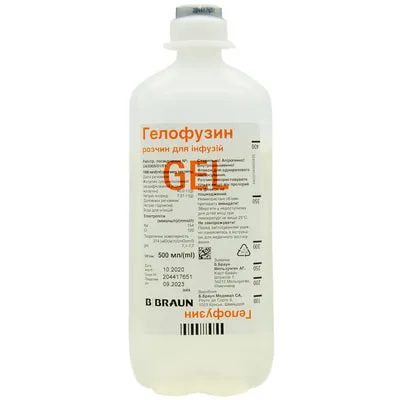
GELOFUSINE
UkraineThe drug is used to treat blood volume deficit (hypovolemia) or shock. It is also used to prevent a drop in blood pressure during anesthesia or in cases of expected significant blood loss during surgery, as well as during procedures involving a cardiopulmonary bypass machine.
Frequently asked questions
How should Gelofusine be taken correctly?
The drug is administered intravenously. The first 20 ml of the solution should be administered slowly to monitor for any potential allergic reaction. The dose and infusion rate must be selected by a physician individually, depending on the patient's condition and the volume of blood lost. In critical situations, the solution may be administered rapidly under pressure.
Who should not use this drug?
Gelofusine is contraindicated in hypervolemia (excess fluid in the body), hyperhydration, acute congestive heart failure, as well as hypersensitivity to any components of the composition. It must not be used in individuals with an allergy to red meat (mammalian meat), its offal, or known sensitivity to alpha-gal.
What are the possible side effects of Gelofusine?
Most commonly, the drug may lead to a decrease in hematocrit levels and plasma protein concentration. Possible allergic reactions (ranging from mild, such as urticaria, to severe, such as anaphylactic shock), nausea, vomiting, abdominal pain, and rarely—tachycardia or a drop in blood pressure.
Can the drug be combined with other medicines?
Caution should be exercised if the patient is simultaneously taking drugs that cause sodium retention (e.g., corticosteroids or non-steroidal anti-inflammatory drugs), as this may cause edema. Since compatibility studies are unavailable, it is not recommended to mix the drug with other medicinal products.
What are the risks of overdose?
Infusing too rapidly or exceeding the dose may lead to fluid overload, causing pulmonary edema, headache, shortness of breath, and impairment of heart and kidney function.
Instructions for use
INSTRUCTIONS FOR MEDICAL USE OF THE MEDICINAL PRODUCT GELOFUSINE (GELOFUSINE)
Composition:
active substances: succinylated gelatin (modified liquid gelatin), sodium chloride;
1000 ml of solution contain 40 g of succinylated gelatin (modified liquid gelatin); 7.01 g of sodium chloride; electrolyte concentration: sodium – 154 mmol/l; chloride – 120 mmol/l;
excipients: sodium hydroxide, water for injections.
Pharmaceutical form. Infusion solution.
Main physico-chemical properties: clear, straw-colored solution, practically free from extraneous particles; pH 7.4 ± 0.3; specific viscosity (at 37 °C) 1.9; isoelectric point at pH 4.5±0.3; colloidal-osmotic pressure 33.3 mm Hg; theoretical osmolarity 274 mOsm/l; gel point ≤ 3 °C.
Pharmacotherapeutic group. Blood substitutes and perfusion solutions. Gelatin preparations.
ATC code B05AA06.
Pharmacological Properties
Pharmacodynamics
Mechanism of action
Gelofusine is a 40 mg/mL solution of succinylated gelatin (also known as modified fluid gelatin) with a mean molecular weight of 26,500 Daltons (weight-average).
The negative charge introduced into the molecule by succinylation causes it to expand, making it significantly more voluminous than unsuccinylated gelatin of the same molecular weight.
In healthy volunteers, the measured initial volume effect of Gelofusine ranges from 80 to 100% of the infused volume, with adequate volume effect maintained for 4–5 hours.
The colloid osmotic pressure of the solution determines the magnitude of its initial volume effect. The duration of effect depends on colloid clearance, primarily via renal excretion. The volume effect of Gelofusine is equivalent to the infused volume of solution. Since Gelofusine is a plasma substitute, it does not possess a plasma-expanding effect.
The solution also restores the extravascular space and does not disturb the electrolyte balance of the extracellular space.
Pharmacodynamic effects
Gelofusine replaces intravascular and extravascular volume deficits caused by losses of blood, plasma, and interstitial fluid. Thus, mean arterial pressure, left ventricular end-diastolic pressure, stroke volume, cardiac index, oxygen delivery, microcirculation, and diuresis increase without dehydration of the extravascular space.
Pediatric population
Only a few clinical studies have been conducted in pediatric patients. In 222 children aged 1 to 15 years with Dengue shock syndrome, Gelofusine, dextran 70, Ringer's lactate, and isotonic saline were equally effective in terms of time to recovery of initial pulse pressure, subsequent episodes of shock, and development of any complications. Among the 56 children who received Gelofusine, 5 (9%) experienced an allergic reaction, but all recovered without sequelae.
In 14 postoperative children (mean age 10 months) who received 15 mL/kg body weight of Gelofusine during the first hour after surgery to maintain normovolemia, and in 25 children aged 0 to 12 years who received Gelofusine for volume replacement after surgery (10 mL/kg body weight), mean coagulation parameters remained within normal limits. No adverse events were observed in these studies.
In 776 preterm infants who received fresh frozen plasma, Gelofusine, or glucose at a dose of 20 mL/kg body weight after birth and an additional 10 mL/kg body weight after 24 hours, no evidence of any adverse short-term outcomes related to gelatin use was found. Developmental outcomes at two years were similar across the three groups.
In 100 cyanotic children (aged 6 months to 3 years) undergoing cardiac surgery with cardiopulmonary bypass, Gelofusine at a dose of 10–20 mL/kg (n = 50) in the initial priming solution was safe and effective. No adverse events were reported.
Overall, available data on Gelofusine are too limited to fully assess its efficacy and safety in the pediatric population (see sections "Special Warnings and Precautions for Use", "Posology and Method of Administration").
Pharmacokinetics
Distribution
After administration, Gelofusine rapidly distributes within the intravascular space.
Metabolism/elimination
Elimination of modified fluid gelatin occurs in two phases; the half-life is approximately 8 hours in the first phase and several days in the second phase. Most of the administered Gelofusine is excreted by the kidneys. Only a small amount is excreted in feces, and no more than 1% is metabolized. Smaller molecules are eliminated via glomerular filtration, while larger molecules are first proteolytically degraded in the liver and then also excreted by the kidneys.
Pharmacokinetics in special clinical situations
The elimination half-life of Gelofusine in plasma may be prolonged in patients undergoing hemodialysis (glomerular filtration rate < 0.5 mL/min), although accumulation of gelatin does not occur.
Clinical Characteristics
Indications
Gelofusine is a colloid plasma substitute for:
- treatment of relative or absolute hypovolemia or shock;
- prevention of hypotension:
- caused by relative hypovolemia during induction of epidural or spinal anesthesia;
- resulting from inevitable significant blood loss during surgical intervention;
- performance of procedures involving extracorporeal circulation, as a component of priming fluid in combination with crystalloid solutions (e.g., use of heart-lung machine).
Contraindications
- Hypersensitivity to any of the active or excipient substances listed in the section "Composition";
- hypersensitivity to galactose-alpha-1,3-galactose (alpha-gal) or known allergy to red meat (mammalian meat) or animal by-products (see section "Special Warnings and Precautions for Use");
- hypervolemia;
- hyperhydration;
- acute congestive heart failure.
Interaction with Other Medicinal Products and Other Forms of Interaction
Caution should be exercised in patients receiving concomitant medications that may cause sodium retention (e.g., corticosteroids, nonsteroidal anti-inflammatory drugs), as concomitant use may lead to edema.
Special precautions for use
Anaphylactic/anaphylactoid reactions
Modified liquid gelatin solutions should be used with caution in patients with a history of allergic disorders, e.g. asthma.
Modified liquid gelatin solutions used for volume replacement may rarely cause allergic (anaphylactic/anaphylactoid) reactions of varying severity. To detect early signs of an allergic reaction, the first 20 mL should be administered slowly and under close observation of the patient, especially at the beginning of the infusion. For symptoms of anaphylactoid reactions, see section "Adverse reactions".
Due to possible cross-reactions involving the galactose-alpha-1,3-galactose (alpha-gal) allergen, the risk of sensitization and, consequently, anaphylactic reaction to gelatin-containing solutions is increased in patients with a history of allergy to red meat (mammalian meat) and/or offal, and/or those with a positive test for anti-alpha-gal IgE antibodies. Gelatin-containing colloidal solutions should not be administered to such patients (see section "Contraindications").
In case of an allergic reaction, the infusion must be stopped immediately and appropriate treatment initiated.
Risks associated with fluid and electrolyte administration
Helofusin should be used with caution in patients:
- at risk of circulatory overload, e.g. with right or left ventricular insufficiency, hypertension, pulmonary edema, or renal insufficiency with oliguria or anuria;
- with severe renal function impairment;
- with severe hypernatremia;
- with severe hyperchloremia;
- with edema associated with water/salt retention;
- with serious coagulation disorders;
- of advanced age, as they are more prone to developing disorders such as cardiac or renal failure.
Serum electrolyte concentrations, acid-base balance, and fluid balance should be monitored, especially in patients with hypernatremia, hyperchloremia, or impaired renal function. Helofusin contains supraphysiological concentrations of sodium (154 mmol/L) and chloride (120 mmol/L).
Particular attention should be paid to the appearance of symptoms of hypocalcemia (e.g. signs of tetany, paresthesia); appropriate measures should be taken.
Effects on hemodilution and blood coagulation
Hemodynamic and hematological systems, as well as the coagulation system, should be monitored.
When compensating for severe blood loss by infusing large volumes of Helofusin, hematocrit must always be checked. Hematocrit should not fall below 25%. In elderly or critically ill patients, hematocrit should not fall below 30%.
Similarly, in such situations, the dilutional effect on coagulation factors should be monitored, especially in patients with pre-existing hemostatic disorders.
Since Helofusin does not replace plasma protein losses, plasma protein concentration should be monitored (see section "Dosage and administration").
Children
Experience with the use of Helofusin in children is limited. Therefore, Helofusin should be administered to such patients only when the expected benefit clearly outweighs the potential risk (see section "Dosage and administration").
Effect on laboratory test results
Laboratory blood tests (blood group determination or transient antibodies) may be performed after Helofusin infusion. However, blood samples are recommended to be taken before Helofusin infusion to avoid difficulties in interpreting results.
Helofusin may affect the results of certain clinical chemistry tests, leading to falsely elevated values:
- erythrocyte sedimentation rate;
- urine specific gravity;
- determination of non-specific proteins, e.g. by the biuret method.
Administration of Helofusin may lead to positive doping test results.
Helofusin contains 3540 mg of sodium per 1000 mL, equivalent to 177% of the WHO recommended maximum daily intake of 2 g of sodium for an adult.
Use during pregnancy or breastfeeding
Pregnancy
Data on the use of Helofusin in pregnant women are lacking or limited. Due to the limited available data and the possibility of severe anaphylactic/anaphylactoid reactions leading to fetal or neonatal distress, the use of Helofusin during pregnancy should be restricted to emergency situations.
Breastfeeding
Data on the excretion of succinylated gelatin into human milk are lacking or limited. However, due to its high molecular weight, significant amounts of gelatin in milk are not expected. Sodium and chloride are normal constituents of the human body and diet. A significant increase in the concentration of these electrolytes in breast milk after Helofusin administration is not expected.
Fertility
There are no data on the effect of Helofusin on human fertility. However, due to the nature of its components, it is considered unlikely that Helofusin would affect fertility.
Ability to affect reaction speed when driving or operating machinery
The medicinal product Helofusin has no effect or has a negligible effect on the ability to drive vehicles or operate machinery.
Method of Administration and Dosage
Like all colloids, the medicinal product Helofusine should only be used if hypovolemia cannot be corrected by crystalloids alone. In severe hypovolemia, colloids are usually administered in combination with crystalloids.
Volume overload due to overdose or excessively rapid infusion must always be avoided. Dosage should be carefully adjusted, especially in patients with lung or cardiovascular disorders.
Dosage
Dosage and rate of administration should be adjusted according to the volume of blood loss and individual requirements for restoration and maintenance of a stable hemodynamic status. Initially, a dose of 500 to 1000 ml is administered; in cases of severe blood loss, higher doses may be required.
Adults
Adults should be administered 500 ml at an appropriate rate depending on the patient's hemodynamic status. If blood loss exceeds 20%, blood or blood components should usually be additionally administered (see section "Special Warnings and Precautions for Use").
Maximum Dose
The maximum daily dose is determined by the degree of hemodilution. Caution should be exercised to avoid reducing hemoglobin or hematocrit below critical levels.
If necessary, additional blood transfusion or packed red blood cells should be administered.
Dilution of plasma proteins (including albumin and coagulation factors) should be taken into account, and adequate replacement should be performed if necessary.
Infusion Rate
The first 20 ml of the solution should be administered slowly to detect early signs of anaphylactic or anaphylactoid reactions (see section "Special Warnings and Precautions for Use").
In severe, acute situations, Helofusine may be rapidly infused under pressure: 500 ml within 5–10 minutes until signs of hypovolemia resolve.
Children
The safety and efficacy of Helofusine in children have not yet been fully established. Therefore, dosage recommendations cannot be provided. Helofusine should be administered to these patients only when the expected benefit clearly outweighs the potential risk. In such cases, the patient's clinical condition should be carefully considered and therapy closely monitored (see also section "Special Warnings and Precautions for Use").
Elderly Patients
Caution should be exercised when administering Helofusine to patients with comorbidities such as heart or renal failure, which are frequently associated with advanced age (see also section "Special Warnings and Precautions for Use").
Route of Administration
Intravenous administration.
Helofusine may be warmed prior to rapid infusion to a temperature not exceeding 37°C.
When administering Helofusine under pressure, all air must be removed from the container and administration set before infusion, as there is a risk of air embolism during infusion.
The solution in the vial is intended for single use only. Any unused content of an opened vial must be discarded and not stored for future use. Partially used vials must not be reconnected.
The medicinal product should be used only if the solution is clear, straw-colored, and the vial and its cap are undamaged.
Any unused medicinal product or waste materials should be disposed of in accordance with local requirements.
Children
Experience with the use of Helofusine in children is limited; therefore, the drug should be used in this age group only after careful benefit-risk assessment and with close monitoring.
Overdose
Symptoms
Overdose or excessively rapid administration of Helofusine may lead to unintentional hypervolemia and circulatory overload, resulting in a significant decrease in hematocrit and plasma protein levels, accompanied by electrolyte and acid-base imbalances. This may lead to subsequent cardiac and pulmonary dysfunction (pulmonary edema). Symptoms of circulatory overload include, among others, headache, dyspnea, and jugular vein distension.
Treatment
If early signs of circulatory overload occur, infusion should be immediately discontinued and a fast-acting diuretic administered. In cases of overdose, symptomatic treatment with electrolyte monitoring should be provided.
Adverse Reactions
Adverse reactions are listed according to their frequency of occurrence:
very common (≥ 1/10);
common (from ≥ 1/100 to < 1/10);
uncommon (from ≥ 1/1,000 to < 1/100);
rare (from ≥ 1/10,000 to < 1/1,000);
very rare (< 1/10,000);
not known (cannot be estimated from available data).
Summary of safety profile
Adverse reactions may occur during and after administration of Gelofusine. These typically include anaphylactic/anaphylactoid reactions of varying severity (see also sections "Contraindications" and "Special precautions", particularly regarding hypersensitivity to galactose-alpha-1,3-galactose (alpha-gal) and allergy to red meat and offal).
List of adverse reactions
Immune system disorders
Rare: anaphylactic/anaphylactoid reactions up to shock (see section "Special precautions")
Cardiac disorders
Very rare: tachycardia
Vascular disorders
Very rare: hypotension
Gastrointestinal disorders
Uncommon: nausea, vomiting, abdominal pain
General disorders and administration site conditions
Very rare: increased body temperature, chills
Investigations
Not known: decreased oxygen saturation
Blood and lymphatic system disorders
Very common: decreased hematocrit and plasma protein concentration
Common (depending on dose administered): relatively high doses of Gelofusine cause dilution of blood coagulation factors and may therefore affect blood coagulation. Prothrombin time and activated partial thromboplastin time (aPTT) may be prolonged after administration of large doses of Gelofusine (see section "Special precautions").
Information on specific adverse reactions
Minor anaphylactoid reactions include: generalized erythema, urticaria, periorbital edema, or angioneurotic edema.
Moderate anaphylactoid reactions include: dyspnea, stridor, wheezing, nausea, vomiting, dizziness (presyncope), diaphoresis, sensation of chest or throat tightness, abdominal pain.
Severe anaphylactoid reactions include: cyanosis or SaO2 ≤ 92% at any stage, hypotension (systolic blood pressure < 90 mmHg in adults), confusion, collapse, loss of consciousness, or urinary incontinence.
In case of anaphylactoid reaction, infusion must be stopped immediately and standard treatment for acute episodes should be initiated.
Children
There are no data regarding a specific pattern or frequency of adverse reactions in children.
Reporting of suspected adverse reactions
Reporting suspected adverse reactions after product authorization is important. It allows continued monitoring of the benefit-risk balance of the medicinal product. Medical and pharmaceutical professionals, as well as patients or their legal representatives, should report any suspected adverse reactions and lack of efficacy via the Automated Pharmacovigilance Information System at the following link: https://aisf.dec.gov.ua
Shelf life. 3 years.
Infusion should be started immediately after connecting the container to the administration set.
Storage conditions
Store at temperatures not exceeding 25 °C. Do not freeze.
Keep out of reach of children.
Incompatibilities
Due to lack of compatibility studies, this medicinal product must not be mixed with other medicinal products.
Packaging
500 ml of solution in bottles. 10 bottles per cardboard box.
500 ml of solution in bottles.
Prescription status. Prescription only.
Manufacturer. B. Braun Medical SA / B. Braun Medical SA.
Manufacturer's location and address of place of business
Route de Sorge 9, 1023 Crissier, Switzerland / Route de Sorge 9, 1023 Crissier, Switzerland.
Marketing Authorization Holder. B. Braun Melsungen AG / B. Braun Melsungen AG.
Holder's location and address of place of business
Carl-Braun-Strasse 1, 34212 Melsungen, Germany / Carl-Braun-Strasse 1, 34212 Melsungen, Germany.
Similar drugs
| Brand name | Dosage form | Active substance / Dosage | Manufacturer |
|---|---|---|---|
| HELASPAN 4 % | solution for infusion |
|
B. Braun Medical SA |
| HELOPLASMA | solution for infusion |
|
Fresenius Kabi France |
| VOLUTENZ® | solution for infusion |
|
Serumwerk Bernburg AG |
The original data is available in the language of the country of manufacture.
Data source: State Register of Medicinal Products of Ukraine
Data last verified: August 13, 2026