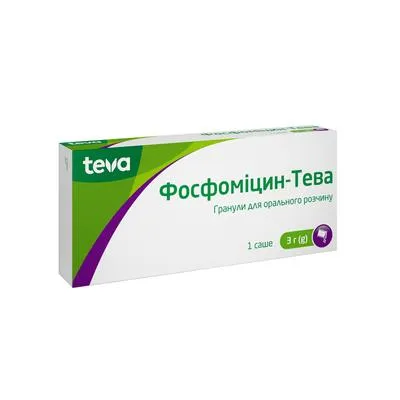
FOSFOMYCIN-TEVA
UkraineThe drug is used to treat acute uncomplicated cystitis in women and girls (over 12 years of age), as well as for the prevention of infections before transrectal prostate biopsy in adult men.
Frequently asked questions
How should Fosfomycin-teva be taken correctly?
To treat cystitis, a single 3 g dose of the drug must be taken. The granules should be dissolved in a glass of water and consumed immediately after preparation. It is preferable to take it on an empty stomach (2–3 hours before or 2–3 hours after a meal), before bedtime, and after emptying the bladder. For prophylaxis before a biopsy, 3 g is taken 3 hours before the procedure and another 3 g 24 hours after it.
Who should not take this drug?
The drug is contraindicated in individuals with hypersensitivity to its components. It is not recommended for use in cases of severe renal impairment (when creatinine clearance is less than 10 ml/min). It should also not be used in children under 12 years of age. Patients with intolerance to certain sugars (fructose, glucose-galactose, etc.) should consult a physician.
What side effects may Fosfomycin-teva cause?
The most common side effects are gastrointestinal disorders, including diarrhea, nausea, abdominal pain, and dyspepsia. Headache, dizziness, skin rash, or itching are also possible. In rare cases, serious allergic reactions, such as anaphylactic shock, may occur.
Can the drug be taken with other medicines?
Simultaneous administration with metoclopramide should be avoided, as it may reduce the concentration of the active substance in the blood and urine. Any other drugs that increase intestinal motility may also have a similar effect. When taking anticoagulants (blood-thinning medications), a change in their activity is possible.
How does food affect the action of the drug?
Food may slow the absorption of the active substance, leading to a reduction in its peak levels in the blood and urine. Therefore, it is better to take the medicine on an empty stomach or 2–3 hours after a meal.
Instructions for use
INSTRUCTIONS FOR MEDICAL USE OF THE MEDICINAL PRODUCT FOSFOMYCIN-TEVA (FOSFOMYCIN-TEVA)
Composition:
Active substance: fosfomycin;
1 sachet contains fosfomycin 3 g (as fosfomycin trometamol);
Excipients: sucrose, citric acid anhydrous, magnesium citrate anhydrous, sodium saccharin, orange flavor, tangerine flavor.
Pharmaceutical form. Granules for oral solution.
Main physicochemical properties: a mixture of powder and granules, almost white in color, with a citrus aroma.
Pharmacotherapeutic group. Antimicrobial agents for systemic use. Other antimicrobials. Fosfomycin. ATC code J01X X01.
Pharmacological properties.
Pharmacodynamics.
Mechanism of action. Fosfomycin exerts a bactericidal effect on proliferating pathogens by inhibiting the enzymatic synthesis of the bacterial cell wall; it inhibits the first step of intracellular bacterial wall synthesis by blocking peptidoglycan synthesis. Fosfomycin is actively transported into the bacterial cell via two distinct transport systems (sn-glycerol-3-phosphate and hexose-6).
Pharmacokinetic/pharmacodynamic relationship. Limited data suggest that the effect of fosfomycin is most likely time-dependent.
Mechanism of resistance. The primary mechanism of resistance is chromosomal mutation leading to altered bacterial transport systems for fosfomycin. Additional resistance mechanisms associated with plasmids or transposons result in enzymatic inactivation of fosfomycin either by conjugation with glutathione or, respectively, by cleavage of the carbon-phosphorus bond within the fosfomycin molecule.
Cross-resistance. Cross-resistance between fosfomycin and antibiotics of other classes is not known.
Susceptibility testing breakpoints. Susceptibility breakpoints established by the European Committee on Antimicrobial Susceptibility Testing (EUCAST) are presented in the table (EUCAST breakpoint table version 11):
| Species |
Susceptible |
Resistant |
| Enterobacteria |
≤ 8 mg/l |
> 8 mg/l |
Acquired resistance prevalence. The prevalence of acquired resistance may vary geographically and over time; therefore, local information on resistance patterns is necessary to ensure appropriate treatment of severe infections.
The following information is based on monitoring programs and surveillance data. It includes microorganisms associated with approved indications:
- Commonly susceptible species
Aerobic Gram-negative microorganisms: Escherichia coli.
- Species for which acquired resistance may be a problem
Aerobic Gram-positive microorganisms: Enterococcus faecalis.
Aerobic Gram-negative microorganisms: Klebsiella pneumoniae, Proteus mirabilis.
- Intrinsically resistant species
Aerobic Gram-positive microorganisms: Staphylococcus saprophyticus.
Pharmacokinetics.
Absorption. After oral administration of a single dose, the absolute bioavailability of fosfomycin trometamol is approximately 33–53%. The rate and extent of absorption are reduced when taken with food, but the total amount of active substance excreted in urine over a given period remains unchanged. The average concentration of fosfomycin in urine remains above the minimum inhibitory concentration of 128 µg/mL for at least 24 hours after an oral dose of 3 g administered either fasting or after food, although the time to reach peak urinary concentration is delayed by 4 hours. Fosfomycin trometamol undergoes enterohepatic recirculation.
Distribution. Fosfomycin is not metabolized. Fosfomycin distributes into tissues, including kidneys and bladder wall, does not bind to plasma proteins, and crosses the placental barrier.
Elimination. Fosfomycin is excreted unchanged primarily via the kidneys by glomerular filtration (40–50% of the dose is recovered in urine), with an elimination half-life of approximately 4 hours after oral administration, and to a lesser extent in feces (18–28% of the dose). Although food slows the absorption of the active substance, the total amount of active substance excreted in urine over time remains unchanged.
Special patient populations. In patients with impaired renal function, the elimination half-life increases proportionally to the degree of renal impairment. Fosfomycin concentration in urine remains effective for up to 48 hours after administration of the standard dose if creatinine clearance exceeds 10 mL/min. In elderly patients, fosfomycin clearance is reduced in accordance with age-related decline in renal function.
Clinical characteristics.
Indications.
- Treatment of acute uncomplicated cystitis in women and girls.
- Perioperative antibiotic prophylaxis in adult men undergoing transrectal prostate biopsy.
Contraindications.
Hypersensitivity to the active substance or to any of the excipients of the medicinal product.
Interaction with other medicinal products and other forms of interaction.
Metoclopramide. Concomitant administration with metoclopramide results in reduced serum and urinary concentrations of fosfomycin; therefore, such combination should be avoided. Other medicinal products enhancing gastrointestinal motility may produce similar effects.
Effect of food. Food may delay absorption of fosfomycin, leading to a slight reduction in peak plasma levels and urinary concentration. Therefore, it is advisable to administer the medicinal product on an empty stomach or approximately 2–3 hours after a meal.
Specific issues related to changes in international normalized ratio (INR). Numerous cases of increased activity of oral anticoagulants have been reported in patients receiving antibiotic therapy. Risk factors include severe infection or inflammation, advanced age, and poor general health. Under these circumstances, it is difficult to determine whether the change in INR is due to the infectious disease or its treatment. However, such changes are more frequently associated with certain classes of antibiotics, particularly fluoroquinolones, macrolides, tetracyclines, co-trimoxazole, and some cephalosporins.
Children. Interaction studies have been conducted only in adult patients.
Special precautions.
Hypersensitivity reactions. Severe and sometimes fatal hypersensitivity reactions, including anaphylaxis and anaphylactic shock, may occur during treatment with fosfomycin. If such reactions occur, fosfomycin therapy should be discontinued immediately and appropriate emergency measures should be initiated without delay.
Clostridioides difficile-associated diarrhea. Cases of Clostridioides difficile-associated colitis and pseudomembranous colitis, ranging in severity from moderate to life-threatening, have been reported during fosfomycin therapy. This diagnosis should be considered in patients who develop diarrhea during or after treatment with fosfomycin. Discontinuation of fosfomycin and initiation of specific anti-Clostridioides difficile therapy should be considered. Antiperistaltic agents should not be administered.
Children. The safety and efficacy of fosfomycin in children under 12 years of age have not been established. Therefore, this medicinal product should not be used in this age group (see section "Dosage and administration").
Chronic infections and male patients. In cases of persistent infections, careful evaluation and re-evaluation of diagnosis are recommended, as these are often associated with complicated urinary tract infections or predominance of resistant pathogens (e.g., Staphylococcus saprophyticus, see section "Pharmacological properties"). Generally, urinary tract infections in male patients should be considered complicated, for which this medicinal product is not indicated (see section "Indications").
Excipients. Fosfomycin-Teva contains sucrose. Patients with rare hereditary disorders of fructose intolerance, glucose-galactose malabsorption, or sucrase-isomaltase deficiency should not take this medicinal product. If you have been diagnosed with intolerance to certain sugars, consult your physician before taking this medicinal product. May be harmful to teeth.
Use during pregnancy or breastfeeding.
Pregnancy. Data on the safety of fosfomycin use during the first trimester of pregnancy are limited (n=152). Current information does not indicate a safety signal regarding teratogenicity. Fosfomycin crosses the placenta. Animal studies have not revealed any direct or indirect harmful effects on reproductive toxicity. Fosfomycin should be used during pregnancy only if clearly necessary.
Breastfeeding. Fosfomycin passes into breast milk in small amounts. A single oral dose of fosfomycin may be used during breastfeeding if clinically necessary.
Fertility. Human data are lacking. In male and female rats, administration of fosfomycin at doses up to 1000 mg/kg/day did not impair fertility.
Ability to affect reaction rate when driving or operating machinery.
No specific studies have been conducted; however, patients should be informed about possible occurrences of dizziness. This may affect the ability to drive or operate machinery in some patients.
Method of Administration and Dosage
Doses
Acute uncomplicated cystitis in women and girls (> 12 years of age): 3 g of fosfomycin as a single dose.
Perioperative antibiotic prophylaxis in transrectal prostate biopsy: 3 g of fosfomycin 3 hours before the procedure and 3 g of fosfomycin 24 hours after the procedure.
Renal impairment. The use of Fosfomycin-Teva is not recommended in severe renal impairment (creatinine clearance < 10 mL/min; see section "Pharmacological properties").
Method of administration
For oral use. In acute uncomplicated cystitis in women and girls, the dose should be taken on an empty stomach (approximately 2–3 hours before or 2–3 hours after a meal), preferably at bedtime and after emptying the bladder. The dose should be dissolved in a glass of water and taken immediately after preparation. Official guidelines on the appropriate use of antibacterial agents should be taken into account.
Children. The safety and efficacy of Fosfomycin-Teva in children under 12 years of age have not been established.
Overdose.
Experience with oral overdose of fosfomycin is limited. Cases of arterial hypotension have been reported following parenteral administration of fosfomycin, as well as drowsiness, electrolyte disturbances, thrombocytopenia, and hypoprothrombinemia. In case of overdose, the patient should be monitored (particularly plasma/serum electrolyte levels), and treatment should be symptomatic and supportive. To enhance drug elimination via urine and promote clearance, rehydration is recommended. Fosfomycin is effectively removed by hemodialysis, with a mean half-life of approximately 4 hours.
Adverse Reactions
The most commonly reported adverse reactions following a single dose of fosfomycin trometamol are gastrointestinal in nature, predominantly diarrhea. These reactions are usually time-limited and resolve spontaneously. The adverse reactions listed below have been reported during clinical studies or in the post-marketing period with the use of fosfomycin trometamol.
Adverse reactions are classified according to the following frequency categories: very common (≥ 1/10), common (≥ 1/100 to < 1/10), uncommon (> 1/1000 to < 1/100), rare (≥ 1/10,000 to < 1/1000), very rare (< 1/10,000), frequency not known (cannot be estimated from the available data).
Within each category, adverse reactions are listed in order of decreasing severity.
Infections and infestations. Common: vulvovaginitis.
Immune system disorders. Frequency not known: anaphylactic reactions, including anaphylactic shock, hypersensitivity (see section "Special precautions").
Nervous system disorders. Common: headache, dizziness.
Gastrointestinal disorders. Common: diarrhea, nausea, dyspepsia, abdominal pain. Uncommon: vomiting. Frequency not known: antibiotic-associated colitis (see section "Special precautions").
Skin and subcutaneous tissue disorders. Uncommon: rash, urticaria, pruritus. Frequency not known: angioneurotic edema.
Reporting of suspected adverse reactions. Reporting of suspected adverse reactions after marketing authorization of the medicinal product is of great importance. It allows continued monitoring of the benefit-risk balance of the medicinal product. Healthcare and pharmacy professionals, as well as patients or their legal representatives, are encouraged to report any suspected adverse reactions and lack of efficacy via the Automated Pharmacovigilance Information System at the following link: https://aisf.dec.gov.ua
Shelf life. 3 years.
Storage conditions. The medicinal product does not require special storage conditions. Keep out of reach of children.
Packaging. 8 g of granules for oral solution in a sachet; 1 sachet per cardboard box.
Prescription status. Prescription only.
Manufacturer. Adifarm EAD.
Manufacturer's address and location of its business operations.
Bul. Simeonovsko shose 130, Sofia, 1700, Bulgaria.
Similar drugs
| Brand name | Dosage form | Active substance / Dosage | Manufacturer |
|---|---|---|---|
| CYSTAPHOCIN | granules for oral solution |
|
PJSC "Chemical Pharmaceutical Plant "Chervona Zirka" |
| CYSTORAL | granules for oral solution |
|
LLC "Corporation "Zdorovya" |
| EVROMYCIN | granules for oral solution |
|
PJSC "HIMFARMZAVOD "CHERVONA ZIRKA" |
| FONUROL® | granules for oral solution |
|
ASTRAFARM LLC |
| FOSFOCIN | granules for oral solution |
|
Labiana Pharmaceuticals, S.L.U. |
| FOSFOKOK | granules for oral solution |
|
Labiana Pharmaceuticals, S.L.U. |
| FOSFOMYCIN | granules for oral solution |
|
ASTRAFARM LLC |
| FOSFOMYCIN | granules for oral solution |
|
PJSC "HIMFARMZAVOD "CHERVONA ZIRKA" |
| PHOSPHOMED | granules for oral solution |
|
WORLD MEDICINE ILAC SAN. VE TIC. A.S. |
| PHOSPHORAL | granules for oral solution |
|
Labiana Pharmaceuticals, S.L.U. |
| PHOSPHOSEPTIC | granules for oral solution |
|
Adifarm EAD |
| UROPHOSCIN® | granules for oral solution |
|
PJSC "Kyivmedpreparat" |
The original data is available in the language of the country of manufacture.
Data source: State Register of Medicinal Products of Ukraine
Data last verified: August 13, 2026