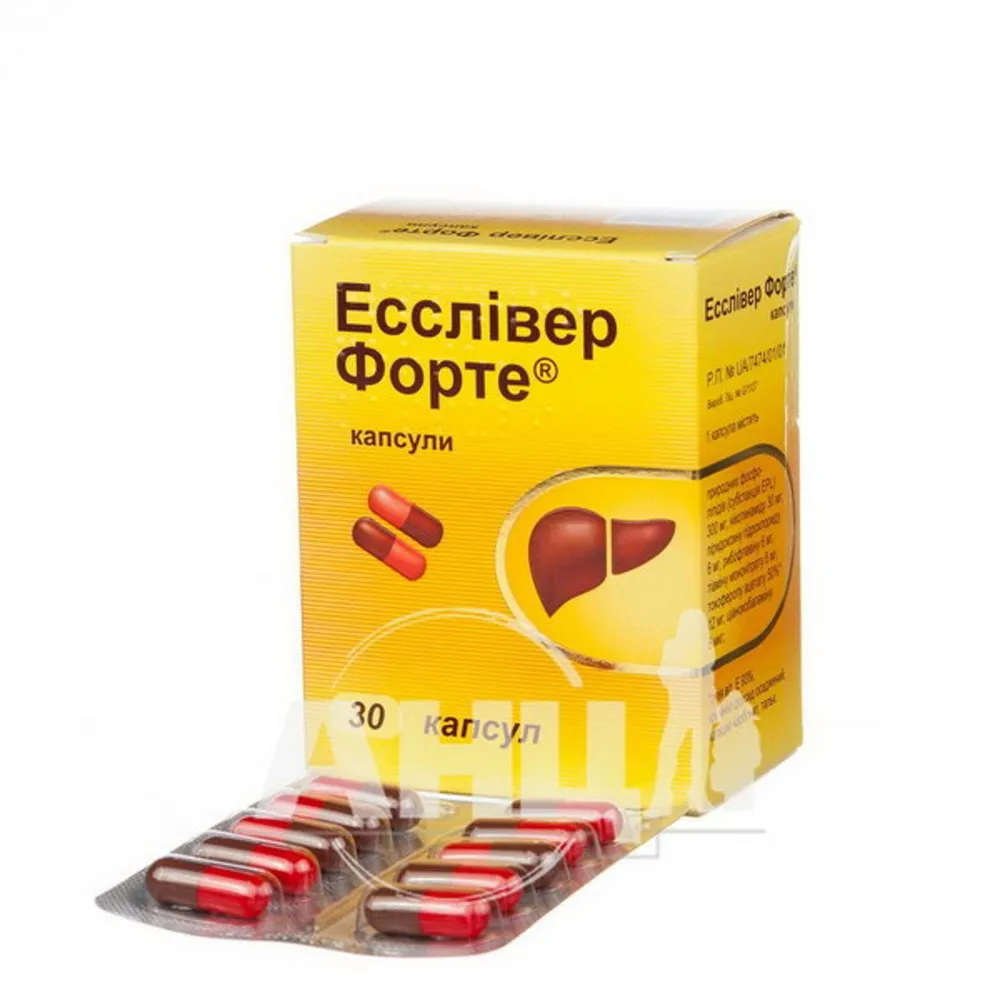
ESSIVER FORTE®
UkraineThe drug is used for alcoholic and non-alcoholic steatohepatitis, acute and chronic hepatitis, liver cirrhosis, as well as for preparation and recovery after surgery on the liver or bile ducts. It is also used for psoriasis and radiation syndrome.
Frequently asked questions
How should Essiver forte® be taken correctly?
Adults and children from 12 years of age (weighing 43 kg or more) usually take 1–2 capsules 3 times a day with meals. Capsules should be swallowed whole, without chewing, and taken with a small amount of water. The duration of the course is usually at least 3 months.
What are the possible side effects of Essiver forte®?
Possible side effects include digestive disorders (nausea, vomiting, diarrhea, constipation, heartburn, abdominal pain), allergic reactions (rash, urticaria, itching), and yellow discoloration of urine. If an allergic reaction occurs, the use of the drug should be discontinued.
Who should not take this drug?
Contraindications include hypersensitivity to the components of the composition, allergic diseases, intrahepatic cholestasis, and peptic ulcer disease of the stomach or duodenum in the acute stage.
Can the drug be taken together with other medicines?
Caution is required when combining with anticoagulants (dose adjustment may be necessary), anticonvulsants, antibiotics, and certain antidepressants. It is not recommended to take it together with other multivitamin complexes to avoid overdose.
Can the drug be taken by pregnant or breastfeeding women?
The use of the drug during pregnancy or breastfeeding is not recommended due to the limited availability of clinical study data.
What should be done in case of overdose?
Symptoms of overdose include nausea, vomiting, diarrhea, headache, drowsiness, and irritability. In such cases, it is necessary to rinse the stomach, take activated charcoal, and use laxatives.
Instructions for use
INSTRUCTION FOR MEDICAL USE OF THE MEDICINAL PRODUCT ESSLIVER FORTE®
Composition:
Active substances: 1 capsule contains natural phospholipids (EPL substance) 300 mg, nicotinamide 30 mg, pyridoxine hydrochloride 6 mg, riboflavin 6 mg, thiamine mononitrate 6 mg, tocopheryl acetate 50%* 12 mg, cyanocobalamin 6 mcg.
*Vitamin E oil 93%, precipitated silicon dioxide, calcium carbonate, talc.
| excipients: talc, magnesium-aluminum silicate hydrate, butylhydroxytoluene (E 321), sodium methylparaben (E 219), sodium propylparaben (E 217), disodium edetate (Trilon B); |
capsule (shell) composition:
red body: gelatin, titanium dioxide (E171), colouring agent Sunset Yellow FCF (E 110), colouring agent Brilliant Blue (E133), colouring agent Ponceau 4R (E 124);
brown cap: gelatin, titanium dioxide (E171), colouring agent Carmoisine (E122), colouring agent Brilliant Blue (E133), colouring agent Quinoline Yellow (E104).
Dosage form. Capsules.
Main physicochemical properties: hard gelatin capsules size "0" with brown cap and red body. The capsule content is a powder ranging from pinkish-yellow to orange. The presence of separate particles from whitish-yellow to brown is permissible.
Pharmacotherapeutic group.
Agents used in diseases of the liver and biliary tract. Hepatotropic agents. ATC code A05B A.
Pharmacological Properties.
Pharmacodynamics.
The main active component of the medicinal product Essentiale Forte® is natural phospholipids (EPL substance). Phospholipids are chemically similar to endogenous phospholipids but differ by their higher content of polyunsaturated fatty acids. These molecules primarily incorporate into cellular membrane structures and facilitate the restoration of damaged liver tissue. Phospholipids exert a hepatoprotective effect against liver cell damage caused by viruses, alcohol, and toxic substances. In liver cells, the rate of substance uptake and excretion increases, enzymatic systems are restored, and liver metabolism improves.
Phospholipids influence disturbed fat metabolism by regulating lipoprotein metabolism, resulting in the conversion of neutral fats and cholesterol into transportable forms, particularly due to enhanced ability of high-density lipoproteins (HDL) to bind cholesterol, directing them toward further oxidation.
During excretion of phospholipids through the biliary tract, the lithogenic index decreases and bile stabilization occurs.
The vitamin complex performs the following functions: nicotinamide exerts a hypolipidemic effect and prevents fatty degeneration of the liver; pyridoxine, as a coenzyme, participates in the metabolism of phospholipids, amino acids, and proteins; thiamine is involved in carbohydrate metabolism; riboflavin acts as a cofactor for numerous respiratory enzymes; tocopherol acts as an antioxidant at the cellular membrane level, preventing oxidation of unsaturated fatty acids.
Pharmacokinetics.
After oral administration, over 90% of the drug is absorbed in the small intestine. The majority is cleaved by phospholipase A into 1-acyl-lysophosphatidylcholine, 50% of which is immediately converted into polyunsaturated phosphatidylcholine during absorption in the small intestine. Polyunsaturated phosphatidylcholine enters the bloodstream via lymphatic pathways and is then transported primarily in complex with HDL to the liver. The maximum concentration of phosphatidylcholine in blood, achieved 6–24 hours after oral administration, averages 20%.
Clinical characteristics.
Indications.
Non-alcoholic steatohepatitis, alcoholic steatohepatitis, acute and chronic hepatitis of various etiologies, liver cirrhosis. Pre- and postoperative treatment in surgical interventions on the liver and biliary tract. Psoriasis, radiation syndrome.
Contraindications.
Hypersensitivity to any component of the medicinal product. Allergic diseases. Intrahepatic cholestasis. Peptic ulcer of the stomach and duodenum in the stage of exacerbation.
Special precautions.
Use with caution and only after consultation with a physician in patients with severe heart or kidney diseases, increased risk of thromboembolism, history of peptic ulcer of the stomach and duodenum, neoplasms, nephrolithiasis, erythremia, erythrocytosis, hyperuricemia.
Interaction with other medicinal products and other types of interactions.
Vitamin B6 reduces the effect of levodopa, prevents or diminishes toxic manifestations observed during the use of isoniazid and other antituberculosis drugs.
Para-aminosalicylic acid (PAS), cimetidine, calcium preparations, and ethanol reduce the absorption of vitamin B12.
Riboflavin is incompatible with streptomycin and reduces the efficacy of antibacterial agents (oxytetracycline, doxycycline, erythromycin, tetracycline, and lincomycin). Tricyclic antidepressants—imipramine and amitriptyline—inhibit riboflavin metabolism, especially in cardiac tissues.
Concomitant use with other multivitamin preparations is not recommended due to the risk of vitamin overdose.
Vitamin E must not be used together with iron or silver preparations, alkaline agents (sodium hydrocarbonate, trisamin), or indirect-acting anticoagulants (dicoumarin, neodicoumarin).
Vitamin E enhances the effect of steroid and non-steroidal anti-inflammatory drugs (sodium diclofenac, ibuprofen, prednisolone); reduces the toxic effects of cardiac glycosides (digitoxin, digoxin), and vitamins A and D. Administration of high-dose vitamin E may cause vitamin A deficiency in the body.
Vitamin E and its metabolites exhibit antagonistic action towards vitamin K.
Increases the efficacy of antiepileptic drugs in patients with epilepsy (in whom elevated blood levels of lipid peroxidation products are observed). Cholestyramine, colestipol, and mineral oils reduce the absorption of vitamin E.
Interaction between Essliver Forte® capsules and anticoagulants cannot be ruled out. Therefore, dose adjustment of the anticoagulant may be necessary.
Special precautions for use.
The use of this medicinal product may lead to false-positive urobilinogen tests when using Ehrlich's reagent.
This medicinal product contains sodium; therefore, caution should be exercised when administering to patients on a sodium-restricted diet.
Use during pregnancy or breastfeeding.
Clinical data on the use of the medicinal product in pregnant women are limited.
Therefore, the use of this medicinal product is not recommended during pregnancy or breastfeeding.
Ability to influence reaction rate while driving or operating machinery.
Does not affect.
Dosage and Administration.
The usual dose of the drug for adults and children aged 12 years and older is 1–2 capsules three times daily. Capsules should be taken during meals, without chewing, and swallowed with a small amount of water.
The dosage and duration of treatment are determined individually by a physician for each patient, taking into account the nature and severity of the pathological process, characteristics of the disease course, achieved therapeutic effect, and drug tolerability. On average, the treatment course should last at least 3 months.
For psoriasis treatment, start with 2 capsules three times daily for 2 weeks, followed by 1 capsule three times daily in combination with standard psoriasis treatment methods for 2 months.
Children.
The drug is indicated for use in children aged 12 years and older, with a body weight of at least 43 kg.
Overdose.
Symptoms: nausea, vomiting, diarrhea, headache, drowsiness, lethargy, facial hyperemia, irritability, and intensification of adverse reactions. With prolonged use at high doses, peripheral neuropathy is possible.
Treatment: gastric lavage, administration of activated charcoal, and hyperosmotic laxatives.
Adverse Reactions
In individual cases, the following adverse effects may occur during the use of the drug.
Gastrointestinal tract: Dyspeptic disorders, nausea, vomiting, loose stools or diarrhea, constipation, heartburn, epigastric discomfort and pain.
Skin and subcutaneous tissue: Allergic reactions, including skin rashes, exanthema, urticaria; very rarely – itching may occur.
In individuals with hypersensitivity to any component of the drug, hypersensitivity reactions may occur, including angioneurotic edema and anaphylaxis.
Discoloration of urine to yellow color may occur.
Methylparaben and propylparaben may cause allergic reactions, and in individual cases – bronchospasm.
Butylhydroxytoluene (E 321) may cause skin reactions (e.g., contact dermatitis) or irritation of eyes and mucous membranes.
Colouring agents Sunset Yellow FCF (E 110), Carmoisine (E 122), and Ponceau 4R (E 124) may cause allergic reactions.
If any of the above-mentioned adverse effects occur, especially hypersensitivity reactions, administration of the medicinal product should be discontinued. The patient should consult a physician who will assess the severity of the reaction and initiate appropriate treatment.
Shelf life
3 years.
Storage conditions
Store in the original packaging, in a place inaccessible to children, at a temperature not exceeding 25 °C.
Packaging
No. 30 – 10 capsules in a blister, 3 blisters per cardboard pack;
No. 50 – 10 capsules in a blister, 5 blisters per cardboard pack.
Availability
Over-the-counter.
Manufacturer
Nabros Pharma Pvt. Ltd.
Manufacturer's address and location of business activity
Survey No. 110/A/2 Amit Farm, Jayn Upsraya, near Coca Cola Factory, NH No. 8, Kajipura – 387411, Kheda, India
Similar drugs
| Brand name | Dosage form | Active substance / Dosage | Manufacturer |
|---|---|---|---|
| ESSENTIALE® FORTE N | capsules | A. Nattermann und Cie. GmbH (manufacturing, primary and secondary packaging, quality control and batch release) |
The original data is available in the language of the country of manufacture.
Data source: State Register of Medicinal Products of Ukraine
Data last verified: August 13, 2026