ENTEROSGEL
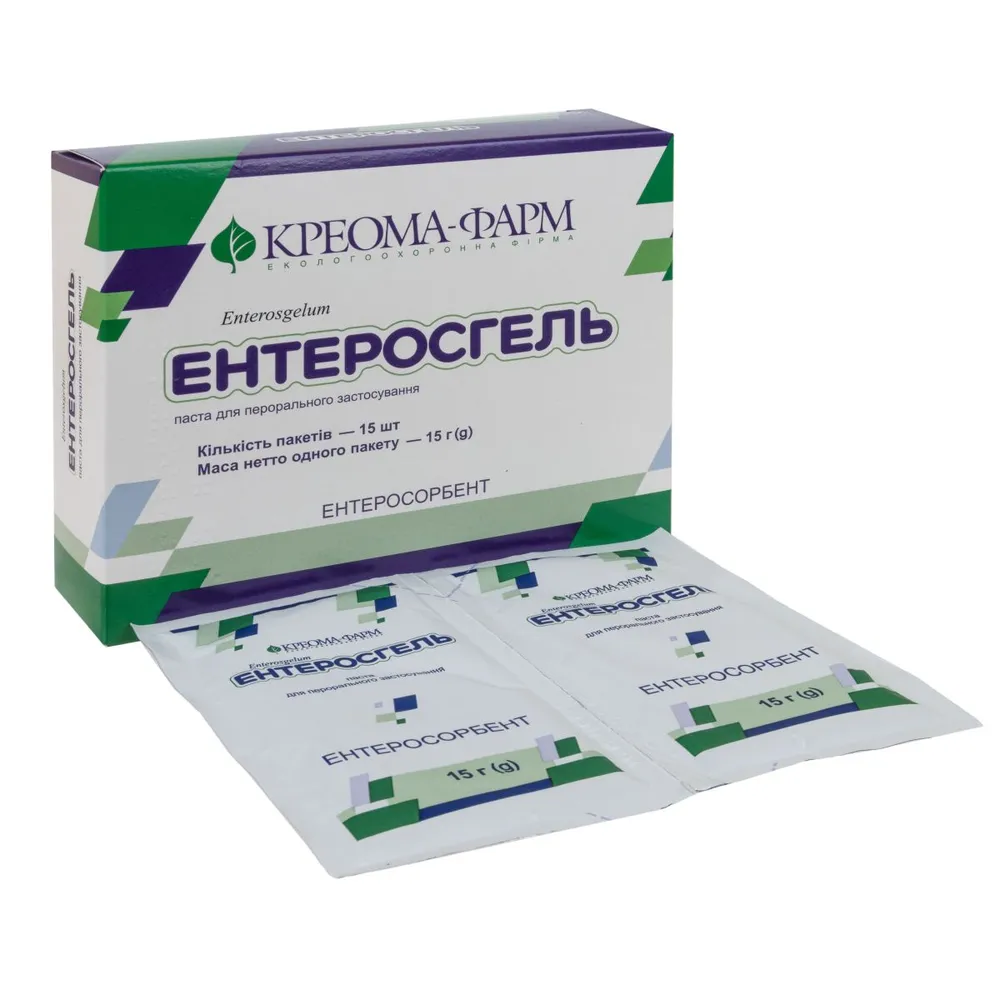
UkraineThe drug is used to cleanse the body of toxins in cases of poisoning (alcohol, drugs), hepatitis, liver cirrhosis, renal failure, diarrhea, gastritis, and enterocolitis. It is also used for allergic diseases, dysbacteriosis, and toxicosis in the first half of pregnancy.
Frequently asked questions
How should Enterosgel be taken correctly?
The drug is taken orally 3 times a day. It is important to observe the interval: 1.5–2 hours before meals or other medications, or 2 hours after them. It should be taken with a sufficient amount of water.
What is the dosage of the drug for different age groups?
Adults and children from 14 years: 15 g (one tablespoon) per dose, 45 g per day. Children from 5 to 14 years: 10 g (one dessert spoon) per dose, 30 g per day. Children from birth to 5 years: 5 g (one teaspoon) per dose, 15 g per day. The course usually lasts 7–14 days.
Who should not take this drug?
Acute intestinal obstruction is a contraindication.
What side effects can Enterosgel cause?
Digestive disorders (dyspepsia) and constipation are possible, especially during the first days of administration. For people prone to constipation, it is recommended to use laxatives or perform a cleansing enema to prevent it.
Can the drug be taken together with other medicines?
Enterosgel may reduce the effect of other medicines, so they should be taken at an interval of 1.5–2 hours. Simultaneous administration with silver preparations and bile acid sequestrants (e.g., cholestyramine) is not recommended.
Can the drug be used by pregnant women and children?
Yes, the drug can be used from birth. Pregnant women can take the drug, but use should be limited if there is a tendency toward constipation.
Instructions for use
INSTRUCTION FOR MEDICAL USE OF THE MEDICINAL PRODUCT ENTEROSGEL (ENTEROSGELUM)
Composition:
Active substance: 100 g of paste contains 70 g of methylsilicic acid hydrogel;
Excipients: purified water.
Pharmaceutical form. Oral paste.
Main physicochemical properties: homogeneous white, odorless, paste-like mass.
Pharmacotherapeutic group.
Enterosorbents. ATC code A07BC.
Pharmacological properties.
Pharmacodynamics.
Enterosgel is an inert silicon-organic compound. When administered, it exhibits sorption activity. The drug effectively adsorbs medium-molecular toxic substances of exo- and endogenous origin, products of incomplete metabolism, incorporated radionuclides, and naturally eliminates them from the body.
Enterosgel alleviates manifestations of intoxication, improves intestinal, liver, and kidney function, and normalizes blood and urine parameters.
Pharmacokinetics.
By coating the mucous membrane of the stomach and intestine, Enterosgel protects it from erosive processes and promotes enhancement of local immunity.
Enterosgel is not absorbed from the gastrointestinal tract and does not undergo metabolic or chemical transformations.
Clinical characteristics.
Indications.
As part of complex detoxification therapy in chronic renal failure; in toxic hepatitis, viral hepatitis A and B, liver cirrhosis, and cholestasis of various etiologies; in enterocolitis, colitis, diarrhea, gastritis with reduced acidity, alcohol and drug intoxication; in allergic and skin diseases (diathesis, neurodermatitis); in burn intoxication; in purulent-septic and inflammatory processes accompanied by intoxication; in first-trimester pregnancy toxemia; in complex treatment of intestinal dysbiosis.
Contraindications.
Acute intestinal obstruction.
Interaction with other medicinal products and other forms of interactions.
The drug may reduce the effect of other medicinal products taken concurrently. Concomitant use with medicinal products belonging to the class of bile acid sequestrants, such as cholestyramine, is not recommended due to increased risk of constipation.
The drug should not be used together with silver-containing preparations.
Special precautions.
When following the recommended administration method (Enterosgel and medicinal products are taken with an interval of 1.5–2 hours), the drug can be used in complex therapy with other medicinal and prophylactic agents, including prebiotics and probiotics (bifidobacteria, lactobacilli), phytopharmaceuticals, adaptogens, and immunomodulators.
Use during pregnancy or breastfeeding.
The drug can be used during pregnancy or breastfeeding. However, its use should be limited in pregnant women who are prone to constipation.
Ability to affect reaction rate while driving or operating machinery.
Does not affect.
Dosage and Administration.
Take orally 3 times daily, 1.5–2 hours before or 2 hours after meals or taking medications, with sufficient amount of water.
For adults and children aged 14 years and older: single dose is 15 g (tablespoon), daily dose is 45 g.
For children from birth to 5 years: single dose is 5 g (teaspoon), daily dose is 15 g; for children from 5 to 14 years: single dose is 10 g (dessert spoon), daily dose is 30 g.
Treatment duration: 7 to 14 days.
In severe cases, double the single dose may be used during the first three days. In chronic conditions (e.g., chronic renal failure), the treatment duration may be extended up to 1 month.
Children.
The drug can be administered to children from birth. For children under 2 years of age, the single dose may be mixed with a small amount of water before administration.
Overdose.
Cases of overdose have not been reported. In case of overdose, adverse effects may be intensified.
Adverse reactions.
Dyspeptic symptoms may occur during administration of the drug. In the first days of treatment, constipation may develop. To prevent constipation, patients prone to this condition are recommended to use a cleansing enema at night or laxatives (lactulose, sodium picosulfate) during the first two days of treatment.
Shelf life. 3 years.
Storage conditions.
Store at a temperature not exceeding 25 °C; do not freeze. The product loses its properties after freezing. After opening the package, store under the same conditions in tightly closed container.
Keep out of reach of children.
Packaging.
135 g, 270 g, or 405 g in a container; 1 container per cardboard box; 15 g in a sachet; 15 or 30 sachets per cardboard box; 90 g or 225 g in a tube; 1 tube per cardboard box.
Dispensing category. Over-the-counter.
Manufacturer.
JSC "EOP "KREOMA-PHARM".
Manufacturer's name and address.
3 Radysheva Street, Kyiv, Ukraine.
Similar drugs
| Brand name | Dosage form | Active substance / Dosage | Manufacturer |
|---|---|---|---|
| ENTEROSGEL WITH LICORICE FLAVOR | paste, oral |
|
PJSC "EOF "KREOMA-PHARM" |
The original data is available in the language of the country of manufacture.
Data source: State Register of Medicinal Products of Ukraine
Data last verified: August 13, 2026