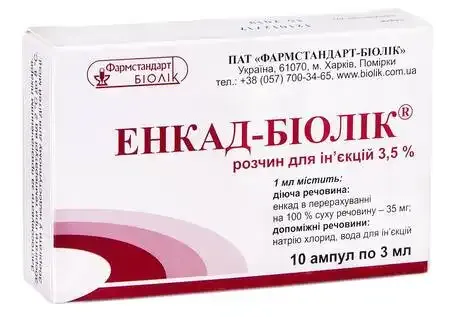
ENCAD
UkraineThe drug is used for hereditary retinal diseases (tapetoretinal degeneration), Sjögren's disease, degenerative diseases of the neuromuscular system, hereditary forms of myopathy, amyotrophy, as well as as a consequence of neuroinfections.
Frequently asked questions
How to take Encad correctly?
An intradermal test must be performed before the first use. The drug is administered intramuscularly, subconjunctivally, by phonophoresis, or locally (applications). Dosage and duration of the course depend on the specific disease and the patient's age. For example, for retinal diseases, adults are administered 5–6 ml of the solution daily for 15 days.
Who should not use this drug?
Contraindications include hypersensitivity to the components, acute inflammatory or viral processes, neoplasms, cardiovascular diseases in the decompensated stage, renal or hepatic dysfunction, urolithiasis, and exacerbation of allergies. It is not recommended for the elderly; the drug is contraindicated for pregnant and breastfeeding women.
What are the possible side effects of Encad?
Possible allergic reactions, skin rash, shortness of breath, joint pain, increased temperature, and enlargement or tenderness of lymph nodes. When administered into the eye, edema and conjunctival redness may occur, as well as temporary blurred vision.
Can I drive a car during treatment?
If the drug is administered into the eye, temporary blurred vision or other disturbances may occur. In such cases, you must wait for full vision recovery before driving or operating machinery.
Can the drug be combined with other medicines?
Interactions with other agents have not been established; however, the drug can be used alongside antihistamines and corticosteroids.
Can the drug be prescribed to children?
The drug can be used in children of a certain age depending on the diagnosis (for example, from 3 years of age for certain diseases), but it must not be used in children under 3 years of age.
Instructions for use
INSTRUCTIONS FOR MEDICAL USE OF THE MEDICINAL PRODUCT ENCAD® (ENCAD)
Composition:
active substance: encad;
1 ml of solution contains encad (calculated as 100% dry substance) – 35 mg;
excipients: sodium chloride, water for injections.
Pharmaceutical form. Injection solution.
Main physicochemical properties: clear, light yellow liquid.
Pharmacotherapeutic group. Agents affecting the digestive system and metabolism.
ATC code A16AX.
Pharmacological Properties
Pharmacodynamics
The medicinal product regulates nucleotide metabolism in tissues, has immunomodulatory properties, improves cellular membrane functions, muscle bioenergetics, reduces myodystrophic processes, and facilitates impulse conduction along motor nerves.
Pharmacokinetics
Not described.
Clinical characteristics.
Indications.
Hereditary diseases of the retina – tapetoretinal degeneration (retinal abiotrophies), Sjögren's disease, degenerative diseases of the neuromuscular system, hereditary forms of myopathies (early stages), congenital and acquired myopathic syndrome, various forms of neural amyotrophies, consequences of neuroinfections, spinal amyotrophies.
Contraindications.
Hypersensitivity to any component of the drug. Acute inflammatory processes and viral etiology diseases, neoplasms, cardiovascular diseases in decompensation stage, renal and hepatic dysfunction, urolithiasis, allergic diseases in exacerbation phase. Not recommended for elderly individuals. Use of ENCAD® by phonophoresis is also contraindicated in cases of ocular hypotension, retinal detachment, and other conditions where ultrasound treatment is contraindicated.
Interaction with other medicinal products and other types of interactions.
Not established. The drug may be used concurrently with antihistamines and corticosteroids.
Special precautions for use.
An intradermal test must be performed before administering the drug. Treatment should only be initiated if the test result is negative.
This medicinal product contains less than 1 mmol (23 mg) of sodium per dose, i.e. it is practically sodium-free.
Use during pregnancy or breastfeeding. Contraindicated.
Ability to affect reaction speed when driving or operating machinery.
Subconjunctival administration of the drug may cause temporary blurred vision or other visual disturbances. If these effects occur, patients should wait until vision is restored before driving or operating machinery.
Administration and Dosage
ENKAD® is administered intramuscularly, subconjunctivally, via phonophoresis, or applied topically. Prior to administration, a skin sensitivity test must be performed: administer 3.5 mg (0.1 ml of a 3.5% solution) of ENKAD® intradermally on the inner surface of the forearm. The test is considered positive if a papule with a diameter of 1 cm appears within 24 hours after administration. Treatment should only be initiated if the test result is negative.
In tapetoretinal degenerations, ENKAD® should be administered intramuscularly to adults daily at a dose of 5–6 ml of a 3.5% solution (175–210 mg daily). For children aged 3 to 7 years, administer 10 mg per year of life daily; for children aged 7 years and older, administer 3 ml of a 3.5% solution (105 mg daily). Divide the daily dose into two administrations with an interval of 5–6 hours. The treatment course lasts 15 days. Repeat courses every 6–8–10 months, but no less than once a year. Concurrently with intramuscular administration, subconjunctival injections of 10.5 mg of the drug daily (0.3 ml of a 3.5% solution) may be administered for 10–15 days.
In degenerative disorders of the neuromuscular system, ENKAD® should be administered at a dose of 2–3 ml of a 3.5% solution (70–105 mg) daily or on alternate days for 12–15 days. The maximum single dose is 5 ml of a 3.5% solution (175 mg). The treatment course should be repeated twice a year.
Administration of the drug (0.5% solution) via phonophoresis should be performed using the standard bath method. Ultrasound intensity: 0.2 W/cm², frequency: 880 kHz, continuous mode, procedure duration: 5 minutes. Prepare the solution immediately before the procedure by diluting the contents of a 3.5% solution ampoule in 18 ml of 0.9% sodium chloride injection solution. The prepared phonophoresis solution should be stored for no more than 10 days. The treatment course consists of 10–12 daily procedures, administered twice a year.
In Sjögren's disease, ENKAD® should be applied topically as applications for 20 minutes using 5 ml of a 1% solution (50 mg) on the oral mucosa. To prepare the 1% solution, dilute the 3.5% ENKAD® solution 3.5-fold with 0.9% sodium chloride injection solution. Apply the applications three times daily after meals. The treatment course lasts 14 days. Conduct 3–4 treatment courses per year.
Children
ENKAD® should not be used in children under 3 years of age.
Overdose
Exaggerated adverse effects. Treatment is symptomatic.
Adverse Reactions
When using the medicinal product ENCAD®, symptoms of individual intolerance are possible.
Eye disorders: with subconjunctival administration – edema and hyperemia of the conjunctiva, which are resolved by instillation of corticosteroids.
Immune system disorders: allergic reactions.
Blood and lymphatic system disorders: enlargement and tenderness of parotid and cervical lymph nodes (further treatment should be carried out with antihistamine agents).
Skin and subcutaneous tissue disorders: rash, hyperemia, requiring discontinuation of the drug.
Respiratory, thoracic and mediastinal disorders: dyspnea.
Musculoskeletal and connective tissue disorders: joint pain.
General disorders and administration site conditions: increased body temperature.
Shelf life. 2 years.
Storage conditions.
Store at a temperature of 2 °C to 8 °C. Keep out of the reach of children.
Packaging. 3 ml in a vial; 10 vials per pack, or 5 vials in a blister, 2 blisters per pack.
Prescription status. Prescription only.
Manufacturer.
LLC "BIOLIK FARMACEUTICAL".
Manufacturer's address and location of activity.
Legal entity address:
70 Pomirky St., Kharkiv, Kharkiv region, 61070, Ukraine.
Place of business address:
Pomirky-70, Kharkiv, Kharkiv region, building b/n, 61070, Ukraine.
Similar drugs
| Brand name | Dosage form | Active substance / Dosage | Manufacturer |
|---|---|---|---|
| ALOE EXTRACT LIQUID | solution for injection |
|
JSC "Lubnipharm" |
| ALOE EXTRACT LIQUID-DARNITSA | solution for injection |
|
PJSC «Pharmaceutical Company «Darnitsa» |
| DALARGIN-PHARMSYNTEZ | solution for injection |
|
PJSC «Lekhim - Kharkiv» |
| ERBISOL® EXTRA | solution for injection | LLC "Erbis Laboratory" | |
| LARGINID | solution for injection |
|
Biolik Pharma LLC |
The original data is available in the language of the country of manufacture.
Data source: State Register of Medicinal Products of Ukraine
Data last verified: August 13, 2026