EMEND
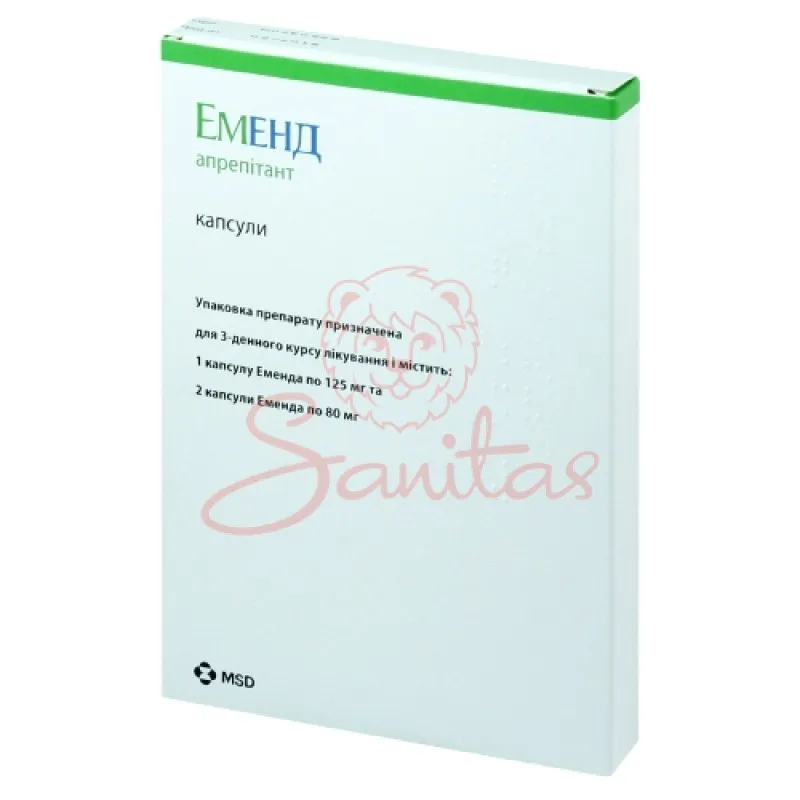
UkraineThe drug is used for the prevention of nausea and vomiting in adults undergoing anticancer chemotherapy (for both high and moderate risk of such symptoms).
Frequently asked questions
How should Emend be taken correctly?
Capsules should be swallowed whole and may be taken with or without food. Typically, the drug is taken for 3 days as part of combination therapy: 125 mg one hour before chemotherapy on the first day, and 80 mg in the morning on the second and third days.
Who should not take this drug?
Emend should not be used by people with hypersensitivity to any of its components. The drug is also not recommended for use in children and adolescents under 18 years of age.
What are the possible side effects of Emend?
Patients most commonly complain of hiccups, increased ALT levels, dyspepsia (indigestion), constipation, headache, and decreased appetite. Increased fatigue may also frequently occur.
Can the drug be taken with other medicines?
Emend must not be taken simultaneously with pimozide, terfenadine, astemizole, or cisapride. Caution should be exercised when used in combination with certain other drugs (e.g., cyclosporine, fentanyl, or warfarin) and herbal products containing St. John's wort.
How does the drug affect contraception?
The effectiveness of hormonal contraceptives may be reduced during treatment and for 28 days after. During treatment and for 2 months after the last dose, the use of additional non-hormonal contraceptive methods is recommended.
Can the drug be taken during pregnancy or breastfeeding?
The drug should not be used during pregnancy, except in cases of clear necessity. Breastfeeding is not recommended during treatment.
Instructions for use
INSTRUCTIONS FOR MEDICAL USE OF THE MEDICINAL PRODUCT EMEND® (EMEND®)
Composition:
Active substance: aprepitant;
1 capsule contains 80 mg or 125 mg of aprepitant;
Excipients: sucrose, microcrystalline cellulose, hydroxypropylcellulose, sodium lauryl sulfate.
Capsule shell – gelatin, titanium dioxide (E 171).
Capsule shell of the 125 mg capsule also contains iron oxide red (E 172) and iron oxide yellow (E 172).
Pharmaceutical form. Capsules.
Main physicochemical characteristics:
80 mg capsules: white, opaque, hard gelatin capsule with «461» and «80 mg» printed radially in black ink;
125 mg capsules: opaque, hard gelatin capsule with white body and pink cap, with «462» and «125 mg» printed radially in black ink.
Pharmacotherapeutic group. Drugs affecting the digestive system and metabolism. Antiemetic agents and drugs for relief of nausea. Other antiemetics.
ATC code A04AD12.
Pharmacological Properties
Pharmacodynamics
Aprepitant is a highly selective antagonist of neurokinin 1 (NK1) receptors, with high affinity for substance P (a P-neuropeptide of the tachykinin family) in humans. Additional screening studies demonstrated that aprepitant was at least 3000 times more selective for NK1 receptors than for other enzymes, ion channel transporters, and receptor sites, including dopamine and serotonin receptors, which are targets for therapy of chemotherapy-induced nausea and vomiting.
NK1 receptor antagonists inhibit the vomiting reflex mediated by the central nervous system in response to cytotoxic chemotherapeutic agents such as cisplatin. In preclinical and human positron emission tomography (PET) studies using aprepitant, it was shown that the drug penetrates the brain and binds to brain NK1 receptors. The effect of aprepitant on the central nervous system is sufficiently prolonged, suppressing both the acute and delayed phases of cisplatin-induced vomiting, and enhancing the antiemetic activity of the 5HT3 receptor antagonist ondansetron and the corticosteroid dexamethasone against cisplatin-induced vomiting.
Pharmacokinetics
Absorption. The mean absolute oral bioavailability of aprepitant is 67% for the 80 mg capsule and 59% for the 125 mg capsule. The mean maximum plasma concentration (Cmax) of aprepitant is reached approximately 4 hours (tmax) after administration. Administration of the capsule with a standard breakfast containing approximately 800 kcal results in a 40% increase in the AUC of aprepitant. This increase is considered not clinically significant.
The pharmacokinetics of aprepitant within the clinical dose range are nonlinear. In healthy young adults, the increase in AUC0–∞ was 26% greater than proportional to dose following single 80 mg and 125 mg doses administered with food.
After oral administration of a single 125 mg dose of Emend® on Day 1 and 80 mg once daily on Days 2 and 3, the AUC0–24h (mean ± SD) was 19.6 ± 2.5 μg × h/mL and 21.2 ± 6.3 μg × h/mL on Days 1 and 3, respectively. Cmax was 1.6 ± 0.36 μg/mL and 1.4 ± 0.22 μ/μg/mL on Days 1 and 3, respectively.
Distribution. Aprepitant is highly bound (approximately 97%) to plasma proteins. The mean geometric value of the steady-state volume of distribution (Vdss) in humans is approximately 66 L.
Metabolism. Aprepitant undergoes extensive metabolism. In healthy young volunteers, aprepitant accounted for about 19% of radioactivity in plasma over 72 hours following a single 100 mg intravenous dose of [14C]-fosaprepitant (a prodrug of aprepitant), indicating the presence of metabolites in plasma. Twelve metabolites of aprepitant have been identified in human plasma. Metabolism of aprepitant occurs primarily via oxidation in the morpholine ring and its side chains, and the resulting metabolites exhibited only weak activity. In vitro studies using human liver microsomes showed that aprepitant is metabolized predominantly by CYP3A4, with minor potential contributions from CYP1A2 and CYP2C19.
Elimination. Aprepitant is not excreted unchanged in urine. Metabolites are excreted in urine and via bile into feces. After a single 100 mg intravenous dose of [14C]-fosaprepitant administered to healthy volunteers, 57% of radioactivity was recovered in urine and 45% in feces.
Plasma clearance of aprepitant is dose-dependent, decreasing with increasing dose, and ranges from approximately 60 to 72 mL/min within the therapeutic dose range. The terminal half-life ranges from approximately 9 to 13 hours.
Pharmacokinetics in Special Populations
Elderly. Following oral administration of aprepitant at a single 125 mg dose on Day 1 and 80 mg once daily from Day 2 to Day 5, the AUC0–24h of aprepitant was 21% higher on Day 1 and 36% higher on Day 5 in elderly patients (≥65 years) compared to younger adults. Cmax was 10% higher on Day 1 and 24% higher on Day 5 in elderly patients compared to younger adults. These differences are not considered clinically significant. No dose adjustment of Emend® is required for elderly patients.
Gender. Following oral administration of Emend® at a single 125 mg dose, the Cmax of aprepitant is 16% higher in women than in men. The elimination half-life of aprepitant is 25% shorter in women than in men, while Tmax is reached in approximately the same time. These differences are not considered clinically significant. No dose adjustment of Emend® is required based on patient gender.
Hepatic Impairment. Mild hepatic impairment (Child-Pugh Class A) does not have a clinically significant effect on the pharmacokinetics of aprepitant; dose adjustment is not required for these patients. Available data do not allow conclusions to be drawn regarding the effect of moderate hepatic impairment (Child-Pugh Class B) on aprepitant pharmacokinetics. There are no clinical or pharmacokinetic data available for patients with severe hepatic impairment (Child-Pugh Class C).
Renal Impairment. Aprepitant at a single 240 mg dose was administered to patients with severe renal impairment (creatinine clearance < 30 mL/min) and to patients with end-stage renal disease requiring hemodialysis.
In patients with severe renal impairment, the AUС0–∞ of total aprepitant (unbound and protein-bound) decreased by 21% and Cmax decreased by 32% compared to healthy volunteers. In patients with end-stage renal disease undergoing hemodialysis, AUС0–∞ of total aprepitant decreased by 42% and Cmax decreased by 32%. Due to the slight reduction in plasma protein binding of aprepitant associated with renal disease, the AUC of pharmacologically active unbound aprepitant did not change significantly in patients with renal impairment compared to healthy volunteers. Hemodialysis performed 4 or 48 hours after drug administration had no substantial effect on aprepitant pharmacokinetics; less than 0.2% of the dose was recovered in the dialysate.
No dose adjustment of Emend® is required for patients with renal impairment or for patients with end-stage renal disease undergoing hemodialysis.
Concentration-Effect Relationship
PET studies using a highly specific NK1 receptor tracer in healthy young men demonstrated that aprepitant penetrates the brain and occupies NK1 receptors in a dose-dependent and plasma concentration-dependent manner. Plasma concentrations of aprepitant achieved with the three-day dosing regimen provide 95% occupancy of brain NK1 receptors.
Clinical characteristics.
Indications.
In combination therapy:
- prevention of acute and delayed nausea and vomiting associated with highly emetogenic cancer chemotherapy based on cisplatin in adults;
- prevention of nausea and vomiting associated with moderately emetogenic cancer chemotherapy in adults.
Contraindications.
Emend® is contraindicated in patients with hypersensitivity to any component of the drug.
Emend® should not be used concomitantly with pimozide, terfenadine, astemizole, or cisapride.
Interaction with other medicinal products and other forms of interaction.
Aprepitant (125 mg/80 mg) is a substrate, moderate inhibitor, and inducer of CYP3A4. In addition, aprepitant is an inducer of CYP2C9. During treatment with Emend®, CYP3A4 activity is inhibited. After completion of Emend® treatment, mild transient induction of CYP2C9, CYP3A4, and glucuronidation occurs. Aprepitant is unlikely to interact with the P-glycoprotein transporter, as confirmed by the absence of interaction between aprepitant and digoxin.
Effect of aprepitant on the pharmacokinetics of other active substances.
Inhibition of CYP3A4 activity
As a moderate inhibitor of CYP3A4, aprepitant (125 mg/80 mg) may increase plasma concentrations of active substances metabolized via CYP3A4 when used concomitantly. The overall exposure to orally administered CYP3A4 substrates may increase approximately 3-fold during the 3-day treatment with Emend®; the effect of aprepitant on plasma concentrations of intravenously administered CYP3A4 substrates is expected to be less pronounced. Emend® should not be used concomitantly with pimozide, terfenadine, astemizole, or cisapride. Inhibition of CYP3A4 activity by aprepitant may lead to increased plasma concentrations of these active substances, potentially causing serious or life-threatening reactions. Caution is recommended when Emend® is used concomitantly with active substances administered orally and primarily metabolized via CYP3A4 and having a narrow therapeutic range, such as cyclosporine, tacrolimus, sirolimus, everolimus, alfentanil, dihydroergotamine, ergotamine, fentanyl, and quinidine.
Corticosteroids
Dexamethasone. When used concomitantly with Emend® at doses of 125 mg/80 mg, the usual oral dose of dexamethasone should be reduced by approximately 50%. The dexamethasone dose used in clinical studies for prevention of chemotherapy-induced nausea and vomiting (CINV) was selected considering the interaction between active substances. Emend® administered at a dose of 125 mg concomitantly with oral dexamethasone 20 mg on Day 1 and Emend® administered at a dose of 80 mg concomitantly with oral dexamethasone 8 mg on Days 2 to 5 increased the area under the concentration-time curve (AUC) of dexamethasone (a CYP3A4 substrate) by 2.2-fold on Days 1 and 5.
Methylprednisolone. When used concomitantly with Emend® at doses of 125 mg/80 mg, the usual intravenous dose of methylprednisolone should be reduced by approximately 25%, and the usual oral dose of methylprednisolone should be reduced by approximately 50%. Emend® administered at a dose of 125 mg on Day 1 and 80 mg/day on Days 2 and 3 increased the AUC of methylprednisolone (a CYP3A4 substrate) by 1.3-fold on Day 1 and by 2.5-fold on Day 3 when methylprednisolone was administered intravenously at a dose of 125 mg on Day 1 and orally at a dose of 40 mg on Days 2 and 3.
During prolonged treatment with methylprednisolone, the AUC of methylprednisolone may decrease as early as 2 weeks after initiation of Emend® treatment due to the inducing effect of aprepitant on CYP3A4. This effect is expected to be more pronounced with oral administration of methylprednisolone.
Chemotherapeutic agents
In pharmacokinetic studies, Emend® administered at a dose of 125 mg on Day 1 and 80 mg/day on Days 2 and 3 did not affect the pharmacokinetics of docetaxel administered intravenously on Day 1 or of vinorelbine administered intravenously on Day 1 or Day 8. Since the effect of Emend® on the pharmacokinetics of oral CYP3A4 substrates is more pronounced than on intravenous CYP3A4 substrates, interaction with orally administered chemotherapeutic agents metabolized primarily or partially by CYP3A4 (e.g., etoposide, vinorelbine) cannot be excluded. Caution and additional monitoring are recommended in patients receiving agents metabolized primarily or partially by CYP3A4. In the post-marketing period, cases of neurotoxicity (a potential adverse reaction of ifosfamide) have been reported with concomitant use of aprepitant and ifosfamide.
Immunosuppressants
During a 3-day CINV treatment course, a temporary moderate increase followed by a slight decrease in exposure to immunosuppressants metabolized by CYP3A4 (e.g., cyclosporine, tacrolimus, everolimus, and sirolimus) is expected. Given the short 3-day treatment course and limited time-dependent changes in exposure, dose reduction of immunosuppressants during concomitant 3-day use with Emend® is not recommended.
Midazolam
Potential effects of increased plasma concentrations of midazolam or other benzodiazepines metabolized by CYP3A4 (e.g., alprazolam, triazolam) should be considered when these agents are used concomitantly with Emend® (125 mg/80 mg).
Emend® increased the AUC of midazolam, a sensitive CYP3A4 substrate, by 2.3-fold on Day 1 and by 3.3-fold on Day 5 when a single oral dose of midazolam 2 mg was administered on Days 1 and 5 during a treatment course with Emend® 125 mg on Day 1 and 80 mg/day on Days 2 to 5.
In another study with intravenous midazolam, Emend® was administered at a dose of 125 mg on Day 1 and 80 mg/day on Days 2 and 3, and midazolam was administered intravenously at a dose of 2 mg before the 3-day Emend® treatment course and on Days 4, 8, and 15. Emend® increased the AUC of midazolam by 25% on Day 4 and decreased the AUC by 19% on Day 8 and by 4% on Day 15. These effects were considered not clinically significant.
In a third study with intravenous and oral midazolam, Emend® was administered at a dose of 125 mg on Day 1 and 80 mg/day on Days 2 and 3, together with ondansetron 32 mg on Day 1, dexamethasone 12 mg on Day 1, and 8 mg/day on Days 2–4. This combination (i.e., Emend®, ondansetron, and dexamethasone) decreased the AUC of midazolam by 16% on Day 6, 9% on Day 8, 7% on Day 15, and 17% on Day 22. These effects were considered not clinically significant.
An additional study with intravenous midazolam and Emend® was conducted. Midazolam was administered intravenously at a dose of 2 mg one hour after a single oral dose of Emend® 125 mg. The plasma AUC of midazolam increased by 1.5-fold. This effect was considered not clinically significant.
Induction
As a weak inducer of CYP2C9, CYP3A4, and glucuronidation, aprepitant may reduce plasma concentrations of substrates eliminated via these pathways for up to 2 weeks after initiation of treatment. This effect may manifest only after completion of Emend® treatment. For CYP2C9 and CYP3A4 substrates, induction is transient, reaching maximum effect 3–5 days after the end of the 3-day Emend® treatment. This effect persists for several days, then gradually diminishes and is not clinically significant two weeks after completion of Emend® treatment. Weak induction of glucuronidation is also observed after oral administration of 80 mg aprepitant for 7 days. Information on the effect on CYP2C8 and CYP2C19 is lacking. Caution is recommended when using warfarin, acenocoumarol, tolbutamide, phenytoin, or other active substances metabolized by CYP2C9 during this period.
Warfarin. In patients receiving long-term warfarin therapy, close monitoring of prothrombin time (INR) is recommended during treatment with Emend® and for 2 weeks after each 3-day course of Emend® used for prevention of chemotherapy-induced nausea and vomiting. In healthy volunteers stabilized on chronic warfarin therapy, administration of a single dose of 125 mg Emend® on Day 1 and 80 mg/day on Days 2 and 3 did not affect plasma AUC of R(+) or S(-) warfarin measured on Day 3; however, a 34% decrease in the minimum concentration of S(-) warfarin (a CYP2C9 substrate) was observed, accompanied by a 14% decrease in INR 5 days after completion of Emend® treatment.
Tolbutamide. Emend® administered at a dose of 125 mg on Day 1 and 80 mg/day on Days 2 and 3 reduced the AUC of tolbutamide (a CYP2C9 substrate) by 23% on Day 4, 28% on Day 8, and 15% on Day 15 after administration of a single oral dose of tolbutamide 500 mg before the 3-day Emend® course and on Days 4, 8, and 15.
Hormonal contraceptives
During and for 28 days after administration of Emend®, the effectiveness of hormonal contraceptives may be reduced. Alternative or additional contraceptive methods should be used during treatment with Emend® and for 2 months after the last dose of Emend®. In a clinical study, single doses of oral contraceptives containing ethinylestradiol and norethindrone were administered from Day 1 to Day 21, with Emend® administered at 125 mg on Day 8 and 80 mg/day on Days 9 and 10, together with intravenous ondansetron 32 mg on Day 8 and oral dexamethasone 12 mg on Day 8 and 8 mg/day on Days 9, 10, and 11. From Day 9 to Day 21 of this study, minimum concentrations of ethinylestradiol decreased by up to 64%, and minimum concentrations of norethindrone decreased by up to 60%.
5-HT3 antagonists. In clinical interaction studies, aprepitant did not show clinically significant effects on the pharmacokinetics of ondansetron, granisetron, or hydrodolasetron (active metabolite of dolasetron).
Effect of other drugs on the pharmacokinetics of aprepitant.
Emend® should be used with caution concomitantly with active substances that inhibit CYP3A4 activity (e.g., ketoconazole, itraconazole, voriconazole, posaconazole, clarithromycin, telithromycin, nefazodone, and protease inhibitors), as such combinations are expected to increase plasma concentrations of aprepitant.
Concomitant use of Emend® with active substances that strongly induce CYP3A4 activity (e.g., rifampicin, phenytoin, carbamazepine, phenobarbital) should be avoided, as such combinations lead to reduced plasma concentrations of aprepitant, potentially resulting in reduced efficacy of Emend®. Concomitant use of Emend® with herbal products containing St. John's wort (Hypericum perforatum) is not recommended.
Ketoconazole.
When a single dose of aprepitant 125 mg was administered on Day 5 of a 10-day treatment with ketoconazole (a potent CYP3A4 inhibitor) at a dose of 400 mg/day, the AUC of aprepitant increased approximately 5-fold, and the mean terminal half-life of aprepitant increased approximately 3-fold.
Rifampicin.
When a single dose of aprepitant 375 mg was administered on Day 9 of a 14-day treatment with rifampicin (a potent CYP3A4 inducer) at a dose of 600 mg/day, the AUC of aprepitant decreased by 91%, and the mean terminal half-life decreased by 68%.
Diltiazem.
In patients with moderate hypertension, administration of aprepitant 230 mg once daily concomitantly with diltiazem 120 mg three times daily for 5 days increased the AUC of aprepitant by 2-fold and simultaneously increased the AUC of diltiazem by 1.7-fold. This pharmacokinetic effect did not affect ECG, heart rate, or blood pressure, except for changes caused by diltiazem alone.
Paroxetine.
Concomitant administration of aprepitant 85 mg or 170 mg with paroxetine 20 mg once daily reduced the AUC of both aprepitant and paroxetine by approximately 25% and Cmax by approximately 20%.
Special precautions for use
Patients with moderate to severe hepatic impairment. Data are limited in patients with moderate hepatic impairment; there are no data in patients with severe hepatic impairment. Emend® should be used with caution in such patients.
Interactions mediated by CYP3A4.
Emend® should be used with caution in patients who are concurrently taking medicinal products that are predominantly metabolized by the CYP3A4 system and have a narrow therapeutic index, such as cyclosporine, tacrolimus, sirolimus, everolimus, alfentanil, dihydroergotamine, ergotamine, fentanyl, and quinidine (see section "Interaction with other medicinal products and other forms of interaction"). In addition, particular caution is advised when co-administering with irinotecan, as this combination may lead to increased toxicity.
Concomitant administration of Emend® with ergot alkaloid derivatives, which are CYP3A4 substrates, may increase plasma concentrations of these active substances. Therefore, caution is recommended due to the potential risk of ergot-related toxic effects.
Concomitant use of Emend® with medicinal substances that strongly induce CYP3A4 activity (e.g., rifampicin, phenytoin, carbamazepine, phenobarbital) should be avoided, as such combinations lead to reduced plasma concentrations of aprepitant (see section "Interaction with other medicinal products and other forms of interaction"). Concomitant use of Emend® with herbal preparations containing St. John's wort (Hypericum perforatum) is not recommended.
Emend® should be used with caution when administered concomitantly with active substances that inhibit CYP3A4 activity (e.g., ketoconazole, itraconazole, voriconazole, posaconazole, clarithromycin, telithromycin, nefazodone, and protease inhibitors), as such combinations are expected to increase plasma concentrations of aprepitant (see section "Interaction with other medicinal products and other forms of interaction").
Concomitant use with warfarin (CYP2C9 substrate). Combined use of Emend® with warfarin leads to a reduction in prothrombin time, expressed as the international normalized ratio (INR). In patients receiving chronic warfarin therapy, close monitoring of INR is recommended during treatment with Emend® and for 2 weeks after each 3-day course of Emend® used for the prevention of chemotherapy-induced nausea and vomiting (see section "Interaction with other medicinal products and other forms of interaction").
Concomitant use with hormonal contraceptives. The effectiveness of hormonal contraceptives may be reduced during and for 28 days after administration of Emend®. Alternative additional non-hormonal contraceptive methods should be used during treatment with Emend® and for 2 months after the last dose of Emend® (see section "Interaction with other medicinal products and other forms of interaction").
Excipients. Emend® contains sucrose. Therefore, patients with rare hereditary problems of fructose intolerance, glucose-galactose malabsorption, or sucrase-isomaltase deficiency should not take this medicinal product.
Sodium.
This medicinal product contains less than 1 mmol sodium (23 mg) per capsule, i.e., essentially "sodium-free".
Use during pregnancy or breastfeeding.
Contraception in men and women. The effectiveness of hormonal contraceptives may be reduced during and for 28 days after administration of Emend®. Alternative additional non-hormonal contraceptive methods should be used during treatment with Emend® and for 2 months after the last dose of Emend®.
Pregnancy. There are no clinical data on the use of aprepitant during pregnancy. The potential for reproductive toxicity of aprepitant has not been fully established, as exposure levels exceeding therapeutic exposure in humans at a dose of 125 mg/80 mg cannot be achieved in animal studies. These studies did not show any direct or indirect harmful effects on pregnancy, embryonic/fetal development, parturition, or postnatal development. The potential impact of neurokinin regulation on reproductive function is unknown. Emend® should not be used during pregnancy except in cases of clear necessity.
Breastfeeding. Aprepitant passes into the milk of lactating rats. It is unknown whether the drug passes into human breast milk; therefore, breastfeeding is not recommended during treatment with Emend®.
Fertility. The potential effect of aprepitant on fertility has not been fully studied, as exposure levels exceeding human therapeutic exposure cannot be achieved in animal studies. Fertility studies did not demonstrate any direct or indirect adverse effects on mating, fertility, embryonic/fetal development, sperm count, or sperm motility.
Ability to affect reaction speed when driving or operating machinery.
Emend® may have a minor influence on the ability to drive or operate machinery. Dizziness and increased fatigue may occur after administration of the drug.
Dosage and Administration
The capsule should be swallowed whole.
Emend® may be taken with or without food.
Emend® should be administered for 3 days as part of a regimen that includes a corticosteroid and a 5-HT3 antagonist. The recommended dose of Emend® is 125 mg orally (p.o.) one hour before chemotherapy (on Day 1) and 80 mg once daily in the morning on Days 2 and 3.
The following treatment regimens are recommended for the prevention of nausea and vomiting associated with emetogenic anticancer chemotherapy.
Regimen for chemotherapy with high emetogenic risk
| Day 1 |
Day 2 |
Day 3 |
Day 4 |
|
| Emend® |
125 mg p.o. |
80 mg p.o. |
80 mg p.o. |
None |
| Dexamethasone |
12 mg p.o. |
8 mg p.o. |
8 mg p.o. |
8 mg p.o. |
| 5-HT3 antagonist |
standard dose of 5-HT3 antagonist (refer to the instructions for the selected 5-HT3 antagonist for the appropriate dose) |
None |
None |
None |
Dexamethasone should be administered 30 minutes before chemotherapy on day 1 and in the morning on days 2 to 4. The dose of dexamethasone was selected considering drug interactions.
Regimen for chemotherapy with moderate emetogenic risk
| Day 1 |
Day 2 |
Day 3 |
|
| Emend® |
125 mg p.o. |
80 mg p.o. |
80 mg p.o. |
| Dexamethasone |
12 mg p.o. |
None |
None |
| 5-HT3 antagonist |
standard dose of 5-HT3 antagonist (refer to the instructions for the selected 5-HT3 antagonist for the appropriate dose) |
None |
None |
Dexamethasone should be administered 30 minutes prior to chemotherapy on Day 1. The dose of dexamethasone was selected considering drug interactions.
Limited data are available on the efficacy of combinations with other corticosteroids and 5-HT3 antagonists. For additional information on concomitant use with corticosteroids, see section “Interaction with other medicinal products and other forms of interaction”. The prescribing information for the concomitantly used 5-HT3 antagonist should be consulted.
Special patient populations.
Elderly patients (≥65 years of age). No dose adjustment is required for elderly patients.
Gender. No dose adjustment is required based on gender.
Patients with renal impairment. No dose adjustment is required for patients with renal impairment or for patients with end-stage renal disease undergoing hemodialysis.
Patients with hepatic impairment. No dose adjustment is required for patients with mild hepatic impairment. Limited data are available in patients with moderate hepatic impairment, and no information is available in patients with severe hepatic impairment. Aprepitant should be used with caution in these patients.
Children.
The safety and efficacy of Emend® in children and adolescents (under 18 years of age) have not been established. Due to lack of data, the drug is not recommended for use in these patients.
Overdose.
In case of overdose, Emend® should be discontinued and general supportive treatment initiated, along with appropriate monitoring. Because of the antiemetic activity of aprepitant, emetic agents will be ineffective. Aprepitant is not removed by hemodialysis.
Adverse Reactions
In patients treated with aprepitant during chemotherapy with a high risk of emetogenicity, the most common adverse reactions attributed to the drug were hiccups (4.6%), increased ALT levels (2.8%), dyspepsia (2.6%), constipation (2.4%), headache (2.0%), and decreased appetite (2.0%). The most common adverse reaction reported during aprepitant therapy in patients receiving chemotherapy with a moderate risk of emetogenicity was fatigue (1.4%).
The adverse reactions listed below were observed in the combined analysis of studies involving chemotherapy with high or moderate emetogenic potential at a higher frequency in patients receiving aprepitant compared to those receiving standard therapy, as well as during post-marketing use.
Frequency is defined as: very common (≥ 1/10); common (≥ 1/100 to < 1/10); uncommon (≥ 1/1000 to < 1/100); rare (≥ 1/10,000 to < 1/1000); very rare (< 1/10,000); unknown (frequency cannot be estimated from available data).
| System organ class |
Adverse reaction |
Frequency |
| Infections and infestations |
candidiasis, staphylococcal infection |
uncommon |
| Blood and lymphatic system disorders |
febrile neutropenia, anemia |
uncommon |
| Immune system disorders |
hypersensitivity reactions, including anaphylactic reactions. |
unknown |
| Metabolism and nutrition disorders |
decreased appetite polydipsia |
common uncommon |
| Psychiatric disorders |
anxiety confusion, euphoric mood |
uncommon uncommon |
| Nervous system disorders |
headache dizziness, somnolence cognitive disorders, lethargy, dysgeusia |
common uncommon uncommon |
| Eye disorders |
conjunctivitis |
uncommon |
| Ear and labyrinth disorders |
tinnitus |
uncommon |
| Cardiac disorders |
palpitations bradycardia; cardiovascular disorders |
uncommon uncommon |
| Vascular disorders |
flushing |
uncommon |
| Respiratory, thoracic and mediastinal disorders |
hiccups oropharyngeal pain, sneezing, cough, postnasal drip, laryngeal irritation |
common uncommon |
| Gastrointestinal disorders |
constipation, dyspepsia eructation, nausea*, vomiting*, gastroesophageal reflux disease, abdominal pain, dry mouth, flatulence duodenal ulcer perforation, stomatitis, abdominal distension, hard stools, neutropenic colitis |
common uncommon uncommon |
| Skin and subcutaneous tissue disorders |
rash, acne photosensitivity reaction, hyperhidrosis, seborrhea, skin lesions, pruritic rash, Stevens-Johnson syndrome/toxic epidermal necrolysis pruritus, urticaria |
uncommon uncommon unknown |
| Musculoskeletal and connective tissue disorders |
muscle weakness, muscle spasms |
uncommon |
| Renal and urinary disorders |
dysuria polyuria |
uncommon uncommon |
| General disorders and administration site conditions |
increased fatigue asthenia, malaise edema, chest discomfort, gait disturbance |
common uncommon uncommon |
| Investigations |
increased ALT increased AST, increased alkaline phosphatase levels positive urine test for erythrocytes, decreased blood sodium levels, weight loss, decreased neutrophil count, presence of glucose in urine, increased diuresis |
common uncommon uncommon |
*Nausea and vomiting were efficacy parameters during the first 5 days post-chemotherapy and were considered adverse reactions only after this period.
The nature of adverse reactions occurring during multiple cycles (up to 6 cycles) of chemotherapy was similar to that observed in cycle 1.
In an additional active-controlled clinical study in 1169 patients receiving aprepitant and chemotherapy with high emetogenic potential, the adverse reaction profile was generally similar to the profile observed in other studies of high emetogenic potential chemotherapy with aprepitant.
Non-PE-CRH studies
Additional adverse reactions were observed in patients receiving a single 40 mg dose of aprepitant for the treatment of postoperative nausea and vomiting, more frequently than with ondansetron: upper abdominal pain, intestinal hyperactivity, constipation*, dysarthria, dyspnea, hypoesthesia, insomnia, miosis, nausea, sensory disturbances, gastric discomfort, partial intestinal obstruction*, decreased visual acuity, wheezing.
* Reported in patients who received high-dose aprepitant.
Shelf life. 4 years.
Storage conditions.
Store in a dry place at a temperature not exceeding 30 °C in the original packaging.
Keep out of reach of children.
Packaging.
Combination pack of 3 capsules; 1 capsule of 125 mg + 2 capsules of 80 mg in blisters in a cardboard sleeve; 1 cardboard sleeve in a cardboard box.
Prescription status.
By prescription only.
Manufacturer.
Merck Sharp & Dohme B.V., Netherlands.
Manufacturer's address and place of business.
Waarderweg 39, 2031 BN Haarlem, Netherlands.
The original data is available in the language of the country of manufacture.
Data source: State Register of Medicinal Products of Ukraine
Data last verified: August 13, 2026