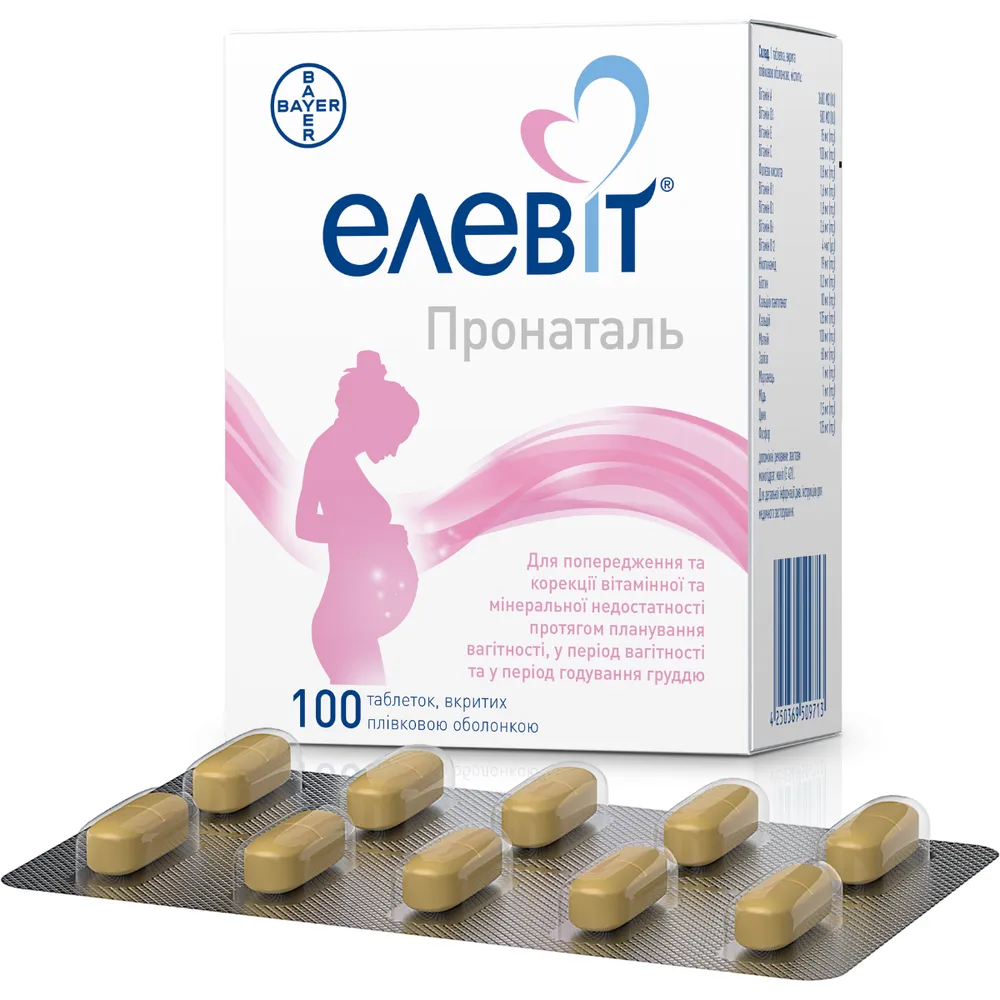
ELEVIT PRONATAL
UkraineThe preparation is intended for the prevention and correction of vitamin and mineral deficiencies during pregnancy planning, during pregnancy, and during breastfeeding. It helps reduce the risk of fetal neural tube defects, prevents anemia, and may reduce nausea in the early stages of pregnancy.
Frequently asked questions
How should Elevit pronatal be taken correctly?
It should be taken as 1 tablet daily in the morning with food, swallowed with a glass of water. The tablet should not be chewed. If nausea occurs in the morning, administration can be moved to the afternoon or evening.
Are there any contraindications for use?
The preparation must not be taken in case of hypersensitivity to its components, excess of vitamins A or D in the body, severe renal impairment, disturbances in iron or copper metabolism, hypercalcemia, sarcoidosis, active pulmonary tuberculosis, or an exacerbation of gastric or duodenal ulcers.
What could be the side effects of Elevit pronatal?
Possible digestive disorders (abdominal pain, constipation, diarrhea, bloating, nausea), allergic reactions (rash, facial edema, itching), headache, dizziness, or insomnia. Discoloration of urine to yellow and stools to dark color is also possible, which is safe.
Can the preparation be taken with other medicines or food?
When taken simultaneously with other drugs (e.g., antacids, antibiotics, or iron preparations), it is recommended to maintain an interval of 2–3 hours. It is not recommended to take the preparation within 2 hours after consuming food containing oxalic or phytic acid (e.g., spinach or whole grains).
Is this safe for the fetus and the child?
When used in the recommended doses, the preparation is considered safe. However, it is important not to exceed the dosage, especially regarding vitamins A and D, as an excess of them can be harmful to the child's development.
Instructions for use
INSTRUCTION FOR MEDICAL USE OF THE MEDICINAL PRODUCT ELEVIT® PRONATAL (ELEVIT® PRONATAL)
Composition:
Active ingredients: 1 film-coated tablet contains:
| Vitamin A |
3600 IU |
| Vitamin B1 |
1.6 mg |
| Vitamin B2 |
1.8 mg |
| Vitamin B6 |
2.6 mg |
| Vitamin B12 |
4 µg |
| Vitamin C (as calcium ascorbate dihydrate) |
100 mg |
| Vitamin D3 |
500 IU |
| Vitamin E |
15 mg |
| Calcium pantothenate |
10 mg |
| Biotin |
0.2 mg |
| Nicotinamide |
19 mg |
| Folic acid |
0.8 mg |
| Calcium (as calcium ascorbate dihydrate, calcium hydrogen phosphate anhydrous, calcium pantothenate) |
125 mg |
| Magnesium (as light magnesium oxide, magnesium hydrogen phosphate trihydrate, magnesium stearate) |
100 mg |
| Phosphorus (as calcium hydrogen phosphate anhydrous, magnesium hydrogen phosphate trihydrate) |
125 mg |
| Iron (as ferrous fumarate) |
60 mg |
| Zinc (as zinc sulfate monohydrate) |
7.5 mg |
| Manganese (as manganese sulfate monohydrate) |
1 mg |
| Copper (as copper sulfate anhydrous) |
1 mg; |
Excipients:
Tablet core: lactose monohydrate, mannitol (E 421), macrogol 400, microcrystalline cellulose, sodium starch glycolate, magnesium stearate, povidone K 90;
Tablet coating: hypromellose, aqueous dispersion of ethylcellulose, macrogol 6000, talc, titanium dioxide (E 171), yellow iron oxide (E 172).
Pharmaceutical form. Film-coated tablets.
Main physicochemical characteristics: greyish-yellow oval film-coated tablets with a score line.
Pharmacotherapeutic group. Multivitamins with other minerals, including combinations.
ATC code A11AA03.
Pharmacological Properties
Pharmacodynamics
Elevit® Pronatal is a multivitamin-mineral preparation containing 12 vitamins in combination with three minerals and four trace elements, specially formulated to provide optimal micronutrient support for both the fetus and the expectant mother.
Vitamins are essential for normal fetal and neonatal development and growth, for metabolism and formation of carbohydrates, energy, lipids, nucleic acids and proteins, as well as for the synthesis of amino acids, collagen and neurotransmitters.
Multivitamin-multimineral preparations are indicated for the prevention and correction of micronutrient deficiencies. Pregnancy and breastfeeding are periods of increased demand for micronutrients, thereby increasing the risk of micronutrient deficiencies for both mother and child. Micronutrient deficiency poses a more serious threat to health, especially during pregnancy, as it may also disrupt normal fetal development in utero.
In evaluating the efficacy and safety of Elevit® Pronatal during the preconception period (one month before conception through the third month of gestation), no neural tube defects were observed compared to six cases in the placebo group. The difference was statistically significant and confirmed in a subsequent pharmacoepidemiological cohort study, in which one case of neural tube defect was observed in the group taking Elevit® Pronatal compared to nine cases in the control group without vitamin supplementation. Furthermore, in both studies, a lower overall rate of major congenital malformations (e.g., urinary tract defects, cardiovascular defects, limb defects, and hypertrophic pyloric stenosis) was observed in the group taking Elevit® Pronatal compared to the placebo group or the control group without vitamin supplementation, respectively. In addition, nausea, vomiting and dizziness were observed twice as infrequently in the group taking Elevit® Pronatal compared to the placebo group.
Erythrocyte folate levels in pregnant women are an indicator of the potential risk of neural tube defects in the fetus. Threshold erythrocyte folate concentrations associated with the lowest risk of neural tube defects are 906 nmol/L.
Supplementation with Elevit® Pronatal is recommended for women planning pregnancy because neural tube defects occur during the first weeks after conception, even before pregnancy can be diagnosed.
Pharmacokinetics
Pharmacokinetic studies of Elevit® Pronatal have not been conducted.
Clinical characteristics.
Indications.
For prevention and correction of vitamin and mineral deficiencies during pre-pregnancy planning, pregnancy, and breastfeeding.
Use of the drug for at least 1 month prior to conception to reduce the risk of neural tube defects and other congenital developmental abnormalities.
For prevention of anemia associated with iron and folic acid deficiency during pregnancy and breastfeeding.
For reduction of nausea and vomiting frequency in early stages of pregnancy.
Contraindications.
Hypersensitivity to any component of the drug, hypervitaminosis A and/or D, concomitant use with products containing vitamin A and/or D, treatment with vitamin A or synthetic isomers isotretinoin and etretinate, or beta-carotene (beta-carotene is considered a source of vitamin A), concomitant intake of retinoids; severe renal impairment, disorders of iron and/or copper metabolism, hypercalcemia, severe hypercalciuria, history of sarcoidosis, active forms of pulmonary tuberculosis, peptic ulcer of the stomach and duodenum in the stage of exacerbation, hypervitaminosis E.
Interaction with other medicinal products and other forms of interaction.
If the drug is used according to recommendations, no specific interactions are expected.
However, when using the medicinal product Elevit® Pronatal together with other drugs, consultation with a physician is recommended.
Cases of interaction of individual components of the drug with other medicinal products have been described:
- absorption of iron may be inhibited when taken concomitantly with antacids, drugs that reduce gastric acidity, fluoroquinolones, bisphosphonates, levodopa, levothyroxine, penicillamine, tetracycline antibiotics, or trientine; if concomitant administration is necessary, these drugs should be taken at an interval of 2–3 hours;
- medicinal products containing calcium, magnesium, copper, or zinc may interact with antacids, antibiotics (tetracyclines and fluoroquinolones), levodopa, bisphosphonates, penicillamine, thyroxine, trientine, digitalis, antiviral drugs, and thiazide diuretics administered orally; patients taking both products should take them at an interval of 2 hours;
- thiazide diuretics may cause calcium retention in the body, thereby increasing the risk of hypercalcemia;
- folic acid enhances phenytoin metabolism; therefore, combination of high doses of folic acid with antiepileptic/anticonvulsant agents such as carbamazepine, phenytoin, primidone, and barbiturates may lead to reduced efficacy;
- vitamin C enhances the action and adverse effects of antimicrobial agents of the sulfonamide group;
- absorption of vitamin E may be impaired by iron and silver preparations.
Interaction with food. Since oxalic acid (found in spinach and rhubarb) and phytic acid (found in whole grains) may inhibit calcium absorption, it is not recommended to take this drug within 2 hours after consuming food containing high levels of oxalic and phytic acids.
Special precautions for use.
Do not exceed recommended doses.
Very high doses of certain components, especially vitamin A, vitamin D, iron, copper, may be harmful to health. If using other vitamins separately or as part of multivitamin preparations or any other medicinal products, consult a physician before starting this medication to avoid potential overdose.
Use with special caution in combination with other products containing vitamin A, synthetic isomers of isotretinoin and etretinate, or beta-carotene, as high doses of these components are considered harmful to the fetus and may cause hypervitaminosis A. Use with caution in combination with other products containing vitamin D, as high daily doses may lead to hypervitaminosis D. Calcium, ascorbic acid, and vitamin D may promote stone formation in predisposed individuals; therefore, vitamin-mineral supplements should be used cautiously in patients with nephrolithiasis or urolithiasis.
This medicinal product should be used with caution under medical supervision in patients with liver disorders, chronic glomerulonephritis, thromboembolism, thyrotoxicosis, decompensated cardiac function, thrombophlebitis, gout, hyperuricemia, erythremia, and erythrocytosis.
This medicinal product contains lactose and mannitol. Lactose-containing preparations should not be used in patients with lactase deficiency, galactosemia, or glucose-galactose malabsorption syndrome. Mannitol may have a mild laxative effect. If a patient has known intolerance to certain sugars, consult a physician before taking this medicinal product.
This medicinal product does not contain iodine. During pregnancy or breastfeeding, adequate iodine intake should be ensured.
Use with caution in patients with peptic ulcer of the stomach or duodenum, cholelithiasis, chronic pancreatitis, diabetes mellitus, and neoplasms.
Use during pregnancy or breastfeeding.
Elevit® Pronatal is intended for use during pregnancy or breastfeeding, but the recommended daily dose should not be exceeded. Consult a physician before use.
One tablet of Elevit® Pronatal contains a dose of vitamin A corresponding to the daily requirement. A controlled clinical study involving more than 2100 women, conducted to evaluate the effect of vitamins on the prevention of neural tube defects, demonstrated that taking Elevit® Pronatal according to recommendations during the first trimester of pregnancy is safe for the fetus. Use during the second and third trimesters of pregnancy was also not associated with risks, and adverse effects on the fetus are unlikely.
Pregnancy.
Vitamin A in doses exceeding 10,000 IU daily administered during the first trimester of pregnancy may have teratogenic effects. Therefore, this product should be taken with special caution in combination with other medicinal products containing vitamin A, synthetic isomers isotretinoin and etretinate, or beta-carotene, as these components are considered harmful to the fetus.
Chronic overdose of vitamin D may be harmful to the fetus.
Overdose of vitamin D should be avoided, as persistent hypercalcemia may lead to delayed physical and mental development, supravalvular and aortic stenosis, and retinopathy in children.
In animal studies, vitamin D overdose during pregnancy has been shown to cause teratogenic effects. There is no evidence that vitamin D at recommended doses causes teratogenic effects in humans.
Breastfeeding.
Chronic overdose of vitamin D may be harmful to the newborn. Vitamins and minerals pass into breast milk. This should be taken into account if the newborn is receiving corresponding supplements.
For women during pregnancy or breastfeeding, the upper safe limit of vitamin D intake has been established at 2000 IU daily. Elevit® Pronatal contains 500 IU of vitamin D per tablet.
Fertility. There are no data on the effect of this medicinal product on fertility.
Ability to affect reaction speed when driving or operating machinery.
No effect on the ability to drive or operate machinery has been observed.
Dosage and Administration
Take 1 tablet of Eleovit® Pronatal per day in the morning with food, swallowing with a glass of water. Do not chew.
In case of morning nausea, it is recommended to take the tablet during the day or in the evening.
The recommended duration of use is starting 1 month before planned pregnancy, throughout pregnancy, or during breastfeeding. This medicinal product is intended for use in women of reproductive age.
Children. There are no data on the use of Eleovit® Pronatal in children.
Overdose.
When used at the recommended doses, the risk of overdose with Eleovit® Pronatal is absent.
Cases of overdose are mostly associated with concomitant use of high doses of monopreparations or multivitamins. Acute or chronic overdose may lead to hypervitaminosis A and D, hypercalcemia, as well as toxic effects of iron and copper.
Symptoms of acute poisoning may include nonspecific signs: sudden onset headache, impaired consciousness, and gastrointestinal disturbances (constipation, diarrhea, nausea, and vomiting). If such symptoms occur, treatment should be discontinued and medical advice should be sought.
Overdose of vitamin C (doses exceeding 15 g) may lead to hemolytic anemia in individuals with glucose-6-phosphate dehydrogenase deficiency.
With prolonged use in high doses, adverse effects may include gastrointestinal mucosal irritation, arrhythmia, paresthesia, hyperuricemia, reduced glucose tolerance, hyperglycemia, transient increases in AST, lactate dehydrogenase, and alkaline phosphatase activity, impaired kidney function, dryness and cracking of the palms and soles, hair loss, and seborrheic eruptions.
Side effects
The product is generally well tolerated. The adverse reactions listed below have been observed during the post-marketing period. Since these reactions were reported voluntarily from a population of unspecified size, it is not always possible to reliably determine their frequency.
Gastrointestinal disorders. Dyspeptic symptoms, including stomach discomfort, gastrointestinal pain and abdominal pain, constipation, diarrhea, bloating, vomiting, nausea.
Immune system disorders. Allergic reactions (including anaphylactic reactions), such as urticaria, facial swelling, dyspnea, asthmatic syndrome, skin flushing, rash, pruritus, vesicles, and shock. If allergic reactions occur, the patient must discontinue treatment and consult a physician.
Metabolism and nutrition disorders. Hypercalciuria, hypercalcemia.
Nervous system disorders. Headache, dizziness, increased excitability, insomnia, somnolence, hyperthermia may occur. If increased excitability occurs during the use of the medicinal product Elevit® Pronatal, it should not be administered in the evening.
Mild yellow discoloration of urine may occur. This effect is harmless and results from the presence of vitamin B2 in the product.
The product contains iron, which may cause dark discoloration of stools. This effect is harmless and has no clinical significance.
In a placebo-controlled clinical study, pregnant women received Elevit® Pronatal at a dose of 1 tablet daily for 6 months. The following adverse reactions were observed: constipation – in 1.8%; diarrhea – in 1.4%; exanthema (skin rash) – in 0.08%. The percentage of subjects experiencing these symptoms in the placebo group was not statistically different.
Shelf life. 2 years. Do not use after the expiry date stated on the packaging.
Storage conditions.
Store in the original packaging at a temperature not exceeding 25 °C.
Keep out of reach of children.
Packaging.
10 or 20 tablets in a blister. 3 or 10 blisters (10 tablets each) or 5 blisters (20 tablets each) in a cardboard box.
Supply category. Over-the-counter.
Manufacturer.
Dragenopharm Apotheker Pueschl GmbH.
Manufacturer's address.
Goellstrasse 1, Tittmoning, Bayern, 84529, Germany.
Similar drugs
| Brand name | Dosage form | Active substance / Dosage | Manufacturer |
|---|---|---|---|
| PIKOVIT | tablets, film-coated |
|
KRKA, d.d., Novo Mesto (responsible for manufacturing 'in bulk', primary packaging, secondary packaging; responsible for batch control) / KRKA, d.d., Novo Mesto (responsible for batch control) / KRKA, d.d., Novo Mesto (responsible for batch control and batch release) |
| UNIVIT | tablets, film-coated |
|
JSC "Kyiv Vitamin Plant" |
The original data is available in the language of the country of manufacture.
Data source: State Register of Medicinal Products of Ukraine
Data last verified: August 13, 2026