DUBAE CORTEX
UkraineThe preparation is used for rinsing the mouth and throat in cases of stomatitis, gingivitis, periodontosis, pharyngitis, tracheitis, and other inflammatory diseases of the oral cavity and throat.
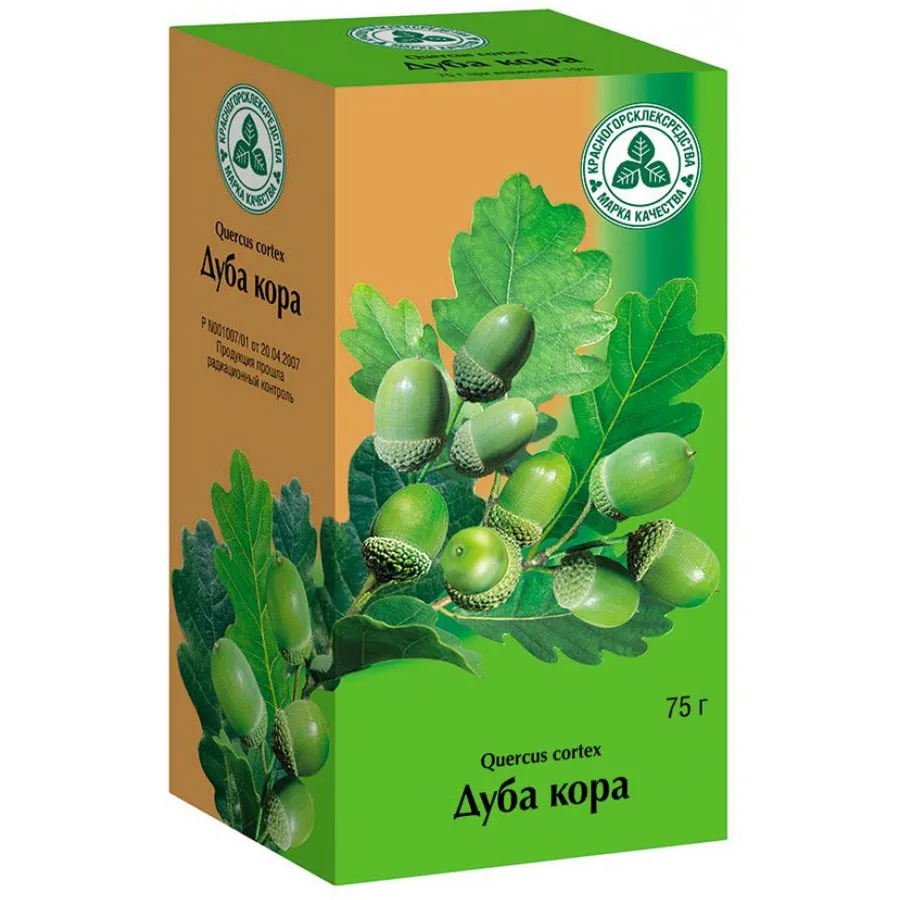
Frequently asked questions
How to correctly prepare the Dubae cortex decoction?
Place 20 g (2 tablespoons) of the bark in an enameled vessel, pour in 200 ml (1 cup) of hot boiled water, cover with a lid, and heat in a water bath for 30 minutes. After this, the decoction must be immediately strained, the remaining bark should be squeezed out, the liquid volume should be topped up with water to 200 ml, and shaken before use.
How and how often should the preparation be used?
The decoction is used for rinsing the mouth and throat 6–8 times a day. The duration of treatment is determined individually depending on the course of the disease and the tolerability of the product.
Can Dubae cortex be used by children?
For children aged 3 years and older, the preparation may only be used as prescribed by a physician.
Who should not take this product?
The preparation is contraindicated in case of individual hypersensitivity to the components contained in the composition.
What are the possible side effects?
Allergic reactions may occur, such as redness (hyperemia), rash, itching, or skin swelling.
Can the preparation be used by pregnant or breastfeeding women?
This can be done as prescribed by a physician, if the benefit to the mother outweighs the potential risk to the child or fetus.
Instructions for use
INSTRUCTION FOR MEDICAL USE OF THE MEDICINAL PRODUCT DUBA KORA (QUERCUS CORTEX)
Composition:
Active substance: oak bark;
One pack contains 100 g of oak bark (Quercus cortex).
Pharmaceutical form. Bark.
Main physico-chemical characteristics: grooved or wrinkled bark pieces no thicker than 3 mm. The outer surface is light grey or greenish-grey, mostly smooth, occasionally with lenticels. The inner surface is pale brown or reddish-brown with slightly prominent longitudinal furrows approximately 0.5 mm to 1 mm wide. The fracture is astringent and fibrous.
Pharmaco-therapeutic group. Agents for local use in dentistry. ATC code A01AD11.
Pharmacological Properties
Pharmacodynamics
Oak bark contains tannins, flavonoids (quercetin), gallic and ellagic acids, phlobaphene, pentosans, pectins, sugars, mucilage, proteins, starch, and mineral substances. This complex of biologically active substances exhibits astringent, anti-inflammatory, and anti-putrefactive properties.
Pharmacokinetics
Not studied.
Clinical characteristics.
Indications.
For topical use as a decoction in cases of stomatitis, gingivitis, periodontitis, pharyngitis, tracheitis, and inflammatory diseases of the oral cavity and throat.
Contraindications.
Individual hypersensitivity to biologically active substances contained in the medicinal product.
Interaction with other medicinal products and other types of interactions.
Not known.
Special precautions for use.
No special safety measures are required when using "Oak bark".
Use during pregnancy or breastfeeding.
Upon prescription by a physician in cases where the benefit to the mother outweighs the potential risk to the fetus/infant.
Ability to affect reaction speed when driving or operating machinery.
Has no effect.
Method of Administration and Dosage
Use as a decoction: place 20 g (2 tablespoons) of the bark into an enameled container, pour 200 ml (1 cup) of hot boiled water over it, cover with a lid and heat on a boiling water bath for 30 minutes, then immediately strain and squeeze the residue into the strained decoction. Adjust the volume of the decoction to 200 ml with boiled water. Use the decoction to rinse the mouth and throat 6–8 times daily.
The decoction should be shaken before use.
The duration of treatment is determined individually, depending on the course of the disease, the stability of the therapeutic effect achieved, and the drug's tolerability.
Children.
This medicinal product may be used in children aged 3 years and older only as prescribed by a physician.
Overdose.
No cases of overdose have been reported.
Side effects.
Allergic reactions (including hyperemia, rash, itching, skin swelling).
Shelf life. 5 years.
Storage conditions.
Store in a dry, dark place at a temperature not exceeding 25 °C.
The prepared decoction should be stored at a temperature between 8 °C and 15 °C for no more than 2 days.
Keep out of reach of children!
Packaging.
100 g per pack with inner pouch.
Classification. Over-the-counter.
Manufacturer/Applicant.
LLC "Ternopharm".
Manufacturer's address and location of business activity / applicant's address.
Ukraine, 46010, Ternopil, Fabrychna St., 4.
Tel./fax: (0352) 521-444, http://www.ternopharm.com.ua.
Similar drugs
| Brand name | Dosage form | Active substance / Dosage | Manufacturer |
|---|---|---|---|
| DUBAE CORTEX | bark |
|
PJSC Pharmaceutical Factory "Viola" |
| DUBAE CORTEX | bark |
|
PJSC "Lektravy" |
| DUBAE CORTEX | bark |
|
JSC "Lubnipharm" |
The original data is available in the language of the country of manufacture.
Data source: State Register of Medicinal Products of Ukraine
Data last verified: August 13, 2026