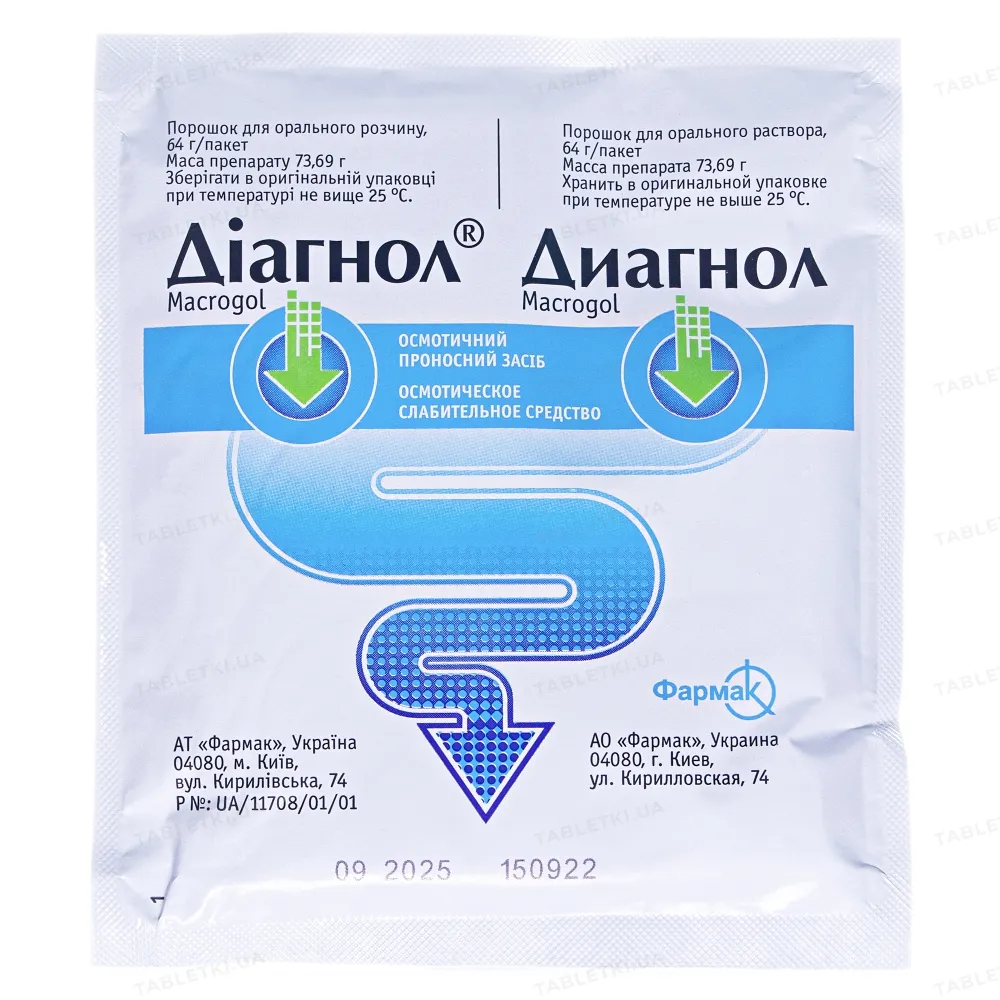
DIAGNOL®
UkraineThe preparation is used for bowel cleansing before surgical interventions, as well as endoscopic and radiological examinations of the intestine.
Frequently asked questions
How to take Diagnol® correctly?
Adults should dissolve the contents of one sachet in 1 liter of water until the powder is completely dissolved. The total amount of solution depends on weight: approximately 1 liter for every 15-20 kg of body weight (usually 3-4 liters). The solution can be taken all at once or divided into two stages (part in the evening, part in the morning before the procedure). It is recommended to consume 250 ml every 10-15 minutes.
What are the possible side effects of Diagnol®?
At the beginning of administration, nausea, vomiting, flatulence, or abdominal bloating may occur. Rarely, allergic reactions may occur: itching, rash, urticaria, angioedema, or anaphylactic shock.
Who should not take this preparation?
Contraindications include hypersensitivity to the components, dehydration, severe heart failure, intestinal obstruction or the threat of its development, intestinal perforation, abdominal pain of unknown origin, as well as severe intestinal diseases (e.g., Crohn's disease or colitis).
Can the preparation be taken with other medicines?
Taking other medications during the use of this preparation is undesirable, as they may not be absorbed into the body and will simply pass through the intestine. If the medication is vital, it is advisable to discuss with a doctor the possibility of using it in a different form.
Can the preparation be used in diabetes mellitus?
Yes, since the preparation does not contain sugar, it can be prescribed to people with diabetes mellitus and those who exclude galactose from their diet.
Can the product be used during pregnancy or breastfeeding?
During pregnancy, the preparation should be used only as a last resort due to insufficient experience. During breastfeeding, use is possible if the doctor considers that the benefit to the mother outweighs the risk to the child.
Can this preparation be given to children?
No, the use of the preparation is not recommended for children.
Instructions for use
INSTRUCTIONS FOR MEDICAL USE OF THE MEDICINAL PRODUCT DIALOGNOL® (DIAGNOL)
Composition:
Active substance: macrogol;
1 sachet contains polyethylene glycol 4000 (macrogol 4000) – 64 g;
Excipients: sodium sulfate anhydrous, sodium bicarbonate, sodium chloride, potassium chloride, sodium saccharin.
Pharmaceutical form. Oral powder for solution.
Main physicochemical properties: white or almost white powder.
Pharmacotherapeutic group. Osmotic laxatives. ATC code A06AD15.
Pharmacological properties.
Pharmacodynamics.
By forming hydrogen bonds with water molecules, Diagnol® retains water in the intestine. The water dilutes and increases the intestinal contents throughout its entire length. Subsequently, the drug is completely evacuated from the intestine together with its contents.
Pharmacokinetics.
The drug is not absorbed and not metabolized. It is excreted from the body in unchanged form.
Clinical characteristics.
Indications.
Bowel cleansing for patient preparation prior to:
- endoscopic and radiological examinations of the intestine;
- surgical interventions on the intestine.
Contraindications.
Hypersensitivity to the components of the drug. Dehydration, severe cardiac failure; carcinoma or any other severe intestinal diseases accompanied by mucosal damage (Crohn's disease, ulcerative colitis); intestinal obstruction or risk of developing intestinal obstruction; intestinal perforation or risk of its occurrence. Toxic megacolon, abdominal pain of unknown origin.
Interaction with other medicinal products and other forms of interaction.
It is not advisable to take other medications during administration of this drug, as they may be expelled from the gastrointestinal tract and their absorption may be reduced or completely prevented. If these drugs are medically necessary, oral administration should be avoided; alternative dosage forms or alternative treatments should be considered.
Special precautions for use
Elderly patients are advised to use the medication under medical supervision.
Diagnol**®** does not contain sugar and therefore can be administered to patients with diabetes mellitus as well as to individuals whose diet excludes galactose.
The medication should be used with caution in patients at risk of developing water-electrolyte imbalance (e.g., patients with impaired liver or kidney function, or those receiving concomitant diuretic therapy). Isolated cases of water-electrolyte imbalance have been reported in high-risk patients.
Patients predisposed to aspiration, bedridden patients, or those with neurological swallowing disorders should use the medication cautiously, under medical supervision, only in an upright sitting position, and via a nasogastric tube, as such patients are at risk of developing aspiration pneumonia.
In patients with cardiac or renal insufficiency, acute pulmonary edema may develop due to excessive water intake.
Ischemic colitis. Cases of ischemic colitis, including severe cases, have been reported during post-marketing use in patients receiving macrogol for bowel preparation. Diagnol® should be used with caution in patients with known risk factors for ischemic colitis or when used concomitantly with stimulant laxatives (such as bisacodyl or sodium picosulfate). Patients who develop sudden abdominal pain, rectal bleeding, or other symptoms suggestive of ischemic colitis should be immediately evaluated.
Use during pregnancy or breastfeeding
Pregnancy
Experience with the use of Diagnol® during pregnancy is limited. Therefore, the medication should be used during pregnancy only if clearly necessary.
Breastfeeding
Since there is no significant absorption of macrogol 4000, Diagnol**®** may be used during breastfeeding if, in the opinion of the physician, the benefit to the mother outweighs the potential risk to the infant.
Ability to affect reaction rate while driving or operating machinery
Not established.
Method of Administration and Dosage
For oral use.
This preparation is intended for adult use. The contents of each sachet should be dissolved in 1 liter of water until the powder is completely dissolved.
Dosage should be calculated at approximately 1 liter of solution per 15–20 kg of body weight. The total dose is 3–4 liters of solution, depending on the patient's body weight.
The preparation can be administered either in a single phase or in two phases, provided that the reconstituted solution is completely consumed (on average, 3–4 liters of solution depending on the patient's body weight).
Preparation Regimen
Single-phase preparation: 4 liters in the evening before the procedure, with a possible 1-hour break after the first 2 liters.
Two-phase preparation: 2 liters in the evening and 2 liters in the morning before the procedure, with the last glass taken 3–4 hours before the procedure; alternatively, 3 liters in the evening and 1 liter in the morning before the procedure, with the last glass taken 3–4 hours before the procedure.
The recommended rate of administration is 1–1.5 liters per hour (250 ml every 10–15 minutes).
The physician may individually adjust the recommended administration rate according to the patient's clinical condition and potential concomitant diseases.
Children
Do not use in children.
Overdose
Diarrhea. Treatment is symptomatic.
Side effects.
Gastrointestinal system: at the beginning of treatment, nausea, vomiting, and flatulence are sometimes observed; these symptoms usually disappear with time. Occasionally, a feeling of abdominal bloating may occur.
Skin and immune system: allergic reactions are rare, including pruritus, urticaria, rash, and angioedema (Quincke's edema). Isolated cases of anaphylactic shock have been reported.
Reporting of side effects
Reporting suspected adverse reactions after registration of the medicinal product is important. It allows continuous monitoring of the benefit-risk balance of the drug. Medical and pharmaceutical professionals, as well as patients or their legal representatives, should report all suspected adverse reactions and lack of drug efficacy via the automated pharmacovigilance information system at: https://aisf.dec.gov.ua.
Shelf life. 5 years.
Do not use the medicinal product after the expiry date stated on the packaging.
Storage conditions. Store in the original packaging at a temperature not exceeding 25°C.
Keep out of reach and sight of children.
Packaging. 73.69 g of powder in a sachet. 4 sachets in a box.
Prescription status. Prescription only.
Manufacturer. JSC "Farmak".
Address of the manufacturer and location of business activity.
74, Kyrylivska Street, Kyiv, 04080, Ukraine.
Similar drugs
| Brand name | Dosage form | Active substance / Dosage | Manufacturer |
|---|---|---|---|
| CASENLAX | powder for oral solution |
|
Cassen Recordati, S.L. |
| FORLAX | powder for oral solution |
|
BOFUUR Ipsen Industries |
| FORLAX | powder for oral solution |
|
BOFUUR Ipsen Industries |
| LEGKOLAKS | powder for oral solution |
|
PJSC "Kyivmedpreparat" |
| LEGKOLAKS | powder for oral solution |
|
PJSC "Kyivmedpreparat" |
The original data is available in the language of the country of manufacture.
Data source: State Register of Medicinal Products of Ukraine
Data last verified: August 13, 2026