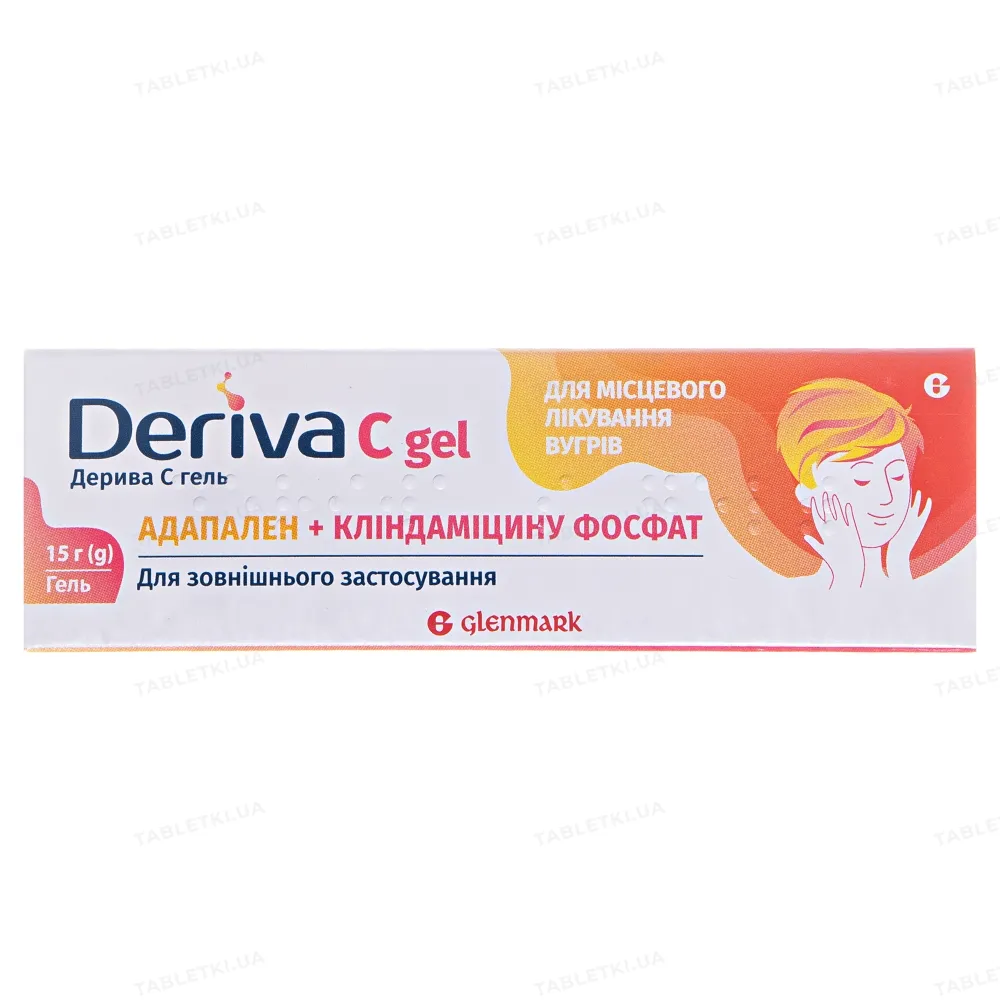
DERIVA S GEL
UkraineThe drug is used for the topical treatment of acne vulgaris.
Frequently asked questions
How should Deriva s gel be used correctly?
The gel should be applied in a thin layer to clean, dry skin on the affected areas once daily, at night. For adults and children aged 12 years and older.
When can results from using Deriva s gel be expected?
The therapeutic effect usually manifests within 8–12 weeks from the start of treatment. During the first few weeks, a temporary worsening of the condition may occur, which is normal.
Are there any contraindications for use?
The drug must not be used in case of hypersensitivity to its components or to lincomycin. Also contraindicated are a history of Crohn's disease, enteritis, ulcerative colitis, or antibiotic-associated colitis.
What are the possible side effects?
Possible redness, peeling, dryness, itching, or burning of the skin at the application site. Allergic reactions, gastrointestinal disorders (abdominal pain, diarrhea, sometimes with blood), as well as rare serious reactions such as acute kidney injury or colitis may also occur.
With which other products should this gel not be combined?
The gel should be used with caution in combination with products containing sulfur, resorcinol, or salicylic acid. It is also not recommended to combine it with other irritants (alcohol-based lotions, abrasive soaps, etc.).
Can the drug be used during pregnancy or breastfeeding?
Use of the drug during pregnancy is not recommended, and it is contraindicated during breastfeeding.
Instructions for use
INSTRUCTIONS FOR MEDICAL USE OF THE MEDICINAL PRODUCT Deriva С gel (Deriva С gel)
Composition:
Active substances: adapalene, clindamycin;
1 g of gel contains 1 mg of adapalene, 10 mg of clindamycin (as clindamycin phosphate);
Excipients: disodium edetate, carbomer 940, propylene glycol, methylparahydroxybenzoate (E 218), poloxamer 407, phenoxyethanol, sodium hydroxide, purified water.
Pharmaceutical form. Gel.
Main physicochemical characteristics: homogeneous white or pale yellow gel.
Pharmacotherapeutic group.
Medicinal products for topical treatment of acne.
ATC code D10AD53.
Pharmacological properties.
Pharmacodynamics. Adapalene is a naphthoic acid derivative and a retinoid-like substance that modulates cellular differentiation and keratinization processes, as well as skin inflammatory processes, which constitute the main pathogenetic mechanisms in the development of acne. Adapalene binds to nuclear retinoid receptors, thereby promoting normal differentiation of follicular epithelial cells, leading to reduced formation of microcomedones and preventing the development of acne, thus helping to maintain intact skin.
Therapeutic effect of the drug usually becomes evident within 8–12 weeks after the start of treatment. When adapalene is applied as a gel, percutaneous absorption into the bloodstream is extremely low.
Clindamycin phosphate is a semisynthetic antibiotic that acts as an inhibitor of bacterial protein synthesis by binding to the 50S ribosomal subunit and inhibiting the initiation process of peptide chain formation. Clindamycin inhibits all tested strains of Propionibacterium acnes with a minimum inhibitory concentration of 0.4 μg/mL. Cross-resistance between clindamycin and erythromycin has been observed.
Pharmacokinetics. Not studied.
Clinical characteristics.
Indications.
Local treatment of common acne (acne vulgaris).
Contraindications.
Hypersensitivity to adapalene, clindamycin, or any other components of the drug, as well as to lincomycin. Enteritis, ulcerative colitis, antibiotic-associated colitis (in medical history), Crohn's disease.
Interaction with other medicinal products and other forms of interaction.
Since the drug may cause local irritant effects in some patients, concomitant use of other potentially irritating topical agents increases the risk of undesirable skin reactions.
The gel should be used with caution together with medicinal products containing sulfur, resorcinol, or salicylic acid.
If it is necessary to use the drug together with other medicinal products, apply the gel once daily at night, and apply other products in the morning.
Clindamycin has the ability to block neuromuscular transmission, which may lead to enhancement of the effect of other drugs with similar properties. Therefore, it should be used with caution in patients receiving such drugs. Cross-resistance between clindamycin and lincomycin has been observed. Antagonism between erythromycin and clindamycin has also been reported.
Special precautions for use.
The product is intended for topical use only.
Contact of the gel with the eyes, lips, nasal alae, periorbital skin, and mucous membranes should be avoided. In case of accidental contact with these areas, they should be thoroughly rinsed with lukewarm water.
The gel should not be applied to areas of skin affected by eczema, sunburn, cuts, or other skin lesions.
During treatment, excessive exposure to sunlight and ultraviolet radiation, including sunlamps, should be avoided due to increased skin sensitivity and a higher risk of developing sunburn erythema.
Concurrent use of the product with cosmetic products that dry the skin (abrasive or medicated soaps, skin cleansers, products containing high concentrations of alcohol, astringents, or shaving creams and lotions) may lead to irritant effects.
If an allergic reaction to any component of the product occurs, treatment should be discontinued and appropriate measures taken.
When clindamycin is used topically, the antibiotic is absorbed through the skin surface. Cases of diarrhea, bloody diarrhea, and colitis (including pseudomembranous colitis) have been reported with both topical and systemic use of clindamycin.
Studies indicate that the main cause of antibiotic-associated colitis is a toxin produced by Clostridium. Colitis typically presents with severe, persistent diarrhea, intense abdominal cramps, and may be accompanied by passage of blood and mucus. Pseudomembranous colitis can be diagnosed via endoscopic examination. Stool culture for Clostridium difficile and stool testing for Clostridium difficile toxin may assist in diagnosing this condition.
If significant diarrhea develops, the medication should be discontinued. In cases of severe diarrhea, endoscopic examination of the colon should be considered to establish a definitive diagnosis.
The use of agents that inhibit peristalsis, such as opioids and diphenoxylate with atropine, may prolong and/or worsen this condition. Vancomycin has been shown to be effective in treating antibiotic-associated pseudomembranous colitis caused by Clostridium difficile. The usual adult dose is 500 mg to 2 g of vancomycin per day orally, divided into 3–4 doses, administered for 7–10 days. In vitro studies have shown that cholestyramine and colestipol resins bind vancomycin. If concomitant use of a resin and vancomycin is necessary, it is advisable to administer these medications at different times.
Given the potential risk of developing diarrhea, bloody diarrhea, and pseudomembranous colitis, the physician must determine whether the use of other medications is appropriate (see sections "Contraindications" and "Side effects").
Contact of the product with the mucous membranes of the eyes and oral cavity should be avoided. Hands should be thoroughly washed after applying the gel. In case of accidental contact with sensitive areas (eyes, abraded skin, mucous membranes), the affected area should be thoroughly rinsed with cool water.
Oral and parenteral administration of clindamycin has been associated with severe colitis, which may be fatal. Topical formulations of clindamycin phosphate should be prescribed with caution in patients with atopy.
Acute kidney injury.
Rare cases of acute kidney injury, including acute renal failure, have been observed during systemic use of clindamycin-containing products. Therefore, monitoring of renal function should be considered in patients undergoing prolonged therapy, especially those with pre-existing renal impairment or those receiving concomitant nephrotoxic drugs (see section "Side effects").
Use during pregnancy or breastfeeding.
As adequate clinical trials on the safety of the gel in pregnant women have not been conducted, the gel should not be used during pregnancy.
Use of the product during breastfeeding is contraindicated.
Ability to affect reaction speed when driving or operating machinery.
No effect.
Dosage and Administration.
The medication should be used in adults and children aged 12 years and older.
Apply the gel once daily, at bedtime, as a thin layer to clean, dry skin at sites of lesions.
During the first weeks of treatment, an initial worsening of acne may occur due to the active ingredient's effect on previously invisible lesions. In such cases, treatment should not be discontinued. Therapeutic effect is observed 8–12 weeks after the start of treatment.
Children.
Safety and efficacy of the medication in children under 12 years of age have not been established; therefore, the medication should not be used in this age group.
Overdose.
Excessive application of the gel may result in skin redness and peeling.
Treatment is symptomatic.
Side effects.
Redness, peeling, dryness, itching and burning of the skin at the application site immediately after application, which subsequently resolves. Allergic reactions, photosensitivity reactions, acne, sensation of pricking, gram-negative folliculitis, gastrointestinal disorders, abdominal pain, urticaria, increased skin oiliness, contact dermatitis, eye burning. Rarely, side effects such as diarrhea, bloody diarrhea, and colitis (including pseudomembranous colitis) may occur.
The following adverse reactions have been reported with oral or parenteral administration of clindamycin.
Infections and infestations: Clostridium difficile-associated colitis.
Hypersensitivity reactions: Maculopapular rashes and urticaria. Most frequently reported were mild to moderate generalized skin rashes. Cases of acute generalized exanthematous pustulosis, erythema multiforme, some resembling Stevens–Johnson syndrome, associated with clindamycin use have been reported. Several cases of anaphylactoid reactions have been reported. If hypersensitivity occurs, the drug should be discontinued.
Musculoskeletal disorders: Polyarthritis.
Renal and urinary disorders: Acute kidney injury.
Immune system disorders: Drug reaction with eosinophilia and systemic symptoms (DRESS syndrome).
Shelf life.
2 years.
Storage conditions.
Store at a temperature not exceeding 25 °C. Do not freeze. Keep out of reach of children.
Packaging.
15 g of gel in a tube, 1 tube per cardboard box.
Prescription status.
Prescription only.
Manufacturer.
Glenmark Pharmaceuticals Ltd./Glenmark Pharmaceuticals Ltd.
Manufacturer's address.
Plot No E-37/39, M.I.D.C., Industrial Estate, Satpur, Nasik – 422 007, India.
Similar drugs
| Brand name | Dosage form | Active substance / Dosage | Manufacturer |
|---|---|---|---|
| BELACNE® DUO | gel |
|
Belupo, lijekovi i kozmetika, d.d. |
| DERIVA WITH MS | gel |
|
Glenmark Pharmaceuticals Ltd. |
| EFFEZEL FORTE | gel |
|
G Production Inc. (GPI) (Additional storage and quality control unit for stability studies) |
The original data is available in the language of the country of manufacture.
Data source: State Register of Medicinal Products of Ukraine
Data last verified: August 13, 2026