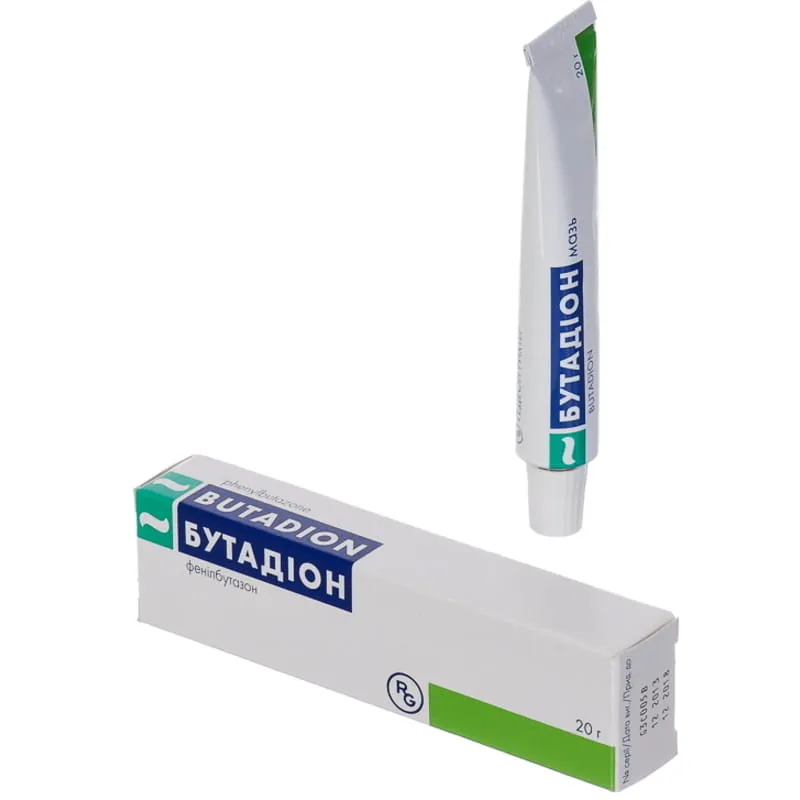
BUTADIONE
UkraineThe ointment is used for skin lesions caused by mechanical trauma or chemical burns (I and II degree), sunburns, insect bites, and inflammation at injection sites. The drug is also applied for soft tissue injuries, edema, hematomas, muscle and tendon strains, inflammation of hemorrhoidal nodes, as well as an adjunct therapy for rheumatoid arthritis, osteoarthritis, and other joint inflammations.
Frequently asked questions
How to use Butadione correctly?
Adults and children aged 14 and older should apply the ointment in a thin layer to the affected area of the skin 2–3 times a day without rubbing it in. After application, hands must be washed thoroughly. It is important to protect the area where the ointment has been applied from direct sunlight.
Who should not use this drug?
Use is contraindicated in children under 14 years of age, pregnant women, and breastfeeding women. It should also not be used in case of hypersensitivity to the components, presence of asthma or allergy to aspirin, deep vein thrombosis of the limbs, on open wounds, fractures, on mucous membranes, or around the eyes. The ointment should not be applied under a bandage or in cases of skin diseases treated with corticosteroids.
What are the possible side effects of Butadione?
Possible local reactions include: itching, rash, redness (erythema), and skin irritation. Systemic effects may include dizziness, headache, nausea, vomiting, edema, fluid retention in the body, or impaired liver and kidney function. In rare cases, serious reactions involving the blood or the gastrointestinal tract may occur.
Can the ointment be combined with other medicines?
Simultaneous use with other non-steroidal anti-inflammatory drugs, whose active substances bind extensively to plasma proteins, should be avoided. With topical application, interaction with other drugs is generally not observed.
What to do if irritation occurs?
If skin irritation occurs during use, therapy should be discontinued immediately and the drug should be replaced with another agent.
Instructions for use
INSTRUCTIONS FOR MEDICAL USE OF THE MEDICINAL PRODUCT BUTADION (BUTADION)
Composition:
Active substance: phenylbutazone;
1 g of ointment contains phenylbutazone 0.05 g;
Excipients: methylparaben (E 218), sodium carmellose, colloidal anhydrous silicon dioxide, polysorbate 60, glycerol (85%), propylene glycol, mineral oil, purified water.
Pharmaceutical form. Ointment.
Main physicochemical properties: white homogeneous ointment with a slight specific odor.
Pharmacotherapeutic group. Agents used locally for joint and muscular pain. Non-steroidal anti-inflammatory drugs for topical use.
ATC code M02A A01.
Pharmacological properties.
Pharmacodynamics.
The active substance of the drug, phenylbutazone, is a non-steroidal anti-inflammatory agent that also has antipyretic and analgesic effects. Phenylbutazone inhibits the synthesis of prostaglandins, thereby reducing inflammatory reactions in tissues. Phenylbutazone suppresses the synthesis of ATP-dependent mucopolysaccharide. It also affects the excretion of uric acid by reducing the reabsorption of uric acid in the tubules.
Systemic absorption following topical application is negligible.
Clinical characteristics.
Indications.
Skin injuries caused by mechanical trauma or chemical burns.
First- and second-degree burns affecting a small area of skin surface, sunburns. Skin inflammation at the site of intravenous or intramuscular injections, insect bites. Inflammation of hemorrhoidal nodes. Traumatic soft tissue injuries, local edema, hematomas, muscle and tendon strains, phantom limb pain following amputation. Local therapy for superficial thrombophlebitis as an adjunct to anticoagulant therapy. As additional therapy in the treatment of rheumatoid arthritis, osteoarthritis, synovitis, tendinitis, tenosynovitis.
Contraindications.
− Hypersensitivity to phenylbutazone or to any component of the drug;
- history of bronchial asthma attack or allergic reaction (allergic rhinitis, urticaria) after administration of acetylsalicylic acid or another nonsteroidal anti-inflammatory drug;
- for treatment of deep vein thrombosis of limbs;
- application of the drug under occlusive dressings;
- application of the drug into eyes, around eyes, onto mucous membranes, open bone fractures, or open wounds;
- eczema or other skin diseases treated with corticosteroids;
- concomitant use with other drugs containing phenylbutazone;
- children under 14 years of age;
- pregnancy and breastfeeding.
Interaction with other medicinal products and other forms of interactions.
There are no data on interactions with other drugs when phenylbutazone is applied topically.
Concomitant use of the ointment with other nonsteroidal anti-inflammatory agents whose active ingredient binds extensively to plasma proteins should be avoided.
Special precautions for use.
If irritation occurs, treatment should be discontinued and the drug should be replaced with an alternative agent.
This preparation is not suitable for the treatment of deep vein thrombophlebitis of the limbs.
After applying the ointment, hands should be thoroughly washed.
The area of skin to which the ointment has been applied should be protected from direct sunlight to prevent the occurrence of photosensitivity.
This medicinal product contains methylparaben (E 218), which may cause allergic reactions (possibly delayed).
This medicinal product contains propylene glycol, which may cause skin irritation.
Use during pregnancy or breast-feeding.
The drug is contraindicated during pregnancy or breast-feeding. The use of nonsteroidal anti-inflammatory drugs may lead to congenital developmental disorders of the fetus.
Ability to influence reaction rate when driving or operating machinery.
There are no data indicating that phenylbutazone affects the ability to drive or operate machinery; however, the possibility of dizziness occurring should be taken into account (see section "Adverse reactions").
Method of administration and dosage.
Adults and children aged 14 years and older: apply the ointment as a thin layer to the affected area of skin without rubbing, 2–3 times daily.
Elderly patients: no special dosage regimen is required.
Children: the ointment is contraindicated for children under 14 years of age.
Overdose.
There is no data on cases of overdose with the ointment. Due to low systemic absorption of the drug, overdose is unlikely.
Treatment: in case of accidental overdose with nonsteroidal anti-inflammatory drugs, supportive and symptomatic therapy should be administered.
Side effects
When non-steroidal anti-inflammatory agents are used locally, local adverse reactions may primarily occur; however, depending on the amount of phenylbutazone absorbed into the body, systemic adverse effects may also develop.
Blood and lymphatic system disorders: The most dangerous reaction may be agranulocytosis; in addition, aplastic anemia and thrombocytopenia may occur.
Immune system disorders: Hypersensitivity reactions.
Metabolism and nutrition disorders: Fluid retention.
Central nervous system disorders: Dizziness, headache.
Respiratory system disorders: Bronchial asthma.
Gastrointestinal disorders: Gastric bleeding, nausea, vomiting, pancreatitis, perforation, peptic ulcer of the stomach or duodenum.
Hepatobiliary disorders: Liver function abnormalities may occur.
Skin and subcutaneous tissue disorders: Rash, erythema, exfoliative dermatitis, photosensitivity, Stevens-Johnson syndrome, pruritus.
Renal and urinary disorders: Worsening of kidney function, particularly in elderly patients and patients with pre-existing renal pathology.
General disorders: Edema.
Shelf life. 3 years.
Storage conditions.
Store in a refrigerator at a temperature of 2–8 °C in the original packaging. Keep the medication out of reach of children!
Packaging. 20 g of ointment in a sealed aluminum tube with a polyethylene cap equipped with a perforated tip. One tube per cardboard box.
Availability. Over-the-counter (without prescription).
Manufacturer. JSC "Gedeon Richter".
Manufacturer's address and place of business.
H-1103, Budapest, 19–21 Demréi Street, Hungary.
The original data is available in the language of the country of manufacture.
Data source: State Register of Medicinal Products of Ukraine
Data last verified: August 13, 2026