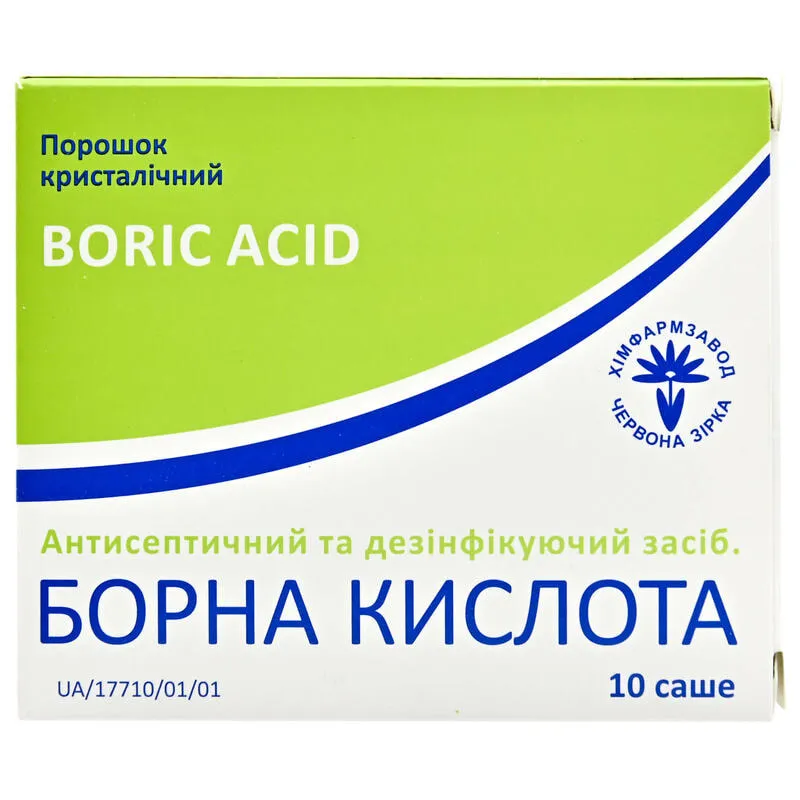
BORIC ACID
UkraineThe drug is used as an antiseptic for conjunctivitis, dermatitis, eczema, diaper rash, pyoderma, otitis, and colpitis.
Frequently asked questions
How should Boric acid be used correctly?
Adults apply it to limited areas of the body. For otitis, alcohol solutions are used (instill 3–5 drops 2–3 times a day or moisten cotton swabs); for dermatitis, aqueous compresses are used; for diaper rash and colpitis, a 10% solution in glycerin is used; and for conjunctivitis, a 2% aqueous solution is used for irrigation. The course of treatment usually lasts no more than 3–5 days.
What are the possible side effects of Boric acid?
Possible side effects include nausea, vomiting, headache, diarrhea, skin rash, itching, swelling, or allergic reactions (including anaphylactic shock). In case of overdose or prolonged use, seizures, confusion, anemia, or hair loss may occur.
Who should not use this drug?
Use is contraindicated in individuals with increased sensitivity to boric acid, renal dysfunction, eardrum injuries, as well as during pregnancy and breastfeeding. The drug is not intended for children.
Can the drug be applied to large areas of skin?
No, the product should not be applied to large areas of skin or used to irrigate body cavities, as this may lead to absorption and intoxication.
Does this product interact with other medicines?
There is currently no precise data on interactions with other drugs, but any simultaneous intake of other medicines must be reported to a physician.
Instructions for use
INSTRUCTIONS FOR MEDICAL USE OF THE MEDICINAL PRODUCT BORIC ACID (BORIC ACID)
Composition:
Active substance: boric acid;
1 sachet contains 10 g of boric acid.
Pharmaceutical form. Crystalline powder.
Main physicochemical properties: crystalline powder, white or almost white, or colorless, shiny, greasy to the touch plates, or crystals of white or almost white color.
Pharmacotherapeutic group.
Antiseptics and disinfectants.
ATC code D08A D.
Pharmacological properties.
Pharmacodynamics.
Boric acid has antiseptic and fungistatic activity, as well as exerting an astringent effect. It coagulates proteins (including enzymatic proteins) of the microbial cell, disrupts cell membrane permeability. A 5% aqueous solution inhibits phagocytosis, while 2–4% solutions suppress bacterial growth and development. It has a weak irritant effect on granulation tissues.
Pharmacokinetics.
The drug is absorbed through damaged areas of the skin and through the mucous membranes of the gastrointestinal tract (in case of accidental ingestion).
The medicinal product penetrates well through the skin and mucous membranes; it is poorly excreted from the body and may accumulate in internal organs and tissues.
Clinical characteristics.
Indications.
Conjunctivitis, dermatitis, eczema, including weeping eczema, intertrigo, pyoderma, acute and chronic otitis, colpitis.
Contraindications.
Hypersensitivity to boric acid, impaired kidney function, chronic mesotympanitis with normal or slightly altered mucosa, traumatic perforations of the tympanic membrane. Pregnancy or breastfeeding. Do not apply to mammary glands.
Special precautions.
Do not apply the medicinal product to large areas of skin. Do not use for irrigation of body cavities — absorption may occur. Avoid contact of the preparation with eyes.
Aqueous solutions should be prepared from powder ex tempore.
Interaction with other medicinal products and other types of interactions.
Interaction is currently unknown.
Inform your doctor about the simultaneous use of any other medicinal products.
Special precautions for use.
The medicinal product is a traditional medicinal product used according to indications supported by long-term use.
Use during pregnancy or breastfeeding.
The medicinal product is contraindicated during pregnancy or breastfeeding.
Ability to affect reaction rate when driving vehicles or operating machinery.
Not studied.
Method of Administration and Dosage
Boric acid should be used in adults, taking into account that the medicinal product can be applied only to limited areas of the skin. 0.5%, 1%, 2%, and 3% alcoholic solutions (containing 0.5 g, 1 g, 2 g, or 3 g of boric acid, ethanol 70% up to 100 ml) are used for otitis: insert tampons moistened with the solution into the external auditory canal, and also instill 3–5 drops 2–3 times daily.
For dermatitis and weeping eczema, use 3% aqueous solution (3 g of boric acid in 100 ml of water) for compresses. Aqueous solutions should be prepared from powder ex tempore.
For pyoderma and intertrigo, apply as a 10% solution in glycerin (10 g of boric acid, glycerin up to 100 ml) to affected areas. This solution may also be used to lubricate mucous membranes in colpitis.
For irrigation of the conjunctival sac in conjunctivitis, use a 2% aqueous solution (2 g of boric acid in 100 ml of water).
The duration of treatment should not exceed 3–5 days.
The patient should consult a physician if symptoms of the disease do not resolve during treatment or if adverse reactions not listed in the medical instructions occur.
Children
The medicinal product is not intended for use in children.
Overdose
Symptoms of acute poisoning: nausea, vomiting, diarrhea, circulatory disturbances, central nervous system depression, hypothermia, shock, coma, erythematous rash. In cases of severe poisoning, measures should be taken to support vital functions; hemodialysis or peritoneal dialysis, or blood transfusion may be required.
With prolonged use of the medicinal product on large skin areas, symptoms of chronic intoxication may develop: tissue edema, exhaustion, stomatitis, eczema, menstrual cycle disturbances in women, anemia, convulsions, and alopecia. In such cases, the drug should be discontinued and symptomatic treatment initiated.
Adverse reactions.
Acute and chronic reactions may occur (especially in cases of overdose, prolonged use, or impaired renal function): nausea, vomiting, headache, confusion, seizures, diarrhea, skin rash, epithelial desquamation.
Allergic reactions are possible, including skin redness, itching, urticaria, swelling, and development of anaphylactic reactions, including shock; oliguria is also possible.
Post-marketing reports of adverse reactions are of great importance. They allow continuous monitoring of the benefit-risk balance of this medicinal product. Medical and pharmaceutical professionals, as well as patients or their legal representatives, should report all suspected adverse reactions and lack of efficacy through the automated pharmacovigilance information system at the following link: https://aisf.dec.gov.ua
In case of any adverse events, consult a physician immediately!
Shelf life. 3 years.
Do not use the medicinal product after the expiry date stated on the packaging.
Storage conditions.
Store in the original packaging at a temperature not exceeding 25 °C.
Keep out of reach of children.
Packaging.
10 g per sachet. 10 sachets per cardboard pack.
Availability category. Over-the-counter (without prescription).
Manufacturer.
JSC "CHEMICAL PHARMACEUTICAL PLANT "CHERVONA ZIRKA"
Manufacturer's address and location of business activity.
1, Gordienkovska Street, Kharkiv, Kharkiv Region, 61010, Ukraine.
Similar drugs
| Brand name | Dosage form | Active substance / Dosage | Manufacturer |
|---|---|---|---|
| BORIC ACID | powder, crystalline |
|
PJSC Pharmaceutical Factory "Viola" |
The original data is available in the language of the country of manufacture.
Data source: State Register of Medicinal Products of Ukraine
Data last verified: August 13, 2026