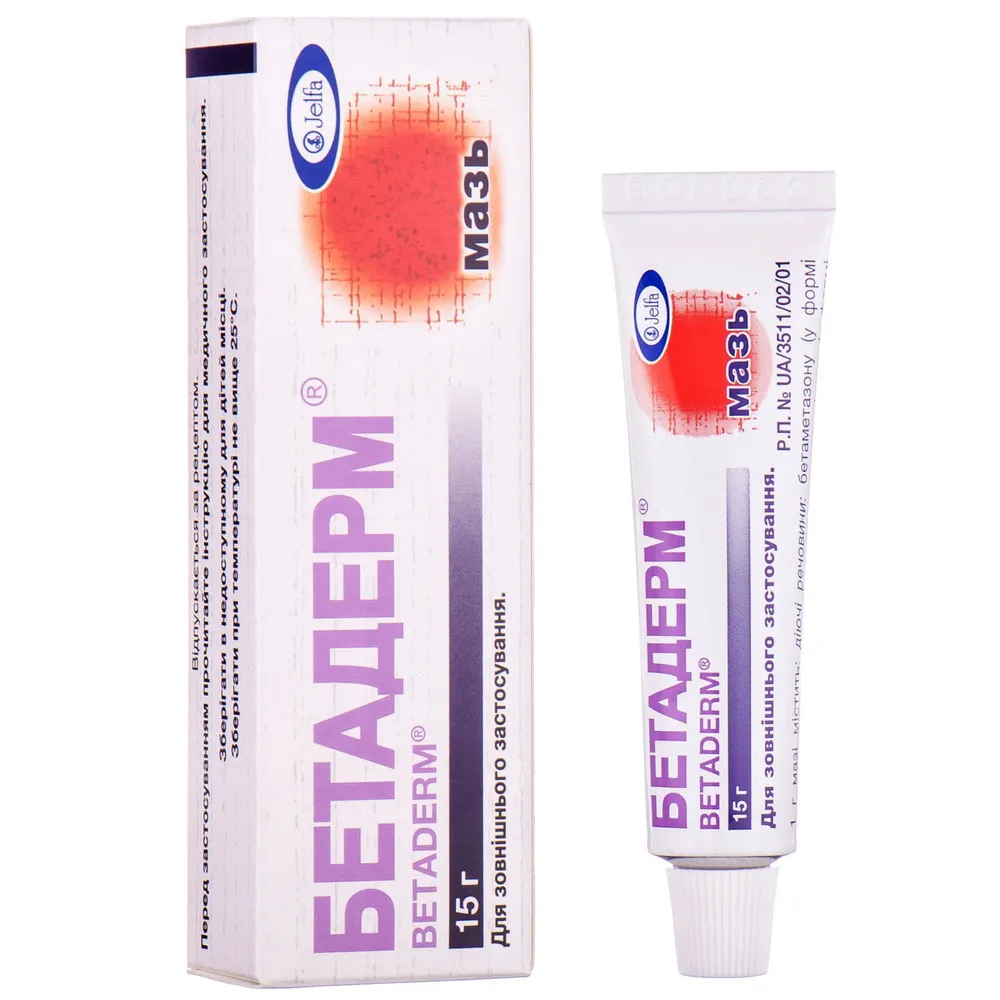
BETADERM
UkraineThe drug is used to treat skin diseases that are responsive to corticosteroids and are accompanied by, or suspected of having, a bacterial infection. Specifically, it is used for eczema, psoriasis, contact, seborrheic, solar, and other types of dermatitis, as well as for anogenital and senile pruritus.
Frequently asked questions
How should Betaderm be applied correctly?
The ointment should be applied in a thin layer to the affected area of the skin 2 times a day (morning and evening). In mild cases, a doctor may prescribe application once a day. It is not recommended to apply the ointment under a dressing (occlusion) or to use it on the skin of the eyelids or face.
What are the contraindications for use?
The drug must not be used in case of hypersensitivity to its components, skin tuberculosis, syphilis, viral lesions (herpes, chickenpox), skin neoplasms, as well as in rosacea and other skin infections without appropriate treatment. It should not be applied to large areas of skin or on damaged skin (for example, burns).
What are the possible side effects of Betaderm?
Possible local reactions: itching, burning, dryness, redness, skin atrophy, appearance of striae (stretch marks) or acne. With prolonged or excessive use, systemic effects are possible: visual impairment (cataract, glaucoma), edema, increased blood pressure, suppression of adrenal function, and effects on the kidneys or hearing.
Can the drug be combined with other agents?
Vaccination (especially against smallpox) is not recommended during treatment. The drug may enhance the effect of immunosuppressants and weaken the effect of immunostimulants. It is also important to remember that the components of the ointment may damage latex condoms, reducing their safety.
Can the drug be used by children and pregnant women?
Use of the drug in children is undesirable due to the risk of stronger systemic effects and suppression of bodily functions. The drug is contraindicated for pregnant women in the first trimester; in subsequent periods, it may be used only if the benefit to the mother outweighs the risk to the fetus and under strict medical supervision.
Instructions for use
INSTRUCTIONS FOR MEDICAL USE OF THE MEDICINAL PRODUCT BETA DERM® (BETADERM®)
Composition:
Active substances: betamethasone, gentamicin;
1 g of ointment contains: betamethasone (as betamethasone dipropionate) 0.5 mg; gentamicin (as gentamicin sulfate) 1 mg;
Excipients: mineral oil, lanolin alcohol, cetylstearyl alcohol, butylhydroxyanisole (E 320), butylhydroxytoluene (E 321), white soft paraffin.
Pharmaceutical form. Ointment.
Main physicochemical properties: white or almost white, greasy, soft mass, translucent.
Pharmacotherapeutic group. Corticosteroids for dermatological use. Corticosteroids combined with antibiotics. Betamethasone and antibiotics.
ATC code: D07CC01.
Pharmacological properties.
Pharmacodynamics.
Betaderm® combines the prolonged anti-inflammatory, antipruritic, and vasoconstrictive effects of betamethasone dipropionate with the broad-spectrum antibacterial activity of gentamicin sulfate. It is active against Staphylococcus aureus (coagulase-positive, coagulase-negative, and some penicillinase-producing strains) and gram-negative bacteria: Pseudomonas aeruginosa, Aerobacter aerogenes, Escherichia coli, Proteus vulgaris, and Klebsiella pneumoniae.
Pharmacokinetics.
Data on the pharmacokinetics of Betaderm® are not available.
Clinical characteristics.
Indications.
Dermatoses amenable to treatment with glucocorticosteroids, complicated or suspected of being complicated by secondary infection caused by microorganisms sensitive to gentamicin: eczema (atopic, infantile, nummular), anogenital and senile pruritus, contact dermatitis, seborrheic dermatitis, neurodermatitis, intertriginous dermatitis, solar dermatitis, exfoliative dermatitis, stasis dermatitis, and psoriasis.
Contraindications.
The drug is contraindicated in patients with hypersensitivity to corticosteroids, gentamicin, or any other component of the drug. Also contraindicated in cutaneous tuberculosis, cutaneous manifestations of syphilis, skin reactions following vaccination, generalized plaque psoriasis, varicose veins, perioral dermatitis, viral skin infections (e.g., chickenpox, herpes), skin neoplasms, rosacea, acne vulgaris, other bacterial and fungal skin infections without appropriate antibacterial and antifungal therapy. Do not use on large skin areas, especially in cases of impaired skin integrity, such as burns.
Interaction with other medicinal products and other forms of interaction.
Vaccination against smallpox should not be performed during treatment with this drug, nor should other types of immunization be carried out (especially during prolonged use on large skin areas) due to the possible lack of an adequate immunological response in the form of production of specific antibodies.
The drug may enhance the effect of immunosuppressive agents and reduce the effect of immunostimulating drugs.
Due to the presence of soft white paraffin and mineral oil, application of Betaderm® ointment to the anogenital area may damage the structure of latex condoms and reduce their safety during use while undergoing treatment.
Special precautions for use.
The drug is not intended for ophthalmic use.
Since Betaderm® contains a potent glucocorticosteroid, it is recommended to apply the preparation only to small areas of skin.
With prolonged use over large areas of skin, the frequency of adverse effects increases, as well as the possibility of developing bacterial resistance to gentamicin sulfate.
Do not use continuously for longer than 2 weeks.
If skin irritation, allergic reactions, or signs of hypersensitivity occur during treatment with Betaderm® ointment, the use of the drug should be discontinued and appropriate therapy should be selected for the patient.
Do not apply the ointment under occlusive dressings, as this may lead to epidermal atrophy, development of striae, and superinfection.
Any adverse effects observed with systemic corticosteroids, including suppression of adrenal cortex function, may also occur with topical application of glucocorticosteroids, especially in children.
Visual disturbances may occur during treatment with both systemic and topical corticosteroids.
If symptoms such as blurred vision or other visual disturbances occur, patients should consult an ophthalmologist to evaluate possible causes, which may include cataract, glaucoma, or rare conditions such as central serous choroidoretinopathy, which has been reported with use of systemic and topical corticosteroids.
Avoid contact of the drug with eyes and mucous membranes. Do not apply to eyelid skin, as this may cause glaucoma or cataract.
Do not apply the drug to facial skin due to the risk of adverse effects (telangiectasia, perioral dermatitis), even after short-term use.
In case of infection, appropriate antifungal or antibacterial agents should be prescribed accordingly.
Since corticosteroids and gentamicin may be absorbed through the skin, there is a risk of systemic adverse effects from glucocorticosteroids (including suppression of adrenal cortex function) and from gentamicin (ototoxicity, nephrotoxicity, particularly in patients with renal impairment).
Use with caution in patients with psoriasis, as topical application of glucocorticosteroids to psoriatic lesions may lead to recurrence due to development of tolerance, risk of generalized pustular psoriasis, and systemic toxicity resulting from impaired skin barrier function.
High-potency corticosteroids applied over large skin areas should be used under careful and regular monitoring, as they may suppress the hypothalamic-pituitary-adrenal (HPA) axis. If HPA axis suppression occurs, the drug should be discontinued, the frequency of application reduced, or the patient switched to a less potent corticosteroid.
HPA axis function usually recovers after discontinuation of the drug.
In some cases, withdrawal symptoms may develop, requiring administration of systemic corticosteroids.
Note that prolonged topical therapy with gentamicin may lead to development of microorganisms resistant to aminoglycosides.
Use in the groin and genital areas only when absolutely necessary, as increased absorption and a high risk of adverse effects are possible even after short-term use.
Use with caution in patients with pre-existing atrophic subcutaneous tissue conditions, especially in elderly individuals.
Avoid using the drug over large skin areas, on damaged skin, in high doses, and in patients with renal or hepatic impairment, as well as in children.
Use during pregnancy or breastfeeding.
As the safety of topical corticosteroids in pregnant women has not been established, the drug should not be used during the first trimester of pregnancy. The drug may be prescribed only during later stages of pregnancy if the expected benefit to the mother outweighs the potential risk to the fetus. Preparations of this class should not be used in high doses, for prolonged periods, or under occlusive dressings during pregnancy.
It is currently unknown whether corticosteroids, after topical application and systemic absorption, can pass into breast milk. Therefore, when deciding whether to discontinue breastfeeding or discontinue use of the drug, the importance of the therapy for the mother should be taken into account.
Ability to affect reaction rate while driving or operating machinery.
The drug usually does not affect the ability to drive or operate machinery.
Method of Administration and Dosage
Apply a thin layer of the ointment to the affected skin area twice daily – in the morning and evening.
The frequency of application is determined individually by a physician depending on the severity of the disease. In mild cases, once daily application may be sufficient; in severe cases, more frequent application may be necessary.
The duration of treatment depends on the size and location of the lesion, as well as the patient's response to therapy. However, if no clinical improvement is observed within 3–4 weeks, the physician should reconsider the diagnosis.
Children
There are no clinical data on the use of this drug in children; therefore, its use in this age group is not recommended.
Since the surface area to body weight ratio in children is greater than in adults, absorption of the drug is more pronounced. Therefore, children are more susceptible to developing suppression of the hypothalamic-pituitary-adrenal (HPA) axis following corticosteroid use, as well as to the development of exogenous corticosteroid effects.
In children treated with topical corticosteroids, adrenal suppression, Cushing's syndrome, growth retardation, inadequate weight gain, and increased intracranial pressure have been reported.
Signs of adrenal cortex suppression include low plasma cortisol levels and lack of response to adrenal stimulation testing with adrenocorticotropic hormone (ACTH) preparations. Increased intracranial pressure manifests as bulging of the fontanelle, headache, and bilateral optic disc swelling.
Overdose
With prolonged use over large skin areas, high doses, or use under occlusive dressings, symptoms of overdose may occur, manifested by an increase in systemic adverse effects typical of corticosteroids (hyperglycemia, glucosuria, suppression of pituitary-adrenal function leading to secondary adrenal insufficiency, and symptoms of hypercortisolism, including Cushing's disease).
After single application of approximately 7 g of ointment, reversible reduction in ACTH levels has been observed.
Excessive or prolonged use of gentamicin may lead to overgrowth of microorganisms resistant to the antibiotic and may result in ototoxic and nephrotoxic effects, which may be particularly dangerous in patients with renal impairment.
Treatment. Appropriate symptomatic therapy should be administered. Symptoms of acute hypercortisolism are usually reversible. If necessary, correct electrolyte imbalances. In cases of chronic toxic effects, gradual withdrawal of corticosteroids is recommended. In case of overgrowth of resistant microorganisms, discontinue treatment with the drug and initiate appropriate therapy.
Adverse Reactions.
Skin and subcutaneous tissue disorders: acne, steroid purpura, epidermal growth suppression, skin prickling, skin induration, skin cracking, sensation of warmth, lamellar desquamation, focal desquamation, subcutaneous tissue atrophy, dry skin, hyperpigmentation, skin discoloration, skin atrophy and striae, telangiectasia, folliculitis, allergic contact dermatitis, urticaria or maculopapular rash, miliaria, pruritus, burning sensation, erythema, hypertrichosis, secondary infection, irritation or exacerbation of existing skin lesions.
Application to facial skin may cause perioral dermatitis.
Vascular system disorders: prolonged use beyond the recommended duration may lead to dilation of small blood vessels (telangiectasia).
Ear disorders: application to mucous membranes or large areas of skin, especially damaged skin, or under occlusive dressing may result in ototoxic effects due to the presence of gentamicin sulfate in the ointment.
Endocrine system disorders: signs of hypercortisolism. Prolonged use of the ointment on large skin areas or under occlusive dressing, or in children, considering the increased absorption of betamethasone dipropionate, may lead to significant systemic corticosteroid effects, manifesting as edema, arterial hypertension, decreased immunity, growth and developmental suppression in children, hyperglycemia, glucosuria, and development of Cushing's syndrome.
Eye disorders: local application to the skin of eyelids may occasionally lead to glaucoma or accelerated development of cataract.
Visual clouding is possible.
Immune system disorders: hypersensitivity to corticosteroids may occur; in such cases, the use of the product must be discontinued immediately.
Renal and urinary system disorders: application to large skin areas, especially damaged skin, or under occlusive dressing may lead to nephrotoxic effects due to the presence of gentamicin sulfate in the ointment.
The product contains cetyl stearyl alcohol, which may cause local skin reactions (e.g., contact dermatitis).
The product contains butylated hydroxytoluene and butylated hydroxyanisole, which may cause local skin reactions (e.g., contact dermatitis) or irritation of eyes and mucous membranes.
Shelf life: 3 years.
Storage conditions: Store at temperatures not exceeding 25 °C. Keep out of reach of children.
Packaging: 15 g ointment in a tube.
Prescription status: Prescription only.
Manufacturer:
Pharmaceutical Plant ELF A.T.
Manufacturer's address and place of business:
58-500 Jelenia Góra, ul. Wincentego Witosza 21, Poland.
Similar drugs
| Brand name | Dosage form | Active substance / Dosage | Manufacturer |
|---|---|---|---|
| BELOGENT | ointment |
|
Belupo, lijekovi i kozmetika, d.d. |
| BETAZON ULTRA | ointment | Corporation "Zdorovya" LLC (all manufacturing stages, quality control, batch release) | |
| CELESTODERM-B® WITH GARAMYCIN | ointment |
|
Organon Haarlem bv |
| TRIACUTAN® | ointment | PJSC "Kyivmedpreparat" | |
| TRIDERM | ointment | Organon Haarlem bv |
The original data is available in the language of the country of manufacture.
Data source: State Register of Medicinal Products of Ukraine
Data last verified: August 13, 2026